• Home
  • Completed Costumes/Impressions
  • Emma and Her Dresses
  • Free Patterns and Instructions

Kitty Calash

~ Confessions of a Known Bonnet-Wearer

Kitty Calash

Tag Archives: Rhode Island history

Punch-Drunk Love

18 Tuesday Aug 2015

Posted by kittycalash in Events, Food, Living History, Museums

≈ 5 Comments

Tags

1790, 1790s, 18th century, George Washington, John Brown, John Brown House Museum, Providence, Rhode Island Historical Society, Rhode Island history

No, Love: I didn’t get drunk and punch someone.

Worst. Housekeeper. Ever.

Worst. Housekeeper. Ever.

On Saturday, we commemorated the 225th anniversary of President Washington’s visit to Providence after Rhode Island finally ratified the United States Constitution on May 29th, 1790. We like to take our time with these things, to be sure that we will have all the rights we’re accustomed to. Happily, we did decide to go along with this United States of America business, and as a reward, His Excellency President Washington made a formal visit in August, 1790. It rained then; this time, we had sultry summer weather.

Once again, the housekeeper spent the day running back and forth and up and down the stairs. Fortunately, I didn’t trip on the gown too much: it’s longer than I usually wear, but I did catch the hem on my shoe buckle, so some tweaking will be required.

Mr Brown greets the President

Mr Brown greets the President

There was the kind of ceremony and formality you would expect, with very little drama, which made for a simpler day than we often have. The afternoon was warm, the speeches were short, and the toasts were drunk.

Of course, you have to look out for John Brown’s housekeeper, who is all too happy to spend her afternoon reading and making punch. Unlike a real 18th century person, I had no idea where to start with punch beyond the basic: rum. I turned to my friends for assistance, and got some solid advice, including a reference to Punch: The Delights and Dangers of the Flowing Bowl.Chapter VIII helpfully turns to “How to Make Punch, or the Four Pillars of Punch.”

Mmm, punch.

Mmm, punch.

I don’t always manage to read all the way through the directions I am meant to be following, but the oleo-saccharum was relatively straightforward, since the instructions were entirely on one page. Lemon peels, sugar, mashing. These are simple things that you can handle even in a week when the workplace van has been stolen and recovered, and you’ve had conversations in which someone asks you to find a photograph for them, even though they don’t know where they saw it.

No, I won't say how many cups I've had.

No, I won’t say how many cups I’ve had.

That went well enough, but I got distracted along the way by the excitement in the house, and added the correct ingredients in the wrong order. I don’t think it mattered. Water, black tea, lemon juice, and a bottle of Smith & Cross rum all went in to the redware pitcher and wafted up the back stairs, giving the servants’ quarters a festive ambience.

While the partakers did not know, the bowl from which they ladled punch had once been used in cleaning the Mr Brown’s house– but that only meant it was quite clean, and thus suitable for use. The bowl was nearly emptied and replenished once, by which time Mr Brown’s housekeeper had sampled quite enough of the concoction.

Share this:

  • Click to share on Facebook (Opens in new window) Facebook
  • Click to share on Pinterest (Opens in new window) Pinterest
  • Click to email a link to a friend (Opens in new window) Email
  • Click to share on X (Opens in new window) X
Like Loading...

By Jupiter!

24 Friday Apr 2015

Posted by kittycalash in History

≈ 1 Comment

Tags

astronomy, history, Ladd Observatory, personal, Providence, Rhode Island history

Ladd Observatory, 1898, back of the transit room.

Ladd Observatory, 1898, back of the transit room. Brown University image

On Tuesday, after a long hiatus, the local observatory was, at last, able to open to the public. Between the Snow on Monday theme of this winter, and the tendency to clouds and rain in what New England calls Spring, Ladd had been closed, and sending plaintive and apologetic emails, for weeks.

We walked up shortly after the 8:00 PM opening to find long lines, and a crowd as large or larger than the Halloween open house nights, when the staff and students turned the Observatory into a haunted house, neighborhood naughties swiped too much candy, and the roof deck was open for star gazing. Being Tiny Town, the Young Mr’s middle school art teacher was in line ahead of us with her young son and wife. To his credit, he did acknowledge her.

The telescope used by Benjamin West to observe the Transit of Venus, 1769

The telescope used by Benjamin West to observe the Transit of Venus, 1769. Brown University image.

There’s a long history of astronomical observation here, with a street named Transit for the 1769 Transit of Venus, observed by Benjamin West and other local notables.

We were happy to join the queue to look through the much larger telescope to see Jupiter, easily visible now.

It is really is a “wow!” moment, cooler even than the packages that make it here from India and astonish me. All that distance, light. How truly awesome the view through a telescope must have been in the 18th century, when we, collectively, knew less about the world and universe. How awesome it is now, to be able to see a world so far away, and to wonder what it is like.

Share this:

  • Click to share on Facebook (Opens in new window) Facebook
  • Click to share on Pinterest (Opens in new window) Pinterest
  • Click to email a link to a friend (Opens in new window) Email
  • Click to share on X (Opens in new window) X
Like Loading...

Checked Linen Aprons post-1800

16 Monday Feb 2015

Posted by kittycalash in Clothing, History, Living History, Museums, Reenacting, Research

≈ 6 Comments

Tags

19th century clothing, apron, authenticity, checks, Clothing, common dress, common people, Costume, dress, fashion, Federal New England Fashion, New England, Newport, Rhode Island, Rhode Island history, sewing, style

Not that this is an exhaustive or final chronicle, but Jackie asked about the apron.

Spring Cleaning, 2012

Spring Cleaning, 2012

I first encountered this form of apron at Old Sturbridge Village, on display in the Firearms and Textiles exhibit space, which I think of as “Muskets and Muslins.” The accession number given on the exhibit label was 26.39.4, but the object does not appear in the OSV online collections database (they do warn that it contains just a selection of their total 60K-plus object holdings). The original at OSV, as sketched and described by me in April 2012 has a drawstring at the neck, straps that button, string at the back opening, and is slim, without gathers. That means the bodice is very similar to the gown bodices of the early part of the 19th century.

Smock, Checked cotton, Pocumtuck Valley Memorial Association. #2000.01.869.

Smock, 2000.01.869 PVMA

There is another original checked bodiced apron in the Pocumtuck Valley Memorial Association collection in Deerfield, MA. This original appears in color in The Needle’s Eye by Marla Miller. As you can see in the images of my apron, I mashed the two styles together to suit the amount of material I had on hand, the skills I had three years ago, and the amount of time I had between seeing the apron and the day of the program, which was probably two days during which time I had pleurisy.*

This is also wrong, but funny.

This is also wrong, but funny.

To refocus: I chose to wear this apron at Whitehorse House in 1820 for a really wrong reason: it was what I had.

Prints in the British Museum show a maid in a yellow gown with a black apron, no bib; there is another, with a maid in a green gown, in a wikigallery, that I could not fully track down; a London Market scene; and a French print from 1818 that does show a bibbed black apron on a shop assistant. The visual research I’d done for the 1820 program suggested that black aprons were the height of fashion, and that they did not always have bibs.

Papering the Saloon at Tickford Hall, watercolor by Diana Sperling, 1816.

Papering the Saloon at Tickford Hall, watercolor by Diana Sperling, 1816.

Since we deal in confessions here, I will tell you that I did buy material for a black apron, and I planned to make a strapped or bibbed one, much like the one Sabine made. The appearance of the dark apron in Diana Sperliing’s watercolor of the ladies papering the saloon at Tickford Park put the dark strapped and sometimes bibbed apron the in English-speaking world. And still I did not manage to make one. If I were to do an 1820 program again, or even an 1813 or later millinery shop again, I like to think I would find the time to make a black strapped and possibly bibbed apron. I do think they were the height of fashion, and are likely to have been worn by women in shops, and by maids.

Do I think the checked apron is wrong? Given that I can rationalize anything, of course not! I think a checked apron is probably reasonably appropriate within the context of a kitchen, even in 1820, especially in New England. Since we did not cook on Saturday, the black apron would have been ideal, but I think the checked apron passes. To make it pass with a higher grade, I will freely admit it requires button and tape upgrades. Since the next dates on the horizon are 1775 and 1780, chances are good those upgrades won’t happen anytime soon. * Do not attend an all-day outdoor event in the cold when you are not well. Do not attend said event without your cloak, or in stays you have laced up a little too firmly. Do not deny that the cold you have might actually be the start of something bigger, when it includes a productive cough. Lo, the lessons of living history are many.

Share this:

  • Click to share on Facebook (Opens in new window) Facebook
  • Click to share on Pinterest (Opens in new window) Pinterest
  • Click to email a link to a friend (Opens in new window) Email
  • Click to share on X (Opens in new window) X
Like Loading...

An Afternoon in N’port

15 Sunday Feb 2015

Posted by kittycalash in Events, History, Living History, Museums, Reenacting

≈ 4 Comments

Tags

#WalkNPT, 1820s, 19th century, 19th century clothing, common people, Costume, dress, Events, Kitty Smith, living history, millinery shop, Nathaniel Sweet, Newport, Newport Historical Society, Rhode Island history, Whitehorne House

IMG_3041

New coat!

I set off for Newport yesterday to spend the day at Whitehorne House with Sew 18th Century. I was pleased to have my coat, and pleased as well to see the ads for “lead colored pelisse cloths” at Nathaniel Sweet’s shop at 112 Cheapside in N’port. Everything fits better when you have some documentation.

We occupied the kitchen at Whitehorne House, interpreting the lives of mythical maids and cousins Eliza and Kitty Smith.

DSC_0607

The Whitehorne Kitchen

We hope to save enough to reopen our millinery shop, which flourished once in Salem just a few years ago. Times are hard in Newport, but there are some promising lotteries–a $10,000 prize in the Kennebec Bridge lottery and an incredible $25,000 prize in the New York Literature Lottery! We will have to save our wages to buy even one ticket– difficult to do with so many tempting’ wares in the shop–but the rewards would well worth our efforts.

A shop on Thames Street is to let not far from the Great Friends Meeting House. We think ’tis a fine location, for while Friends may be plain, they are well dress’d. One of our visitors offered to spread the rumor that the shop is haunted, so no one else will rent it, but I worry that such a tale might drive off custom.

DSC_0611

Gingerbread, bread-and-cheese and apples form’d our repast

Visitors called from as far away as New Jersey, New York and Connecticut, but found Mr Whitehorne at the Coffee House and Mrs Whitehorne out makin’ calls. As prominent citizens, they are busy about the town. Mrs Whitehorne is well-known for her receipts, and we were pleased to offer callers a sample of her fruited gingerbread. Indeed, ’tis delicious, though not as sticky as the late Mr S preferred.

Some visitors thought our plan to invest in woolen mills was a fine idea, and in addition to the mills on the island (there is one in Portsmouth), we hear there are several in Hartford. Providence has not the monopoly on industry she imagines.

DSC_0615

There is much washin’ and mendin’

The laundry does pile up in a household of seven children, and since we have run out of wood, I suspect the laundress has as well. The island is short of lumber now, and wood must come from Swansea. Still, there is always mending’ to be done.

Perhaps if we had known how many visitors would call, I might have taken more care in tidyin’ up the kitchen. ‘Twas a surprise to see so many, from so far away, but we do think N’port is due for a revival. ‘Tis a busier day of visitin’ than I was accustomed to in winter at the farm on Poppasquash Neck, but with Mr Smith now dead, and our lad on a brig in the coastal trade, we could not keep the lease. I am grateful to my cousin for helpin’ me find work in such a lovely house.

IMG_3043

Share this:

  • Click to share on Facebook (Opens in new window) Facebook
  • Click to share on Pinterest (Opens in new window) Pinterest
  • Click to email a link to a friend (Opens in new window) Email
  • Click to share on X (Opens in new window) X
Like Loading...

A Valentine’s Puzzle Purse

14 Saturday Feb 2015

Posted by kittycalash in Events, History, Living History, Making Things, Museums

≈ 2 Comments

Tags

1820s, 19th century, common people, living history, Making Things, Museums, Newport, Rhode Island, Rhode Island history

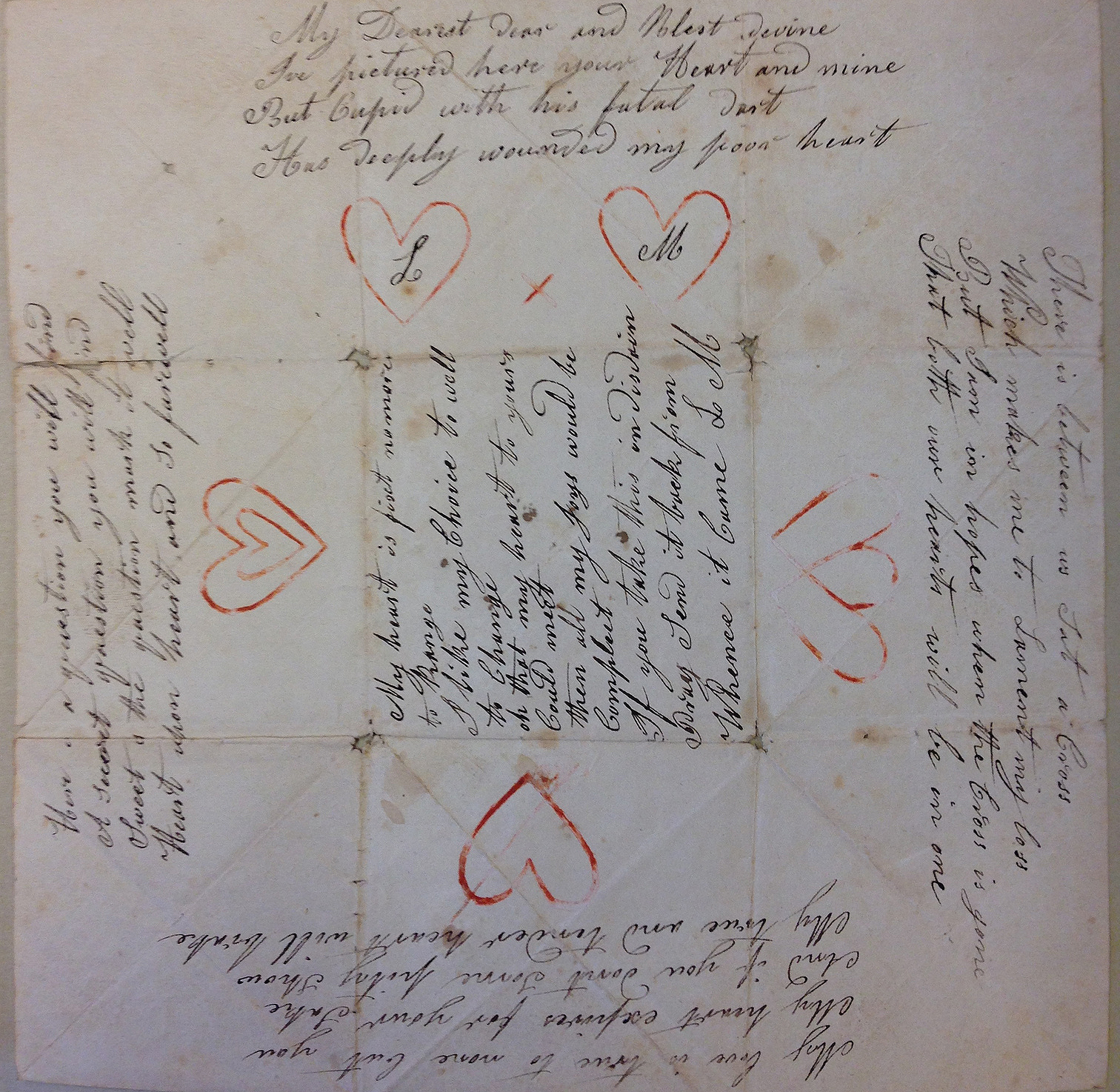
Puzzle Purse Valentine. RIHS Graphics Collection Lot 42

Puzzle Purse Valentine. RIHS Graphics Collection Lot 42

Here’s a nifty little thing you can make: A puzzle purse. This is from the collections of the Rhode Island Historical Society, but the form seems to have been fairly common; I know I’ve seen other fancifully-folded letters.

Because I’ll be spending Valentine’s Day in 1820, I thought I’d try to replicate this token. News on how it turned out later… I don’t feel clever enough to write my own verse, but here is the Rhode Island example transcribed.

My love is true to none but you
My heart expires for your sake
And if you don’t me pity show
My true and tender heart will brake

Here a question you will find
A sweet question you will find
Sweet is the question mark it well
Heart upon heart and so farewell

My Dearest dear and Blest Devine
I’ve pictured here your Heart and mine
But Cupid with his fatal dart
Has deeply wounded my poor heart

There between us sat a Cross
Which makes me to Lament my loss
But I am in hope when the Cross is hone
That both our hearts will be in one

My heart is fix’t no more to Range
I like my Choice to well to Change
Oh that my Heart to yours could meet
Then all my joys would be compleast
If you take this in disdain
Pray send it back from
Whence it Came L M

Share this:

  • Click to share on Facebook (Opens in new window) Facebook
  • Click to share on Pinterest (Opens in new window) Pinterest
  • Click to email a link to a friend (Opens in new window) Email
  • Click to share on X (Opens in new window) X
Like Loading...
← Older posts
Newer posts →

Archives

wordpress statistics

Creative Commons License
Kitty Calash blog by Kirsten Hammerstrom is licensed under a Creative Commons Attribution-NonCommercial-ShareAlike 4.0 International License.

Website Built with WordPress.com.

  • Subscribe Subscribed
    • Kitty Calash
    • Join 621 other subscribers
    • Already have a WordPress.com account? Log in now.
    • Kitty Calash
    • Subscribe Subscribed
    • Sign up
    • Log in
    • Report this content
    • View site in Reader
    • Manage subscriptions
    • Collapse this bar
 

Loading Comments...
 

    %d