Tags
19th century clothing, authenticity, Events, fashion, John Brown House Museum, living history, Rhode Island, Rhode Island Historical Society, What Cheer Day
An overview of the day, to begin with.
12 Wednesday Nov 2014
Posted in Events, Living History, Museums, Reenacting, Thanks
Tags
19th century clothing, authenticity, Events, fashion, John Brown House Museum, living history, Rhode Island, Rhode Island Historical Society, What Cheer Day
An overview of the day, to begin with.
22 Wednesday Oct 2014
Posted in Living History, Museums, Uncategorized
≈ Comments Off on What Cheer! Wednesday
Tags
18th century clothes, 18th century clothing, 19th century clothing, interpretation, John Brown House Museum, living history, Museums, Reenacting, Rhode Island, Rhode Island Historical Society, weekend, What Cheer Day, work
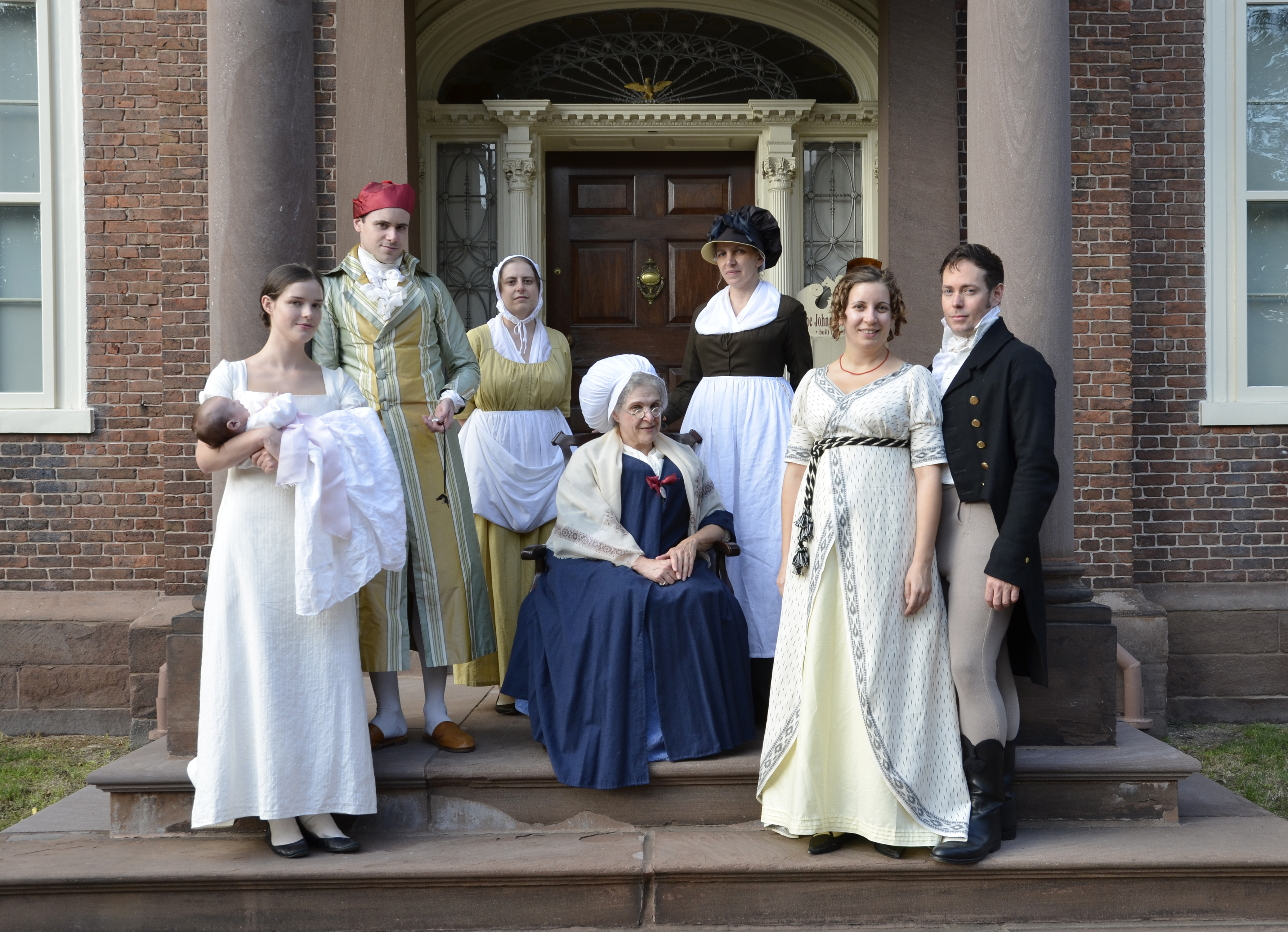
Where are you going this weekend? I’m going to Providence in 1800, along with my family and friends.
The mantua maker is coming, and writes a very pretty letter about the new fashions she has found for the young ladies.
Mrs Brown will be in, and receiving guests, and we hear that Mr Herreshoff will come to call as well. While he may decry the state of the roads, we expect him to have news of business conditions in New York, and his prospects for the future.
Miss Alice– Mrs Mason, now– will be at home with her sister, Miss Brown, and Mr Mason is living here now as well. I do not know how I shall keep their room in order, since he is hardly outside of it!
There are other visitors I expect as well; there is a man (I cannot call him a gentleman) who has been doing jobs for us, though he does not live here at the house. He seems extraordinarily interested in the house, and will not stay away. Whatever can be his interest? There may also be a tailor and his apprentice– though the apprentice tends to daydreaming, and looks above his station, studying Latin at all hours. I think he will not be long in his apprenticeship if he will not pay attention.
If you have not visited us before, you can find directions here.
30 Tuesday Sep 2014
Posted in Clothing, History, Living History, Reenacting, Research
Tags
18th century clothing, 19th century clothing, authenticity, Clothing, common dress, common people, John Brown House Museum, Julia Bowen, Julia Bowen Martin, living history, Providence, Research, Rhode Island, What Cheer Day
What Cheer Day preparations must begin in earnest now, no matter how distracting I might find orderly books or silk shoes (not in my size, alas: no last can be found). I already have clothes enough for a housekeeper, though I still crave a broadcloth Spencer and am working on a petticoat. I’ll hardly go outside that day, so why am I thinking bonnets– especially when I have a known bonnet problem?
One of my favorite resources for Federal era Providence is Julia Bowen’s diary. Born December 1, 1779, Julia’s diary records her life in Providence in 1799, when she was 19. She records the daily activities of the second set of Providence women– daughters not of the most elite merchants, like John Brown and John Innes Clark, but the Bowens, Powers, Howells, and Whipples. Distinguished, but not super-elite. Many of the entries are as prosaic and superficial as you’d expect from a young woman in late adolescence, and thank goodness they are, or we’d never be able to imagine life in such fine detail.
Julia got me thinking about bonnets with her entry of April 12:
found the Major & Citizen Sarah & C. Angell altering their cold scoops into Rosina hats, so busily were they employed that the Major could not go a visiting, which deprived me at once of the greatest pleasure I anticipated in my visit.
(She used code names for her friends; some we can decode, and some we cannot.)
I haven’t been able to decipher what “Rosina hats” were, but cold scoops I could handle: coal scoops.
That colloquialism fits not just fashion plates but extant coal scoops and buckets.
You just have to imagine them turned over.
I went for cold scoop, with a pasteboard brim and olive green taffeta brim and caul. The mannequin is a 3-D sketch, if you will, of what the housekeeper plans to wear this autumn. At least until she can figure out what a Rosina hat is.
09 Tuesday Sep 2014
Posted in Clothing, Events, Fail, Living History, Making Things, Philosophy, Reenacting
Tags
19th century, 19th century clothing, authenticity, Clothing, common dress, Costume, Events, fashion, history, interpretation, Newport, Newport Historical Society, Quaker, Quakers, Rhode Island, Rhode Island history, style
Hard to say which, but I am ill at ease and dissatisfied with my costuming. You might even call it bratty. But I don’t wanna be like Bridget Connor!
It started the week of the Stamp Act protest, when I felt quite tired of being the shabby, unrefined woman of the regiment and street vendor, and wanted a nice cozy shop like the milliner had. I was also looking forward to being a housekeeper again, and several weeks of moving boxes and volumes with red rot at work had me feeling generally filthy and unappreciated. Bratty.
When in doubt, sew. A new dress can’t help but cheer you up, right?
Well… sort of…
Last Thursday, we did a reprise of the Williams family letters program at the Newport Historical Society. The Williams family were Quakers, and the letters were from the early part of the 19th century, so for the program in March, I made a green silk cross-front gown based on the Quaker gown in the back of Costume in Detail. (Check out the schematic on the 19thus.come page; I didn’t see this until I was mostly done with the dress, but thank goodness I got it right!)
But it’s September, and Thursday was expected to be quite warm, so I salved my bureaucratic wounds in the $1.99 loft at the local mill store, and made a new Quaker gown, also suitable for a maid.
I ask you! Even though it’s my very own pattern based on sketches of original drawings, even though it fits, even though it cost $10, even though every seam is overcast and the whole thing is made with period correct stitches, it still fails to make me happy and cheerful and delighted.
This brattiness has resulted in a reappraisal of my approach– and a trip to Sewfisticated in Framingham. What did I buy there? Yards and yards of pink taffeta? Gold taffeta? Blue taffeta?
No.
Because they didn’t have the right colors in the right weave– too slubby– or in enough yardage. Brace yourselves: I bought brown.
It appears I do not learn from my mistakes. When I think, “Gee, I’d like a pretty dress,” I end up buying fabric based on the texture as much as the color, and I have to tell you, that brown taffeta has the most wonderful l hand and sheen, and I will look much more like a Copley portrait than I ever have before, so that’s something.
It seems I have created a set of mental rules for myself, a mission, if you will, for the historic clothing I sew and the roles I take on, and I only play within those rules.
25 Monday Aug 2014
Posted in Events, Living History, Museums, Uncategorized
Tags
18th century, Colony House, common people, living history, Newport, Newport Historical Society, Rhode Island, Rhode Island history, Stamp Act Protest, Washington Square
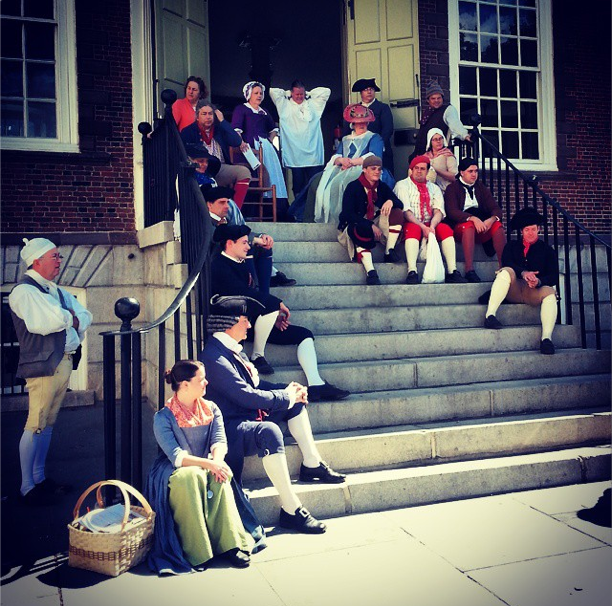
Last Saturday, we stepped back in time to 1765 in Newport. I know: Newport always seems to be in a different time than gritty Providence, but this trip was truly different.
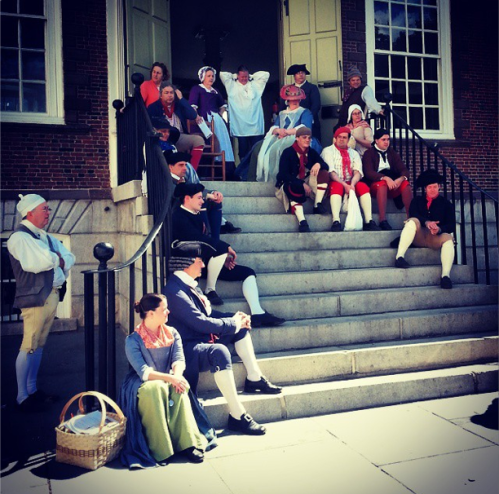
We were headed across the Bay for a Stamp Act Protest (no rioting, per police request). In this effort, we joined a large group of recruits from New England and even beyond, to fill Washington Square and other sites in the city.
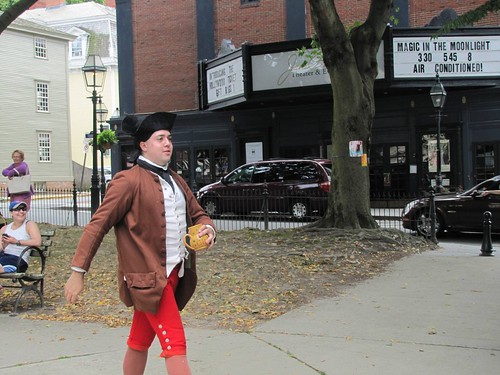
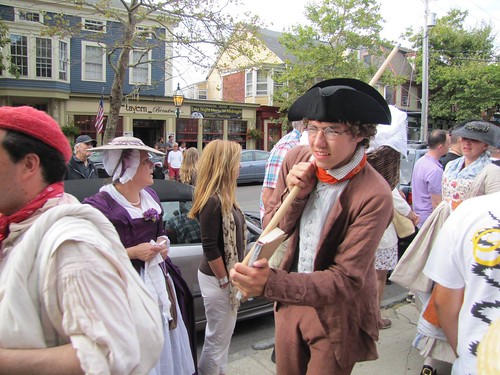
Stationed around the square were sailors mending or making a sail*, an apprentice-less printer, a sleepy apprentice boy, a tailor and his journeyman, a milliner, and leading citizens, one of whom was kind enough to read the newspaper to the apple seller, who wonders what has become of her son.
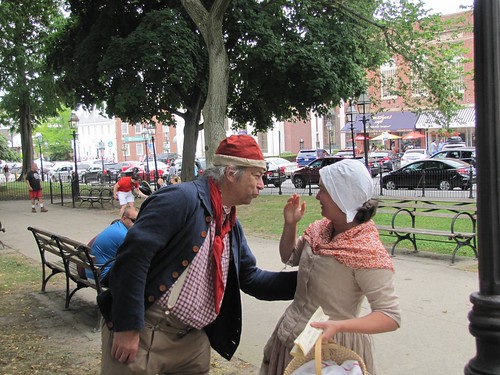
Up the street, some very fine ladies were having tea. Their refinement was evident in their appearance and dress, as well as in the elegant setting of their tables. They wanted none of my apples, as they had imported citrus fruits, far better than the apples the island’s trees produce. (Wasted on tea, truly: what one wants to do with a lemon is to find some rum and make a punch.)
The news was very bad, and tempers flared in the square. Mistress Ellery told me that dinner parties had become impossible to hold: parties nearly come to blows over discussions of taxes, customs, stamps, and the oppressive policies of Mr Robinson, who insists on enforcing the very letter and penny of the law. (He was quite insulting on the quality of my apples, indeed, spitting one upon me even as he continued to eat it!)
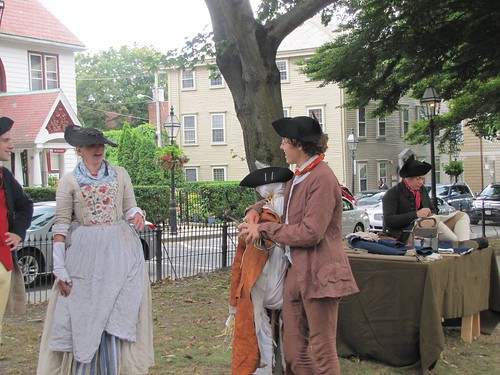
As the afternoon wore on, the debate grew more intense and the crowd more heated. And effigy of Mr Howard was made, paraded, and hung, and then the crowd of protesters dispersed to the White Horse Tavern.
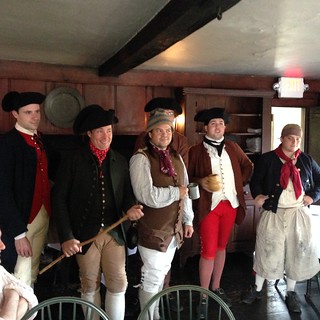
Tensions seemed to dissipate, though when the runner came, the protesters– now fortified with ale, porter and cider–ran down the street to “plunder” Mr Howard’s house, played here by the Wanton-Lyman-Hazard House.
Although the mistress of the house tried to reason with them, the crowd would not be dissuaded, convinced of their mission (and perhaps more fortified than you would expect after just one glass). They carried their loot to the front of the Colony House, and heaped it up, glorying in their success.
In the end, the house was not looted, tensions were dissipated, and the protesters dispersed into the afternoon. We were well-rewarded with cheese and ale at the Colony House, and enjoyed discussing the events of 1765 and 2014 with the public and Newport Historical Society staff members.
*Yes, Virginia, they do look like tents. That’s because they are tents. Someday, Light Infantry soldiers will sleep beneath that canvas. But for now, keep stitching!