• Home
  • Completed Costumes/Impressions
  • Emma and Her Dresses
  • Free Patterns and Instructions

Kitty Calash

~ Confessions of a Known Bonnet-Wearer

Kitty Calash

Tag Archives: Rhode Island

The Society of Friends

09 Sunday Mar 2014

Posted by kittycalash in Clothing, Events, History, Museums

≈ 2 Comments

Tags

19th century clothing, fashion, living history, Newport, Newport Historical Society, Quaker dress, Quakers, reading, Rhode Island, Seventh Day Baptist Meeting House, style
Courtesy Newport Historical Society

Courtesy Newport Historical Society

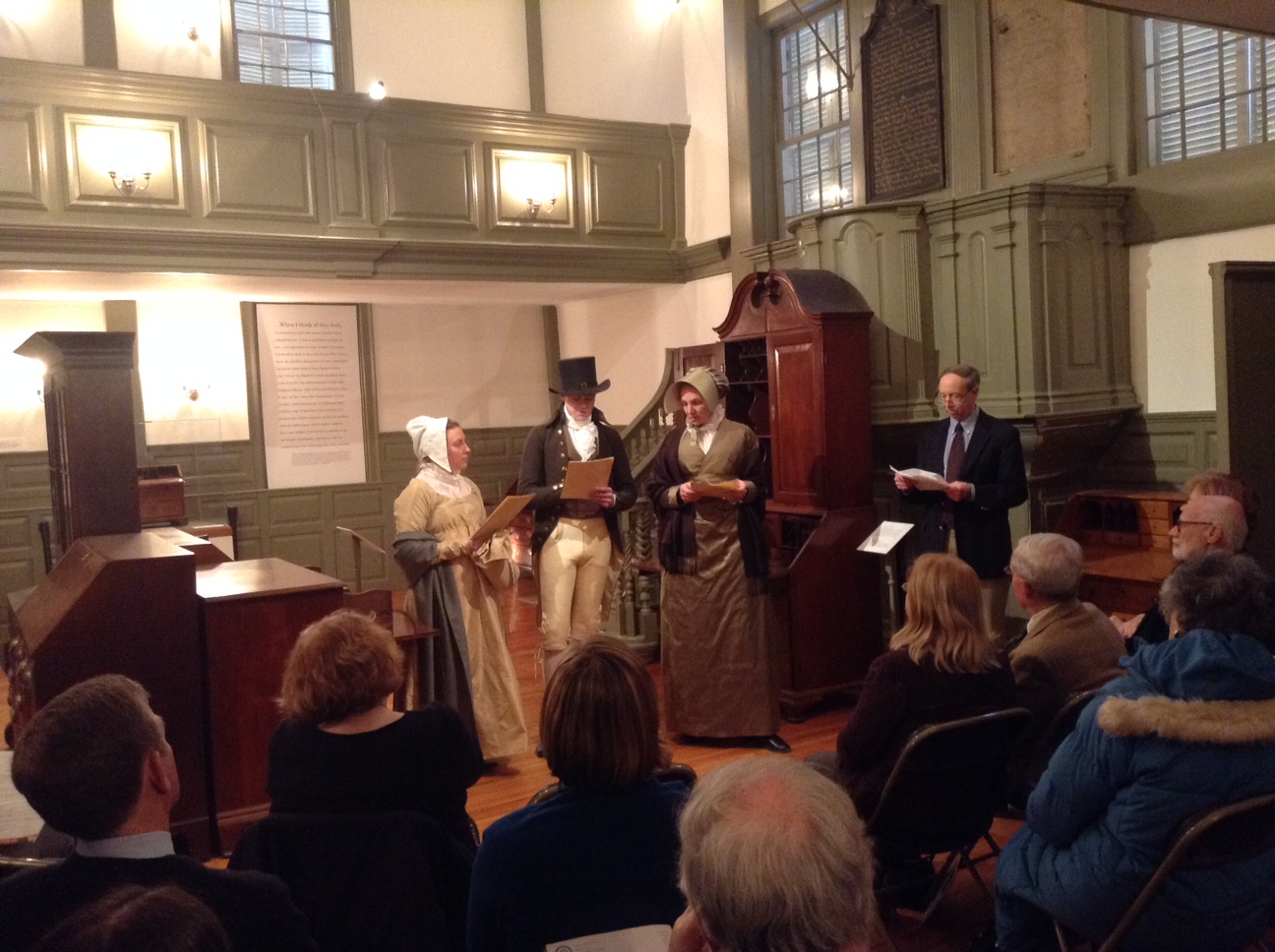
Last Friday, I joined my friends in Newport for a program at the Newport Historical Society.

We stood in the Seventh Day Baptist Meeting House behind the NHS’s headquarters building and read excerpts of letters from the Williams Collection.

This is a simple, elegant concept for a program, and works incredibly well if the correspondence have the gift for expression that these people did. Even quotidian details–the price someone wants to get for their dining set, the likelihood of moving one’s mother, who must be carried ‘as carefully as a box of China’–take on humor when read aloud.

Courtesy Newport Historical Society

Courtesy Newport Historical Society

The best letter might well have been the last one, read by Sew 18th  Century. The latest of the selection, the writer described a visit to Newport around 1844, arriving at the dock to the bustle of wagons, walking streets and finding a barber who knew the old fish hawker, the enormous jaw bone of a whale on a street corner, and even lifting the latch to walk inside the Seventh Day Baptist Meeting House where we were standing.

It was a lovely way to end the program, resonant with details the audience could connect with.

My dress turned out all right, and I managed to get it on and keep it on, which seemed a small miracle requiring only two pins.

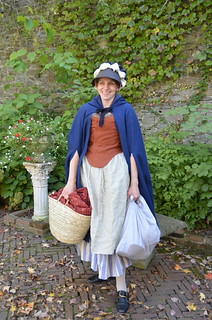
When I tried it on at home, the front panel didn’t wrinkle, so I think I pulled it too tightly around me on Friday. I kept my bonnet on because I didn’t have time to make a new cap, so made do with the housekeeper’s cap from last fall. The chemisette was made by Cassidy, and saved me from the migratory ‘charms’ of a kerchief. The ‘shawl’ was a gift  Christmas from my mother, who rightly saw it as a scarf, but those who wish to keep warm do not quibble when they cannot find exactly what they want. Before I wear the dress again, I have to attend to interior seams of the skirt and scoot the cuffs down to lengthen the sleeves. Four yards of 48-inch wide silk was just enough, but needs a little tweaking when you’re a tall as I am.

Share this:

  • Share on Facebook (Opens in new window) Facebook
  • Share on Pinterest (Opens in new window) Pinterest
  • Email a link to a friend (Opens in new window) Email
  • Share on X (Opens in new window) X
Like Loading...

Consider the Collar

31 Friday Jan 2014

Posted by kittycalash in Clothing, Events, History, Museums, Research

≈ 5 Comments

Tags

18th century clothing, 19th century clothing, authenticity, dress, fashion, living history, museum collections, Museums, Newport, Newport Historical Society, Quakers, Research, Rhode Island, Rhode Island history, style

The Newport dresses seemed a little strange to me, in that the collar treatment was more like what I would expect to see on a pelisse than on a gown. But I am willing to be wrong, and delighted to be wrong if that’s how I will learn something.

Brown silk Quaker dress, Newport Historical Society, 20.4.1
Brown silk Quaker Dress, Newport Historical Society, D77
Morning dress, ca. 1806. American Cotton, wool. Length at CB: 54 in. (137.2 cm) Gift of George V. Masselos, in memory of Grace Ziebarth, 1976 MMA 1976.142.2
Morning dress ca. 1820. British. Cotton. Length at CB: 46 in. (116.8 cm) Purchase, Marcia Sand Bequest, in memory of her daughter, Tiger (Joan) Morse, 1979 MMA 1979.385.1

@silkdamask (that’s Kimberley Alexander’s twitter handle; she has a blog you might want to follow if you don’t already) posted a photo of the dress (above left) she imagined a young woman she’d been writing about might have worn. Housed at the Met, this embroidered American cotton and wool gown ca. 1806 has a cross-over bodice and collar.

Another day dress from the Met (above right) has a ca. 1820 date, but looks very much like the gown worn by Mrs Amelia Opie (she was a British Quaker) in this engraving after an 1803 portrait. (Other, similar gowns and portraits are pinned here.)

Amelia Opie (1769-1863). Engraving by Ridley after painting by [John] Opie, 1803. Massachusetts Historical Society, Photo. 81.490

Amelia Opie (1769-1863). Engraving by Ridley after painting by [John] Opie, 1803. Massachusetts Historical Society, Photo. 81.490

Nantucket and New Bedford  both hard large Quaker populations (remember Moby Dick?), and the Williams family in Newport had connections to New Bedford, so I looked in collections in Nantucket and New Bedford as well.

The gown below, now in the collection of the New Bedford Whaling Museum, was worn by Susan Waln Morgan Rodman (Mrs Benjamin Rodman), while pregnant; using a genealogy, we can establish pretty solid date ranges for the dresses at New Bedford Whaling Museum. It looks 1820s in style, and her first two children are born in 1821 and 1822.

Maternity gown worn by Susan Waln Morgan Rodman (Mrs Benjamin Rodman). New Bedford Whaling Museum, 1991.45.5.

Maternity gown worn by Susan Waln Morgan Rodman (Mrs Benjamin Rodman). New Bedford Whaling Museum, 1991.45.5.

A date range of 1820 to 1822 seems plausible. Susan Waln Morgan Rodman would have been about 20 with her first pregnancies. (Genealogies are on Google books.)

She seems to have kept up with style and to have liked clothes; a search for her name in the NBWM catalog returned some interesting items, though the catalog does not allow for linking to item records or searches. Mrs Rodman’s appears to have kept pace with style changes; that is, her wardrobe did not ossify in 1820-something, but evolved as fashions changed, and was appropriate for different situations.

Does that mean that all Quaker women kept pace with style changes? It’s hard to say; each of us today updates our wardrobe according to our fancy, our purse, our inclinations and our age. Are those Newport gowns going to turn out to look more like the Met gowns than I imagine? I don’t know, but it seems possible.

Share this:

  • Share on Facebook (Opens in new window) Facebook
  • Share on Pinterest (Opens in new window) Pinterest
  • Email a link to a friend (Opens in new window) Email
  • Share on X (Opens in new window) X
Like Loading...

Newport Friends

30 Thursday Jan 2014

Posted by kittycalash in Clothing, Events, History, Literature, Living History, Museums, Research

≈ 9 Comments

Tags

18th century clothing, 19th century clothing, authenticity, dress, fashion, living history, museum collections, Museums, Newport, Newport Historical Society, Quakers, Research, Rhode Island, Rhode Island history, style

Newport History, V 65, Part 1. Number 222.

Newport History, V 65, Part 1. Number 222.

I had a bit of a surprise when details emerged about the program Sew 18th Century and I will be doing in early March at her workplace. I’ve known about this since late October, but only started focusing on this last weekend, when I realized just how close March really is, and how much time I’ll be spending on well-chlorinated pool decks in February. I’m so glad I asked, because it turns out that we’re reading letters from a family of Quakers. I was not expecting Quakers, and had what is probably a completely inappropriate fabric in mind! (Off-white meandering red floral vines, to mimic a V&A gown.)

Still, there is no surprise that cannot be managed by research. There is an article about the family in Newport History, and they were kind enough to send it to me, and it arrived yesterday. Yay, mail in a small state! The article is helpful in providing context and family history, and there is even a photo, probably from a daguerreotype, of one of the women in the family.

Ruth Williams silhouette, Newport Historical Society, 91.14.4

So, what did Quaker women in Newport wear between 1800 and 1820? Lappet caps, for one thing. Lappet caps appear to have been a common cap in late 18th and early 19th century Rhode Island, and Ruth’s silhouette seems to bear that out.

These caps are also seen in many images of Quaker women, and borne out by the images in the collection where I work (sadly not appearing the catalog record, but still stable in the blog post on caps).

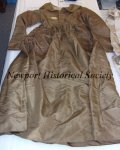
I can’t read letters in just a cap and a shift (it’s not that kind of event), so I need a dress. Newport Historical Society has two possibly Quaker gowns from the early 19th century, and they seem like plausible models.  But they raise questions quite aside from what you might find out by digging into provenance. What’s up with collars?

Brown silk Quaker dress, Newport Historical Society, 20.4.1
Brown silk Quaker Dress, Newport Historical Society, D77

The form, a brown or drab front-closing, high-waisted (but not too high) gown, with long sleeves and a pieced, shaped back, is consistent with images of Quaker women from the first quarter of the 19th century. The color and material (brown silk) is consistent with those images, and with earlier im,ages of Philadelphia Quaker women, and that all matches up with a gown that was worn by Sarah Brown of Providence. But the collar is curious, and without putting the garment on a dress form, it’s hard to tell exactly where the collar would fall, and how it would lie.

A Quaker's dress of greenish-brown taffeta American, Early 19th century. MFA Boston. 52.1769

A Quaker’s dress of greenish-brown taffeta
American, Early 19th century. MFA Boston. 52.1769

This gown at the MFA seems iconic to me, and I can imagine it underneath the white linen, cotton or silk kerchiefs and shawls of the portraits.

To learn more about Quaker aesthetics, I’ll be taking a trip down the hill to the RISD Library sometime this week, to look at books and articles. of particular interest is Quaker Aesthetics: Reflections on a Quaker Ethic in American Design and Consumption, 1720-1920. I’m also interested in an article by Deborah Kraak, Variations on ‘Plainness’: Quaker Dress in 18th Century Philadelphia. It’s not Newport, but at least it’s this continent.

I have read The Quaker: A Study in Costume, by Amelia Mott Gummere, and found it to be a pretty challenging work. It is possible that paint fumes made the writing seem more disjointed than it is, but I thought Gummere’s time-skipping references made it hard to follow the changes in Quaker dress in America, beyond what I do expect from a book published in 1901.

Share this:

  • Share on Facebook (Opens in new window) Facebook
  • Share on Pinterest (Opens in new window) Pinterest
  • Email a link to a friend (Opens in new window) Email
  • Share on X (Opens in new window) X
Like Loading...

A Cloak for the Cold

04 Saturday Jan 2014

Posted by kittycalash in Clothing, Living History, Making Things

≈ 4 Comments

Tags

18th century clothes, 18th century clothing, cloak, common dress, fashion, living history, Rhode Island, sewing, short cloak, style, winter, wool

January 11

January 11, 1777. Providence Gazette

We’ve had a bit of snow and cold, which kept me at home (when there’s a parking ban, most businesses have to close, as most parking is on the street here). We have plans in another century this evening, so I thought a second cloak would be in order. The first cloak I made was based on one in the collection at work as well as on a Rhode Island runaway advertisement.

Long blue cloak, in 2012

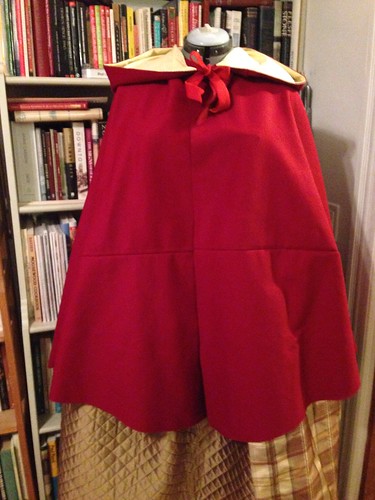
Although I’m not displeased with the cloak, the length can be annoying and I knew that the blue cloak for a runaway was not what I wanted to wear with the sacque. So I sacrificed some yardage from the Strategic Fabric Reserve, read up on cloaks, and got out my scissors. A cloak is a fairly simple thing to make, so I don’t know why it took all day, beyond getting distracted, making dinner, shoveling, re-learning high school geometry, and trying to do a very careful job.

Hood, with lining, pinned to the body of the cloak

Because I’m tall and have long arms, I made the new cloak a little longer than I would have for a true short cloak: it is easier to trim than to add, though this is pieced on the fronts and on the hood and on the hood lining.

Pieced across the front.

The front piecing is more noticeable than I really like, but that’s how this came out and how cloaks often work out. I won’t really care, as long as I am warm and able to move my arms. When it’s really cold, as it is today, I can wear both red and the blue cloaks with a wool gown and petticoats and wool kerchief. Or perhaps I should just wear a sheep.

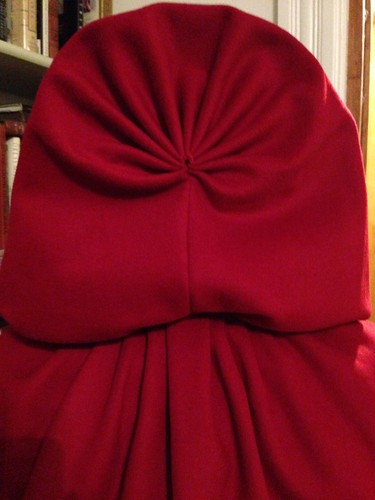
Back pleats. By a third cloak, I might get them really right.

I found the trick to getting the pleats/gathers on the hood to flip correctly was to work from the outside, or right side, once the back seam had been sewn up partway. It took three tries to figure that out, but somehow working the pleats/gathers from the right side worked. I did backstitch the pleats/gathers on the inside to hold them in place.

Inside the hood. with lining in place.

In all, this took less than a yard of yellow silk Persian, about half a yard of red wool twill tape, and two yards of crimson broadcloth, all from Wm Booth, and all but the Persian purchased as remnants. There’s a fair amount of broadcloth left, so a yard and a half with aggressive piecing might work, especially if you want a shorter cloak, and are not as tall as I am.

Share this:

  • Share on Facebook (Opens in new window) Facebook
  • Share on Pinterest (Opens in new window) Pinterest
  • Email a link to a friend (Opens in new window) Email
  • Share on X (Opens in new window) X
Like Loading...

The Checkered Past

26 Tuesday Nov 2013

Posted by kittycalash in Clothing, History, Research

≈ 3 Comments

Tags

18th century clothes, authenticity, Clothing, common dress, common people, common soldier, Costume, dress, exhibits, fashion, living history, Research, resources, Rhode Island

Coat, 1790s American CB: 38 in. Gift of The New York Historical Society, 1979.346.42. MMA
Textile Sample Book, 1771. British Rogers Fund, 156.4 T31, MMA

Some gentlemen I know should consider what they might want to do to avoid (or alternately, encourage) having this coat made for them. It’s really a lovely thing, found as the best things are, while looking for something else.

It reminded me, too, of the textile sample book at the Met, currently on display in the Interwoven Globe exhibition. (No, I haven’t seen it; I’m going to try, but…).

Wm Booth has a new linen coming in the winter, and as the men in my house have outgrown or outworn their shirts, I am thinking of making new check shirts. I did finish a white shirt at Fort Lee, which will go to the Young Mr (his small clothes being now his too-small clothes). I will have to make Mr S a white shirt for best wear, but they could each use a second working shirt. At least with checks you get “cut here” and “sew here” lines.

Last week, I found a weavers’ book in the Arkwright Company Records (Box 1, Folder 1, 1815). It’s a slim, blue paper-covered volume with small samplers glued in to the pages, and full of checks and stripes. Blue and white, red and blue, checks and stripes were prevalent in the late 18th and early 19th centuries. The more I look at extant garments, sample books, and ads, the more I think the streets must have been a vibrant, if grimy, visual riot.

Share this:

  • Share on Facebook (Opens in new window) Facebook
  • Share on Pinterest (Opens in new window) Pinterest
  • Email a link to a friend (Opens in new window) Email
  • Share on X (Opens in new window) X
Like Loading...
← Older posts
Newer posts →

Archives

wordpress statistics

Creative Commons License
Kitty Calash blog by Kirsten Hammerstrom is licensed under a Creative Commons Attribution-NonCommercial-ShareAlike 4.0 International License.

Website Built with WordPress.com.

  • Subscribe Subscribed
    • Kitty Calash
    • Join 621 other subscribers
    • Already have a WordPress.com account? Log in now.
    • Kitty Calash
    • Subscribe Subscribed
    • Sign up
    • Log in
    • Report this content
    • View site in Reader
    • Manage subscriptions
    • Collapse this bar
 

Loading Comments...
 

    %d