• Home
  • Completed Costumes/Impressions
  • Emma and Her Dresses
  • Free Patterns and Instructions

Kitty Calash

~ Confessions of a Known Bonnet-Wearer

Kitty Calash

Tag Archives: sewing

About that Spencer…

13 Wednesday Nov 2013

Posted by kittycalash in Clothing

≈ 2 Comments

Tags

buttons, Clothing, fashion, mistakes, Regency, sewing, silk, Spencer, worsted

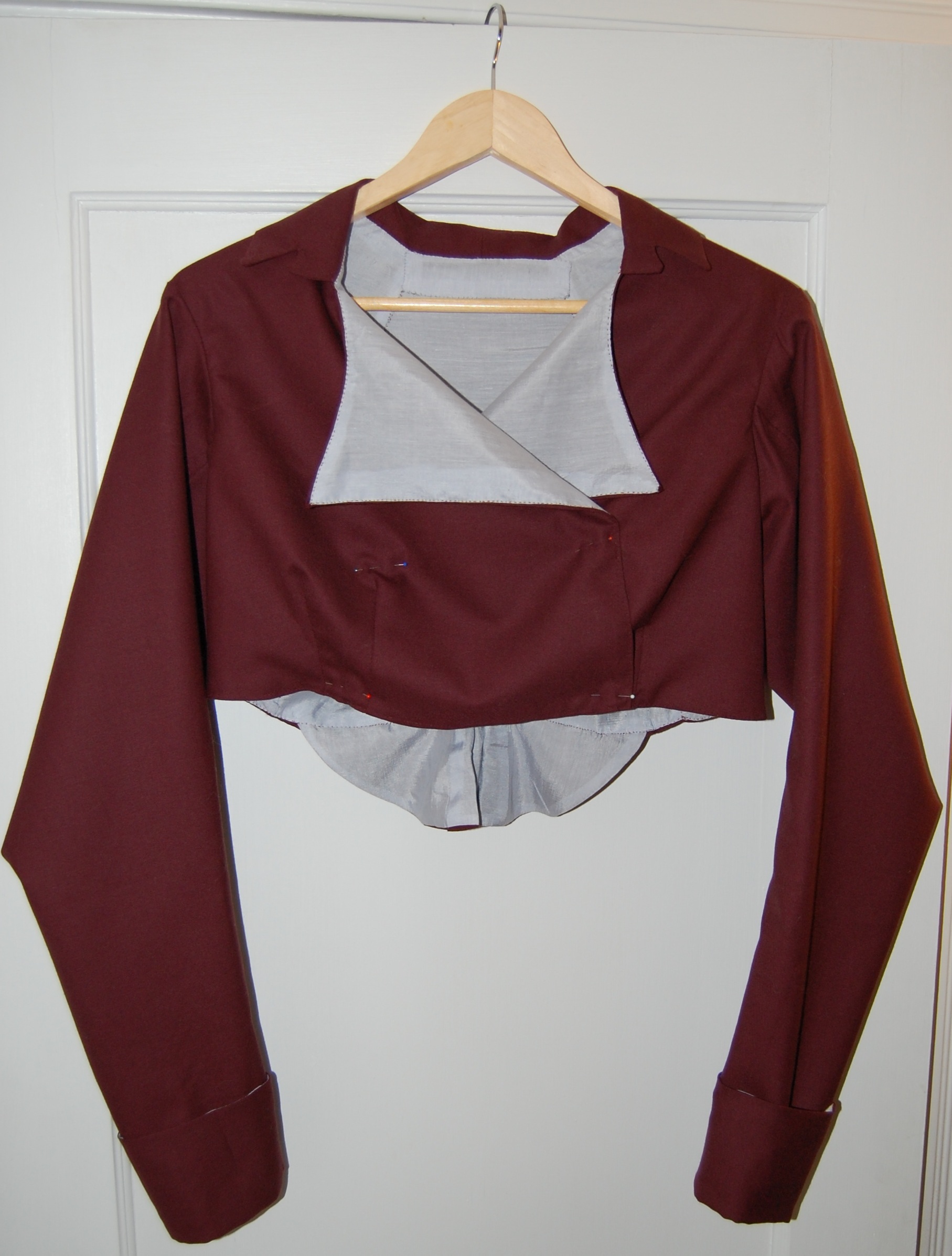
It's better on a human than on a hanger.

It’s better on a human than on a hanger.

Take my Spencer, please.

I’m close to being finished– all that remains are closures, but the sewing is done. It fits, though I haven’t yet tried it on over stays.  It looks less wretched in the mirror than it does on a hanger, I will give it that.

The wool is a yard and a quarter worsted remnant, and while it has a nice hand, it was sometimes annoying to press. It may have been the fault of the silk, though; I used a very light weight silk–even lighter than Booth’s “persians”– and that was probably a mistake.

DSC_0405

Last-minute peplum and button additions.

The Swedish Spencer closes with clasps, and while hooks and eyes are pretty common for center-closing garments (men’s and women’s) “clasps” was new to me. The double-breasted riding habit coat in Janet Arnold (from the Salisbury Museum, no photos online) closes with covered buttons. That seems reasonable for this worsted trial garment. I’m beginning to wonder if the Swedish Spencer is really finished, or if the clasps might be a later addition. Time to write a letter, I think…

Share this:

  • Share on Facebook (Opens in new window) Facebook
  • Share on Pinterest (Opens in new window) Pinterest
  • Email a link to a friend (Opens in new window) Email
  • Share on X (Opens in new window) X
Like Loading...

Bust darts from Hell

05 Tuesday Nov 2013

Posted by kittycalash in Clothing, History, Making Things, Research

≈ 6 Comments

Tags

19th century, bust darts, details, dress, Events, fashion, museum collections, patterns, sewing, Spencer

Spencer ca. 1800. MMS 1991.239.2

It all started out so well, in the muslin, but in the wool, not so much. I cut up a remnant, proving that a yard and a quarter of 60” fabric is enough for a Spencer, even for my arm length (but not less, thanks to that arm length and a respect for the grain).

The pattern I’m using has bust darts, which I haven’t sewn in years. They took some tweaking with the steam iron.

In 18th century clothing, one doesn’t see bust darts; there are some above the bust, shaping gowns at the robings, but for the most part they aren’t needed. Think cones, thanks to the stays. And later in the 18th century, a lot of work is done by gathers and drawstrings, as in the white and black  ca. 1800 French spencer at the Met.

Spencer ca. 1818-1819. MMA 1982.132.3

Spencer ca. 1818-1819. MMA 1982.132.3

But if you’ve got an endowment of the non-fiscal kind, and you want your military-inspired garment to fit smoothly over your endowment, what do you do?

In this example, you hide the bust dart under braid and buttons. Check out that diagonal seam—and that the fabric appears to have been cut on the bias.
Brilliant, right? Gain ease by using the stretchy quality of the bias and hide the shaping under decorative elements.

Here’s an extreme detail.

Spencer, 1813. MMA C.I.39.13.48

Spencer, 1813. MMA C.I.39.13.48

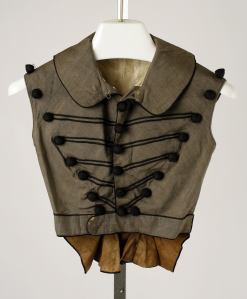
In the garment below, of wool, three bust darts of the same length help shape the front. And again, decorative braid hides the shaping. 

It’s only cataloged as “wool,” with no weave given. There is a detail image of the darts and braid as well; I think that might be serge, and not superfine broadcloth. Still, three bust darts help achieve a smooth fit.

The Swedish Spencer at the museum in Lund has but one grainy photo: it’s hard to imagine that it doesn’t have bust darts, but the photo leaves much to the imagination.

Share this:

  • Share on Facebook (Opens in new window) Facebook
  • Share on Pinterest (Opens in new window) Pinterest
  • Email a link to a friend (Opens in new window) Email
  • Share on X (Opens in new window) X
Like Loading...

Still More Sacques

29 Tuesday Oct 2013

Posted by kittycalash in A Silk Sacque

≈ Comments Off on Still More Sacques

Tags

10th Massachusetts, 18th century clothes, authenticity, Colonial Williamsburg, fashion, Museums, Reenacting, sacque, sewing, silk taffeta

1770-1780, Colonial Williamsburh 1999-247,A-C
ca. 1770 Colonial Williamsburg, 1993-330,A
ca. 1755 (Silk), dress remodeled ca. 1770. Colonial Williamsburg 1990-12,1
ca. 1750, altered ca. 1775, Colonial Williamsburg 1989-330,1
ca. 1775, remade late 19th century, Colonial Williamsburg, 1955-428,1
1770-1780, Colonial Williamsburg CW 1991-472, A-C

I’m particularly interested in remodeled gowns, not that I have the patience to make a ca. 1750 or 1760 gown and then re-make it, even though I suppose it would be the path to the greatest authenticity. In figuring out “what next” now that the pleats are stitched down and secured to the lining, and the front panels cut, and one even pinned, awaiting a seam, I looked at the sack/sacque in Costume Close Up. It’s both tiny and a polonaise, so it’s not the best example for me to follow, but when you’re trying to understand construction before you totally screw up  take the next steps, you look at whatever details you can.

That led me back to Colonial Williamsburg’s collections database, which I try to avoid because they don’t have stable permalinks to their records. However, they have good cataloging and an amazing collection, so it’s hard not to end up back there.

I feel a little more confident in thinking of a ca. 1770- 1775 gown with a compère front. A compère front is a false stomacher, where there are two halves sewn to either side of the opening in the bodice. The sides then button closed. Button, and not pin, people: sweet. I will gladly trade you a week of sewing buttonholes for a wardrobe failure today (Of course, I’m not sure whether a compère front is accurate for a ball gown, but I very much want to avoid a pin explosion at a public gathering.)

Trim is another tricky area: in my regular, 21st century life, I am not someone who wears ruffles and lace or even many colors other than black, brown, grey and red. When I chose the cross-barred fabric, it was a choice really grounded in who I am, and in my love of things architectural, bold, and elegant. (Thanks to my Dad and my education, I now wonder, can one make a Miesian sacque? Let’s find out.)

Serpentine trim, no matter how appropriate and accurate, is not for me. I like the simple trim on the purple gown (padded furbelows), and will probably replicate linear, and not serpentine, trim.

Share this:

  • Share on Facebook (Opens in new window) Facebook
  • Share on Pinterest (Opens in new window) Pinterest
  • Email a link to a friend (Opens in new window) Email
  • Share on X (Opens in new window) X
Like Loading...

Sacque Rationalizations

28 Monday Oct 2013

Posted by kittycalash in A Silk Sacque

≈ 1 Comment

Tags

10th Massachusetts, 18th century clothing, authenticity, Costumes, fashion, gown, LACMA, living history, Museums, Reenacting, sacque, sewing, silk taffeta

Sacque-Front
Sacque-Back

Before I get any farther along in the process of making a sacque (and I have not made much progress) I thought I should start to really look at gowns, and try to understand them.

Not only do I need to understand how they’re made, I want to understand how they change over time, and what’s appropriate for different time periods and situations. This will, or could, have some bearing on what I make for the gentleman accompanying me to the celebrations for which this gown is being made. If I start from Mr S, whose best coat right now is the 1777 Saratoga private’s coat, then I ought to have nothing better than a second-hand sacque several years out of date, and that is reaching indeed.

SacqueBySacque_back
What good fortune it is that the LACMA dress seems to be a gown in flux! This is the brown silk cross-barred gown with an assigned date of ca. 1760, which seems to have been abandoned in mid-alterations. Trim down the rights and left fronts ends abruptly at the waist, and two halves of what might have been a compère front lack any trim but boast plenty of holes. The front skirts come close together, but it’s hard to tell if they are meant to nearly close, or if the gown is fitted to a mannequin that’s too small and not adequately padded out.

Replicating a gown in mid-alterations would be interesting, but not what you’d wear to a ball, so I kept looking. In Hamburg there is another cross-barred sacque-back gown from about this era. There are similarities and differences, and never as much information as you’d like to have. Who owned and wore these? Who made them? When and where were they worn? We’ll never know, but at least with two similar gowns one can fill in some details for another, or help us understand them both.

The serpentine trim on the pink gown in Hamburg makes clear how unfinished or mid-alteration the brown gown in LA really is despite the visual interest created by the fabric itself.

Sacque_by_SacqueFront

So, what to do for my gown? And when will it be from? LACMA is hedging their bets with ca. 1760. I think Hamburg is pushing it a bit late with ca. 1775, but a ca. 1770 date for a gown based on the two seems reasonable. That would mean that the coat Mr S wears should also be ca. 1770, or newer than his green linen coat and older than his Saratoga coat. And luckily, I already have a plan, some fabric, and a pattern as a place to start.

While the ball itself has no date per se, it is in celebration of Washington’s Birthday, which puts it after 1775 at the earliest (think transfer of command of the Continental Army in Cambridge). Does that make a ca. 1770 gown too early? It would depend, I think on how one imagined the ball and oneself. If you’re a frugal woman who has lost much in the war, you’ll remake your gown; should the flounces become the shirred cuffs of later gowns? Could the kind-of compère front of the LACMA gown be a stomacher cut in half and stitched to the sides, with the pin hole indicating where trim had been removed from a once-was stomacher? Is it reasonable to make a compère front for a ca. 1770 gown? I want one mostly to avoid the stomacher angst I always seem to have, and in a way it marks a place between stomacher-front and front-closing gowns.

These unprovenanced gowns stand without the particular context and personality of their owners; the fun and the challenge for us, as costumers and reenactors, is in trying to bring our personalities to the fact-based garments we create.

Share this:

  • Share on Facebook (Opens in new window) Facebook
  • Share on Pinterest (Opens in new window) Pinterest
  • Email a link to a friend (Opens in new window) Email
  • Share on X (Opens in new window) X
Like Loading...

The ‘Bigger’ Issues

18 Friday Oct 2013

Posted by kittycalash in Clothing, Fail, Making Things, Reenacting

≈ 4 Comments

Tags

18th century clothes, authenticity, Clothing, common dress, failure, living history, patterns, sewing

What of those wardrobe issues?

1. The Cross-Barred Gown is Too Big. I will have to take it apart and make it smaller as it is too wide across the back in general and the shoulders. This is fairly simple.

2. The stays are Too Big. I can lift them up and do the shimmy inside them. Seriously. Eighteen months ago, when they were made, I had a two inch gap at the back and the front did not lace closed. Now I can lace them shut front and back.

Whether I have some body image issues or am just a crack-addled monkey can be debated among impolite company some other time, but to solve these problems, here’s the half-baked scheme plan I have in mind:

I re-cut and re-fit my bodice block for an open robe and made it smaller. (For the sacque, I need only trim the sides of the back because I haven’t gotten any farther than that, thank goodness! Now I have a better sense of the shoulder width I need to fill with pleats, also good.) For the Cross-Barred Gown, dis-assembly and re-construction can happen in the spring. Simple enough, and adjustable, too but…
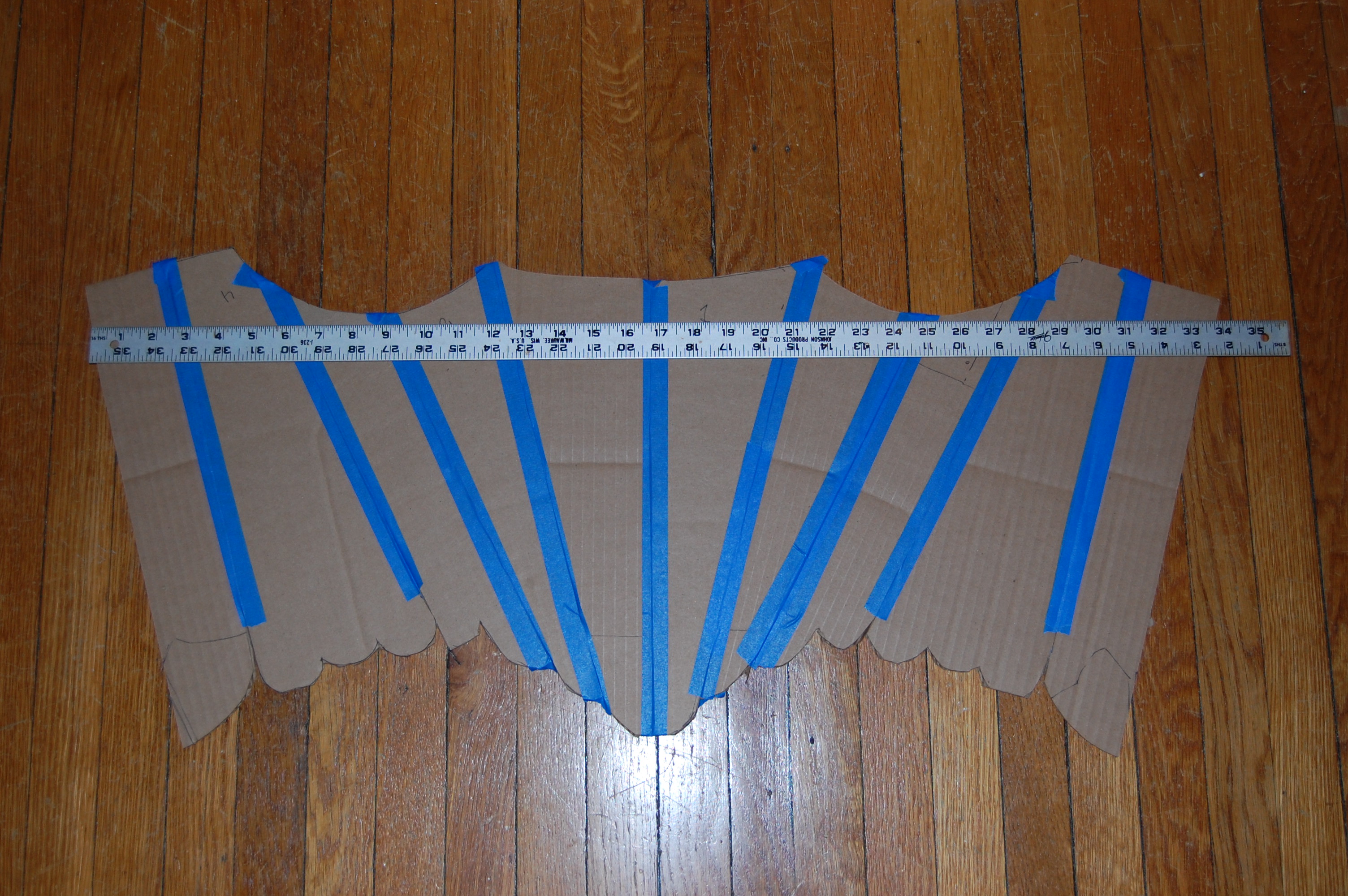
Stay pattern mock-up, measured.

Stay pattern mock-up, measured.

The stays are a little different, and much more serious. I’m not yet sure what to do. I could unstitch the binding and the panels and remove some bones, re-stitch the seams and re-apply the binding…or I could start all over, but make the stays a size smaller. The cardboard mockup measures 33 inches across. With a tape measure snugged up, I measure 37 inches around. Seems like all should be well, no? Two inches, front and back?

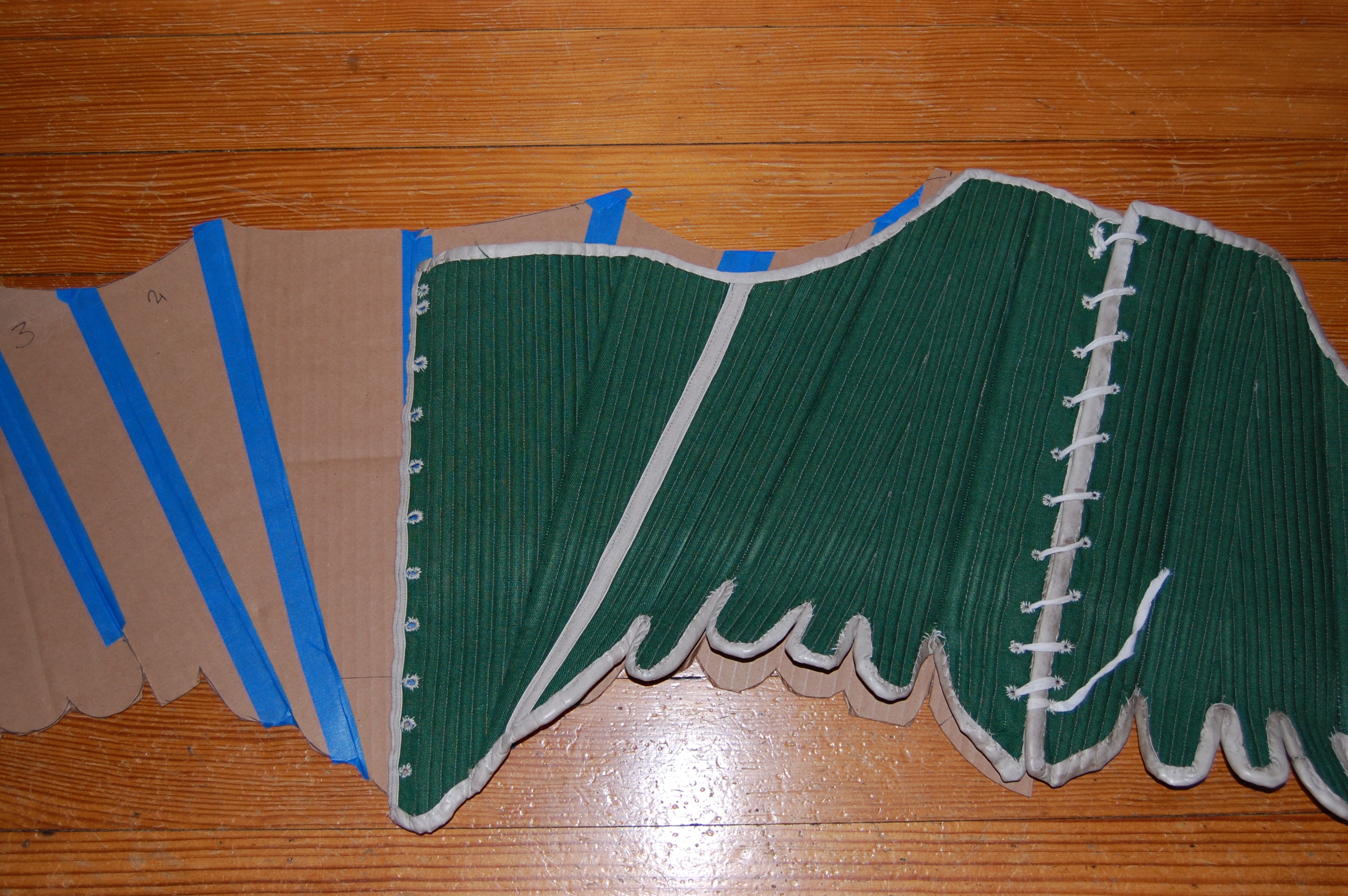
32 inches, but they don't fit.

32 inches, but they don’t fit.

It is not. Here you can see the green stays and the yard stick: 32 inches. I should have five inches altogether, right? No. These lace shut front and back (see the back lacing, kindly trust me on the fronts).

How did I not notice this before?

How did I not notice this drop before? (The pale line is the tide line of petticoat waistbands & ties)

Then I compared the mock up and the stays. Curiouser and worser!

Somehow when I assembled this hot mess, I mis-aligned the pieces,and the fronts are lower than they should be. This explains much about the increasingly poor quality of fit as these slide down my ribcage…as you can imagine, the stays can’t do their job when they’re not in the right place to do their job.

If I am to reclaim these and my decorum, the first step will have to be dis-assembly simply to get the various panels into the their proper places. I think it would be fairly simple to do to the fronts, and then I could end some of the madness by sewing the front panels shut and converting these to back-lacing stays. It might be only a temporary fix, but that alone would be worth the effort. Fortunately, I won’t require these until November 23, and in the meantime, I know which gowns are too big, and need to be smaller. With open fronts, at least they’re pretty adjustable.

Share this:

  • Share on Facebook (Opens in new window) Facebook
  • Share on Pinterest (Opens in new window) Pinterest
  • Email a link to a friend (Opens in new window) Email
  • Share on X (Opens in new window) X
Like Loading...
← Older posts
Newer posts →

Archives

wordpress statistics

Creative Commons License
Kitty Calash blog by Kirsten Hammerstrom is licensed under a Creative Commons Attribution-NonCommercial-ShareAlike 4.0 International License.

Website Built with WordPress.com.

  • Subscribe Subscribed
    • Kitty Calash
    • Join 621 other subscribers
    • Already have a WordPress.com account? Log in now.
    • Kitty Calash
    • Subscribe Subscribed
    • Sign up
    • Log in
    • Report this content
    • View site in Reader
    • Manage subscriptions
    • Collapse this bar
 

Loading Comments...
 

    %d