• Home
  • Completed Costumes/Impressions
  • Emma and Her Dresses
  • Free Patterns and Instructions

Kitty Calash

~ Confessions of a Known Bonnet-Wearer

Kitty Calash

Tag Archives: women’s history

Book Review: Book of Ages

17 Sunday Nov 2013

Posted by kittycalash in Book Review

≈ 1 Comment

Tags

18th century, book review, Boston, common people, history, Massachusetts, Research, resources, women's history

Book of Ages, by Jill Lepore.

Book of Ages, by Jill Lepore.

This is a book about reading and writing as much as it is a book about Jane Franklin, Benjamin Franklin’s little sister. Book of Ages has been reviewed elsewhere, and Lepore wrote a really lovely piece in the New Yorker called The Prodigal Daughter that is unfortunately behind a subscription firewall, but which I have read on actual paper. If you can get hold of it, I do recommend reading it before you read Book of Ages. It makes the book all the more poignant to know something about Lepore’s process.

This is, in many ways, another book about mud and misery (see the best bits of Longbourn). Because Jane Franklin Mecom (her married name– she married at 15) left behind so little, Lepore builds much of her story out of the context of Boston and New England in the mid-18th century.

It’s not exhaustive in its detail, and that’s fine: the book is an easy, comfortable read that still provides well-researched information about the lives of women in the 18th century. I finished it over a week ago, but details still remain (and that is a testament to Lepore– these could have been supplanted in my mind by details of exterior water meters, skunk removal techniques, or indexes for early vital records). Among the details I recall: Funerary and mourning customs, from published sermons to the distribution of mourning gloves and rings; soap making and trades practiced by small holders in home workshops; Jane Franklin Mecom’s wartime flight to Rhode Island; the power and practice of extended family networks.

It also reminded me of the differences in educational methods or standards for boys and girls, which helps remind us all of the importance and significance of the ideal of free public education for all. (We had some early proponents here in Rhode Island.) What might Jane Franklin’s life have been like in other circumstances? Honestly, even if she’d been well-off and well-educated, as as woman in the 18th century, she would never have had the same chances as her brother, no matter how evenly their intellects might have been matched.

If anything, that’s reason alone to read Lepore’s book, to celebrate the life of a woman who was both ordinary and extraordinary, and to recognize how much closer to all the anonymous, disappeared women of the past we can get through this example.

Share this:

  • Share on Facebook (Opens in new window) Facebook
  • Share on Pinterest (Opens in new window) Pinterest
  • Email a link to a friend (Opens in new window) Email
  • Share on X (Opens in new window) X
Like Loading...

Lovers & Fighters

24 Tuesday Sep 2013

Posted by kittycalash in History, Research

≈ 1 Comment

Tags

10th Massachusetts, 18th century, common people, common soldier, Revolutionary War, women, women's history

The wife of Bob Munn, Keeper at Sandpit Gate. Paul Sandby, Royal Collection Trust  RCN 914337

The wife of Bob Munn, Keeper at Sandpit Gate. Paul Sandby, Royal Collection Trust RCN 914337

On Sunday,  Mr FC mentioned that they knew the names of at least two of the women of the 10th Massachusetts, including one notorious woman, Bridget Mahoney. I mentioned this in an email to Mr HC, and got back four solid paragraphs of information. I sincerely and earnestly wish I had those retention skills, but embedded in one paragraph was that they knew of a woman in Wallcott’s company, because the brigade chaplain, Enos Hitchcock, had baptized the child of a soldier in Wallcott’s company.

Enos Hitchcock was the pastor of the First Congregational Church in Providence, and I happen to be fairly familiar with his pastel portrait and his diaries. The Rhode Island Historical Society published his diaries in 1899, and they can be read online thanks to the Open Library.

Here’s what I found, reading and searching:

April 25, 1779
Baptized child of Richard Northover, Soldier of the Train, by the name of Mary.

May 5, 1779
Married Sgt Bates and Mrs Lucy Gun

May 9, 1779
Baptized Lydda, daughter of George Wilson and Letty, his wife, of Capt. Buckland’s Train—Baptiized Adaulph, son of John Degrove of the above company

May 31, 1779
Sent for to go aboard the Lady Washington galley to marry John Thompson and Abia Chase

June 21, 1779
Married Henry Smith and Phebe Cockswain, late Brewer’s Regt.

Three baptisms and three marriages in just over 8 weeks: that’s a busy regiment.

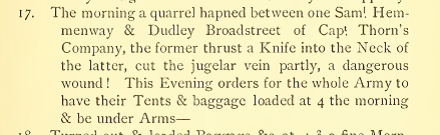
Of course, they did their share of fighting, and not just on the field. I did not witness the fight instigated on Sunday morning by Mr FC, against the New York troops in which there was shoving, the beating of Mr S with a hat, and the deflection of Mr McC, who upon arriving with a shovel, was put to work digging.

September 17, 1777. Enos Hitchcock diary.

September 17, 1777. Enos Hitchcock diary.

In Hitchcock’s diary, I found an account of a quarrel near Stillwater, NY on September 17, 1777. This was intramural knife-thrusting, but clearly, the 10th Massachusetts were very busy men.

Share this:

  • Share on Facebook (Opens in new window) Facebook
  • Share on Pinterest (Opens in new window) Pinterest
  • Email a link to a friend (Opens in new window) Email
  • Share on X (Opens in new window) X
Like Loading...

Women’s Work

22 Tuesday Jan 2013

Posted by kittycalash in Events, History, Living History, Reenacting

≈ 5 Comments

Tags

18th century, Events, interpretation, living history, women's history, work

Cooking. Gets you every time.

Cooking. Gets you every time.

Three holes (at least; there might be four) and mending to do. The patches are cut, but I’m thinking now that a wool apron might be a good thing to have. The other thing I’ve been thinking about is what James Thurber called The War Between Men and Women, and how even in educated, enlightened North America, it plays on. [i]

At living history events or reenactments, the work and activities are divided along gender lines. Participants are supposed to follow “the rules,” which keep women on the observer side of the rope line and the men free to run around with muskets. Women sometimes seem purely decorative at the military events, and the relationships between men and women are curious. There’s the sexism between reenactors, and the sexism of the public, who can often assume women know nothing about what’s happening.  Women should, after all, know their place, just as the men know theirs.  Women can cook and clean up after the men, and the men will do all the talking, even when they’re wrong.[ii]

In a more domestic setting, this same historical dynamic can play out: women cook and serve the meals, wash the dishes, fetch the wood and water, and clean the kitchen, while men muck about outdoors until their tools break. Then they lounge about smoking, drinking, and talking.

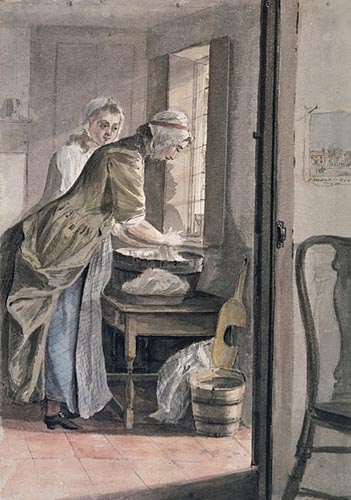
Sandby, Washing at Sandpit Gate, 1765. Royal Collection.

Sandby, Washing at Sandpit Gate, 1765. Royal Collection.

That’s all OK, to a degree.  But we’re not in the 18th century, and the women in the kitchen don’t enjoy washing other people’s dirty dishes as well as all the cooking pots and tools. We had a system on Sunday evening, but I did notice that some men just can’t be the only guy helping: once the other guys leave the room, they’re out, too, with a kind of desperation, even as the light wanes and we need all the help we can get to finish up.

So what to do? Interpreting the 18th century means facing gender roles that most American women today don’t like or embrace. What’s the best way to interpret women’s history and women’s roles in the past to people today?

On Sunday, I left the house to call the guys to the first meal, and a visitor asked if the sheep in the field were part of the site. “Yes,” I said. “ But I don’t know where the sheep are today; I don’t get to leave the house much.” And that is true: aside from fetching water when I didn’t have a man or boy to ask to do it, there was hardly need, reason, or even time, to leave the house.

I think we do a disservice to the visitors to living history sites of all kinds if we don’t find a way to talk about women’s history, and the roles—proscribed or not—that women could take on. At a RevWar encampment, we can talk about the reasons women followed the armies, the kinds of work they did for pay or rations, and what the Revolution meant for women. At the farm and at the manor, I think it’s important to talk about women’s lives in the Early Republic. How this would work at the farm, exactly, I’m not yet certain; at the manor it is easy enough, for the women who lived there were born just before the Revolution. They were well-educated and expected to choose their own husbands. We know who they were; we know less about the women at the farm, though we know about their work.

How we experience that work isn’t really the point, but the chasm between choosing to spend a day never looking beyond the scope of the hearth and having to spend days that way is enormous. It’s a point I want to make,  in a way more sophisticated than “life was hard and greasy.” It’s something to work on.


[i] This is in no way meant to equate the petty first world problems of a bunch of reenactors/living historians with the larger and more brutal problems elsewhere in the world. But relationships can change when situations change…

[ii] Fortunately, the Second Helping Regiment doesn’t work quite this way, and not just because they’re busy chewing whatever has been made for them. Cooking, and the subsequent chewing, can be used strategically.

Share this:

  • Share on Facebook (Opens in new window) Facebook
  • Share on Pinterest (Opens in new window) Pinterest
  • Email a link to a friend (Opens in new window) Email
  • Share on X (Opens in new window) X
Like Loading...
Newer posts →

Archives

wordpress statistics

Creative Commons License
Kitty Calash blog by Kirsten Hammerstrom is licensed under a Creative Commons Attribution-NonCommercial-ShareAlike 4.0 International License.

Website Built with WordPress.com.

  • Subscribe Subscribed
    • Kitty Calash
    • Join 621 other subscribers
    • Already have a WordPress.com account? Log in now.
    • Kitty Calash
    • Subscribe Subscribed
    • Sign up
    • Log in
    • Report this content
    • View site in Reader
    • Manage subscriptions
    • Collapse this bar
 

Loading Comments...
 

    %d