• Home
  • Completed Costumes/Impressions
  • Emma and Her Dresses
  • Free Patterns and Instructions

Kitty Calash

~ Confessions of a Known Bonnet-Wearer

Kitty Calash

Author Archives: kittycalash

The 1763 Project

09 Thursday May 2013

Posted by kittycalash in 1763 Project, Clothing, Living History, Making Things, Reenacting

≈ Comments Off on The 1763 Project

Tags

1763, 18th century clothes, plans, resources, sewing project

Doll, 1763. V&A, T19.36, T19P.36

Doll, 1763. V&A, T19.36, T19P.36

Sweet, right? Who wouldn’t want to look (or at least dress–those pupils suggest something untoward, chemically) like this doll? And she’s 1763. Of course, my friend DC didn’t get the grant he applied for, so he has to try again.

Still, it seems the event will go ahead and I am stumbling on under the impression that I will have a chance to make myself something lovely for August. Of course, that comes only after I make the regimental menswear, so why am I typing and not backstitching? Because after a while, it’s just plain dull. Plus, doll! Printed cotton! Lightweight and lovely! And look: a hairstyle I can manage: birds’ nest.

Nice Petticoat.

Nice Petticoat.

What I like about this doll are her details. (The better written description is on the V&A website, but the better photos are at VADS.) She’s wearing a sacque (known also as a sack-back robe or a robe a la Francaise) and matching petticoat, a green silk quilted petticoat, a white linen petticoat, and a pocket that matches her gown.

The blue silk of her stomacher is used as trim on her sleeves, which are ornamented with flounces. Hallie Larkin goes into this well on her blog post about Changes in Cuffs. And that’s what stops me: the fine linen and the lace.

An actual reproduction, no less.

An actual reproduction, no less.

The gown itself, even a sacque, seems like something I can manage. (And yes, this is but one more piece of cotton sacque evidence.) A very similar fabric is available and if this sells out, there are variations on the theme. The blue silk stomacher can be managed: I have taffeta sources, and from making bonnets have learned the basics of the serpentine designs. I could make that. But those flounces–what about those?

Here she is from the V&A, ca. 1760, T.19-1936

Here she is from the V&A, ca. 1760, T.19-1936

Here’s the V&A description: “lace and cotton elbow ruffles.” Hmm. Cotton, perhaps that I can find in a fine, sheer weave. But the lace?

The more I think about this lovely gown, about the materials, and who would wear it, the more I think I’m better off sticking with lightweight wool and Sandby’s cherry seller...

I love a good challenge, but the lads need regimentals and their own 1763 apparel. Sandby’s woman wears a gown I’ve made before, so construction screw-ups will be fewer time will be shorter. And at least we can all wear whatever I make for various other celebrations and riots. New England had them in abundance in the 1760s and 1770s.

Share this:

  • Share on Facebook (Opens in new window) Facebook
  • Share on Pinterest (Opens in new window) Pinterest
  • Email a link to a friend (Opens in new window) Email
  • Share on X (Opens in new window) X
Like Loading...

Sampler Resources

08 Wednesday May 2013

Posted by kittycalash in History, Research

≈ 2 Comments

Tags

18th century, auctions, embroidery, Museums, Research, resources, Rhode Island, Sampler Archive Project, Sampler Consortium, samplers, Sotheby's

Sew 18th Century had a fun post recently about “Which State House is it?”

Sotheby's Sale N08832, Lot 563: The Sarah Waterman sampler

Sotheby’s Sale N08832, Lot 563: The Sarah Waterman sampler

I’m not usually a sampler fan (you know this is not an area in which I shine), but I have learned a lot more about samplers through work than I ever expected to. And what do you know? Some of it stuck!

I thought I would pass along some helpful resources for sampler fans. Last year, one of the (if not THE) premier sampler collections was sold at auction by Sotheby’s. Through the magic of the interwebs, you can see the catalog online:

Important American Schoolgirl Embroideries: The Landmark Collection of Betty Ring 

Even I say “Yum!” to all those pictures. I like color and texture, but sometimes samplers make me feel like all the air has been sucked out of the room. Walker Evans has the same effect. But when you look at them like this–or arrayed on a worktable–they turn into pictures, and those I enjoy. You page through the catalog and see what Betty Ring had, and whimper a little about these going in to private and not public hands. I know we whimpered…how I covet a green-background sampler!

But wait–there’s more! Be sure to check out  American Needlework Treasures, and Girlhood Embroidery Volumes I & Volume II which are available as full-text PDFs with images. In Girlhood Embroidery, you can read more about the Mary Balch School.

If you like samplers, and want to learn more or support sampler work, visit The Sampler Consortium website. You can become a lifetime member free of charge, and enjoy email updates with sampler news. The Consortium is connected to The Sampler Archive Project, which is funded by the NEH. We’re pleased to be part of the SAP’s first phase, and I am pleased to have learned so much just by cataloging.

Share this:

  • Share on Facebook (Opens in new window) Facebook
  • Share on Pinterest (Opens in new window) Pinterest
  • Email a link to a friend (Opens in new window) Email
  • Share on X (Opens in new window) X
Like Loading...

In the Grip of La Grippe

07 Tuesday May 2013

Posted by kittycalash in History

≈ 2 Comments

Tags

18th century, catarrh, contagion, illness, la grippe, newspapers, Research, resources

lwlpr13377

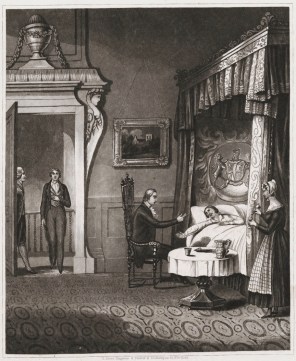
The Life of a Nobleman: the sick room, LWL call no.
830.00.00.73+

I had a cold this week past, and quite miserable it made me, too. It got me thinking about illness, and historical perceptions of illness.

I love words, and old words are best, and one of my favorites has long been catarrh. It sounds just like what it is. The Times (another one of my loves) has a hilarious column on the subject, originally published in 1865. It makes me want to write a chapbook, “Letters on Cattarh.” The first known use of the word is in the 15th century, so chances are good it turns up in 18th century usage. In fact, it turns up in the Boston Post Boy of Jan 1 1736 not as a cause of death, but as the reason for the state of George Bethune’s lungs.

Scanning America’s Historical Newspapers (yes, I do this for fun) turns up more than 1,400 hits before 1783 alone for “illness,” most resulting in death, though some are described as past, and disfiguring. My money’s on smallpox for those.

Providence Gazette and Country Journal, 1768.

Providence Gazette and Country Journal, 1768.

Catarrh turns up 27 times. Here it is in the Providence Gazette and Country Journal of 1768. It’s from an extract of the minutes of the American Society, held at Philadelphia, for Promoting Useful Knowledge. I can imagine the gentlemen sitting with pipes and punch bowl, grumbling to each other, “We can send a ship to Suriname, but we can’t cure the common catarrh.” Or perhaps it is the ladies who say it, as the gentlemen come stumbling home from the meeting to Promote Useful Knowledge.

La Grippe

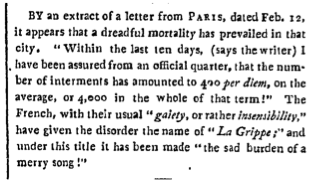
La Grippe, as experienced by poor Adelaide, is influenza. The etymology suggests a 1770-80 French origin, from gripper, to seize suddenly. That’s pretty descriptive, if you’ve ever had flu. La Grippe turns up in the index of the Philadelphia Repository and Weekly Register, January 1, 1803, as “prevalent at Paris,” and on April 9, 1803, we can read the little article about it.

On April 11, 1803, in the Alexandria Advertiser and Commercial Intelligencer there appears an “Extract of a private letter” describing interments of 400 per day, and 4000 in a ten-day period. This was serious, serious stuff. Facing illness today, we’re so much better off than people were in 1803, or even 1903. Germ theory is only 150 years old at the most, and really, thank goodness for it.

For more on the various diseases and epidemics of the past, I give you the Contagion database from Harvard. It’s an excellent collection of articles and links to additional reading, from smallpox to influenza. I feel better already.

Share this:

  • Share on Facebook (Opens in new window) Facebook
  • Share on Pinterest (Opens in new window) Pinterest
  • Email a link to a friend (Opens in new window) Email
  • Share on X (Opens in new window) X
Like Loading...

Happy Anniversary

06 Monday May 2013

Posted by kittycalash in Events, Making Things, Thanks

≈ 10 Comments

Tags

anniversary, Costume, Dress U 2013

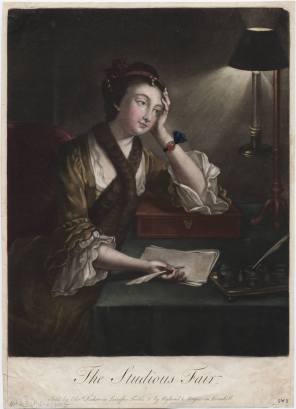
The studious fair, Lewis Walpole Digital Library. 767.00.00.12+

The studious fair, Lewis Walpole Digital Library. 767.00.00.12+

WordPress was kind enough to point out that I’ve been blogging here for a year. Thanks, WordPress. Almost 200 posts later, what do I think? More to the point, what do you think? You can tell me in the comments.

Here’s what I think:

Pretty dresses are showing up on costume blogs as people get ready for Dress U, and I feel so very not shiny.  I feel the way I felt when my mother made a pretty blue and white and pink roller print robe à la Française for a classmate to wear as Mrs. Washington or Mrs. Jefferson in the 5th grade play in which I played Sam Adams.

And I look back at what I’ve written, and I realize that I’m never going to have that pretty dress until I figure out who is wearing that dress, and why. It’s about the research, about the narrative, about the documentation. It’s a curse, but it keeps me writing.

That, and some desire to be as busy as I can manage to be. Even with classes to prep for Dress U in four weeks, two men to outfit for Monmouth in six weeks, I still signed up for a weekly Wednesday night writing workshop this month.

What can I say? Life is good. Thanks for reading. Here’s to staying interesting for another year.

Share this:

  • Share on Facebook (Opens in new window) Facebook
  • Share on Pinterest (Opens in new window) Pinterest
  • Email a link to a friend (Opens in new window) Email
  • Share on X (Opens in new window) X
Like Loading...

Details. All in the Details.

04 Saturday May 2013

Posted by kittycalash in Clothing, History, Living History, Making Things, Museums

≈ 4 Comments

Tags

18th century, authenticity, embroidery, muse, pockets, Research, Rhode Island, sewing project

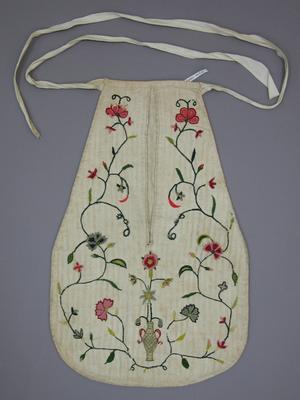
Detail, pair of pockets. Gallery of Costume, Platt Hall, Manchester City Galleries. MCAG.1922.2150

This image is from the fantastic VADS site‘s  gallery of pockets. I need new pockets, or a pocket update and overhaul, so I went looking for inspiration.

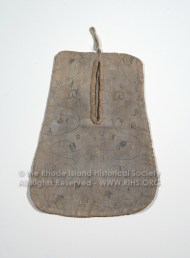
Child's Pocket, 1720-1760. RIHS 1985.1.9.

Child’s Pocket, 1720-1760. RIHS 1985.1.9.

This is a dangerous path to go down if you are as unskilled with a crewel needle as I am.

Sew18thCentury can do it– so, sew, lovely. Me…well, everything I knew about embroidery I learned as a child, and promptly forgot with puberty. So my skills remain appropriate for reproducing this, from a Rhode Island collection. The pocket is child-sized, at 14 inches, and the embroidery has a crabbed, angry look, as if the girl would much rather have been outside, chasing her dog or brother.  I can relate, at least to the dog part.

My copy, on the clearance-bin frame.

My copy, on the clearance-bin frame.

I  made a pattern of the embroidery, traced it onto linen, and started working on dredging up those long-forgotten skills. As a child, I had a sewing or embroidery book, but what I remember most about the projects I made was how far their finished form was from what I had envisioned.

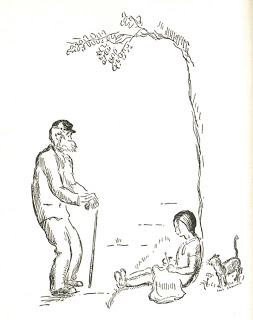
Jane, and the Oldest Inhabitant

Jane, and the Oldest Inhabitant

This is not an uncommon experience for children; my son has certainly experienced this, and even adults are subject to it. I think the best rendition of it, sewing-wise, is Eleanor Estes’ portrayal in The Middle Moffat of Jane Moffat attempting to make a “brocated bag” for Mama’s Christmas present.

The image of Jane sewing or crocheting under a tree while talking to Cranbury’s Oldest Inhabitant, a Civil War veteran, sums up every reenactment I’ve ever been part of… but I digress.

DSC_0283

A detail. Sigh. I know, practice, but…

My embroidery stitches lack a lot, but most of what they lack is practice–and that’s what makes reproducing that RIHS pocket a perfect project for me. Pockets were “sampler” projects, and suitable for girls to learn on. This combines plain sewing with embroidery, and ends up as something useful and authentic, so what more can I ask?

Pocket, single, embroidered. Snowshill Costume Collection, National Trust (UK). mid 1700s. SNO1452

Pocket, single, embroidered. Snowshill Costume Collection, National Trust (UK). mid 1700s. SNO1452

The VADS site has tons of images to inspire me, and with practice, someday I could manage something as beautiful as this. I need only make sure that it fits my time period and station–and for some events it will, but for most, the plain pocket or the crabbed-stitch embroidered pocket, are probably far more appropriate.

Share this:

  • Share on Facebook (Opens in new window) Facebook
  • Share on Pinterest (Opens in new window) Pinterest
  • Email a link to a friend (Opens in new window) Email
  • Share on X (Opens in new window) X
Like Loading...
← Older posts
Newer posts →

Archives

wordpress statistics

Creative Commons License
Kitty Calash blog by Kirsten Hammerstrom is licensed under a Creative Commons Attribution-NonCommercial-ShareAlike 4.0 International License.

Website Built with WordPress.com.

  • Subscribe Subscribed
    • Kitty Calash
    • Join 621 other subscribers
    • Already have a WordPress.com account? Log in now.
    • Kitty Calash
    • Subscribe Subscribed
    • Sign up
    • Log in
    • Report this content
    • View site in Reader
    • Manage subscriptions
    • Collapse this bar
 

Loading Comments...
 

    %d