• Home
  • Completed Costumes/Impressions
  • Emma and Her Dresses
  • Free Patterns and Instructions

Kitty Calash

~ Confessions of a Known Bonnet-Wearer

Kitty Calash

Category Archives: History

This is That

24 Friday Aug 2018

Posted by kittycalash in History, Living History, Museums

≈ Comments Off on This is That

Tags

blue, emotions, Mark Rothko, Museums, Napoleon, Virginia Museum of Fine Art, VMFA

Mark Rothko: another suicidal abstract bad-boy painter from the middle of the last century, so what?
This is what: a day at the museum when then the last painting in the Napoleon exhibit is presented in such a way that it was, in effect, the same as the last painting I happened to see.

Napoleon on his Death Bed
Untitled (Primary Title) oil on canvas by Mark Rothko, 1970. VMFA

Rothko wasn’t one of my top-ten favorite artists, but he was the top of the list of color-field painters I liked when I was studying art. He’s the kind of artist who grows on you as you mature, the way eating habits change with experience. The article I’m reading now compares his work to Roman villa murals, and that makes sense when you encounter his work. It’s color and not color, depth and surface, immersive. Simply immersive. Rothko creates a world that exists within your own head; his paintings invite you into his mind, which then occupies yours. It’s not always comfortable, given Rothko’s own dark visions. It remarkably effective in its apparent simplicity, the colors hovering over one another, creating depth with saturated color.

Red, Orange, Orange on Red oil on canvas by Mark Rothko, 1962. St. Louis Art Museum, 129:1966
No. 22 (Untitled), 1961, oil and acrylic on canvas by Mark Rothko, 1961. Collection Albright-Knox Art Gallery, Buffalo, New York, Gift of The Mark Rothko Foundation, Inc., 1985 1985:9

The first Rothko I saw must have been in Chicago, though the first one I remember is Red, Orange, Orange on Red in St. Louis; I must have seen the Albright Knox’s not long after they acquired it– the red and black are more familiar and more comfortable, in a way, than the orange and red.

But this is a history blog, you say, a costume blog. Why are we talking about Rothko? We’re talking about Rothko because seeing a Rothko– standing in front of an actual Rothko, taking a breath and looking— is an experience. An emotional experience. Reader, I wept.*

Just as the projected waves washed the walls of the final gallery in the Napoleon exhibit, so too did the blues of this untitled painting move. They vibrated with emotion, and I was immersed in blue, a kind a symphony of color, as close as I will ever come to synesthesia.

And that’s what good exhibits do, what good history does, what accuracy does. It renders the past visible, tactile, sensible, immersive. It catches us, and we fall down. Art, history, culture: if we are sucked into that otherness, hooked by feeling, we are more likely to learn something.

As stood before the Rothko, I noticed a Cornell– and a teenager noticing the Cornell. Joseph Cornell’s boxes were my first obsession, when I skipped school to go to the Art Institute of Chicago to spend my day surrounded by Cornell’s tiny universes, transported to another place.
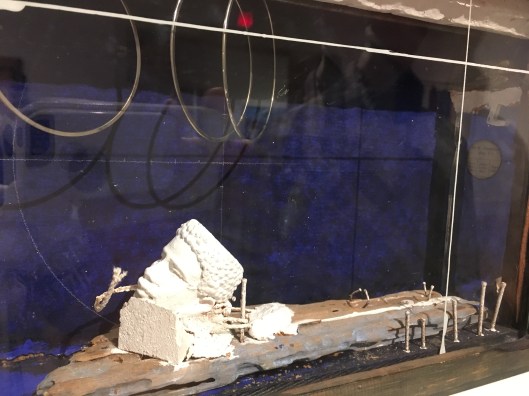
Untitled (Primary Title), painted and papered wood and glass box, with wood, plaster pipe, metal rings, nails, and string by Joseph Cornell, probably 1950s. Virginia Museum of Fine Arts, 96.41

Isn’t that what we’re trying to do, every time we dress in these funny clothes, visit historic sites, reenact the past? Aren’t we all seeking some sublime moment, when this solid present becomes the ether of the past? Sometimes the way to understand that most readily is to study something else entirely– like a Rothko. Or a Cornell. Sometimes the way into a thing is sideways, when understanding and inspiration come from an unfamiliar place, when me make connections we don’t expect.

L’Empereur Napoléon Ier sur son lit de mort, oil on panel by Denzil O. Ibbetson, 1821.

Death and Napoleon and Rothko and Cornell all seem obviously connected to me– and not just through the symbolism of the rich cobalt blues.

*I do this in museums: when I walked into the Kaufman Gallery at the NGA, tears welled in my eyes at the sight of so much beauty.

Share this:

  • Click to share on Facebook (Opens in new window) Facebook
  • Click to share on Pinterest (Opens in new window) Pinterest
  • Click to email a link to a friend (Opens in new window) Email
  • Click to share on X (Opens in new window) X
Like Loading...

Black and Blue

21 Tuesday Aug 2018

Posted by kittycalash in Clothing, Events, History, Making Things

≈ 6 Comments

Tags

1790s, bonnets, fashion plates, Federal style, millinery, Regency Society of Virginia, Spencers

IMG_4756
IMG_4760

Unlike some of my earlier posts, this Black and Blue refers to a different kind of historical effect: the purely aesthetic. (Yes, it is a departure for me. Moving below the Mason-Dixon line has been curious, as my encounters at the bank regularly make me wonder if I have stumbled into the Invasion of the Body Snatchers or Pleasantville. Surely real humans aren’t this nice! I thought the people of Rhode Island were just fine, but maybe my standards were warped by growing up in a Major Midwestern City.) In any case, times change and so do people. Onward, to the aesthetic!

First, there was the new waistcoat. That should be enough to refresh an outfit, right?
Wrong.

The armscye sits way back over the shoulder blades

The set of the armscye didn’t coordinate with the white gown I made two summers ago, so a new item would be in order. I thought this would be the case in the muslin, but when I basted up the blue silk (selected because I had enough material to make a waistcoat and a cap), it was clear something new would have to go underneath.

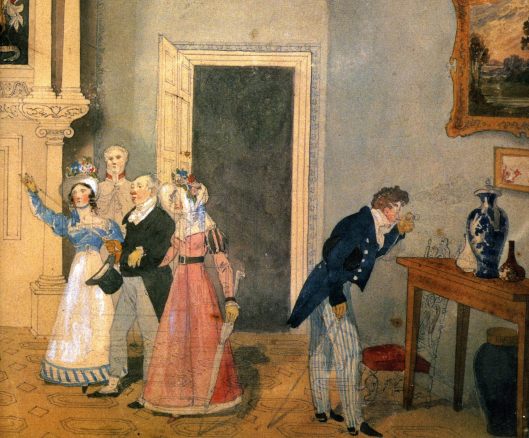
The original waistcoat’s date of ca. 1797 helped narrow down my choices, and a 1799 fashion plate helped as well. Blue over white: pretty snazzy. I sketched up the plan for the white wrap-front gown, re-imagined that when I got batiste after asking for voile, and figured I’d be fine. A blue silk cap trimmed in black wool lace or gold silk cord still seemed like a good solution.


But the fashion plate showed a black hat or bonnet, and whilst trolling Etsy with a Manhattan in hand, searching for an 1830s-appropriate buckle, I took a look at one of my favorite shops, just to see.

Reader, I saw.

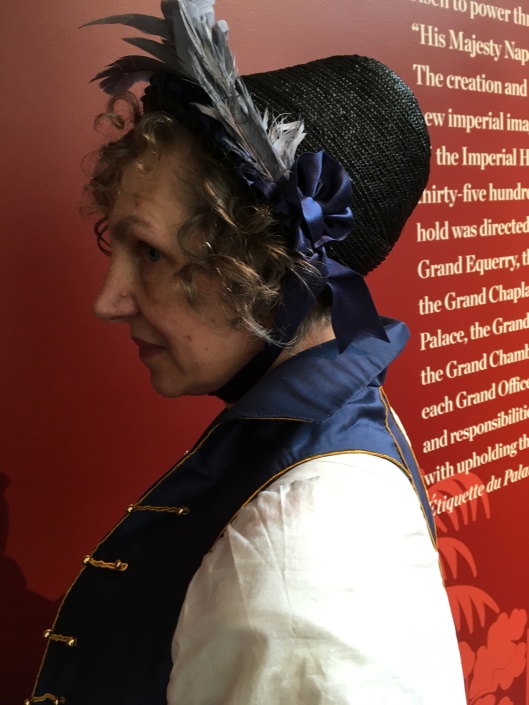
The “overly honest milliner” confessed that this style would not flatter everyone. Challenge accepted! In truth, though, I have a small head, and having cut my hair short for the summer, can (must) wear a slightly different kind of headware. I’ve also tried on enough of Anna’s millinery to know what will and won’t work for me, so I was pretty certain this bonnet would suit me well.

I trimmed it with some blue silk double-faced satin ribbon recovered from a failed bonnet attempt of several years ago, and then cast about for something else. Something different. Wednesday found me steaming feathers– as you do– while Drunk Tailor pulled KP duty. I hid the feather quills (more or less) with a ribbon rosette, and the considered fastening. Many early-nineteenth century bonnets don’t tie under the chin, and in any case, I didn’t have enough ribbon left to pull that off.

Parking lot selfie, with sweat, curls, and feathers. I like the way the feathers contrast with the curls.

The solution? Another rosette. On the feather side, I stitched the straight tail of the ribbon to the bonnet. The second rosette attached to the ribbon, which I then ran under my chin and pinned. Bonnet secured, more or less, though the feathers necessitate caution when exiting a vehicle.

Share this:

  • Click to share on Facebook (Opens in new window) Facebook
  • Click to share on Pinterest (Opens in new window) Pinterest
  • Click to email a link to a friend (Opens in new window) Email
  • Click to share on X (Opens in new window) X
Like Loading...

Tripping in Richmond

20 Monday Aug 2018

Posted by kittycalash in Clothing, Events, History, Museums

≈ 5 Comments

Tags

art history, Costume, Federal style, Museums, Regency Society of Virginia, Travel, Virginia Museum of Fine Art

Visiting the Stately Home: an early touristic diversion

Friday night, Drunk Tailor and I waited until the worst of rush hour in NOVA was over and headed south to Richmond, surprised not to be engulfed in a terrific thunderstorm of the kind we are becoming accustomed to driving in. We had planned a weekend trip to see the Napoleon: Power and Splendor exhibition at the Virginia Museum of Fine Arts. It’s a traveling exhibit, but this is the first time I’ve been close enough to see it, and we had the added benefit of being able to attend in costume with the Regency Society of Virginia. (Reader: I required a new outfit.)

The idea of visiting a museum in costume is incredibly appealing, and all the more so when you can visit galleries of objects from the time period your costume replicates. Add to that the layer of traveling on the weekend in the clothes from the time when tourism first became a “thing” (at least among the monied classes), and you have a recipe for an excellent adventure.

(Somehow, while often at events together, Drunk Tailor and I are rarely seen “together,” so images like this are nice to have.)

If you are going to play the tourist, especially if you are visiting the “spoils” of the former emperor, you have to dress appropriately. American tourists today may travel in camo crocs and backwards baseball caps, but people in the past dressed for touring and it seemed appropriate to dress for this trip.

Admiring the panorama. (Cropped only to enhance periodicity)

This trip, with the fun of visiting in period clothes, reminds me of the books still in storage, and the books I have yet to read — one on early country house tourism— that document the changes in how people spent their time and consumed goods, and the reasonably concurrent rise of both the museum and the department store.

Raptures about the mounting, I think, but we might as well we shopping.

Peale and Zola have more in common than you might think, or at least Mr. Peale and Mr. Selfridge. These compendia of material goods are similarly structured — both organized around themes or types, whether ladies’ lingerie or Oceanic art– and have similar aims of edification and [cultural] consumption.

When your hat sees its cousin in a case….

All in all, an excellent trip, with much to see and talk about. After finishing our tour of the Napoleon exhibit, we lunched (another experience similar to the department store) and toured more of the museum, and had a day well spent.

Share this:

  • Click to share on Facebook (Opens in new window) Facebook
  • Click to share on Pinterest (Opens in new window) Pinterest
  • Click to email a link to a friend (Opens in new window) Email
  • Click to share on X (Opens in new window) X
Like Loading...

Down and Out in Upstate New York

27 Friday Jul 2018

Posted by kittycalash in Events, History, Living History, Reenacting

≈ Comments Off on Down and Out in Upstate New York

Tags

Continental Army, cooking, empathy, Fort Ticonderoga, pain, servants

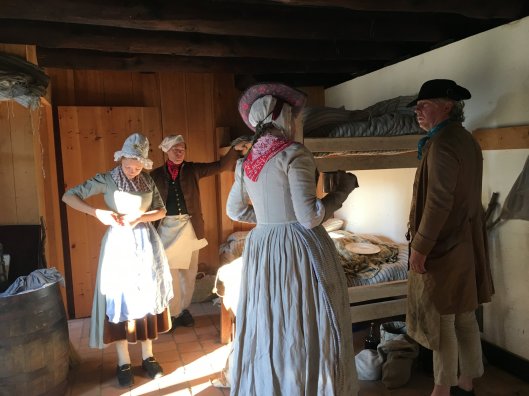
Other folks have covered aspects of this past weekend at Fort Ticonderoga, leaving me with little that needs adding but much to look into. Portraying a British servant is more intuitive for me than portraying an American: the hierarchy of the British is more explicit than the American, especially in a military context. We mimic the British structure, and while I considered that running a fort’s servant set might/should/would mimic that of a Big House, I wonder if that’s true.


Miss S, Mr. B., Your Author, and Drunk Tailor

How did a set of servants from different places, answering to different masters, interact? What  kind of rivalries developed? And who had ultimate below-stairs authority? It’s been a long time since I experienced workplace politics, so the past weekend gave me much to ponder about how the lower sorts managed– and managed up.

For me, the name of the serving game is managing the people you serve to make your own life easier. Servants had so much to do– as many of us do in real life– that the only way to manage the workload was to– well, manage the workload, or at least the person who set it.

As John Brown’s housekeeper, I ran a household of several (three+) servants and six residents. Even a household that small required extensive stair climbing and coordination, even without a working kitchen! The Browns never had more than three or four household servants we could document, which again makes me wonder about the actual number of servants a complement of New England officers would have.

Ow. That’s what my face means. Pierre was a trooper.

Thus far, I’ve found good quantification of servants in Philadelphia households in 1775, but have yet to crack the code on New England or Continental Army servants, so more hours on JSTOR await.

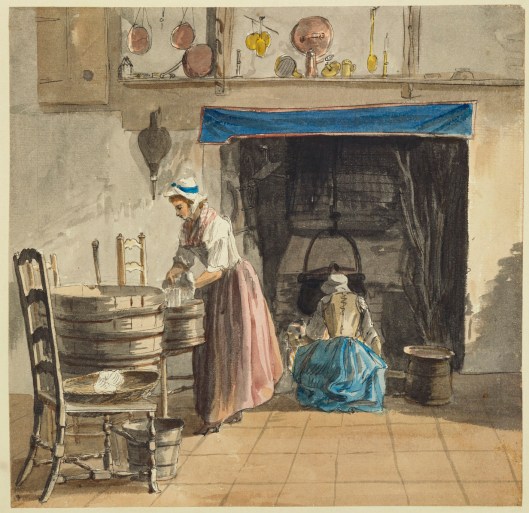
Paul Sandby. At Sandpit Gate circa 1752
Pencil, pen and ink and watercolor. RCIN 914329

No matter what one ultimately decides the research shows about the number of servants and their roles in an American occupied fort, I know I spent the day more immersed than I have been in a long time. Fort Ticonderoga provided a picturesque backdrop, and my body provided a four-dimensional pain experience reminding me of the tribulations of women in the <cough> period </cough>. I spent the majority the day (the part I was awake, anyway) experiencing the full joys of being  female and still fertile. The more I read about archaeology of the 18th century, particularly in the privies and trash pits, the more I think nearly everyone in the past felt pretty awful most of the time. If that hunch is correct, I nailed Saturday despite appearing in undress (which I can at least document to Sandby at Sandpit Gate).

Share this:

  • Click to share on Facebook (Opens in new window) Facebook
  • Click to share on Pinterest (Opens in new window) Pinterest
  • Click to email a link to a friend (Opens in new window) Email
  • Click to share on X (Opens in new window) X
Like Loading...

Petty is as Petty Does

20 Friday Apr 2018

Posted by kittycalash in Events, History, Living History, Reenacting

≈ 2 Comments

Tags

common people, common soldier, Fort Dobbs, North Carolina, petty sutler, Provincials, women's work

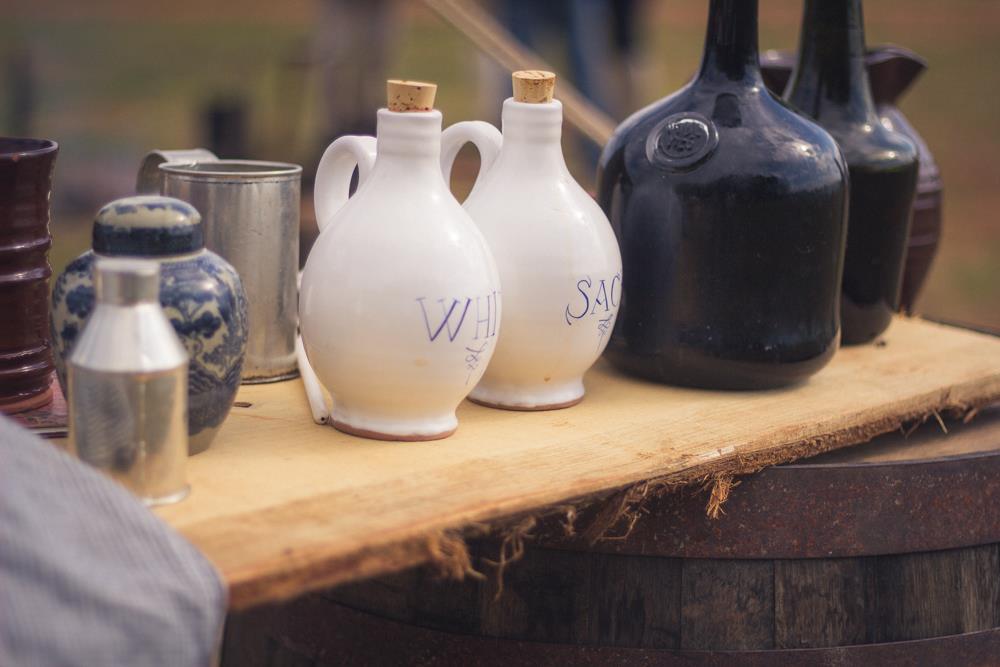
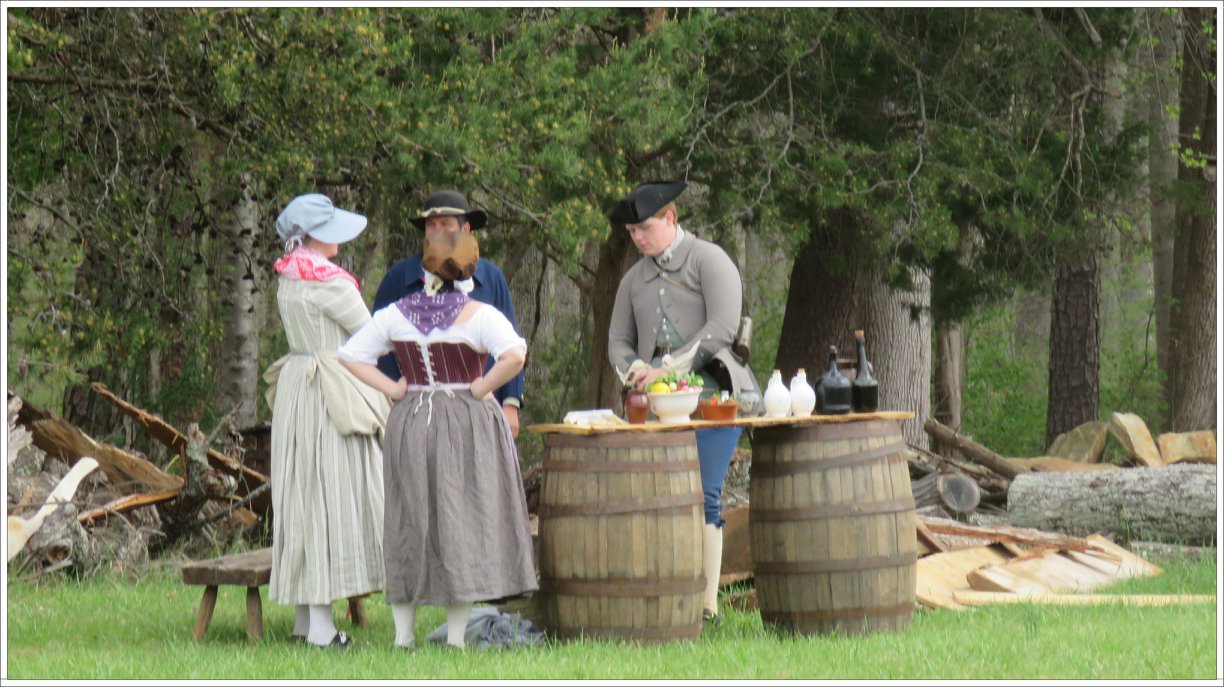
It was a simple set up: two barrels, a board, my frail, and me. (I could really use a wheelbarrow, and a rain deck. At least the rain deck is something I can make myself.) But this was more than adequate to sell luxury goods (rum, whiskey, radishes, and ginger candy) to the soldiers at Fort Dobbs.

I didn’t think it was hot– which may be thanks to that nifty new checked linen shade bonnet– but it was. Have I forgotten how to take care of myself outdoors in warm weather? Perhaps because I’ve spent so much more time lately on winter events, I’ve let the “drink all the water” mantra slide. It’s clearly time to revive the summer skills, with Monmouth not all that far away.

Share this:

  • Click to share on Facebook (Opens in new window) Facebook
  • Click to share on Pinterest (Opens in new window) Pinterest
  • Click to email a link to a friend (Opens in new window) Email
  • Click to share on X (Opens in new window) X
Like Loading...
← Older posts
Newer posts →

Archives

wordpress statistics

Creative Commons License
Kitty Calash blog by Kirsten Hammerstrom is licensed under a Creative Commons Attribution-NonCommercial-ShareAlike 4.0 International License.

Website Built with WordPress.com.

  • Subscribe Subscribed
    • Kitty Calash
    • Join 621 other subscribers
    • Already have a WordPress.com account? Log in now.
    • Kitty Calash
    • Subscribe Subscribed
    • Sign up
    • Log in
    • Report this content
    • View site in Reader
    • Manage subscriptions
    • Collapse this bar
 

Loading Comments...
 

    %d