• Home
  • Completed Costumes/Impressions
  • Emma and Her Dresses
  • Free Patterns and Instructions

Kitty Calash

~ Confessions of a Known Bonnet-Wearer

Kitty Calash

Category Archives: History

Who was Bridget Connor?

26 Wednesday Feb 2014

Posted by kittycalash in History, Living History, Research

≈ 5 Comments

Tags

10th Massachusetts, 18th century, Brigade of the American Revolution, common people, common soldier, Continental Army, genealogy, impressions, laundry, living history, orderly books, Research

Detail, James Malton, 1761-1803, A Military Encampment in Hyde Park, 1785, Watercolor with pen in black ink, with traces of graphite on moderately thick, moderately textured, beige, laid paper, Yale Center for British Art, Paul Mellon Collection. B2001.2.999

Detail, James Malton, A Military Encampment in Hyde Park, 1785. YCBA Paul Mellon Collection. B2001.2.999

Who knows? She’s hard to find, though I am told and have real hope that the microfilm of the Abbott orderly books that chronicle her misdeeds in wending its way to me down the dirty, salt-and-sand covered highways of southeastern New England.

Where have I looked for her and Francis Connor, whom I presume is her husband?

  • In every online vital record for the Commonwealth of Massachusetts.
  • In the National Archives microfilm of compiled records of Massachusetts soldiers in the 10th Regiment and the miscellaneous records.
  • In the Revolutionary War pension records index.
  • In the DAR index.
  • In the Soldiers and Sailors of Massachusetts.

Francis appears in Soldiers and Sailors of Massachusetts, for seven months’ service. That’s all I can find.

Well, crap, right? This genealogy stuff in Massachusetts is hard work—there are so many more people and towns than we have here in Li’l Rhody—but diligence and method pay off, and when you figure you’ve about exhausted the primary sources you can access for now,[1] you turn to secondary sources.

Lest you think I dislike Deborah Samson, note that I found her life a useful source in thinking about Bridget, as well as Book of Ages and Jane Franklin Mecom’s life. I’ve also been re-reading Holly Mayer’s Belonging to the Army.
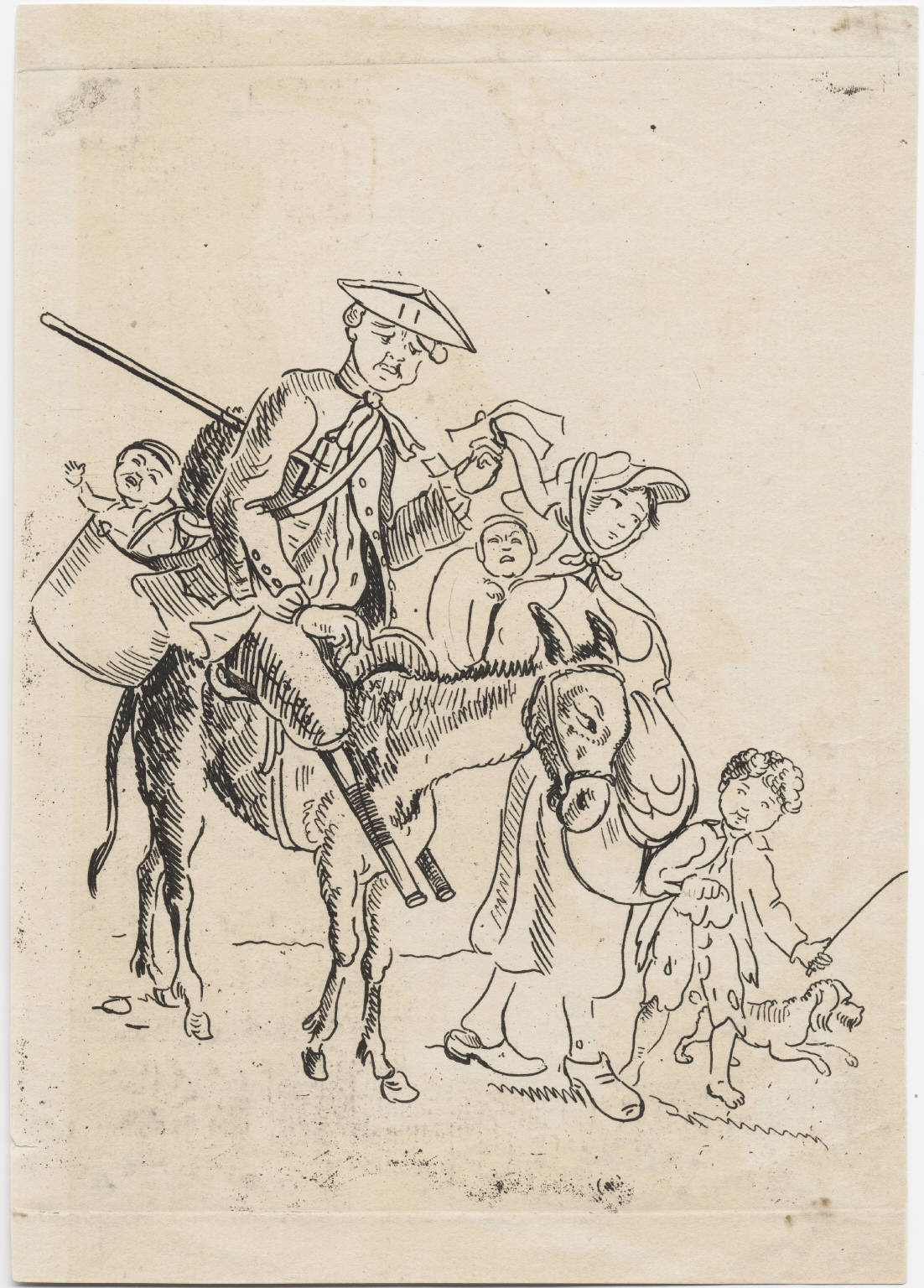
Crippled soldier with family. Etching, London (?) ca. 1760. Lewis Walpole Library, 760.00.00.16

Crippled soldier with family. Etching, London (?) ca. 1760. Lewis Walpole Library, 760.00.00.16

The common denominator: poverty, and the resulting lack of choices. This is useful for Bridget, because her story is probably one of necessity. Most women who followed the Continental Army, and worked for it, were from the lowest ranks. [2] These are women who would do what was necessary to survive, and as Mayer notes, “would rather steal than starve.” [3]

I’m not suggesting that Bridget, who would likely have received rations, needed to steal shirts to survive: I rather think she was attempting to leverage her position and profit by ill-gotten gains. But how did she end up in the Army to begin with? Massachusetts in 1782 is not New York in 1780, or Rhode Island in 1778.  What drove her to (presumably) follow Francis Connor?

Late in the war, maintaining troop strength is more difficult. The fervor of patriotism has cooled, and recruiting sergeants find it harder to fill the ranks.[4] There are bounties to be had, and the economy has suffered. Could Francis have been a property-less laborer who enlisted for the bounty? Nothing talks like cash. And, if the couple were tenants somewhere, without Francis’ income, Bridget might not have been able to maintain a home. Laundry doesn’t pay that much.

Why didn’t she stay with family? Could they have been indentured servants? Could they have been immigrants? My guess is that Bridget had no family, and if Francis had family, Bridget got on with them as well as she did with the officers of the 10th. I think she had nowhere to go, no way to survive without Francis.

Did they love each other? Did they like each other? Were they grifting together? I don’t know—but Francis Connor deserts the same day Bridget Connor is expelled from camp, so they’re bound together in some way. No matter what, Bridget was assuredly dependent on Francis.

Knowing so little about them opens up a world of possibilities, and the “opportunity” to do a great deal more research on the context of 18th century Massachusetts populations and enlistments. My best guess is that they’re an unpropertied laboring class couple from Boston, source of many of the relatively unstable and non-homogenous companies that made up the 10th Massachusetts. I also think they don’t have family, and might be former indentured servants. I have guesses about their religion and country of origin, which could be why the records are so hard to find. [5]

Looking for Bridget, and not finding her, leaves me with more and more questions, and I’m happy about that.


[1] She’s in the Abbott Orderly books, at least. Other Orderly Books to follow, as time and funds permit.

[2] Mayer, Belonging to the Army, page 122.

[3] Mayer, page 127

[4] How do you think Deborah Samson got in, passing as a boy? That’s 1782 for you.

[5] The Catholic Diocese of Rhode Island maintains separate historical vital records, and when we cannot find someone in the usual town records, we ask the genealogist if their family is perhaps Catholic or Quaker. Lack of evidence can be a suggestion of faith in my home state. But could these two be Irish Catholic in Massachusetts in 1782? I have no idea, but it seems a great stretch and a great question all at once.

Share this:

  • Share on Facebook (Opens in new window) Facebook
  • Share on Pinterest (Opens in new window) Pinterest
  • Email a link to a friend (Opens in new window) Email
  • Share on X (Opens in new window) X
Like Loading...

Anachronisms, ahoy!

14 Friday Feb 2014

Posted by kittycalash in Art Rant, Book Review, History

≈ Comments Off on Anachronisms, ahoy!

Tags

18th century, 4th Massachusetts, anachronisms, common people, common soldier, deborah sampson, history, Light Infantry, masquerade, Research

Deborah Sam[p]son (Gannett), oil on paper by Joseph Stone, 1797. RIHS Museum Collection, Gift of Jesse Metcalf, 1900.6.1

Deborah Sam[p]son (Gannett), oil on paper by Joseph Stone, 1797. RIHS Museum Collection, Gift of Jesse Metcalf, 1900.6.1

There’s a petition circulating in certain government circles in support of a campaign to give Deborah Sam[p]son her very own stamp. This is, in part, fueled by the upcoming 250th anniversary of the founding of Sharon, MA.

I’ve got no problem with that—commemoration is something we humans do and need. And Deborah Samson’s is an interesting story, but possibly not for the reasons cited in the letters from officials who shall remain nameless. They describe her as “a pioneer of promoting women’s rights and eliminating gender barriers” and “a trailblazer for gender equality,” phrases that would have been just about nonsense in the Revolutionary war period.

And that’s my problem with it: the anachronistic representation of a woman’s story, bent to the purposes of the present. Don’t get me wrong—I’m a feminist, I’ve enjoyed Deborah Samson’s story since I read about her as a kid in one book or another, so I sympathize with the Stamp Movement.

What makes me crazy is bad history.

Hannah Snell, as depicted in an excerpt from "The Life and Adventures of a Female Soldier," the narrative of the most famous cross-dressing British soldier of the century. It appeared in Isaiah Thomas's New England Almanack (Boston, 1774). Printers recycled the image on other imprints. American Antiquarian Society.

Hannah Snell, as depicted in an excerpt from “The Life and Adventures of a Female Soldier,” the narrative of the most famous cross-dressing British soldier of the century. It appeared in Isaiah Thomas’s New England Almanack (Boston, 1774). Printers recycled the image on other imprints. American Antiquarian Society.

In Masquerade, Alfred Young tells Sampson’s story well, busting myths that both we—and she—created. (This short bio is a good overall sketch of Deborah’s life. ) What struck me the most about Deborah Samson’s life was the lack of certainty, stability, and material comfort. We’ll never know the specific circumstances that led her to enlist, though Young does yeoman’s work to unearth everything he can about her life and circumstances, and the context in which she lived.

I’m not an unbiased reader—I did get a little shouty on the third floor when I read “trailblazer for gender equality,” and that phrase has lingered and grown tattered as my colleagues and I have chewed it over—but Young’s point about women of the lower sorts is well taken.

Here’s an excerpt from an interview with Young about the book:
“In cross-dressing, Deborah was like a good many other plebeian women we are discovering who were in flight: to escape indentured servitude, to avoid the shame of a pregnancy, to get out of the reaches of the law, and so on. But to explain why she carried it off so long, you have to fall back on her skills and resourcefulness.”

So much for that pioneer of promoting women’s rights—Samson was a pioneer in skillful deceit (no mean feat) and in using that deceit to further the main chance, that is, Deborah Samson’s chance. What’s wrong with that? I like that better, and that’s my bias and my interests.

Reading about Deborah Samson helped me think about Bridget Connor and the women like her, probably less skilled and less educated than Samson, probably even more impoverished. It’s a mysterious mix of personality and circumstances that drives us all, but considering what we can know about Deborah Samson helps us understand her not so much as a pioneer for gender equality but as a self-interested human being acting for herself despite the barriers of class, education, and gender. And that can help us understand the people we can know even less about, like Bridget Connor.

For a taste of historical prose, you can find an annotated version of Samson’s story written by Herman Mann here, at Harvard University Library’s digital page delivery system.

Share this:

  • Share on Facebook (Opens in new window) Facebook
  • Share on Pinterest (Opens in new window) Pinterest
  • Email a link to a friend (Opens in new window) Email
  • Share on X (Opens in new window) X
Like Loading...

What Snow Day?

13 Thursday Feb 2014

Posted by kittycalash in History

≈ Comments Off on What Snow Day?

Tags

art history, George Morland, ice, paintings, snow, snow day, weather, Yale Center for British Art

Benjamin West, 1738-1820, American, active in Britain (from 1763), Page Boy Asleep, undated, Brown wash with pen and brown ink on medium, slightly textured, cream laid paper, Yale Center for British Art, Paul Mellon Collection.B1975.4.786

Just because the Young Mr had a snow day and slept in didn’t mean the rest of us did.  So what did we do?

We went to work, just as they would have in the 18th century. We joke that the streets in our town are better after ice and snow, because the potholes are filled in and the ride is smoother.  You can see the principle at work here, in a watercolor by Benjamin Henry Latrobe.  Sleighs and sleds will run more smoothly on snow-packed roads, and sometimes I think a sled would be better than a Subaru in the city of Providence.

Still, I’m grateful for furry boots and buckets of salt, central heat and an electric tea kettle. Every winter, one or more of us falls on the ice, and when I went out to salt the paths this morning, I could see where Mr S had slipped on snow-covered ice.

In the Morland below, the scene revolves around the central figures, a man who has fallen on the ice despite his stick, the woman, black bonnet thrown back, who has witnessed his fall. We haven’t reached this point yet, and snow has become sleet that will freeze later, with more snow to come, so our vista is not nearly as attractive. But it’s clear that we, as humans, have never enjoyed snow and ice very much, and I think the donkeys are unimpressed as well.

George Morland, 1763-1804, British, Winter Landscape with Figures, ca. 1785, Oil on canvas, Yale Center for British Art, Paul Mellon Collection, B1993.30.23

Share this:

  • Share on Facebook (Opens in new window) Facebook
  • Share on Pinterest (Opens in new window) Pinterest
  • Email a link to a friend (Opens in new window) Email
  • Share on X (Opens in new window) X
Like Loading...

The Monuments Meh

09 Sunday Feb 2014

Posted by kittycalash in Art Rant, History, Movie Review, Museums

≈ Comments Off on The Monuments Meh

Tags

George Clooney, history, Kelly's Heroes, movie reviews, The Monuments Men, The Train, World War II

GI guards works of art stolen by the Nazis

GI guards works of art stolen by the Nazis

Mr S and I went to the movies on Saturday afternoon to see the long-awaited Monuments Men movie. It had been the hotly anticipated film in my set– guns, art, George Clooney: what’s not to like? We knew the history would be bad, we expected inaccurate museum practices, but still. The ingredients were sound, how bad could it be?

Well…not so bad that I’m sorry I went to see it, but sadly lacking in oomph. When a movie has a website that includes lesson plans, maybe you should not be surprised by its leaden, film-strip qualities.

I’d read the Times review, I knew what I was getting into when we bought our tickets, and we bough them anyway. Art, guns, Clooney, remember?

Here’s what I thought, in somewhat random order:

That movie’s not done. The soundtrack is horrible and needs to go. Also, the voice-over. George Clooney can read me the dictionary at bedtime any time, but the kill the heroics. Please.

But that’s just a symptom of the film and director’s insecurity. This movie isn’t brave enough to be convinced of its own mission, not unlike museums today. It keeps trying so hard to sell me on the idea that art is humanity, our collective soul, that must be saved and is, in fact, worth a life. Dude, I bought that program before I was 12. To toss a cliche back, Just believe. Everything else will follow. If the film, the director, and the star keep trying to sell me on the principle idea, there’s something wrong.

A Rembrandt self-portrait recovered at a German salt mine that had been used as a storehouse, with Harry L. Ettlinger, right. Monuments Men Foundation

A Rembrandt self-portrait recovered at a German salt mine that had been used as a storehouse, with Harry L. Ettlinger, right. Monuments Men Foundation

There’s no clear enemy, and that leads to the film’s core flabbiness: no tension. Clooney looks slender as I expect my 1940s-era heroes, but the center doesn’t hold. Narrative, dramatic films need tension. (You know, plot.) “Get the art before something bad happens” doesn’t quite do it. Before Hitler burns it? Before the Soviets scoop it up and haul it back to the USSR? Ultimately, Clooney doesn’t need Nazis or Soviets as enemies: his real enemy here is time.

Surely Mr. Clooney schooled himself in the one of the loopiest but most entertaining WWII caper films, Kelly’s Heroes. Acting out of pure self-interest, a group of American soldiers on 3 days R&R race 30 miles behind enemy lines to steal $16 million in gold. It’s not great art, but this is a good movie. Anachronistic? You bet. Oddball is an unlikely character, a Joseph Heller minor figure crossed with a healthy dose of filthy hippie. Crapgame’s a stereotype and so is Big Joe. But there’s tension in this movie, helped along by a pleasant lack of music, which allows us to experience the crunches, thrums, clicks and booms of war. A few scenes in The Monuments Men refer to Kelly’s Heroes (Goodman and Dujardin’s scene on a road is reminiscent of a road ambush in the Eastwood film), but the places where you might expect to find parallels, I found the Eastwood film better. (Yes, we went home and watched it.)

And then there’s Sam Epstein from Newark via Germany. This Monuments Men character left Germany in 1938, with his parents, but his grandfather stayed behind. By 1944/1945, his grandfather had not been heard from in 4 years, but the family knew he’d been sent to Dachau. Though the family lived in a town with a museum with a Rembrandt self-portrait, Sam has never seen it; they weren’t allowed into the museum, because, as the grandfather said, they were ‘too short.’ Why can’t the film confront the confiscation of Jewish property more directly? Why can’t it do a better job with the Holocaust than Clooney’s scene with the German officer? There’s brief scene with a barrel of gold that is absolutely chilling: and I think the film would have been better served with more upfront recognition of that barrel’s contents, what ‘too short’ really means, and the pervasive anti-Semitism of most of the world in the 1940s. (Gentleman’s Agreement, anyone?)

I don’t know enough about the actual history to quarrel over that, and while I will hunt up the books and read them, I was more taken with what seemed like obvious cinematic, movie-making failings– the “I’m heroic!” soundtrack, the lack of central tension, and the curious blindness to, or oddly tangential portrayal of Nazi racial hatred that fueled confiscation programs.

(For another movie about French resistance to Nazi art theft, there is always The Train: Burt Lancaster, art, and guns.)

I wish Clooney had been more willing to frighten us, to make a Saving Private Ryan about saving (or failing to save all of) the art. Feeling the losses and the failures more might have let us see the greatness, the monumentality, if you will, of what the team did accomplish.

Pluses: Good costuming with uniforms that age over time. Plenty of hardware.
Minuses: Soundtrack, unconvincing replicas of masterpieces. Also, nobody had 2014 Hollywood teeth in the 1940s.
Damn terrifying: The vision of Clooney to come in the final scene.

Share this:

  • Share on Facebook (Opens in new window) Facebook
  • Share on Pinterest (Opens in new window) Pinterest
  • Email a link to a friend (Opens in new window) Email
  • Share on X (Opens in new window) X
Like Loading...

Taking Tea

04 Tuesday Feb 2014

Posted by kittycalash in Events, History, Living History, Museums, Research

≈ 5 Comments

Tags

Henry Sargent, historic interiors, interpretation, John Brown House Museum, Museum of Fine Art Boston, Museums, paintings, Research, social life and customs, tea party, The Tea Party

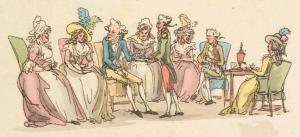
Detail, Picturesque studies and scenes of everyday life watercolor by Thomas Rowlandson, 1790. Royal Collection Trust. RCIN 810396

Detail, Picturesque studies and scenes of everyday life. Handcolored etching by Thomas Rowlandson, 1790. Royal Collection Trust. RCIN 810396

Hat tip to Jane Austen’s World for the image at left, which helped me start visualizing another program I’m involved with, this time ‘at home’ in Providence.

When we started reinterpreting the house museum, we began going back through primary sources to figure out how rooms might have been used, and furniture arranged (we don’t have inventories, so we read the house and diaries and letters– but that’s for another post).

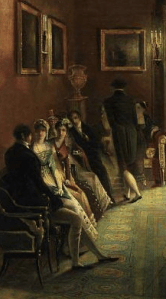
Detail, The Tea Party. Oil on canvas by Henry Sargent, 1824. MFA Boston, 19.12

Detail, The Tea Party. Oil on canvas by Henry Sargent, 1824. MFA Boston, 19.12

One of the things I remember most vividly was the description of the uncomfortable tea parties Providence women gave, where the guests sat in chairs against the walls of the rooms, balancing a tea cup in one hand and plate in another. Several hard drives later, I’m not sure where that primary source is (the hunt begins tomorrow) but it conjured images of every hostess in Providence a Hyacinth Bucket, and every guest a quivering Elizabeth Next Door.

Detail, The Tea Party. Oil on Canvas by Henry Sargent, 1824. MFA Boston, 19.12

Detail, The Tea Party. Oil on Canvas by Henry Sargent, 1824. MFA Boston, 19.12

Surely that couldn’t be true? I thought I must be making it up, but then the Rowlandson turns up on the interwebs and there they are, in a row. More famously and closer to home, Henry Sargent’s painting of a Boston tea party in 1824. (The catalog description is rather nice.)

Here’s an 1824 tea party in Boston. While this is later than the tea party we’ve planned at work, it is still full of useful hints about how early, formal tea parties were conducted. We think– or I do, anyway– of ladies in frilly hats seated a tables with cakes heaped on stands and floral tea pots. I hear “tea party” and I think “doilies,” but this is not your grandmother’s tea party. It’s a different kind of social occasion, both more formal and more relaxed.

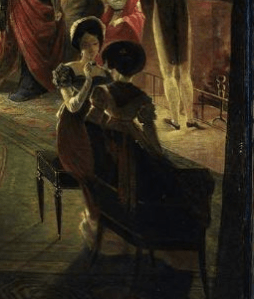
Detail, The Tea Party, oil on canvas by Henry Sargent, 1824. MFA Boston, 19.12

Detail, The Tea Party, oil on canvas by Henry Sargent, 1824. MFA Boston, 19.12

There’s not a central table to sit around, but instead chairs lined up against the wall, groups of guests, chatting. Others guests stand close to the fireplace, and a pair of ladies have taken a settee and a stool for their close conversation. We can just make out the tiny tea cup in the lady’s gloved hand.

In many ways, this depiction reminds me more of contemporary cocktail parties or open houses with the guests in small, changing groups, and no place to put your cup. Of course, most of us don’t have waiters (that’s who you see in the detail above with his back to us) or fabulous houses on the Tontine Crescent in Boston.

In so many ways, the social customs, habits and mores of the past are lost to us, and as we try to recreate them, the we excavate them from a combination of unlikely sources. Accounts, paintings, diaries, and etiquette manuals serve as sources, but it’s easier to recreate the economics of tea than the structure of a tea party. And once we do have an approximation, will it be a party anyone wants to go to?

Share this:

  • Share on Facebook (Opens in new window) Facebook
  • Share on Pinterest (Opens in new window) Pinterest
  • Email a link to a friend (Opens in new window) Email
  • Share on X (Opens in new window) X
Like Loading...
← Older posts
Newer posts →

Archives

wordpress statistics

Creative Commons License
Kitty Calash blog by Kirsten Hammerstrom is licensed under a Creative Commons Attribution-NonCommercial-ShareAlike 4.0 International License.

Website Built with WordPress.com.

  • Subscribe Subscribed
    • Kitty Calash
    • Join 621 other subscribers
    • Already have a WordPress.com account? Log in now.
    • Kitty Calash
    • Subscribe Subscribed
    • Sign up
    • Log in
    • Report this content
    • View site in Reader
    • Manage subscriptions
    • Collapse this bar
 

Loading Comments...
 

    %d