• Home
  • Completed Costumes/Impressions
  • Emma and Her Dresses
  • Free Patterns and Instructions

Kitty Calash

~ Confessions of a Known Bonnet-Wearer

Kitty Calash

Category Archives: History

More Banyan Business

12 Friday Jul 2013

Posted by kittycalash in Clothing, History, Museums

≈ Comments Off on More Banyan Business

Tags

18th century clothes, banyan, Clothing, fashion, menswear, Museums, RISD Museum of Art

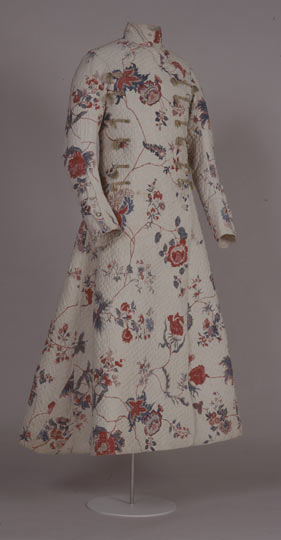
Prince of Wales' banyan, ca. 1780. Royal Pavilion & Museums, Brighton. ID CT002728

Prince of Wales’ banyan, ca. 1780. Royal Pavilion & Museums, Brighton. ID CT002728

Soooo, what about that banyan?

Cotton chintz printed in red, brown and purple with blue pencil. Batting seems to be cotton by the way it has bunched in the diamonds, but I expected wool. If it is wool, it is super fine lambs’ wool. Since it was for the Prince of Wales, I think that’s possible.

The mariner’s cuffs are pieced onto the end of the sleeves, reducing bulk (no double layer). The buttons at the cuffs are round, domed, self-covered buttons.

The double breasted closure is made with multi-colored silk braid frogs and silk dome-shaped buttons.

The collar is quilted, too.

The center back seam does not bother to match the pattern; it’s just sewn up the center.

Triangular piecing at the side seams helps give this flair in the skirts. You can see this in the photo at left.

The sleeves are set in, two-piece sleeves typical of menswear.

That’s everything I can remember from my visit on Saturday with Sew 18th Century. I really do have to go back with a notebook and a stool!

Share this:

  • Share on Facebook (Opens in new window) Facebook
  • Share on Pinterest (Opens in new window) Pinterest
  • Email a link to a friend (Opens in new window) Email
  • Share on X (Opens in new window) X
Like Loading...

One Hot Banyan

11 Thursday Jul 2013

Posted by kittycalash in Clothing, History, Museums

≈ 1 Comment

Tags

18th century clothes, Costume, exhibits, fashion, Museums, Research, resources

Prince of Wales' banyan, ca. 1780. Royal Pavilion & Museums, Brighton. ID CT002728

Prince of Wales’ banyan, ca. 1780. Royal Pavilion & Museums, Brighton. ID CT002728

Alert! This item is currently on display at the RISD Museum of Art in Providence, through August 18, 2013. I have been to see it twice now.

As much as I am itching to get this on a table and investigate it, I am limited to craning my neck and squatting in front of the case. Awesomeness in cotton, this banyan has a five-button mariner’s cuff with a double arc like a broken pediment on a chest-on-chest. It would be a crazy thing for a Continental private to come strolling out of a tent in, not to mention impossible to make before the next camping excursion, but holy cats! that’s one fine banyan.

The RISD Museum is free on Sundays. You, too, can entertain the guards by craning your neck–photography is not allowed. Next visit: sketchbook.

There are a lot of other wonderful things to see, too–silk jersey breeches I expect to see on a colleague at some point, an indigo silk frock coat, the greatest great coat ever, and Fred Astaire’s tails, as well as a small section that I think does everything PUNK wanted but failed to do.

Share this:

  • Share on Facebook (Opens in new window) Facebook
  • Share on Pinterest (Opens in new window) Pinterest
  • Email a link to a friend (Opens in new window) Email
  • Share on X (Opens in new window) X
Like Loading...

D-Day: Robert Capa

06 Thursday Jun 2013

Posted by kittycalash in History, Museums

≈ 2 Comments

Tags

art history, D Day, history, Magnum Photos, photo editing, photography, photojournalism, Robert Capa, World War II

Robert Capa, American, b. Budapest 1913 - d. Indochina 1954

Robert Capa, American, b. Budapest 1913 – d. Indochina 1954 © International Center of Photography

Once upon a time in the Midwest, I worked in a Department of Photographs and Prints. (That’s where I met Mr S, when he was hired as the first museum Photographer, though he was initially known as the Badger in the Basement for the tenacity with which he defended his studio.)

I am fortunate to have a visual memory, and that’s part of how I got my job, and part of how I got to be an Assistant, and then a full, Photo Editor of the museum’s magazine. I love images, and I love photography, and I suppose I must love photographers, too, since there’s one around here somewhere in this place that I call home.

FRANCE. Normandy. June 6th, 1944. Landing of the American troops on Omaha Beach. Robert Capa, International Center of Photography

FRANCE. Normandy. June 6th, 1944. Landing of the American troops on Omaha Beach. © Robert Capa © International Center of Photography

One of the best assignments was photo editing an article based on the World War II diary and service of a local doctor who served in the Army infantry. He wasn’t the most enlightened or unbiased man, but in the 1940s, I suppose that was sadly normal. I read the piece for placement and image ideas, not for tone or subtlety. North Africa, Monty, Casserine, Messina, Easy Red and Omaha: that’s what I underlined.

My go-to for WWII photography was Robert Capa first and last. There’s Blood and Champagne, but the book I read first was Slightly Out of Focus. It was written by Capa, just as he wrote Images of War. (I discovered these killing time on summer weekends in the air-conditioned fine art reading room of the downtown public library.) Capa did not love war, even as he thrived in the combat photography environment, and said, “If your photographs aren’t good enough, you’re not close enough.” But he also noted, like Cartier-Bresson, that you had to like people to take good photographs of them.

His images are dark: not just the imagery, but the prints themselves. A well-printed Capa has deep, rich, dark tones (D-Day images excepted, thanks to a horrendous processing error), and even decades later, a vintage Capa print has magic.

I called Magnum, back in the days when one called, described what I had seen, cited the books I’d read, listed what I wanted prints of to use in the magazine. I think I knew enough to get a little more: vintage prints of images I hadn’t seen. They arrived, sandwiched in cardboard, in a FedEx envelope.

TALY. Near Troina. August 4-5, 1943. Sicilian peasant telling an American officer which way the Germans had gone. Robert Capa, International Center of Photography

TALY. Near Troina. August 4-5, 1943. Sicilian peasant telling an American officer which way the Germans had gone. R © Robert Capa © International Center of Photography

There were photos like this one, and one of a soldier shaving, using his helmet as a basin. There were images I’d seen, and some I had not. They were dark, and sympathetic, and captured the war and humanity as no other images I’ve seen have ever done.

His portfolio was huge, and includes not just war photography, but fashion and film and humorous photos, too. Holding one of his prints–or at least a print made close to the time when he had shot the negative, and might have been alive–was as close as I was ever going to get to meeting Robert Capa. For all he lived through–escaping Fascism, documenting the Spanish Civil War, the Rape of Nanking, the Blitz, all of World War II– Robert Capa died after stepping on a land mine on the road to Thai Binh in what was then French Indochina.

INDOCHINA. May 25, 1954. Vietnamese troops advancing between Namdinh and Thaibinh. This is one of the last pictures taken by Robert Capa with his Nikon camera before he stepped on a landmine and died at 14.55. © Robert Capa © International Center of Photography

INDOCHINA. May 25, 1954. Vietnamese troops advancing between Namdinh and Thaibinh. This is one of the last pictures taken by Robert Capa with his Nikon camera before he stepped on a landmine and died at 14.55. © Robert Capa © International Center of Photography

It seems so sad, and yet one has to remember that he died working, doing not just what he loved–taking photographs–but what he had to do. He didn’t love war, but he loved people. The beauty of the images he made almost undoes their purpose, in recording war’s horrors, but the real affection for people that comes through in those contrasty prints redeems the violence, I think, giving us sympathy for the people uprooted, displaced, used and abused by war, whether soldier or civilian. Through that love,Capa found courage and we can find truth. Keep looking: there is more to see.

Share this:

  • Share on Facebook (Opens in new window) Facebook
  • Share on Pinterest (Opens in new window) Pinterest
  • Email a link to a friend (Opens in new window) Email
  • Share on X (Opens in new window) X
Like Loading...

Lunatic Fringe

28 Tuesday May 2013

Posted by kittycalash in Clothing, History, Living History, Reenacting

≈ 2 Comments

Tags

10th Massachusetts, 18th century clothes, Brigade of the American Revolution, common soldier, hunting frock, hunting shirt, overalls, Revolutionary War, uniforms

Hunting frock and overalls complete!

Hunting frock and overalls complete!

Oh, my goodness, it’s done! It’s done, and the photos have passed the master. Phew! Just one more to go, oh, my goodness, no.

The Young Mr was allowed to carry a musket in the Warren Memorial Day Parade. I do not love a parade, so I didn’t go. But he had no overalls of suitable fit and they were so nearly done, that I resolved to finish them, and finish them I did, in time for bed on Saturday, no less. It’s all thanks to BBC’s brutal but entrancing programming. My sewing better to blood curdling screams (also courtesy ITV), which seems awful but there it is…though the darkness of Mad Men has proven good for back stitching, decent button holes require murder.

Buttonholes. I hate those guys less now.

Buttonholes. I hate those guys less now.

Fifteen button holes, multiple fittings, and some curse words have resulted in a pair of decent-fitting overalls that did not split at the knee or stretch too extremely when worn. And atop it all, in the yard if not in the parade, the new model hunting front adopted by the 10th Massachusetts. The Young Mr is uniform-forward as Neal Hurst’s research has led the adjutant to conclude that the men were wearing frocks, and not shirts. (In the Rhode Island records, I found that rifle frocks were listed until 1780/1781, when the Records of the State of Rhode Island began to indicate rifle or hunting “frocks or shirts.” That’s a wrinkle for Mr Hurst, but I saw only frock in 1777-1780.)

Lunatic fringe. Cut, fold, clip, strip, stitch.

Lunatic fringe. Cut, fold, clip, strip, stitch.

The fringing is a task completed by Mr S, who has fringed the strips for his own Rhode Island hunting frock, and now knows what fun awaits him as another frock will made for him. My goal? Another complete 10th Massachusetts kit by June 15. I’ve sewn buttonholes in a moving car before, and I expect to be felling seams or sewing buttonholes as we travel down to New Jersey. They’ll be fine; after all, the traffic is murder.

Share this:

  • Share on Facebook (Opens in new window) Facebook
  • Share on Pinterest (Opens in new window) Pinterest
  • Email a link to a friend (Opens in new window) Email
  • Share on X (Opens in new window) X
Like Loading...

Museum Madness and Things to Make

23 Thursday May 2013

Posted by kittycalash in 1763 Project, History, Making Things, Museums

≈ 4 Comments

Tags

Museum of Fine Art Boston, Museums, muslin, over dress, Regency, tunic

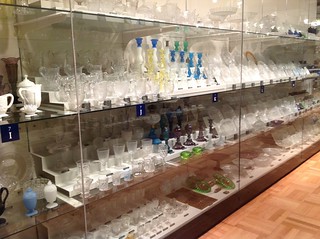
After a day at the Met on Friday, I went to work at my own museum on Monday. We moved paintings, rounded up miniatures for photography, and packed an ax for transport.

Glass at the Met. I hate this stuff.

On Tuesday, I took the MBTA up to Boston to deliver the ax (tomahawk, throwing ax, ax comma belt in Chenhall) to another museum, at the Old State House. I think this show will be very nice, and I had the pleasure of meeting someone whose wife I know through the interwebs: behold the power of the interwebs, and the small size of the reenacting community. Also, my state.)

Then, because I cannot get enough of this stuff, I took the Green line over to the MFA. By now you’re thinking, Kitty, really? How many museums do you need to visit in five days? Should we get you help? But the thing is, objects get me really stoked. Paintings, sculpture, heck, even glass– and I hate glass– make me pretty happy.

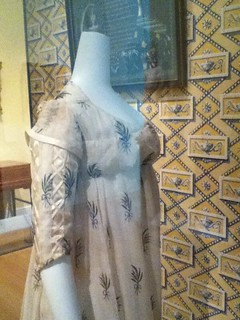
1998.96, overdress or tunic. MFA Boston

I’d just been to the MFA in July, so this trip was to visit some friends among the Copleys and Greenwoods and Blackburns. But I also know that the textiles have to rotate often, and there are dedicated mannequins in the Art of the Americas Wing.  My reward for a return trip? This lovely over dress or tunic.

I love the fabric, and thought immediately of Quinn’s Tree Gown. Hmm. As you can imagine, I will be hot on the trail of something like this fabric as soon as I am done with the menswear on my list. (There is a lot of menswear, but that doesn’t mean I can’t do some real thinking and research in preparation for this tunic…which is all I can do for now.)

It does cross over in the front, and the floral motifs line up across the layers.

There are more photos of the overdress in the MFA set on flickr, and I have a lot more thinking to do about this tunic. It does have a cross-over front, which I like, but the lacing is really striking. This may take another trip to the MFA with a better camera.

Oversleeves, cross front, lacing, diamond-shape piece in the back like a keystone…there’s a lot of detail, and lot to love (and eventually curse while making) in this tunic.

Share this:

  • Share on Facebook (Opens in new window) Facebook
  • Share on Pinterest (Opens in new window) Pinterest
  • Email a link to a friend (Opens in new window) Email
  • Share on X (Opens in new window) X
Like Loading...
← Older posts
Newer posts →

Archives

wordpress statistics

Creative Commons License
Kitty Calash blog by Kirsten Hammerstrom is licensed under a Creative Commons Attribution-NonCommercial-ShareAlike 4.0 International License.

Website Built with WordPress.com.

  • Subscribe Subscribed
    • Kitty Calash
    • Join 621 other subscribers
    • Already have a WordPress.com account? Log in now.
    • Kitty Calash
    • Subscribe Subscribed
    • Sign up
    • Log in
    • Report this content
    • View site in Reader
    • Manage subscriptions
    • Collapse this bar
 

Loading Comments...
 

    %d