• Home
  • Completed Costumes/Impressions
  • Emma and Her Dresses
  • Free Patterns and Instructions

Kitty Calash

~ Confessions of a Known Bonnet-Wearer

Kitty Calash

Category Archives: Making Things

Criss Cross, or, My Checker’d Past

09 Monday May 2016

Posted by kittycalash in Clothing, Events, Living History, Making Things

≈ 1 Comment

Tags

19th century clothing, Clothing, Costume, dress, fashion, Federal style, Making Things, sewing

Every now and then I look up from what I’m doing (tiny stitches, usually, though sometimes budget math) and realize that Objects in Mirror are Closer Than They Appear. Oops. It was just yesterday I was daydreaming about miniatures, and now I shall want a paintbox and brushes in a mere six weeks– and those six weeks are punctuated by a courier trip, a couple of exhibits, not to mention shepherding The Young Giant through prom and finals.
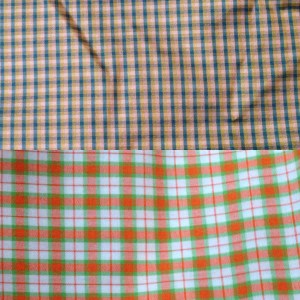
Top: check silk taffeta, Artee Fabrics Bottom: check cotton, Mood Fabrics

Top: check silk taffeta, Artee Fabrics
Bottom: check cotton, Mood Fabrics

This weekend, thanks to the SFR hunt for collar interfacing of an appropriate weight, I realized I’d better get a wiggle on my own sewing, and managed to hunt up the orange check from hell, pop it in the washer, and hunt up the pattern I intend to use.

Mrs Catherine Morey oil on canvas by Michael Keeling, 1817. (c) Walker Art Gallery; Supplied by The Public Catalogue Foundation

Mrs Catherine Morey oil on canvas by Michael Keeling, 1817. (c) Walker Art Gallery

I’m stuck on that 1817-1819 range because of someone’s eventual and particular Mode of Transportation, so I was super pleased to find this portrait while trolling the BBC’s Your Paintings site. Actually, I’m pretty over the moon about this image, since it places that cross-over front firmly in 1817. I’ve made a version of this form already, so I can but hope the next iteration will be even closer to correct for the period, once I tweak the pattern a bit.

The pattern: therein lie so many rubs, often going the wrong way. Still, I remain enamored of the check and of the cross-front gown. Any checkered doubts were dispelled when Alison for reminded me of the sort-of-cross front check gown at the Met, whose catalogers are hiding behind circa 1820 which allows leeway back to 1815. Behold, of course, the ruffled neck of the bodice (I do expect mine will fit a bit better since I am squishier than a mannequin, and possess appropriate infrastructure).

Morning dress ca. 1820. British, cotton.
Metropolitan Museum of Art, Purchase. 1979.385.1
Marcia Sand Bequest, in memory of her daughter, Tiger (Joan) Morse.

Speaking of infrastructure, the appropriate stays are finished, entirely hand-sewn, and ready for deployment in pattern fittings before they debut at Genesee.
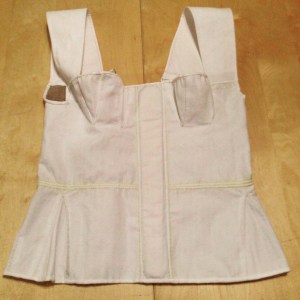
File_000 (1)

Six weeks to Genesee: at least one 1817 dress, another sheet, a portfolio and paint box, followed immediately by 18th century stays, a front-closing gown, and a bucket repair. Surely that’s all manageable, right?
Share this:

  • Share on Facebook (Opens in new window) Facebook
  • Share on Pinterest (Opens in new window) Pinterest
  • Email a link to a friend (Opens in new window) Email
  • Share on X (Opens in new window) X
Like Loading...

Stay Thy Hand

02 Monday May 2016

Posted by kittycalash in Clothing, Fail, Making Things

≈ 7 Comments

Tags

18th century, 18th century clothes, 19th century, 19th century clothing, Costume, dress, fail, sewing, stays

IMG_6784

Stays. They’re infrastructure: absolutely necessary, a major time commitment, and decidedly unsexy. I am in dire need to two new pairs, one for late 18th century use and one for early 19th century, and each with deadlines looming.

I can manage 19th century attire and Genesee with the chopped-and-dropped corded stays I already have, but New Jersey will not happen at all unless new stays are made. It was like a weekend of penance chez Calash, two straight days of stay mocking up and making.

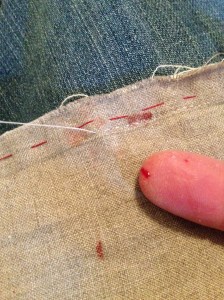
Of course I bled on them. That’s how I know they’re mine.

IMG_6786

And let’s get this out of the way: I thought backstitching the back seam was a little more difficult on this side, but ascribed it to sore fingers. Wrong! I failed to notice that I was stitching through all the layers, and not leaving one free to fold over and finish.

IMG_0806

A glass of cider and an hour later, I’d rectified the error. These are now fully bound along the bottom edge, and ready for the top edge binding. Somewhere there’s coutil for the straps, and then numerous hand-sewn eyelets later, I will have a finished pair of hand-sewn stays.

New stays deserve a new gown, and since I found this lovely image, I know what that new gown should look like (as well as a portfolio).  Happily, there’s a dress in Cassidy’s book that will serve as a reasonable basis for recreating this image. I’m still pondering the portfolio, and what it might be made of: paper or leather covered pasteboard? As the clock ticks down to June, I suspect I will be using a portfolio I already have on hand.

And then there are the the 18th century stays, with their history of woe.

File_000

I’ve gotten this far with the new 18th century pair, and an interesting business it is. I altered the front side pieces and the stomacher, but cannot see the back well enough (even with a camera and a mirror) to adjust it by myself, so further changes will have to wait until I have some assistance.

The tabs aren’t right in the back, and while the advice is to shorten the stays when the tabs flare this way, I found the fronts were still too low, once again riding at nipple-cutting height. Finally it occurred to me that the problem– slippage–might actually be one of waist. I lengthened the fronts half an inch and nipped the waist in, and found the fit more pleasing.  I suspect the back pieces need to be trimmed a bit before they’ll fit (they’re stitched closed in this version, so you know they’re too big).

Another weekend of work awaits– with focus, those early 19th century stays may be done by then, if there are no more finger injuries.

Share this:

  • Share on Facebook (Opens in new window) Facebook
  • Share on Pinterest (Opens in new window) Pinterest
  • Email a link to a friend (Opens in new window) Email
  • Share on X (Opens in new window) X
Like Loading...

Frivolous Friday: Something Fishy

08 Friday Apr 2016

Posted by kittycalash in Frivolous Friday, History, Making Things

≈ 2 Comments

Tags

18th century, 19th century, entertainment, fishing, fishing tackle, Frivolous Friday, hobbies

Fishing Tackle kit, Winterthur Museum, 1961.0492 A-Y

Fishing Tackle kit, 1820-1860 Winterthur Museum, 1961.0492 A-Y

The best things turn up when I’m looking for something else (in this case, the shell-printed pocket). These serendipitous finds always lead someplace interesting, in this case, to historical fishing (and my personal interest in historical hunting prints).

It’s a pleasantly refined sporting activity, suitable for ladies and gentlemen, with the pleasant result of dinner– presuming you manage both to catch a fish and not fall in. Standing up in boat seems unwise, and that hat surely casts an incredible and unmissable shadow on the water, but Morland’s party has caught a fish nonetheless.

Always something new to learn, and heaven knows I need yet another line of inquiry to pursue with all the others…though this might at least be a useful pursuit, if only in the meditative quality of an afternoon spent outdoors catching nothing.

George Morland, 1763–1804, British, A Party Angling, 1789, Oil on canvas, Yale Center for British Art, Paul Mellon Collection B2001.2.22

George Morland, 1763–1804, British, A Party Angling, 1789, Oil on canvas, Yale Center for British Art, Paul Mellon Collection B2001.2.22

Share this:

  • Share on Facebook (Opens in new window) Facebook
  • Share on Pinterest (Opens in new window) Pinterest
  • Email a link to a friend (Opens in new window) Email
  • Share on X (Opens in new window) X
Like Loading...

Flopsy Mopsy

16 Wednesday Mar 2016

Posted by kittycalash in Events, History, Living History, Making Things, Reenacting, Research

≈ 8 Comments

Tags

18th century, cleaning, common people, Fort Ticonderoga, interpretation, living history, mops, women's history, women's work

Mop sellers, red chalk on paper, Paul Sandy, 1759. Museum of London 65.59/5#sthash.EaUTT9dg.dpuf

Mop sellers, red chalk on paper, Paul Sandy, 1759. Museum of London 65.59/5

They’re pretty consistent: mops appear to be made of fibers attached to a handle. These look like they’re simple string mops. A stick and string? A stick and rags strips? Something along those lines. But what kind of string? What kind of fiber? How was it attached?

I’ll confess that I have been too lazy to search collection for extant mops– no, seriously, if someone offered me an 18th century mop my first reaction after “Absolutely!” would be, “Wait a second…how can there be anything left of an 18th century mop? My own mops don’t last all that long….” so I assumed no such critter exists in captivity (feel free to prove me wrong, I could use an assist here). Instead, I went ahead with the daft notion of replicating what I saw in images.

Sandby helpfully supplies us with mop sellers who carry fuzziness on a stick. Most likely wool, since sheep were plentiful and cotton expensive in this period. But maybe not. In any case, a simple business.

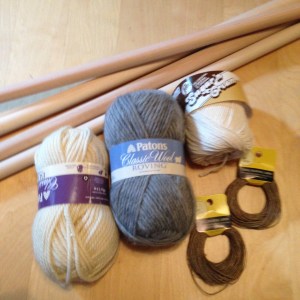
Supplies assembled

Supplies assembled

After work on Saturday, I went mop-top-shopping. It was not one stop. An internal rant developed about how companies can call anything “wool” that is less than 100% wool, but I managed to contain myself and with enough hunting turned up hero cord, 100% wool yarn and 100% cotton yarn as well as dowels. Sadly, I could not find wool roving in any color but grey. So, making a mop from craft and hardware store supplies is a pretty easy thing, especially when you don’t have many tools to complicate the business.

IMG_6275

This is not my first rodeo where string is concerned, so I wrapped the yarn around a cutting board just the way you’d make a pom pom. How else will you get it all the same length (more or less)? The result: a somewhat sad hank in search of purpose, tied off in the more-or-less middle of the strands.

Temporarily secured
Temporarily secured
Tied off with hemp cord

Secured temporarily with a rubber band, I tied the hank to the dowel with hemp cord. Then I turned the wool (and later cotton) back over itself, and tied it off again. I pulled as tight as I could manage, much to the chagrin of my now-blistered pinky finger. Small price to pay, though, for two new entrants in the experimental archaeology of cleaning. As I looked at the images in Sandby’s drawing and in the prints, I was pretty confident the mops are not tied off again in this second way, but one band didn’t seem secure enough. So, yet another compromise, but one that I hope will result in less hilarity from losing mop heads in the midst of washing floors.

Wool...
Wool…
...and cotton
…and cotton

Now, if I would but turn my attention to the lint, string, and yarn scattered about my floor at home…

Share this:

  • Share on Facebook (Opens in new window) Facebook
  • Share on Pinterest (Opens in new window) Pinterest
  • Email a link to a friend (Opens in new window) Email
  • Share on X (Opens in new window) X
Like Loading...

Mopping Up

14 Monday Mar 2016

Posted by kittycalash in Living History, Making Things, Research, Uncategorized

≈ 4 Comments

Tags

18th century, cleaning, common people, Fort Ticonderoga, interpretation, living history, mops, women's history, women's work

A City Shower. Oil on canvas by Edward Penny, 1764. Museum of London

A City Shower. Oil on canvas by Edward Penny, 1764. Museum of London

Springtime sadness is best remedied by scouring[1], so in the best Scandinavian fashion, I have been looking into 18th century cleaning. Dem barracks, right?

First of all, were you wondering about what exactly they “smoked and cleansed” smallpox victims’ rooms with? Brimstone and frankincense.[2] Now you know what Edward Langford would wake up smelling when the house next door was free of smallpox.

But what about those floors? They need to be cleaned. Swept, yes, and scrubbed with sand. But also mopped, and the doorstep mopped.

Tit for Tat. stipple etching, London, Printed for R. Sayer Map, Chart & Printseller N° 53 Fleet Street, as the Act directs Novr 24. 1786. British Museum 1861,0518.958

Tit for Tat. stipple etching, London, Printed for R. Sayer Map, Chart & Printseller N° 53 Fleet Street, as the Act directs Novr 24. 1786. British Museum 1861,0518.958

I have a broom and a whisk broom, and can substitute a kettle for my sad bucket[3] but I lack a suitable mop. Lack never deterred me, whether of skills, knowledge, or supplies, so off to the interwebs and library I went.

I started with Foul Bodies, the 2009 monograph by Kathleen M. Brown. Nothing on floors, sadly.

I remembered the 10th Massachusetts Orderly book from 1782, that was more helpful.

Some part of the Camp and about the long Barracks in particular is relaxing into nastiness. Regimental QuarterMasters have been ordered to have them Clean and keep them so. An Officer of each Company has been ordered to visit the Barracks every day and to Confine & Report those who throw bones of meat Pot Liquor or filth of any kind near the Barracks. Yet all this has been done and no report has been made. it is hatefull to General Howe to Reitterate orders as it ought to be shamefull those who make it necessary.

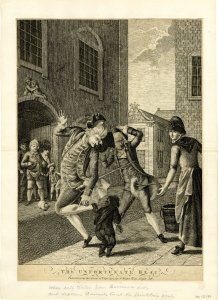
The Unfortunate Beau, etching, Publish'd as the Act directs 12th Sept 1772, by S.Hooper, No.25 Ludgate Hill. British Museum 1991,1214.20

The Unfortunate Beau, etching, Publish’d as the Act directs 12th Sept 1772, by S.Hooper, No.25 Ludgate Hill. British Museum 1991,1214.20

Nastiness. Those barracks sound noisome, don’t they? We can’t have that.

So let’s cast out the bones, sweep the floors of the branches and dirt and grit the men have brought in, and mop them, too, now that it’s spring.

Mop, you say?

What did mops look like the in 18th century?
And how on earth will we acquire one?

Tune in next time for another exciting installment of “historical cleaning instead of cleaning my own house.”


[1] Dude, I have scrubbed baseboards with a toothbrush. Not one of my finer moments, but a memorable one.

[2] Kathleen Brown, Foul Bodies: Cleanliness in Early America. (New Haven: 2009) p. 129

[3] Really really: I meant it when I said keep the bucket wet.

Share this:

  • Share on Facebook (Opens in new window) Facebook
  • Share on Pinterest (Opens in new window) Pinterest
  • Email a link to a friend (Opens in new window) Email
  • Share on X (Opens in new window) X
Like Loading...
← Older posts
Newer posts →

Archives

wordpress statistics

Creative Commons License
Kitty Calash blog by Kirsten Hammerstrom is licensed under a Creative Commons Attribution-NonCommercial-ShareAlike 4.0 International License.

Website Built with WordPress.com.

  • Subscribe Subscribed
    • Kitty Calash
    • Join 621 other subscribers
    • Already have a WordPress.com account? Log in now.
    • Kitty Calash
    • Subscribe Subscribed
    • Sign up
    • Log in
    • Report this content
    • View site in Reader
    • Manage subscriptions
    • Collapse this bar
 

Loading Comments...
 

    %d