• Home
  • Completed Costumes/Impressions
  • Emma and Her Dresses
  • Free Patterns and Instructions

Kitty Calash

~ Confessions of a Known Bonnet-Wearer

Kitty Calash

Category Archives: material culture

Reap what you Sew

12 Tuesday Sep 2017

Posted by kittycalash in Clothing, History, Living History, Making Things, material culture, Reenacting

≈ 1 Comment

Tags

bonnets, George Stubbs, living history, Making Things, museum collections, Research

Too big!

Lampshade: She’s been the Holy Grail of bonnet making.

There were several failures in the winter of 2016, and some revisiting of the Whale-Safe Bonnet as I tried to figure out the brim and the caul. My first efforts made a caul that was waaaaay too small. That’s not necessarily a bad thing, as I’ve made plenty of too-big bonnets. (Too small did not make the move from RI to VA, but trust me: too small a caul was far too small.)

Reapers 1785 George Stubbs 1724-1806 Purchased with assistance from the Friends of the Tate Gallery, the Art Fund, the Pilgrim Trust and subscribers 1977 http://www.tate.org.uk/art/work/T02257
Haymakers 1785 George Stubbs 1724-1806 Purchased with assistance from the Friends of the Tate Gallery, the Art Fund, the Pilgrim Trust and subscribers 1977 http://www.tate.org.uk/art/work/T02256

This morning, I took another look at George Stubbs’ paintings of working women. I know the lampshade-like bonnet is pre-1770, but where are we at the end of the Revolutionary War period? Well, BIG was in, obviously. (We can have a healthy debate about the likelihood of these gowned women depicting actual working women, but for now, let’s stick to bonnet brim shapes.)  They’re a little cone-like, aren’t they? With generous (yuuuge) cauls, though.

IMG_1921
IMG_1922

Now, I have gone about this all a bit backwards, which is to admit that I picked up the shellacked brim of yesteryear that did make the move down to VA, and decided to make it up as a bonnet yesterday. The brim is easy– trace and cut with a seam allowance– but the caul? I winged it, using a selvage edge for the inside of the back drawstring (I like my headwear to be adjustable and pack flat) and economized on fabric to leave plenty of taffeta left over. So there’s nothing particularly well-researched about this, except for all the years of looking and thinking and drawing and making that came before the moment I threw this all together yesterday afternoon watching North by Northwest and drinking a Manhattan.*

Part I like best?
Part I like best?
The way it hides my face!

Making this up raises more questions: how individually fitted were bonnets to wearers? Did caul and brim size vary depending on wearer? What’s the class line below which a woman doesn’t have a bonnet, but only a hat? How quickly did styles change? The sort-of-conical black bonnet is seen on “older” women in paintings well past the height of the style. But as I’ve asked before, what do we really understand about the portrayal of age in art? Are we really reading the symbols correctly? How well do we grasp the semiotics of the 18th century? All of those questions are present when we try to replicate the past using only visual sources. Yes, there is an extant 18th century black silk bonnet at Colonial Williamsburg, and we can use that in conjunction with images to make the things we wear. But pondering all of these questions makes me think it’s time for another troll through collections in Great Britain, just in case new cataloging has put old bonnets online.

*See my other blog, TipsyMilliner, for more.

Share this:

  • Click to share on Facebook (Opens in new window) Facebook
  • Click to share on Pinterest (Opens in new window) Pinterest
  • Click to email a link to a friend (Opens in new window) Email
  • Click to share on X (Opens in new window) X
Like Loading...

Objectivity

06 Wednesday Sep 2017

Posted by kittycalash in Collecting, material culture, Museums

≈ Comments Off on Objectivity

Tags

cataloging, collections management, data, material culture, museum collections, Yale Furniture Archive

Recently I’ve had more than my share of time to think about museums and objects, and what they mean to me and why I love them, and have dedicated my life to them, albeit a bit accidentally.

Transferware in open storage, Metropolitan Museum of Art, May 2013.

In the hours I spent alone in a curatorial office, listening to the murmur of school tours on the other side of the door, I began to see that curation and registration are means of managing the evidence locker of the future. We collect, tag, and maintain the means by which the future will understand the past, and it’s our job to be a neutral as we can—to refrain from laying the thumb of our prejudices on the scale—as we collect objects, images, and documents. It’s a game of forecasting, trying to guess what will best explain us and our time to the future, as well as Monday morning quarterbacking as we both weed and augment what was collected in the past to better reflect how we understand history now.

I was always a stickler for good data and record editing (and have raccoon-eyed photos of a catalog launch to prove it), and I make unkind sport of museum databases on a regular basis when I see misidentified and misdated objects. Good data matters—it’s everything, really—because if you don’t know what you have, and where it is, you might as well not have it. But more than that, compendia of data can show you things you didn’t expect to find.

RIFA Record 4925

Yale’s Rhode Island Furniture Archive is a good example of how a massive amount of data can be used. Take this record of side chair possibly made by John Carlile and Sons, and scroll down. That’s a lot of associated chairs. And they all look very similar. Examining the materials, especially secondary woods, of a labeled chair and comparing the style, make, and materials with other very similar chairs can help identify chairs, associate them with a maker, and provide a sense of Carlile’s production volume.

And Carlile’s easy! Looking at hundreds of pieces of furniture with some location provenance, reading probate inventories and other documents helped untangle James Halyburton or “Ally Burton” as a maker.


James Halyburton in the RIFA

When you can see enough things at once, you can discern patterns and better understand exactly what it is you’re seeing. Good data makes that possible, makes concrete what was once solely seen as connoisseurship, and helps bring unknown stories, unrecognized people, to light. Data analysis is a powerful tool for better understanding the past: that’s why museum collections matter, and why I think it’s so important for museums to make their data accessible. It’s one of the ways we understand our collective past.

Share this:

  • Click to share on Facebook (Opens in new window) Facebook
  • Click to share on Pinterest (Opens in new window) Pinterest
  • Click to email a link to a friend (Opens in new window) Email
  • Click to share on X (Opens in new window) X
Like Loading...

Ceci n’est pas une assiette

04 Monday Sep 2017

Posted by kittycalash in Collecting, material culture, personal

≈ 3 Comments

Tags

collecting, history, material culture, personal, Providence, Rhode Island, transferware, World War II

Historic American Buildings Survey, George F.A. Palmer, Photographer, 1937 DETAIL OF PARLOR FIREPLACE. – Jeremiah Dexter House, 957 North Main Street, Providence, Providence County, RI

Last weekend, Drunk Tailor and I delivered the Giant to his new life as a college student back in New England, and paid a call on of my oldest friends, a 96-year-old former OSS agent and descendent of the Dexter family. My eldest friend had something she wanted to give me: a souvenir of the Dexter House, in recognition of the hours I’d spent working with her identifying and organizing several hundred years of family papers.

In the photo at left, the coffee pot on the mantle is now in a museum collection, as are the miniatures, the bellows, and the pipe box (which is now on display in a historic house museum). What my eldest friend gave me is not in the image of the house, but resembles the plate to the left of the fireplace: a Staffordshire transferware “Village Church” pattern plate with a wild rose border, ca 1825.

Transferware soup plate ca. 1825. Unknown maker, Staffordshire, England.

I’m a fan of blue and white china, and while I prefer earlier Canton ware, this plate is more special to me than the ones I’ve bought at auction or in New Bedford antique shops: because of course it’s not a plate, it’s memory, or an emotion, made solid.

Drunk Tailor and I spent an early Sunday afternoon on my friend’s porch listening to stories about her children, in particular about her daughter Mary, now an artist living in Mexico. Is it a comfort or an annoyance to learn that schools have been misjudging children since schools were invented, trying hard to fit round pegs into square holes? Mary, always more interested in drawing than in lectures, once left a classroom when the teacher said, “If anyone doesn’t want to hear this lesson, then they can leave now.” Out Mary went, three other girls following her out to play on a beautiful spring afternoon.

That story, and many others, aren’t apparent in the plate with its crazed face and discoloration. Only my memories (and anything I write down and keep with the plate) make the associations. But it is always the stories about the objects that make them important (even big-ticket dec arts items, like Plunkett Fleason easy chairs.)

Last night, before Drunk Tailor and I watched The Maltese Falcon, we watched Adam Savage’s TED talk on his obsession with objects. The TED talk is worth a watch for anyone interested in material culture and objects. Our human fascination with things goes beyond the shiny surface of new things (tabernacle mirrors or iPhones) as they become repositories of memory, symbols of feelings or moments.

War correspondents and personnel of the Office of Strategic Services, leaving from the Railhead, Camp Patrick Henry, Virginia, enroute overseas. NARA. National Archives Identifier: 542171 Local Identifier: 336-H-17(E8671)
Creator: War Department. Army Service Forces. Office of the Chief of Transportation. 3/12/1943-6/11/1946

This: In my desk drawer, I have a buckeye Drunk Tailor picked up and handed to me in a garden in New Jersey. It’s useless: inedible, too light to be a paperweight, but it reminds me of that November afternoon, the soft green of the garden, and how shy I felt. Anyone cleaning out my desk would toss that bit of organic matter, even as I keep it as a talisman of one of our first dates: the places, the smells, and the feelings.

And this, too: My friend is 96. I may never see her again, though when I left her, she was healthy and cheerful, making plans for the fall with her children, grandchildren, and great-grandchildren coming to visit. Given my reticence and her old-fashioned New England reserve, I may never be able to tell her how much she means to me (I try), or how interesting I think she is. (“I’m not interesting, dear, I just worked hard,” is what she says when I try to convince her to donate her personal papers to an archive.) But I have a plate that was in a house that had a great deal of meaning to her, and my best guess is that her gift of that plate to me means she knows how much I like and admire her. It reminds me of her, and reminds me of how little time there is before all that’s left is the plate and my memories.

Share this:

  • Click to share on Facebook (Opens in new window) Facebook
  • Click to share on Pinterest (Opens in new window) Pinterest
  • Click to email a link to a friend (Opens in new window) Email
  • Click to share on X (Opens in new window) X
Like Loading...

Styles Style: Book Recommendation

06 Sunday Aug 2017

Posted by kittycalash in Book Review, material culture, Research

≈ 1 Comment

Tags

book review, CoBloWriMo, Research, resources

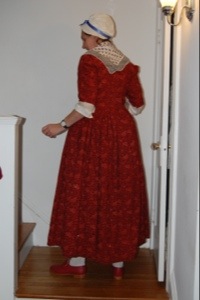
Please forgive the watch– a test shot of a gown from a runaway ad.

This is a quick one, because I’m writing in advance of a trip to New England, but for me, the best secondary source I’ve read that helped me understand the people I was clothing is John Styles’ The Dress of the People. That’s not to say that I haven’t read more, and found period resources and collections of resources equally useful. If you’re doing a poor woman in America, Don Hagist is your man, with Wenches, Wives and Serving Girls (now Wives, Slaves, and Servant Girls. Read Good Wives, Nasty Wenches, and Uneasy Patriarchs for more on period terminology).

I like Styles because he helps us understand the why of people’s clothing, and their wants. For me, context is key (I harp on this a lot) so insight into how many shifts are usual, the fashion for pocket watches, and the activity of the second hand clothes market is really helpful. So despite my love of shiny satin gowns and fashion of all eras, among the few books I didn’t send to storage when I moved was The Dress of the People. I think that’s a strong recommendation.

(researc

Share this:

  • Click to share on Facebook (Opens in new window) Facebook
  • Click to share on Pinterest (Opens in new window) Pinterest
  • Click to email a link to a friend (Opens in new window) Email
  • Click to share on X (Opens in new window) X
Like Loading...

I Fall to Pieces: Extant Garment Fragments

03 Thursday Aug 2017

Posted by kittycalash in Clothing, History, material culture, Museums, Research

≈ 1 Comment

Tags

18th century clothes, CoBloWriMo, fashion, Federal New England Fashion, Rhode Island history, Sally Brown Herreshoff, style

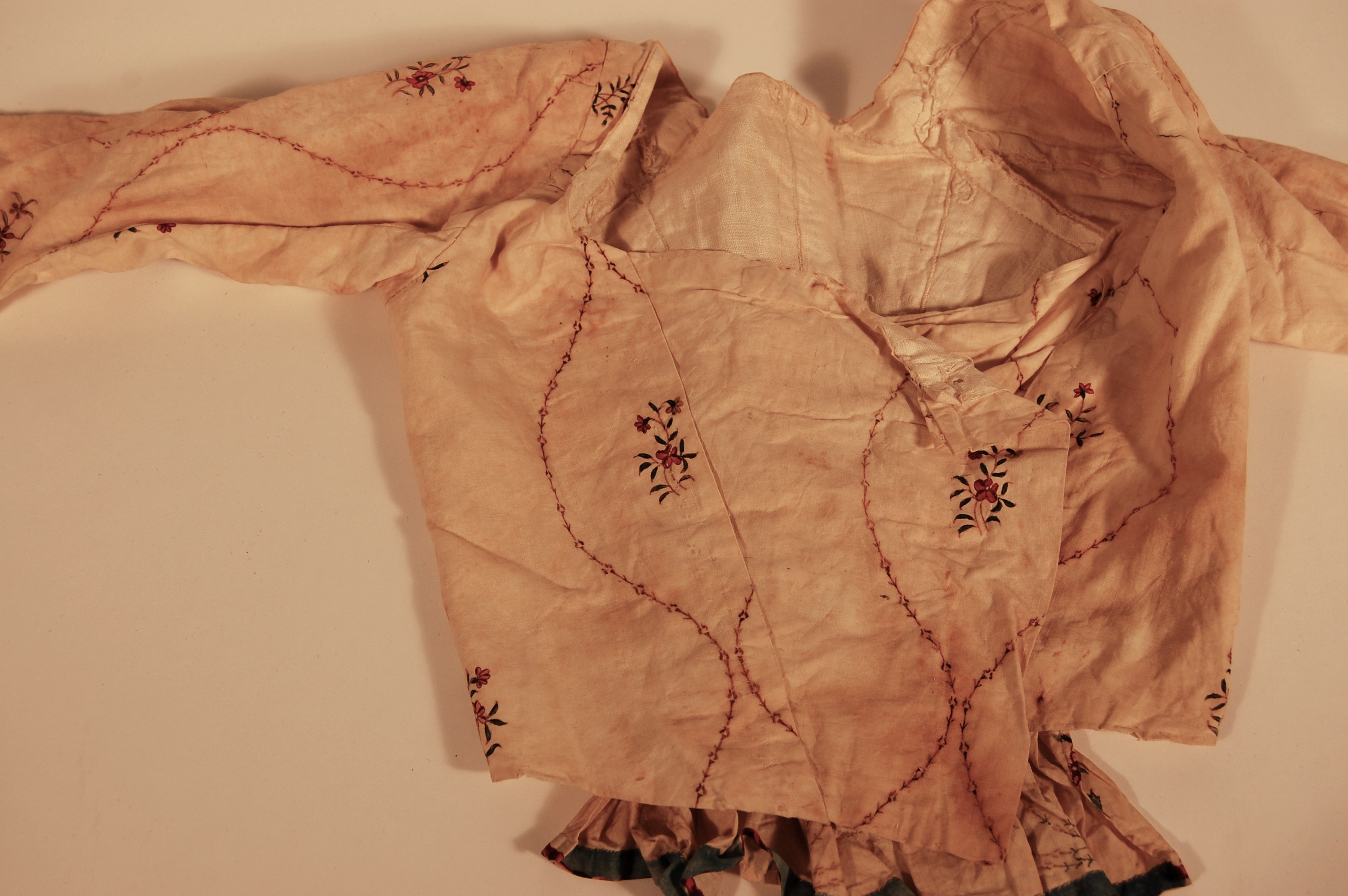
Bodice, painted Indian cotton, 1780-1795 RIHS 1990.36.27

Bodice, painted Indian cotton, 1780-1795
RIHS 1990.36.27

Once upon a time, not very long ago, when I worked in a historic house museum, I was asked to present at a conference in Worcester. I chose to talk about these fragments, and I still like to think about them. The delicate fabric was saved as a pair of sleeves, a bodice with a tiny peplum, a skirt.

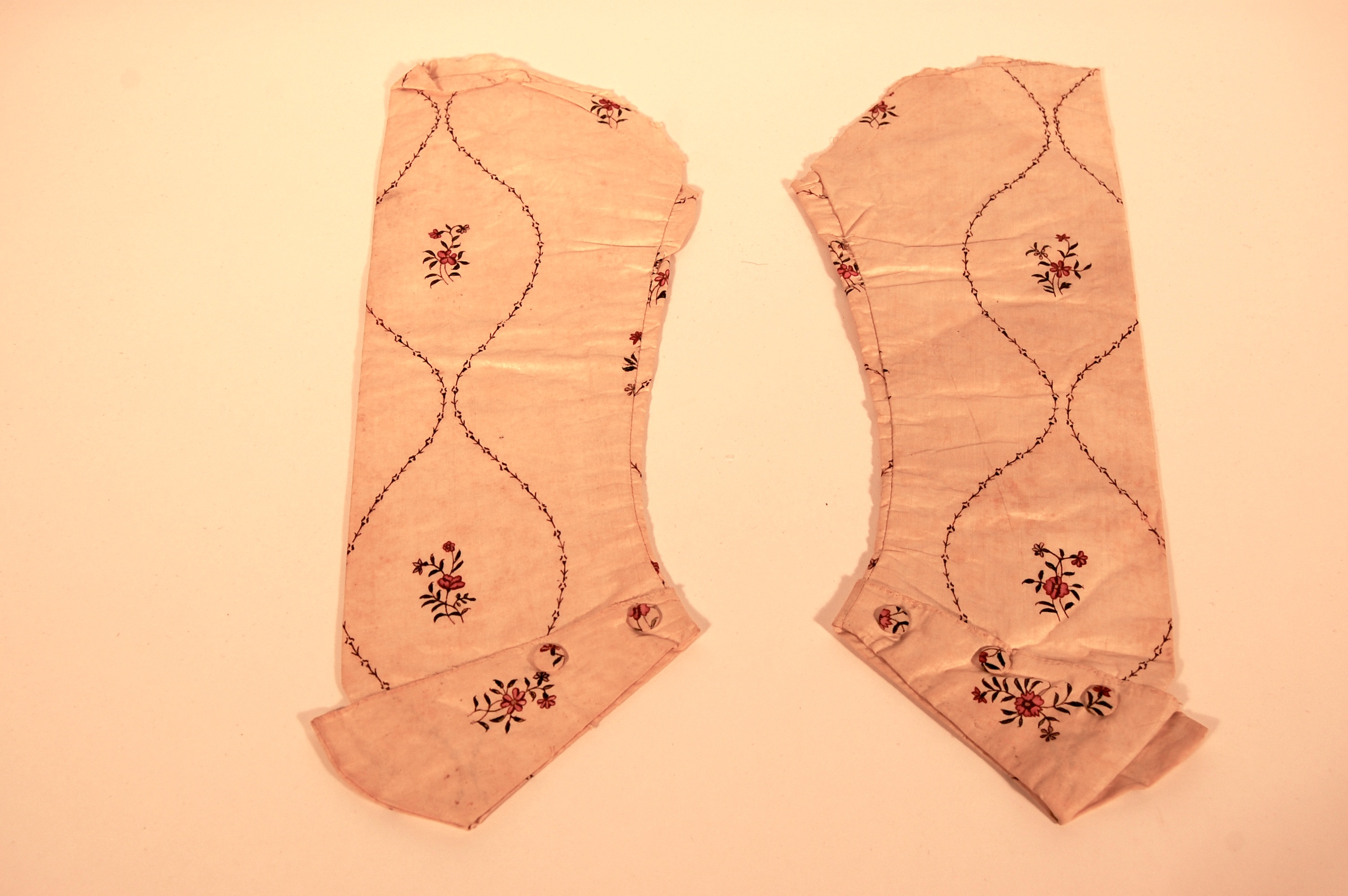
Sleeves, removed from bodice 1990.36.27. RIHS 1990.36.25A-B

Sleeves, removed from bodice 1990.36.27.
RIHS 1990.36.25A-B

The pieces appear to have been part of a pieced-back closed-front gown with a matching petticoat circa 1785. I think someone decided (quite rightly) that the style was too passé for 1795, and altered the gown significantly.

Not only is there evidence of new sleeves being fitted into the gown’s armscyes, we have the sleeves-that-used-to-be. And my dear! No one is wearing sleeves like that this season!

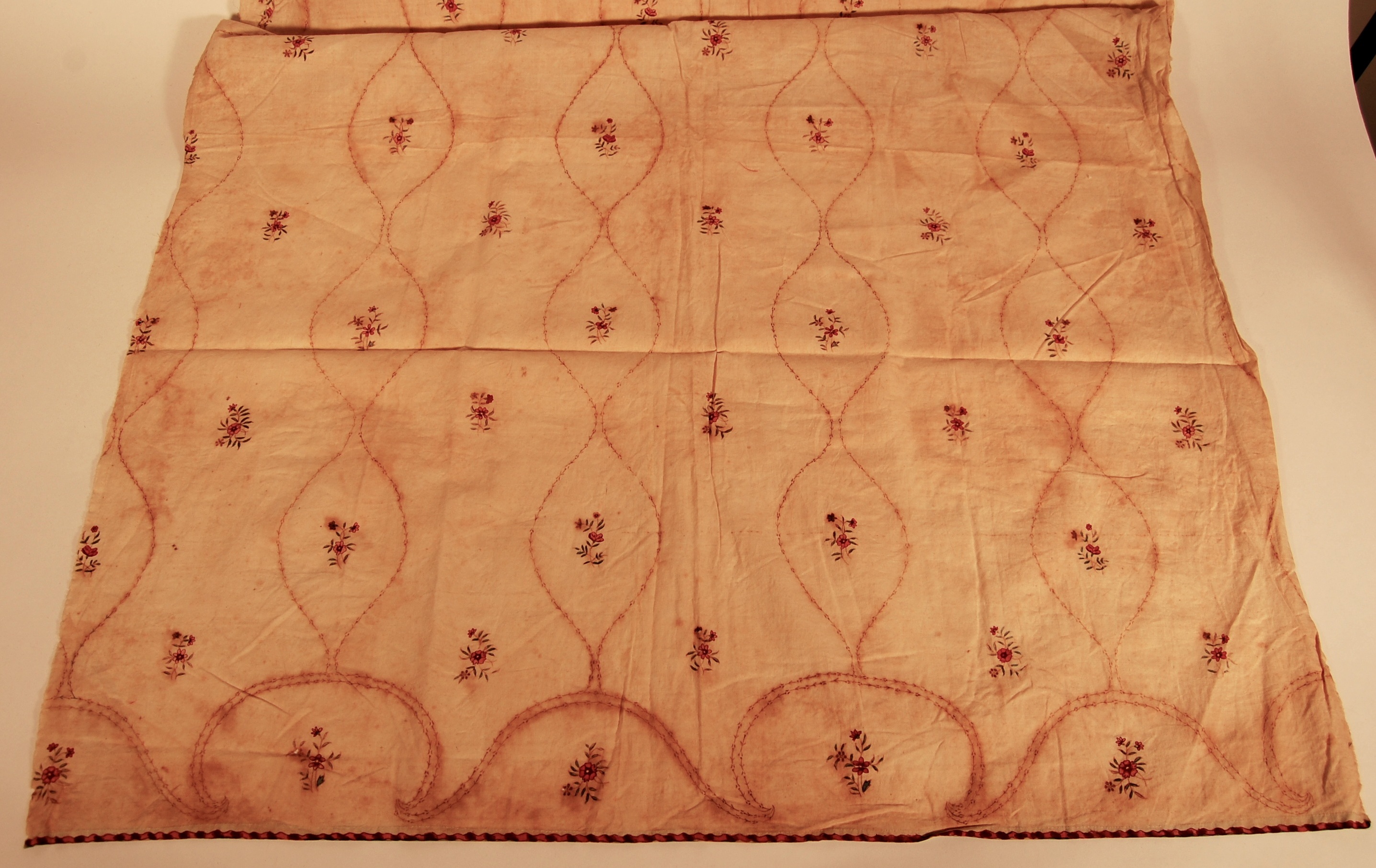
I find these garments in limbo really fascinating. Was that bodice finished and worn with a matching petticoat? (Yes, there’s a panel of that left, too; what a lovely hem!)

Skirt panel, painted Indian cotton. RIHS 1990.36.33

Skirt panel, painted Indian cotton.
RIHS 1990.36.33

Who wore the gown? Was it Sally Brown, born in 1773? And did she alter it, or did her sister’s mantua maker, Nancy Smith? We can only guess at this point, as so many documents remain in private hands. The alterations are not as finely done as the original gown, so I think there are two hands at work here– whose were those hands? There’s always more to think about and learn.

In case you’re wondering, thanks to the Met, we can see what the gown probably looked like in its first incarnation, and then what the alterations were meant to achieve. (Link to the gown on the left; link to the gown on the right.)

Robe a l'anglaise, 1785-1795 MMA 2009.300.647
Robe a l’anglaise, 1785-1795 MMA 2009.300.647
Gown and petticoat, 1790-1794 MMA C.I.45.6a,b

Share this:

  • Click to share on Facebook (Opens in new window) Facebook
  • Click to share on Pinterest (Opens in new window) Pinterest
  • Click to email a link to a friend (Opens in new window) Email
  • Click to share on X (Opens in new window) X
Like Loading...
← Older posts
Newer posts →

Archives

wordpress statistics

Creative Commons License
Kitty Calash blog by Kirsten Hammerstrom is licensed under a Creative Commons Attribution-NonCommercial-ShareAlike 4.0 International License.

Website Built with WordPress.com.

  • Subscribe Subscribed
    • Kitty Calash
    • Join 621 other subscribers
    • Already have a WordPress.com account? Log in now.
    • Kitty Calash
    • Subscribe Subscribed
    • Sign up
    • Log in
    • Report this content
    • View site in Reader
    • Manage subscriptions
    • Collapse this bar
 

Loading Comments...
 

    %d