• Home
  • Completed Costumes/Impressions
  • Emma and Her Dresses
  • Free Patterns and Instructions

Kitty Calash

~ Confessions of a Known Bonnet-Wearer

Kitty Calash

Category Archives: Philosophy

Staging Christmas

22 Thursday Dec 2016

Posted by kittycalash in Events, material culture, personal, Philosophy

≈ 2 Comments

Tags

christmas, emotions, interpretation, material culture, personal

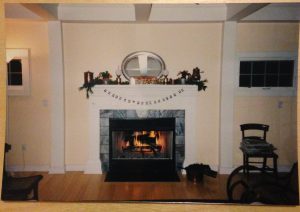
The house on High Street, Noank CT, 2000

The house on High Street, Noank CT, 2000

It’s pretty stagey to begin with, isn’t it? Full of ritual, some so old we don’t know why we still perform them. What I like best is the food, not the cakes and cookies, delicious as they are, but savory meals and the warmth of a full table. Second to that, decorating.

The past year has given me opportunity to reflect on the tasks I love, and why, and the basis for the work I’m passionate about. Curiously, it began in high school, as the props mistress for drama productions, morphed into installations, performance art, and site specific sculpture in college, before metastasizing into exhibition development, installation, and historic house interpretation with a side line in living history because, you know, costumes. Things and I go way back, and thinking about that made getting ready for yet another Christmas more fun.

Providence, 2016

Providence, 2016

Embracing the staginess makes the sometimes uncomfortable family closeness easier; I have proposed celebrating by reenacting a Don Draper Christmas, as long as someone else does the driving. Adding a layer of actual performance somehow made it easier to understand, a phenomenon opposite to what happens when you write a word over and over until it makes no sense. It’s the same distance you feel when you really try to understand someone’s past, and how they think. It’s familiar, but somehow unrecognizable.

This is probably the last Christmas in this apartment, which adds a poignancy to the proceedings, and it’s the first interactions for some participants, so, as with What Cheer Day, I’ve set a stage and we’ll see what happens.

Christmas with Katie, Chicago.

Christmas with Katie the Cat, Chicago, ca 1978

Every year, some things are the same: a balsam fir, candles, apples, cats. The characters and locations ebb and flow, with some consistency. Cats come and go, the boy grows. The love remains the same.

Share this:

  • Click to share on Facebook (Opens in new window) Facebook
  • Click to share on Pinterest (Opens in new window) Pinterest
  • Click to email a link to a friend (Opens in new window) Email
  • Click to share on X (Opens in new window) X
Like Loading...

Change

20 Tuesday Dec 2016

Posted by kittycalash in personal, Philosophy

≈ Comments Off on Change

Tags

authenticity, Hamilton, interpretation, personal, philosophy

my-obama-me_20-12-16-1

Changing seasons, change we can believe in, be the change you want to see in the world.

This dumpster fire of a year is nearly over, and the commonplace is to note how much has changed: that’s our human instinct. But much does not change, most often within ourselves.

It’s our perception or understanding that changes, and, if we are lucky, causes us to act. That’s the mechanism behind the progressive movement in enacting/reenacting/living history. It’s the mechanism behind organizational change, and personal change. Sometimes it’s the sole inspiration to get me to clean my house. Holy cats, that’s a lot of kitty fur! As the sun finally shines in on the rug.

Sometimes we push as hard as we can to make change happen, but lack access to all the levers: then we have to wait. I am waiting now: I have pushed every lever and turned every knob within my reach, and the waiting is agony.

High school seniors applying to college know this feeling: when will I know? People starting new habits wonder, when will I see a difference? As a species, we have trouble with time. But tiny changes and tweaks aggregate, accrue over time like compound interest. We’ll get there.

Think about what you used to know, and what you know now, how you’ve learned more about what (or who) you love, how the way you approach a problem from collar stands to coat names. All those little changes make a difference– all the difference, the only difference.


Share this:

  • Click to share on Facebook (Opens in new window) Facebook
  • Click to share on Pinterest (Opens in new window) Pinterest
  • Click to email a link to a friend (Opens in new window) Email
  • Click to share on X (Opens in new window) X
Like Loading...

The Art of Deviance

01 Tuesday Nov 2016

Posted by kittycalash in History, Living History, personal, Philosophy, Reenacting, Research

≈ Comments Off on The Art of Deviance

Tags

18th century clothes, authenticity, common people, difficult interpretations, interpretation, living history, Research

portrait as a process test

portrait as a process test

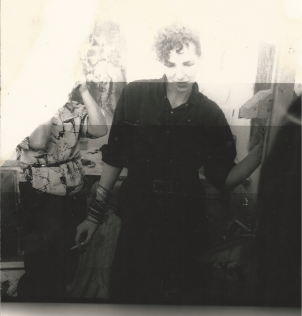
Some regular readers know I was part of Chicago’s punk rock scene in the early 1980s: my first foray into unusual music and natty dressing.* I think that’s me and my keffiyeh at a Naked Raygun show in the Chicago episode of Sonic Highways. But more to the point, I was on the fringes of an underground, taking style tips from obscure English zines, and being told I looked like a whore by a variety of men using Chicago’s public transit system. Judge not lest ye be judged aside, I’m accustomed to occupying uncomfortable spaces by design and by accident. (I wasn’t looking to be called a whore on the Fullerton El platform when I dressed in a below-the-knee vintage skirt and lot of Bakelite jewelry combined with bullet belts and studded leather, but everybody’s a critic when it comes to women’s appearance.)

The Frail Sisters, 1794

The Frail Sisters, 1794

Now that I live in Providence, where indoor prostitution was legal for decades, if not centuries, my interest in gender role non-conformity extends to finding ways to document and represent sex workers in Rhode Island history. The adult section of the now-defunct Providence Phoenix, ‘zines, and diaries help record at least some aspects of this facet of our culture, but how do we represent it, and do it well? Jamie Lee Curtis in Trading Places is not a realistic model.

In discussing this lately, I’ve found consistent themes in representing sex workers in the 18th century: white face powder, rouge, bright clothing, visible stays, friendliness rather than reserve. There are lithographs to guide the portrayal through clothing, and visual tropes that signified a lack of virtue in the 18th century. In considering the local variations on this theme, my thought had been to expand upon the visual imagery by reading the Providence and Newport town papers, and the records of the Colony of Rhode Island, along with the contemporary newspapers.

The Tar's Triumph, or Bawdy-House Battery, print by Charles Mosley, 1749. British Museum 1868,0808.3896

The Tar’s Triumph, or Bawdy-House Battery, print by Charles Mosley, 1749. British Museum 1868,0808.3896

Nothing is likely to be quite as good as the Nort’ Providence chief of police who, in the midst of Tropical Storm Irene, pursued a stripper who took clients on the side when she ran a red light in her SUV. She crashed into a parked car in Pawtucket and abandoned the car, at which point the chief of police searched the vehicle, found her open purse, and stole the cash she’d earned that morning. When questioned later, he was at pains to explain why the money was wet…** in any case, the Providence brothel riot of 1782 aside, I do not expect to find anything quite as lurid.

The Bargain Struck, or Virtue conquer'd by Temptation. Mezzotint, 1773. British Museum 1935,0522.1.130

The Bargain Struck, or Virtue conquer’d by Temptation. Mezzotint, 1773. British Museum 1935,0522.1.130

My sartorial choices for a prostitute would include a rather over-fancy cap with a worn silk ribbon, rouge and a velvet patch, a silk gown stained on the back, silk petticoat stained at the knees, laddered stockings, and heeled shoes tied with silk ribbons, or fastened with paste buckles. If my character worked from a brothel, the dress could be brighter and cleaner, but in either case, neck handkerchiefs would be optional or silk and askew, showing my stays and cleavage.

This is not an easy impression. It’s not just that I do not want to parody an 18th century prostitute, but that I want to honor the memory of these largely forgotten women. They had families– in all likelihood they had children, as we know from the story of Mary Bowen and Eliza Jumel– they had feelings, desires, dreams, felt love and pain. They were likely desperate.

They were human.

We owe them the respect of representing them well– of representing them at all– if we strive to recreate a more complete picture of the past.


*What else is this crazy thing we do?

**You cannot make this stuff up.

Share this:

  • Click to share on Facebook (Opens in new window) Facebook
  • Click to share on Pinterest (Opens in new window) Pinterest
  • Click to email a link to a friend (Opens in new window) Email
  • Click to share on X (Opens in new window) X
Like Loading...

A Giant One-Night Stand

26 Wednesday Oct 2016

Posted by kittycalash in Events, History, Living History, Museums, Philosophy, Reenacting

≈ 4 Comments

Tags

anarchist guide to historic house museums, authenticity, experimental archaeology, first person interpretation, historic house museums, interpretation, John Brown House Museum, Rhode Island history, What Cheer Day

Drunk Tailor’s told you some of the story, and Our Girl History a little bit more, but here we specialize in confessions, so let’s begin.

One night stands: no, not that kind, this kind: the Anarchist kind. I’ve been following Mr Vagnone’s work for some time now, and while museum professionals are not all in agreement about his techniques and approaches, I find them intriguing and thought provoking. I’ve also found that the best way to accomplish anything is by baby steps, as annoying as that can be. That’s how we got to this What Cheer Day: incremental progress over a five-year period. What was so different? Well….

Jimmie and Billie, unwell and unable to dress themselves without Gideon's aid. Photograph by J. D. Kay

Jimmie and Billie, unwell and unable to dress themselves without Gideon’s aid. Photograph by J. D. Kay

To begin with, we slept in the house. Eight of us. In the period beds and on the period sofas. No harm came to anything, except the gentlemen, who seem to have contracted mild, possibly mold-based, ailments from ancient feather beds.*

img_8303

We scampered around the enormous house (I swear the front hallway would contain my entire flat, both floors!) in bare feet and period night clothes. I has a regret about that, because the floors could be cleaner, and I forgot to ask for my slippers back.  

Anyway:

Big house. Dark night. Flickering candles. Rain storm. Cantonware cider jug.

Mind blowing.

Why? Why do it? Why risk it? Why, when I’ve been there after dark? Why, when I’ve slept in other historic houses and historic beds? Because to really understand someone, you have to walk in their shoes– or sleep in their bed, as the case may be.

Goody Morris makes up a bed. Photograph by J. D. Kay

Goody Morris makes up a bed. Photograph by J. D. Kay

I lay in bed in an enormous mansion house, the first one built on the hill in Providence, completed in 1788. Almost every week, I tell the story of the house, the family moving, James complaining about the June heat as he walked up the hill from Water Street to move into the new brick edifice. I tell the story of Abby’s wedding, the longways dances on the second floor of the unfinished house, candles and dancers glittering in the enormous mirrors at either end of adjoining rooms. But I’d never seen it. I’d never heard it. I’d never really thought about service circulation and stealthy maneuverings in the house.

Now I have.

Now I have lain in the enveloping warmth of a feather bed and heard the rain pouring outside, and nothing else. I’ve heard the deep quiet of thick brick walls. I’ve seen the utter darkness of the house at night, and, padding up the stairs to bathroom, been comforted by the presence of my companions even as they failed to sleep across the hall.**

A dreadful night: almost too much to bear. Photograph by J. D. Kay.

A dreadful night: almost too much to bear. Photograph by J. D. Kay.

To enter the room as a maid, I’ve used the doorway from the former service stairs, and silently carried in a jug to serve the occupants. I’ve gotten closer to the near-invisible role of servants, in a period when full invisibility hasn’t yet been established. I’ve watched someone I love sleep off a migraine in a room where we interpret illness and 18th century medicine.

Best Maid/Bad Maid.  Photograph by J. D. Kay

Best Maid/Bad Maid. Photograph by J. D. Kay

All of that is mundane. And because I did all of that in a historic house with period furnishings, all of that is magical. My job now is take what I have learned and felt, and find new ways to use those personal experiences to connect our visitors’ personal experiences to a larger (and a smaller) story about Providence, early Federal Rhode Island, and a family.


* Most amazingly comfortable feather beds ever. Drunk Tailor’s review is unprintable on a family blog, but hilarious.

** Sorry about that… I slept pretty well, considering.

Share this:

  • Click to share on Facebook (Opens in new window) Facebook
  • Click to share on Pinterest (Opens in new window) Pinterest
  • Click to email a link to a friend (Opens in new window) Email
  • Click to share on X (Opens in new window) X
Like Loading...

What Cheer Day: Emotional Goals and Historical Content

25 Tuesday Oct 2016

Posted by kittycalash in Events, History, Living History, Museums, Philosophy, Reenacting

≈ 6 Comments

Tags

authenticity, emotions, first person interpretation, historic house museums, interpretation, John Brown House Museum, museum practice, Rhode Island Historical Society, What Cheer Day

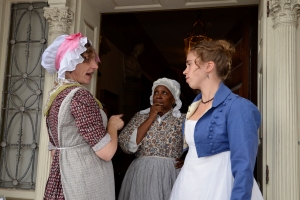
Petulant Alice faces her first hurdle, Kitty and Goody Morris. Photograph by J. D. Kay

Petulant Alice faces her first hurdle, Kitty and Goody Morris. Photograph by J. D. Kay

I think about three or four things most of the time: food, sex, museums, and clothes. That seems pretty adequate, but from time to time I am forced to consider intersections between these rather broad topics. The intersectionality of clothing and museums seems pretty obvious: from accurate costumed interpretation to proper packing and storage, easy. Food and museums will be much on my mind in the coming year, as we work on “Relishing Rhode Island,” and I’m continually harping on how eating locally and seasonally is the core of eating historically. Sex and museums is a little harder (yes, I know about the Museum of Sex), though one gets a chance even in a historic house museum, and really, it’s not just about the act: it’s about the feels.

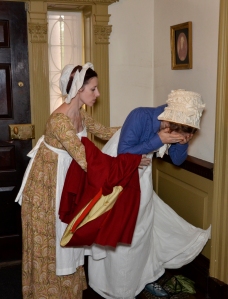
Mary assists Alice in the hallway as she prepares to face her mother. Photograph by J. D. Kay

Mary assists Alice in the hallway as she prepares to face her mother. Photograph by J. D. Kay

In the main, I am not particularly good at the feels aside from some very hands-on experience with anxiety, but a number of things have coalesced recently to make me reconsider the intersection of emotions, museums, and history.

Hamilton is one, and if you read this, you probably watched the Hamilton’s America documentary  on PBS last Friday. If you didn’t, go do it now. Really: I can wait. And here’s why:

In the thinking I’ve been doing for some time about Hamilton,* I’ve reached the conclusion that what makes it so damn good (aside from the brilliant writing) is how Lin-Manuel Miranda has captured the emotions. The quotes I wrote down from the documentary are about emotion and drama, because I’m looking for them (confirmation bias for the win) but here they are:

“Each piece of music is specific to an emotion and a character”

“I got into the history through the characters”

“Research is over and you write the character defined by history”

“Write the parts you think are a musical”

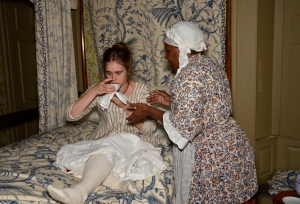
Goody Morris helps Alice drink lemon water to soothe her stomach. Photograph by J. D. Kay

Goody Morris helps Alice drink lemon water to soothe her stomach. Photograph by J. D. Kay

What is a museum exhibit but “the parts you think are a musical?” While Our Girl History struggled with being Alice (I know a bit about the part where your ego gets connected to a character), she had to portray a character defined by history, but also by emotion. And in thinking about Hamilton, about What Cheer Day, and about the exhibits that give me pleasure, and art that brings me joy, I have reached a couple of conclusions.

I believe that museums, where we currently set educational and interpretive goals, and increasingly experiential goals, need to begin setting emotional goals for their programs and exhibitions. You could argue that experiential and emotional goals are the same, but I disagree: I believe that interpretation helps define the experiences that create emotional responses, and within the intersection of experience and emotion we will find the educational goal revealed, because we are always working within a content-driven context.

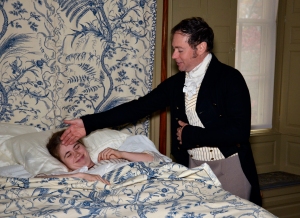
James checks on sister Alice. Photograph by J. D. Kay

James checks on sister Alice. Photograph by J. D. Kay

I also believe the reason gun-based reenactments retain their popularity is their easy emotions. “Boom!” is exciting anywhere: there’s an immediate reaction of shock, surprise, a mild fear, and excitement. Traditional reenactments have those “boom!” emotions embedded within them, which is how they retain their potency. Until we locate the emotion within the everyday– and trust me, it’s there– we will not see the primacy of non-military reenactments and living history.

*Yes, I was aware of it when it was in previews at the Public Theatre. I am *that* kind of hipster, but really, it was because Oscar Eustis went from Trinity Rep here to the Public and there’s a PVD-NYC theatre connection.

Share this:

  • Click to share on Facebook (Opens in new window) Facebook
  • Click to share on Pinterest (Opens in new window) Pinterest
  • Click to email a link to a friend (Opens in new window) Email
  • Click to share on X (Opens in new window) X
Like Loading...
← Older posts
Newer posts →

Archives

wordpress statistics

Creative Commons License
Kitty Calash blog by Kirsten Hammerstrom is licensed under a Creative Commons Attribution-NonCommercial-ShareAlike 4.0 International License.

Website Built with WordPress.com.

  • Subscribe Subscribed
    • Kitty Calash
    • Join 621 other subscribers
    • Already have a WordPress.com account? Log in now.
    • Kitty Calash
    • Subscribe Subscribed
    • Sign up
    • Log in
    • Report this content
    • View site in Reader
    • Manage subscriptions
    • Collapse this bar
 

Loading Comments...
 

    %d