• Home
  • Completed Costumes/Impressions
  • Emma and Her Dresses
  • Free Patterns and Instructions

Kitty Calash

~ Confessions of a Known Bonnet-Wearer

Kitty Calash

Category Archives: Research

Checked Linen Aprons post-1800

16 Monday Feb 2015

Posted by kittycalash in Clothing, History, Living History, Museums, Reenacting, Research

≈ 6 Comments

Tags

19th century clothing, apron, authenticity, checks, Clothing, common dress, common people, Costume, dress, fashion, Federal New England Fashion, New England, Newport, Rhode Island, Rhode Island history, sewing, style

Not that this is an exhaustive or final chronicle, but Jackie asked about the apron.

Spring Cleaning, 2012

Spring Cleaning, 2012

I first encountered this form of apron at Old Sturbridge Village, on display in the Firearms and Textiles exhibit space, which I think of as “Muskets and Muslins.” The accession number given on the exhibit label was 26.39.4, but the object does not appear in the OSV online collections database (they do warn that it contains just a selection of their total 60K-plus object holdings). The original at OSV, as sketched and described by me in April 2012 has a drawstring at the neck, straps that button, string at the back opening, and is slim, without gathers. That means the bodice is very similar to the gown bodices of the early part of the 19th century.

Smock, Checked cotton, Pocumtuck Valley Memorial Association. #2000.01.869.

Smock, 2000.01.869 PVMA

There is another original checked bodiced apron in the Pocumtuck Valley Memorial Association collection in Deerfield, MA. This original appears in color in The Needle’s Eye by Marla Miller. As you can see in the images of my apron, I mashed the two styles together to suit the amount of material I had on hand, the skills I had three years ago, and the amount of time I had between seeing the apron and the day of the program, which was probably two days during which time I had pleurisy.*

This is also wrong, but funny.

This is also wrong, but funny.

To refocus: I chose to wear this apron at Whitehorse House in 1820 for a really wrong reason: it was what I had.

Prints in the British Museum show a maid in a yellow gown with a black apron, no bib; there is another, with a maid in a green gown, in a wikigallery, that I could not fully track down; a London Market scene; and a French print from 1818 that does show a bibbed black apron on a shop assistant. The visual research I’d done for the 1820 program suggested that black aprons were the height of fashion, and that they did not always have bibs.

Papering the Saloon at Tickford Hall, watercolor by Diana Sperling, 1816.

Papering the Saloon at Tickford Hall, watercolor by Diana Sperling, 1816.

Since we deal in confessions here, I will tell you that I did buy material for a black apron, and I planned to make a strapped or bibbed one, much like the one Sabine made. The appearance of the dark apron in Diana Sperliing’s watercolor of the ladies papering the saloon at Tickford Park put the dark strapped and sometimes bibbed apron the in English-speaking world. And still I did not manage to make one. If I were to do an 1820 program again, or even an 1813 or later millinery shop again, I like to think I would find the time to make a black strapped and possibly bibbed apron. I do think they were the height of fashion, and are likely to have been worn by women in shops, and by maids.

Do I think the checked apron is wrong? Given that I can rationalize anything, of course not! I think a checked apron is probably reasonably appropriate within the context of a kitchen, even in 1820, especially in New England. Since we did not cook on Saturday, the black apron would have been ideal, but I think the checked apron passes. To make it pass with a higher grade, I will freely admit it requires button and tape upgrades. Since the next dates on the horizon are 1775 and 1780, chances are good those upgrades won’t happen anytime soon. * Do not attend an all-day outdoor event in the cold when you are not well. Do not attend said event without your cloak, or in stays you have laced up a little too firmly. Do not deny that the cold you have might actually be the start of something bigger, when it includes a productive cough. Lo, the lessons of living history are many.

Share this:

  • Share on Facebook (Opens in new window) Facebook
  • Share on Pinterest (Opens in new window) Pinterest
  • Email a link to a friend (Opens in new window) Email
  • Share on X (Opens in new window) X
Like Loading...

New England Spencers

07 Saturday Feb 2015

Posted by kittycalash in Book Review, Clothing, History, Making Things, Museums, Research, Snark

≈ 7 Comments

Tags

19th century clothing, cataloging, common dress, common people, Dublin Seminar, Federal New England Fashion, Federal style, New England, Regency, Research, Spencer, Spencers, Sylvia Lewis

You may recall how tortured I was (sort of) about making a Spencer for What Cheer Day, concerned that Spencers could not be documented to Rhode Island, let alone New England. I had the same worry about the Not-Quite-Good-Enough Coat.

JDK_8210_1

Things will come to those who wait, and what came this week was the long-awaited Proceedings of the Dublin Seminar for 2010, Dressing New England. In it I found an article by Alden O’Brien, Federal New England Fashion in the Diary of Sylvia Lewis.

Sylvia Lewis [Tyler], Diary (1801-1831), MSS 2899 in the Americana Collection of the NSDAR provides the basis for O’Brien’s article and my joy. It begins routinely enough with my favorite stuff– spinning!– and carries on to knitting: stockings, mittens, gloves, a hat or two, and even “comforters,” or scarves. Shag, or thrummed, knitting is mentioned, so at least those of us interpreting the world of 1801 and later can be war.

The real excitement comes on the third page: in the winter of 1803-1804, Sylvia Lewis cuts and sews a greatcoat. Then, in 1806, she makes a green Spencer, and in 1808, a black one.

Spencer ca. 1800 French. silk. Purchase, Irene Lewisohn Trust Gift, 1991 1991.239.2

Spencer ca. 1800
French. silk. Purchase, Irene Lewisohn Trust Gift, 1991
1991.239.2

1806 is still later than I wore my Spencer. They’re shown in fashion plates of the 1790s, and here’s a pattern, too: so they’re clearly worn in Europe earlier than 1806. The similarity between the French silk spencer at the Met and fashion plates gives me confidence that they are being made and worn in the 1790s and early years of the 19th century; Spencers are also mentioned in tailoring manuals of this period.

1797, with a similar shape to the Met's French silk spencer.

1797, with a similar shape to the Met’s French silk spencer.

They’re placed in New England with written documentation, but how early are they here? And what did they look like? I know of one in a private collection which I am slavering to see, based on the description of the wool. The MFA has a few that seem to be local to Lexington, and there is one in Maine with a catalog record that shines with passive aggressive crankiness, and delights when compared to another in the same catalog. And no, I’m pretty confident that gentlemen did not wear spencers, or tailed spencers, at any time.

"wearing a spencer"
“wearing a spencer”
"she *says* its a spencer"
“she *says* its a spencer”

But there’s really good stuff in Sylvia Lewis’s diary for anyone who wants to know more about clothing production, use, and costs in early Federal New England. Even if your Library doesn’t have it, your Librarian can get a copy of the article for you through ILL or you can buy the entire proceedings here.

Share this:

  • Share on Facebook (Opens in new window) Facebook
  • Share on Pinterest (Opens in new window) Pinterest
  • Email a link to a friend (Opens in new window) Email
  • Share on X (Opens in new window) X
Like Loading...

Drapers, Sutlers and Other Sources

10 Saturday Jan 2015

Posted by kittycalash in Clothing, Living History, Making Things, Reenacting, Research

≈ 11 Comments

Tags

Clothing, fashion, Research, resources, sewing, shopping, style

Shopping with swatches: it’s what I do.

The biggest difference between sewers is location: I have access to resources here that people in the Midwest don’t, but friends in New York have the garment district, which is just a little too far for me.  For a lot of my projects, I’m buying from the reputable sources we all know about: Burnley & Trowbridge and Wm Booth Draper. They’re supplying people who want accurate fabrics, they do their research, and the goods are well described. But how to choose among the offerings? And where else can you go?

Wools
The creme de la creme are Kochan and Philips wools. I have some bottle green I haven’t cut yet, which I got from Roy Najecki because he’s local, he’s got the stuff, and he has other stuff my household uses (like cartridge box clasps and quarter-inch mohair braid).

Wm Booth and B&T’s wools are also good, and you can get samples. What you buy will be dictated by what you are making. Broadcloth for suits and cloaks, stuff (worsteds) for gowns and waistcoats. Buy the best you can afford: this is an investment. Divide the cost of the fabric by the number of times you’ll wear a garment, and look at the per-wear cost, the way you might look at a suit for work. (I have no regrets about that Saratoga coat, which has now been worn on at least 5 separate occasions, making the per-wear cost $25 after 18 months, and I know it will be worn again.)

Once you’ve felt and seen good-quality, period-correct wools, shopping locally is easier. Take a swatch with you and compare to what’s in the stores and you’re likely to find yourself shopping online. You’ll want 100% wool, and that’s expensive pretty much everywhere. Here in Rhode Island, I do have access to mill stores and remnant tables that make a difference in my costs and allow me to be a little more frivolous in my sewing. Sewfisticated in Framingham and Somerville and Lorraine Fabrics in Pawtucket both have remnant tables with reasonably priced goods with pretty accurate fibre labels. They’ve been the source for many a garment, but have no online sales. I don’t recommend JoAnn’s wools: they’re not as tightly woven and they’re over-priced. Wm Booth and Burnley and Trowbridge are a better value.

Silks
Here again, it’s unfortunate, but my local sources come into play. Artee, Sewfisticated and Lorraine all have both discounted taffetas and tantalizing remnant tables, but Wm Booth and Burnley & Trowbridge have fabrics the local shops do not carry. I don’t have a local source for what Booth calls “persian,” but taffeta can be found– though color choices can be limited.

The trick with silks is slub. Much of what is sold today is silk dupioni. It is not universally bad for all historical applications, as by the 19th century, silks were being sold in several grades. If it’s right for your impression (i.e. not upper class), and you can find a pretty fine dupioni, you can use it. But the really slubby (bumpy) stuff should remain in this century.

Crisp taffetas from the bridal department can be your friend, though home decorating can also yield good results. Some higher-end home dec departments do stock wool, linen and silk fabrics, as the best designers and manufacturers use them. You’ll pay for it, but again: it’s an investment you’ll enjoy over time. Online, there’s Hyena Silks, too, which has supplied some friends. But my silks are pretty much locally bought, at $9/yard.

Cottons
Here’s the biggest trouble spot for a lot of people. The mantra is that today’s quilting cottons are nothing like the cottons of the past, and while that is true in part, it is not the whole, or nuanced, truth. Quilting cottons are stiff and crisp, and generally do not drape as well as apparel fabrics. But what’s more correct is to say that the range and hand of cottons available today in historically correct or acceptable prints do not come close enough to the cottons of the past. Still, you can find good analogues for late 18th and early 19th century cottons (1750-1825) if you’re careful.

Aside from Wm Booth and Burnley & Trowbridge, I buy from Reproductionfabrics.com. She has been a good source for Indian print cottons. Time Travel Textiles no longer has a functioning web store, but the articles are still there, and useful.
Regency Revisited sells via phone and Facebook now, and has an interesting range of prints, though I have not bought from them…yet…as I am trying hard to sew down the strategic fabric reserve.

But again, I buy locally from the bargain loft at the mill store where I can feel the goods. It’s worth ordering some swatches from Burnley & Trowbridge just to get a sense of the hand of different goods. That, along with printed resources, can serve you well in an actual store (presuming they still exist near you).

Linens
Again, much of my trade is with the main two sutlers, but I buy linen in quantity from Fabrics-store.com. It’s not the best of the best (see the main two) but it gets the basic job done.

For really nice and perfectly correct linen, in every sense, Justin Squizzero’s hand-woven linens are the way to go. I’ll get a hand-woven neckerchief one of these days– actually, I want one for February– but have yet to make the leap to buying hand woven linen shirts and shifts.

Share this:

  • Share on Facebook (Opens in new window) Facebook
  • Share on Pinterest (Opens in new window) Pinterest
  • Email a link to a friend (Opens in new window) Email
  • Share on X (Opens in new window) X
Like Loading...

Fabric Selection Resources: Printed & Online

09 Friday Jan 2015

Posted by kittycalash in Book Review, Clothing, Living History, Making Things, Reenacting, Research

≈ 1 Comment

Tags

fabric, Research, resources, sewing, shopping, style

Jackie asked about fabrics: how do you choose?

I’m going to start with prints, cottons, linens and silks; the second part will cover wools and sutlers.

There’s no substitute for feeling up the real thing, or samples, and while I do not have the book, I’m told by a very reliable source that it is worth buying Swatches from Wm Booth or from Hallie. I also order Burnley & Trowbridges swatch sets, which are often  more extensive than what’s on their website. Those samples help me gauge fabrics online– comparing the actual square with a thumbnail online is helpful.

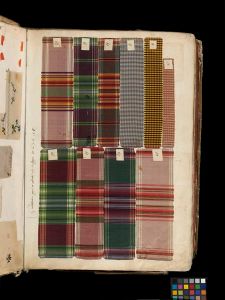
Barbara Johnson: a typical page

Barbara Johnson: a typical page, this from 1803

Where else can you look for guidance? One of the best books that spans a wide range of living history time periods is the Barbara Johnson book of swatches. Owned and published by the Victoria and Albert Museum, A Lady of Fashion is out of print, but the pages have been scanned and are available online. The print version is better– it’s big!– but you can download the images and get a better sense of the scale of the samples.

What is particularly useful is that Barbara Johnson dated the samples, and wrote down how they were used. You can’t get better than that!

Susan Greene’s Wearable Prints is neither small nor cheap, but it is extensive, covering 1760 to 1860. This is a very hand book to have to help sort out typical looks for different time periods, and the likely range of colors.

Textile Sample Book, 1771. Metropolitan Museum of Art. 156.4 T31

Textile Sample Book, 1771. Metropolitan Museum of Art. 156.4 T31

Other museums have digitized sample books: the Met, for example, has multiple images of woven fabrics from a 1771 sample book online.

What you need to remember here is fibre: those homespuns at JoAnn will not behave the way linens behave, even if they look the same. Hand and drape are everything, and cotton, or cotton-poly will not do want linen does. Buy the linen, it’ll look, feel, and wear better.

There are many more sample books, but you have to be careful: some are dated only “19th century.” Great. That’s where Susan Greene and Barbara Johnson can help you sort out which *part* of the 19th century you’re looking at.

Swatch book, 1763-1764. Victoria and Albert Museum, T.373-1972

Swatch book, 1763-1764. Victoria and Albert Museum, T.373-1972

For silks, you can see a very specific and detailed range of silks in Selling Silks, which reproduces another sample book at the Victoria and Albert. Not all samples are 1763-1764; you will need to read the descriptions, but this can be helpful in figuring out how to use fabrics. I have come into some red silk damask that I can make into a gown; it’s vintage silk from France, probably pre-World War II. The pattern is large, replicating a 1740s fabric, but when I make up my gown, I think it can be 1760s, but not a lot later.

Part of looking and buying is understanding how textiles might be bought, saved, made up, reused and repurposed over time.


Share this:

  • Share on Facebook (Opens in new window) Facebook
  • Share on Pinterest (Opens in new window) Pinterest
  • Email a link to a friend (Opens in new window) Email
  • Share on X (Opens in new window) X
Like Loading...

In Tents Tuesday*

06 Tuesday Jan 2015

Posted by kittycalash in History, Living History, Making Things, Reenacting, Research

≈ Comments Off on In Tents Tuesday*

Tags

10th Massachusetts, 18th century, common soldier, Continental Army, Research, Revolutionary War, sewing, tents

You know The Tent Article, don’t know? You do, if you’re camping 18th century private soldier style in your hand-sewn coat.

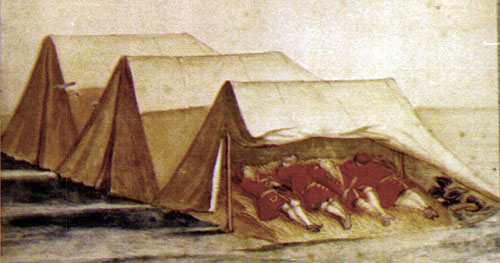
Scene of the Camp on Hampton Green, 1781

Scene of the Camp on Hampton Green, 1781

The Tent Article (hereafter The Document) pulls together documentation and research assembled by a team of living history enthusiasts dedicated to replicating the 18th century enlisted army experience in an accurate manner. Though the PowerPoint format affects the overall length, be warned: we are talking 300+ pages here.

No strangers to the pursuit of the accurate and never ones to shy away from an arduous task involving pointy objects and string, the 10th Mass assembled on Saturday afternoon for a round of tent sewing.

I first read The Tent Article in 2012, and was promptly ashamed of our hand-me-down tent which had everything to recommend it in terms of price, but wanted in terms of accuracy. In response, I began making 1/8″ scale models of tents to figure out how much linen I would need to buy in order to make a truly correct tent. Finally, all that edumacation in art and architecture had utility! Alas: distractions arose, cost overwhelmed, our then-primary regiment scoffed, and I abandoned hand-sewn tent plans.

Fast forward to Tyler Putnam’s blogging on The First Oval Office project, and I was once again intrigued. I began calculating how much vacation time I might need to complete a tent by hand in our living room. Well, thank goodness for finding fellow travelers, because lo and behold! The 10th Mass had tents in want of sewing, so I could learn a great deal without filling our home with excessive yardage.

“Sails.”

Progress was made last August in Newport, where the tents masqueraded as sails, but the canvas languished unsewn until last Saturday, when we duly assembled in Hopkinton and unfurled the vast expanse of linen. It was suggested that I might know some people with access to sail lofts (!), but in about 4 hours, a number of us managed to finish the final foot of backstitching and to flat-fell a little more than 60 feet of tent seams.

It's a vast expanse of linen.

It’s a vast expanse of linen.

The Document was consulted to make sure we were proceeding correctly, though the iPad misbehaved and forwarded us many pages to grommets. (I’m looking forward to those, as I enjoy sewing eyelets– and have just earned myself the dubious honor of sewing at least half of them, I’m sure.) We checked the images, threaded our needles, and off we went.

A few inches (feet) of felling had to be unstitched and resewn, but heavy linen is wily and some stitchers were newer to the process than others. But by the close of day, all seams were felled, needles packed, and tentage folded.

Next up, per The Document, are mud flaps. This should get interesting, as math in front of an audience usually is.


IMG_2728

I promised a pun, so here’s the worst. Somehow we got on to unfortunate reenactorisms, which collided with Star Wars, and brought us to the realization that what we needed were light sabres… ’cause it’s the 10th Massachusetts Regiment Light Infantry Company. We were punished for this hilarity by having to drive home on untreated roads into snow that looked like we were trying to take the Millenium Falcon to hyperspeed.


*It really happened on Saturday.

Share this:

  • Share on Facebook (Opens in new window) Facebook
  • Share on Pinterest (Opens in new window) Pinterest
  • Email a link to a friend (Opens in new window) Email
  • Share on X (Opens in new window) X
Like Loading...
← Older posts
Newer posts →

Archives

wordpress statistics

Creative Commons License
Kitty Calash blog by Kirsten Hammerstrom is licensed under a Creative Commons Attribution-NonCommercial-ShareAlike 4.0 International License.

Website Built with WordPress.com.

  • Subscribe Subscribed
    • Kitty Calash
    • Join 621 other subscribers
    • Already have a WordPress.com account? Log in now.
    • Kitty Calash
    • Subscribe Subscribed
    • Sign up
    • Log in
    • Report this content
    • View site in Reader
    • Manage subscriptions
    • Collapse this bar
 

Loading Comments...
 

    %d