What’re you lookin’ at?

Tags

, , , ,

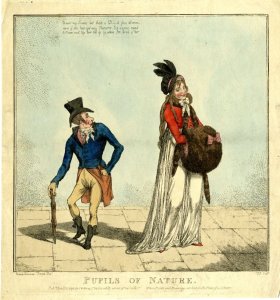
Pupils of Nature.hand-colored etching published by S W Fores after Maria Caroline Temple, 1798. British Museum, 1867,0713.409

Pupils of Nature.hand-colored etching published by S W Fores after Maria Caroline Temple, 1798. British Museum, 1867,0713.409

No, really: Do you know what you are looking at?

When we set out to make historic clothing and costumes, it’s important to understand our sources. Newspaper advertisements and account books are one source of information that can be difficult to decode: from Swankskin to Tammies to Shalloons, Nankeens, and Calimancos, we encounter words we do not understand. Dictionaries can help, but it is as well to remember that we need that help decoding the words.

We don’t get the same handy, universal guidebook in quite the same way when we look at extant garments. What we do often get is provenance. Knowing a garment’s history is essential to truly understanding it. It helps date the item, for one thing, and understanding the history of the wearer gives us even more information about the clothing. How old was the person when this was worn? What was their social status? Income level? And if there are mends and alterations: even better!

I came to understand the family who lived in the house where I work more clearly through their clothes. Muslin waistcoat fronts that, on examination, are not truly out of the tippy-top drawer helped me see the Big Fish/Small Pond nature of the family and their wealth. You may be a Playa in backwater Providence, but you Just Another Guy in Philly. It was a little window into the insecurities of the father, and how those played out in his reaction to his daughters’ marriages.
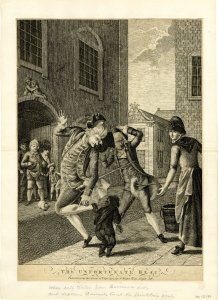
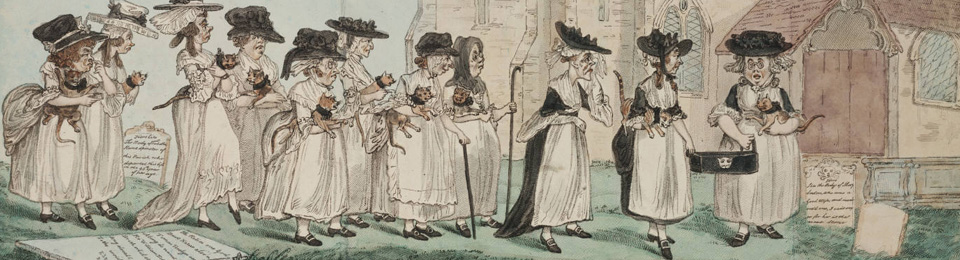
The Unfortunate Beau, etching, Publish'd as the Act directs 12th Sept 1772, by S.Hooper, No.25 Ludgate Hill. British Museum 1991,1214.20

The Unfortunate Beau, etching, Publish’d as the Act directs 12th Sept 1772, by S.Hooper, No.25 Ludgate Hill. British Museum 1991,1214.20

But (in the grand scheme of things) there are only so many newspaper ads and account books and few enough garments, let alone the zebras of garments with solid provenance. The groups are smaller still when you consider relevance to what you need or want to know or replicate. Small state? You’ll have a small pool.

So we turn, often, to images. Here again, provenance is helpful when we look at a portrait. Even knowing the maker is helpful: Ralph Earl or James Earl? Portraits by brother James aren’t the same level as those by Ralph, so you get a different kind of information. But that’s all quite aside from what’s contained within the image– and that’s even before you begin to consider what you are doing when you replicate the image.

Understanding the symbols and meanings of images and objects is slightly esoteric but questioning your sources (Interrogating the Object, if you will) allows you to better understand what the heckers you are doing and how it may be perceived. In the pursuit of historical clothing, living history and reenacting, that is more important than we credit. Do we really know what the sources mean? I’ve argued before that we don’t-– and that doesn’t mean DON’T it means USE WITH CAUTION. We’re long removed from the details of, say, satirical engravings that lack a literary source, so those need especial caution as sources. We lack the context.

The Bargain Struck, or Virtue conquer'd by Temptation. Mezzotint, 1773. British Museum 1935,0522.1.130

The Bargain Struck, or Virtue conquer’d by Temptation. Mezzotint, 1773. British Museum 1935,0522.1.130

Now, if your goal is straightforward: replicating costume for fun, say, you will care less about the notion of meaning within images than someone who is trying to understand the past by inhabiting the clothing with the hope of gaining insight into the worldview of the past. That second category is possibly a more tortured group of souls than the first, laboring as we do at an impossible task.

We are talking about semiotics here, and if you want a quick intro, The Signs of Our Time by Jack Solomon, PhD clocks in at 244 pages including bibliography. It’s old– 1988– and perhaps oversimplified, but we’re not in graduate seminar here, so it will do for our purposes. Solomon’s book contains a handy list he calls the Six Principles of Semiotics:

  1. Always question the “common sense” view of thing, because “common sense” is really “communal sense”: the habitual opinions and perspectives of the tribe.
  2. The “common sense” viewpoint is usually motivated by a cultural interest that manipulates our consciousness for ideological reasons.
  3. Cultures tend to conceal their ideologies behind the veil of “nature,” defining what they do as “natural” and condemning contrary cultural practices as “unnatural.”
  4. In evaluating any system of cultural practices, one must take into account the interests behind it.
  5. We do not perceive our world directly but view it through the filter of a semiotic code or mythic frame.
  6. A sign is a sort of cultural barometer, marking the dynamic movement of social history.

Now that you’ve read the list, perhaps what I obsess about will be clearer: we don’t fully understand the culture of the past. We don’t have the same semiotic or mythic filter than the people of the 18th century had, but when we recognize first that they had a filter, and second that the filter varied from culture to culture, we can better understand our sources.

If you can accept that the cultural filters of England and France and the United States were all different, perhaps it will be easier to accept that you cannot mimic a French fashion plate in portraying a middle-class New England woman without encountering some questions. But if you replicate that fashion plate for the pleasure of experiencing that fashion moment, that’s another game altogether.

Intention matters. Your goal will dictate your sources, and how you use them. As committed as I am to the everyday (because no one is documenting us or saving us, no matter how desperately we try to signal our being with Facebook and Instagram posts), I’m not suggesting that we all attempt to recreate the same past. I’m arguing that we strive to understand what we are doing (dressing up, portraying a specific character, portraying an archetype) and that when we know what we are doing, we understand better how to use the sources we have.
Fashion, Fantasy, and Intention

Tags

, , , , , ,

Fort-based: as military as I get.

Fort-based: as military as I get.

I am not a costumer, not really. But I’m not really a re-enactor in the classical sense: I no longer roll with a military unit and my military experiences are typically fort-based domestic activities. My favorite events have me representing women’s work in the past, the quotidian experiences of ordinary people. Documentation is my thing: what happened on a particular day, in a particular place. Who was there? What were typical clothes? The foods in season? The gossip of the day?

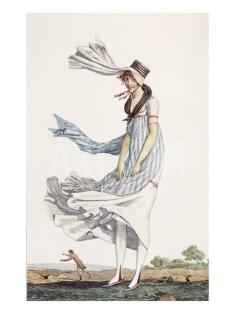
A Lady's Summer Promenade Dress, 1800.

A Lady’s Summer Promenade Dress, 1800.

And yet. Everything I do is really a fantasy, even when it’s work. We are not [yet, always] using the actual words people spoke or wrote. We typically inhabit characters who are grounded in fact but for whom we do not have full documentation. We are representations. We are playing, more than we are being.

I could easily be persuaded to take a walk along a sea wall  or coast to collect seaweed samples for pressing. This would inch me into Austen territory, especially if my friends will join me. I’ve even gone to the lengths of acquiring an appropriate hat, and to make another gown is but nothing in the pursuit of happiness.

Mary Gunning, Countess of Coventry. Jean-Étienne Liotard,.

Woman in a Turkish interior Pastel on vellum, Jean-Étienne Liotard, 1749. Museum of Art and History, Geneva.

If I could truly be a fabulist, I might be tempted to adopt a style a la Turque, for a portrait by Copley or for my paramour. This portrait by Liotard– who was known for his Ottoman works—  is a great temptation, with her patterned overdress and belt with golden clasps, though she is thirty-three years earlier than The Abduction from the Seraglio, Mozart’s comedic and trendy 1782 opera.

If I made myself a Turque (and Reader, it is tempting though useless), I will confess it would be for the multiple pleasures of wearing it, knowing why it had been worn in the past, and for the pleasure of having it taken off me. Because we forget what the European fascination with exoticism and Orientalism meant: they meant sex. The Abduction itself is, in essence, a tale of sex trafficking.

And that is something we do forget about the past, that the clothing we adopt as we portray the past had meaning– sometimes a meaning we miss, when we layer costume upon clothing. Wives and mistresses alike were portrayed a la Turque, and some theorize that this style of portraiture was chosen to portray the sitter in timeless, classic dress. For Copley’s sitters, it was a way to be at the height of London fashion; for Lady Mary Montagu, Turkish dress allowed her to travel freely in the Ottoman Empire. But portraits of women in Turkish dress situated in Turkish interiors were also allusions to polygamy and to sexuality, and there is no way of escaping the fact that paintings of women were largely made for men.

So what, then, of fantasy dressing in the past? What sense can we make of historical representations of “Oriental” fashion? How do we understand what our clothing and our appearance means? Every choice we make is layered with meaning, in the present and in the past.  For women, routinely objectified by society, the meaning of our clothing is particularly important, even when, or perhaps especially, when it is not what we want to focus on.


Documented Fantasies

Tags

, , , , , , , , , , ,

It was three years ago on a warm August afternoon in the museum room we’d turned into a photo studio when I quipped, “All my fantasies are documented.” It’s been hard to live down ever since.

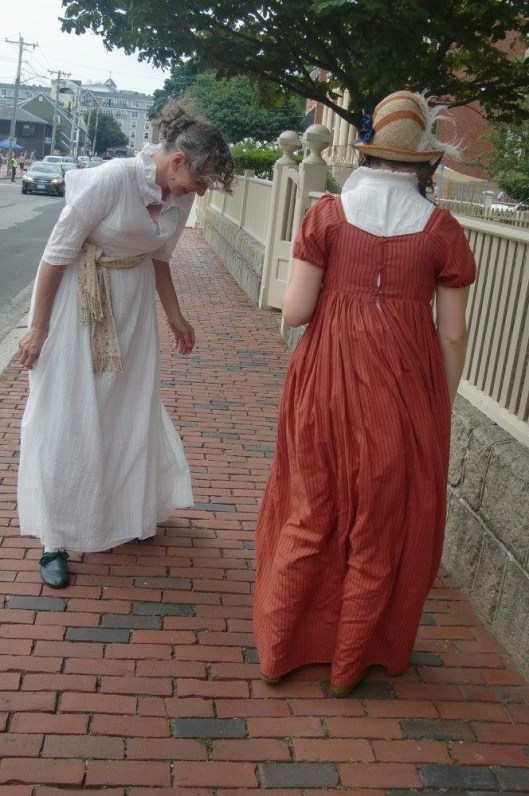
With Mrs B watching Miss B self-perambulate upon the sidewalk.

With Mrs B watching Miss B self-perambulate upon the sidewalk.

Documentation, research: we all do it, everyone who reads this blog does it. What matters is how you use it– or, maybe even more importantly, how well you understand how you are using your research. This past weekend was the Salem Maritime Festival, and round number three for me in the West India Goods Store (WIGS, which sounds far more political than it is). The year was 1804, and as you may recall, that required a new dress.

Reader, I wore it. And it survived!

Yes, it is made from an IKEA curtain. The pattern is my own, derived from examples in Janet Arnold, at Genesee, and the KCI. Once again, I discovered the power of upper body strength and leverage. It’s not that my stays are too big necessarily. The busk is too long, that I will grant you. But I think the shoulder straps are as well, and the shift– that slattern! She was rolling a la Renaissance Faire, which is completely unacceptable, of course, as she slid down my right shoulder by the end of the day when the shop had been unpacked into the conveyance.

So let us focus on the non-slattern part of the day, when a mercantile enterprise briefly overtook the WIGS.

There was some custom, though numerous debts were recorded in the ledger.  (Somehow, there are no images of Mr K sweating over the figures in the book, though I recall them clearly.)

IMG_7634 (1)

The shop was hot, but we attempted to stay fed and hydrated, as we discussed the various kinds of goods imported to places like Salem and Providence in 1804. Politics were rather difficult to discuss, as Mr K has a marked antipathy for Mr Jefferson that caused a mild agitation; expanding the country does seem a bold and perhaps unconstitutional move, given the deal Mr Jefferson has struck with Bonaparte, but perhaps this is for the best. The Indians will surely benefit from Christianity and education.*

It’s engaging in the moment, and we’ve done our research. But it’s a fantasy nonetheless, a kind of happening grounded in primary sources and material culture. I’m OK with that– I understand what I am doing– but I wonder sometimes if the people I’m watching on social media understand what they are doing with the fantasies they portray.


* To be SUPER clear, I’m staying in character here. I worked in Missouri and I have enough understanding of “manifest destiny” to disagree with this point of view.

Friday’s Fright: A Dress in White

Tags

, , , , , , , ,

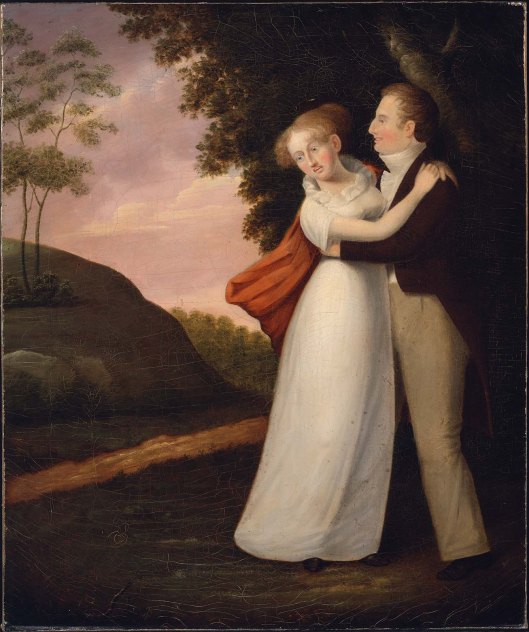
The Frightened Girl, oil on canvas by Cephas Thompson ca. 1810. MFA Boston, 1986.397

The Frightened Girl, oil on canvas by Cephas Thompson ca. 1810. MFA Boston, 1986.397

Two paths crossed for me this week, both in the early Federal era. Cephas Thompson, a self-taught New England painter, recently became very interesting to me. Although he grew up in Massachusetts, Thompson painted extensively in Virginia, but also in Providence, so of course the story resonated with me. But even more than the story, I loved the images. What a show the portraits would make– and he seems to have painted miniatures as well– so when I met with a local preservationist who turned out to be a fellow art school fugitive, wheels began to turn.

“What clothes!” my new friend said.
“I can get you a room full of people in those clothes,” I replied. And what fun would that be, a gallery opening where the people in the portraits appear to have come to life? Beats the pants off mere mannequins, but keep your Cossacks on: this one’s gonna take a while. In the meantime, what about those clothes?

Salem Register, July 14, 1803.

Salem Register, July 14, 1803.

Saturday marks the third time I’ve been part of the Salem Maritime Festival, and once again the West India Goods Store will be the base of operations for a mercantile enterprise. Millinery has its charms, but this year, the park historian shared fascinating notes on “She Merchants” of Salem, and the Hathorne sisters really intrigued me. Drunk Tailor dug into online newspapers (harder than ever to access remotely) and found an 1803 issue of the Salem Register

That’s an incredibly helpful list of goods to sell (and to pack from the Strategic Fabric Reserve), but a new year means a new dress, of course, and for reasons still not entirely clear to me, this seemed like exactly the right time to wear white. That’s sort of where Cephas Thompson comes back into play: white dresses.

Mrs. Cephas Thompson (Olivia Leonard). Oil on canvas by Cephas Thompson, 1810-1820. MMA, 1985.22

Mrs. Cephas Thompson (Olivia Leonard). Oil on canvas by Cephas Thompson, 1810-1820. MMA, 1985.22

There’s a pile of white cotton and white linen on my table, ready to be packed up this evening: with the dress on for a fitting, I felt like a bowl of whipped cream, the red silk Spencer and scarf the cherry on top. Happily, white and red are documentable to New England, though I would be mortified to be as frighted of a garter snake as the girl in Thompson’s painting. Strawberries and coffee are entirely different, and I shall probably require a bib for Saturday, lest my whipped cream be spoilt.

Forsaken Friday: a love letter from 1800

Tags

, , , , , , , , ,

Once again, I begin to consider What Cheer Day, and, feeling uninspired, I turned to primary sources, thinking that reacquainting myself with the characters might prove useful. Among the documents I read today was this letter written by Carl F. Herrreshoff (late of Prussia, but now in New York) to Miss Sally Brown of Providence.

New York 17th June 1800

I hasten my dear Sally to answer three of your letters, two of which, one by Gideon and one by the mail, I received yesterday. I am glad to know you at your favourite place, and the more so as I am well convinced you will think of your absent friend on visiting those spots where we have been so happy. That moments like those should ever return, I thought it folly to hope until a few weeks since; a little lonely spot, where I would quietly reflect on what is past and love you with a pious resignation, was all I dare to wish for, but my love is too powerful for my reason, one beam of light was sufficient to give another turn to my imagination, and your last letter has compleated it. I begin already to see a chain of melancholy days in my solitude, I begin to think myself entitled to more happyness, what ever reason may say to the contrary; but taught by sad experience, like you my dear Sally, not to anticipate much happyness, I shall guard my heart from being to sanguine.One happyness I am not however determined to enjoy, let the consequences be what they will. I will see you, dear excellent girl, I will hear it confirmed from your lips that your heart is above the caprices of fortune, that it is as constant as my own. But though I feel now as much alacrity to obey your command as ever, it is not in my power to do it immediately. I have fixed to go to Philadelphia for a few days; I shall be as expeditious as possible, and on my return the first packet shall convey me to you. I rely on finding you at Point Pl. for I feel very averse to go to Providence. Ursus is in the same condition with your little mare, and I have sent him to the pasture, but I will try to get another horse.
Think of your promise: let me find you in good health and spirits; as for my own health, though never blooming, it is very strong, it have never been really affected from all my mind has suffered these ten months past, and since I have entertained the prospect of meeting you again, I feel as if there had been a great change in my fortune.
I lament that our pleasure will be chilled by the situation of poor A. Let us be ever so good we cannot escape our share of misery in the world, every one must have his turn.
As for your request regarding H I assure you, that if
I made a confident of him in matters which concerned you, it was of my own sentiments merely.
Adieu my charming little Sally, I expect a letter from you dated from Point Pl. forget not to direct all your letters in future to the care of John Murray & Son. Is Mr Coggeshall’s house still a tavern in Bristol? You shall soon hear again from

Your sincerest friend
Herreshoff

I think it proper to write to your father before I go to Providence, are you not of the same opinion & if I should write from here, before I receive your answer, I shall enclose my letter in yours.

Carl Herreshoff to Sally Brown, 17 June 1800.
MSS 487, Herreshoff-Lewis Family Papers
RIHS Manuscripts Collection

A month after this letter was written, “poor A.” gave birth to her first daughter, Abby Brown Mason, a day after marrying James Brown Mason, the child’s father. It was not until 1801 that Sally Brown married Carl Herreshoff, despite her father’s misgivings. John Brown never really liked his sons-in-law, and given his nickname of “Old Thunder,” you have to wonder how they felt about him.

For me, this letter full of longing and acquiescence to a powerful love, has resonance beyond its years. Distance is easier to overcome today, to a degree, but letters remain a poor substitute for a lover.