Not by Half (robes)

Tags

, , , , , , ,

two ladies looking out a window in 1790s garments

The Frail Sisters, 12 May 1794. British Museum, 2010,7081.1077

Here’s the British Museum’s description of this print: “Two young women dressed in fine clothes in a room with decorated wallpaper, one sitting in front of the window looking onto the street, with a pet squirrel on her lap, turning to smile towards the viewer and pointing at herself, while the other stands behind her chair on the right. 12 May 1794.” It’s good to get the pet squirrel question out of the way.

This is another print that’s hard for us to read completely: you might wonder why they’re called the Frail sisters. Is Frail a proper noun, an adjective, or something else? It’s probably code: frail here may well refer to the strength of their morals rather than their biceps.
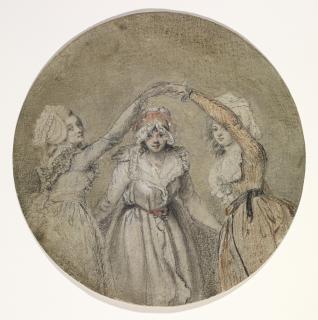
he frail sisters John Raphael Smith (1752-1812) Chalk (black and coloured) on paper (given a light grey ground) Height: 19.4 cm (circular); Acquisition Witt, Robert Clermont (Sir); bequest; 1952 D.1952.RW.4037, Copyright: © The Samuel Courtauld Trust, The Courtauld Gallery, London

The frail sisters
John Raphael Smith (1752-1812)
Chalk (black and coloured) on paper (given a light grey ground) Height: 19.4 cm (circular);
Witt, Robert Clermont (Sir); bequest; 1952
D.1952.RW.4037, Copyright: © The Samuel Courtauld Trust, The Courtauld Gallery, London

There’s another Frail Sisters drawing, also 18th century, probably late 1780s-early 1790s. This is appears to be a ‘straight’ drawing, but I don’t know: it could be an artist’s portrait of three prostitutes at play. Or it could be actresses (they weren’t so very far from prostitutes and courtesans).

Mrs Frail appears in William Congreve’s Love for Love; do these images also reference characters first seen in Restoration comedies? This is stuff I haven’t thought about in a long time, so I can’t yet unpack how the title and meaning of the print relate to what the women are wearing. And I might be over-thinking things a bit, so let’s step back and just look.

What is the standing sister wearing?

A half-robe, indoors. Time of day, indeterminate, but perhaps morning.

The Farmer's Door. George Morland, London: Published by J. R. Smith, King Street, Covent Garden, Aug. 4, 1790

The Farmer’s Door. George Morland, London: Published by J. R. Smith, King Street, Covent Garden, Aug. 4, 1790

A somewhat easier image to read is the print after George Morland’s The Farmer’s Door, from 1790. This genre painting presents the romanticized vision of humble life, with the farmer’s wife and her children (note the blue stays on the seated child).

Is the farmer’s wife wearing a half-robe over a quilted petticoat and apron? The quality of the images I can find is poor, and the coloring questionable.

In another version here, the kerchief is clearer and seems to go over a long-sleeved garment with a short skirt.
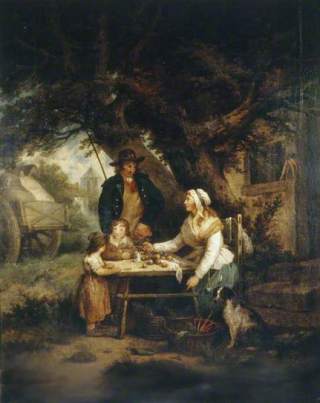
Selling Carrots by George Morland Date painted: 1795 Oil on canvas, 76 x 63.5 cm Collection: Brighton and Hove Museums and Art Galleries

Selling Carrots
by George Morland
Date painted: 1795
Oil on canvas, 76 x 63.5 cm
Collection: Brighton and Hove Museums and Art Galleries

In Selling Carrots, there is another short-skirted garment with long sleeves worn over a petticoat and with a kerchief.

Without getting overly distracted by titles and meaning, I think there are clues to how these half-robes or jackets are worn by women of different classes, aspirations, and locations. For rural women who are not gentry, these appear to be comfortable working clothes worn all day. For urban women, they seem to be worn early in the day, and sometimes out of doors, perhaps even to the lending library.

Half Robe or Jacket: How Do You Wear One?

Tags

, , , , , , , , , , , , , , , , ,

Half robe, 1790-1800. National Trust Inventory Number 1348749,

Half robe, 1790-1800.
National Trust Inventory Number 1348749,

What Cheer Day is coming, and I hate to miss an opportunity to make a new gown (despite having just made one, and despite needing to make some waistcoats and trousers for the event). While I lay awake last night, I pondered my options, and whether a half gown would be suitable.

Although I have concluded it probably is not, I was curious about how these should be worn. Where can you wear such a garment? Is it only suitable for at-home use?

This is the robe from Nancy Bradfield’s Costume in Detail, replicated by Koshka the Cat here, and approximately by me, here.

Since I will be a housekeeper again, I think a gown is more correct for me, but that doesn’t stop me thinking about half robes, and whilst scrolling images by year at the Yale Center for British Art, I found this by Cruikshank:

ladies in a lending library

Isaac Cruikshank, 1756–1810, British, The Lending Library, between 1800 and 1811, Watercolor, black ink and brown ink on medium, lightly textured, beige wove paper, Yale Center for British Art, Paul Mellon Collection

There’s a lot to love in this image, even with its fuzzy “between 1800 and 1811” date. Not only do we get an array of reading material (Novels, Romance, Sermons, Tales, Voyages & Travels, Plays), we get costume tips and– special bonus– a dog gnawing its leg.

(If you are curious about some of the books in the Library at the John Brown House, check out this tumblr bibliography. I’ve been using it of late, and the representative genres are quite similar to what we see in the Cruikshank.)

We also get a chemisette on the lady at the counter, along with a very dashing hat, a fancy tiered necklace on the lady in pink, who also carries a green…umbrella? Parasol? With just a veil, that seems likelier than the longest reticule ever.

I like our Lady in a Half-Robe and her deep-brimmed bonnet showing curls at her brow. She and her companions show the range of white and not-white clothing seen in early 19th century fashion plates, and the range of head wear, too.

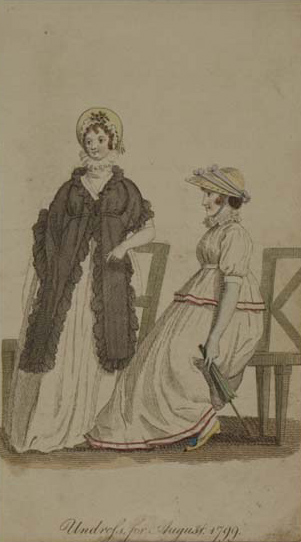
Undress for August, 1799. Museum of London

Undress for August, 1799. Museum of London

The last question I’m asking myself, though, is whether the yellow garment is a half-robe or a short pelisse or a jacket. And can you wear a half robe out of doors? And what did the ladies of the period call that garment?

In this fashion plate (featured by Bradfield on page 84, found by me at the Museum of London), the lady on the right is certainly wearing a short upper body garment, and I’d wager that she’s out of doors or headed that way, since she’s carrying a (green) parasol. Bradfield calls her garment a “jacket,” and until I can find the text of the Ladies’ Monthly Museum for August 1799, perhaps that is the term we should use instead.

While two images aren’t a lot of evidence, it does appear possible to wear a half-robe or jacket out of doors for informal visits in clement weather, and finding two is as good a reason as any to look for more.

Malaise or Ennui?

Tags

, , , , , , , , , , , , , , , ,

image Hard to say which, but I am ill at ease and dissatisfied with my costuming. You might even call it bratty. But I don’t wanna be like Bridget Connor!

It started the week of the Stamp Act protest, when I felt quite tired of being the shabby, unrefined woman of the regiment and street vendor, and wanted a nice cozy shop like the milliner had. I was also looking forward to being a housekeeper again, and several weeks of moving boxes and volumes with red rot at work had me feeling generally filthy and unappreciated. Bratty.

When in doubt, sew. A new dress can’t help but cheer you up, right?

Well… sort of…

Last Thursday, we did a reprise of the Williams family letters program at the Newport Historical Society. The Williams family were Quakers, and the letters were from the early part of the 19th century, so for the program in March, I made a green silk cross-front gown based on the Quaker gown in the back of Costume in Detail. (Check out the schematic on the 19thus.come page; I didn’t see this until I was mostly done with the dress, but thank goodness I got it right!)

But it’s September, and Thursday was expected to be quite warm, so I salved my bureaucratic wounds in the $1.99 loft at the local mill store, and made a new Quaker gown, also suitable for a maid.

I ask you! Even though it’s my very own pattern based on sketches of original drawings, even though it fits, even though it cost $10, even though every seam is overcast and the whole thing is made with period correct stitches, it still fails to make me happy and cheerful and delighted.

image

This brattiness has resulted in a reappraisal of my approach– and a trip to Sewfisticated in Framingham. What did I buy there? Yards and yards of pink taffeta? Gold taffeta? Blue taffeta?

No.

Because they didn’t have the right colors in the right weave– too slubby– or in enough yardage. Brace yourselves: I bought brown.

Many thanks to Sew 18th Century for taking the photos!

Many thanks to Sew 18th Century for taking the photos!

It appears I do not learn from my mistakes. When I think, “Gee, I’d like a pretty dress,” I end up buying fabric based on the texture as much as the color, and I have to tell you, that brown taffeta has the most wonderful l hand and sheen, and I will look much more like a Copley portrait than I ever have before, so that’s something.

It seems I have created a set of mental rules for myself, a mission, if you will, for the historic clothing I sew and the roles I take on, and I only play within those rules.

Wash on Monday

Tags

, ,

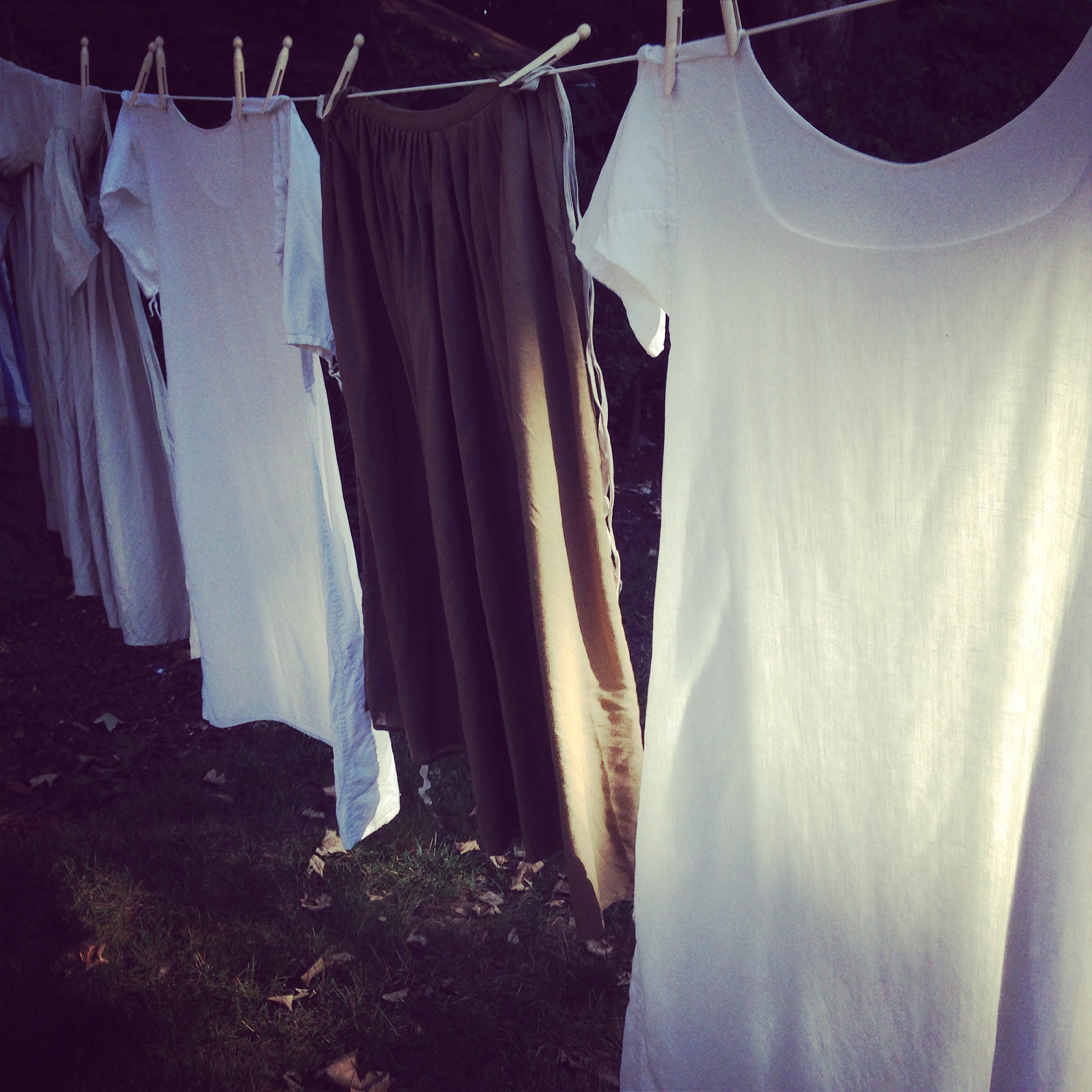
shifts and petticoats on a line

Living history laundry

We spent Labor Day laboring at home: even the Young Mr spent the day working on a five page essay (due Wednesday) for history class. I spent the day tidying the house and washing clothes from all centuries.

Of our historic clothes, I don’t often wash more than body linen (shifts, shirts, stockings) but the petticoats had not been washed in some time; in the end, I washed the tow and blue striped one, but only aired the Virginia cloth and madder linen. Since I may not wear these again this year, washing and airing seemed warranted.

It’s incredibly easy to wash in this century, with the luxuries of indoor plumbing, a hot water heater and a washing machine. At Walloomsac, though I didn’t do any laundry, we were always fetching water, and I think of how much water we use, and how easily.

chintz and checked clothes on a  clothesline

Red, white and blue

While I stitched a dress (new, though the mending pile is growing), I listened to biography of the Buddha, and thought about mindfulness and living history.

What is there to learn from sewing a gown, or hanging my wash on the line? How much does it matter that sunlight makes my shifts brighter, or that the dress in my lap is not a exact replica of an extant garment, but rather one made using period techniques, a close analog of a period fabric, and is cut to period style?

So little remains of the vast middle and smaller lower classes that it would be stifling to limit oneself only to exact replicas. And in any case, we can never recreate the mindset or worldview of the people of the past. We can only mimic their processes, read their words, and study the things they have left behind in our best attempts to understand them.

Two Decades in…

Tags

, , , , , , , ,

Tureen in the wild

Tureen in the wild

On Wednesday, Mr S and I will mark our twentieth wedding anniversary, and due to some unfortunate timing, one of us has a medical procedure scheduled for that day, so we won’t actually celebrate on the day itself. (In sickness and in health, you know…)

Instead, we went antiquing in New Bedford on Sunday, after Mr S spent Saturday clearing brush at Minute Man National Historic Park. New Bedford was a nice change from the places we usually go in Rhode Island, and I always enjoy looking in Massachusetts, because objects there are typically free of Rhode Island connections, which means I can actually make encumbrance-free purchases.

I don’t know how encumbrance-free this purchase was…for now we are encumbered with a large hard paste porcelain tureen decorated with cranes and a federal eagle.

The platter it sits on may not be its original platter, but do I care? No. Look at that fantastic, crazy thing. The face the Young Mr made when this was unwrapped in front of him was priceless, but he has long questioned my sanity; now he will question my aesthetics.

Pride of place, with a friend's painting and Mr B's hats

Pride of place, with a friend’s painting and hats by Mr B

It sits in pride of place on our mantle now, and as far as I can tell, it’s typical of the shape of tureens made for the American market ca. 1790-1810. I’ve not seen the cranes before, and I still haven’t found this pattern in a museum or auction house, though Winterthur’s tureen collection is pretty amazing.

If the thing is real (and it looks and feels like the real ones at work), its voyage has been  incredible: from China to a port in Massachusetts, down through time to a shelf in an old mill building, to my mantle.  Think of the person who ordered this– and the set it was likely part of– by letter, and then waited for months for the goods to arrive. Some sets were as large as 250 pieces, custom-monogrammed at the factory, and then packed into barrels and crates lined with straw and loaded onto ships bound back to the East Coast.

I’d love to know this piece’s story, but even without a provenance, the object itself is pretty astonishing, and fits into our already eclectic china (and yes, mantle business).  Now, for a soup party!