• Home
  • Completed Costumes/Impressions
  • Emma and Her Dresses
  • Free Patterns and Instructions

Kitty Calash

~ Confessions of a Known Bonnet-Wearer

Kitty Calash

Tag Archives: 18th century clothes

What Cheer! Wednesday

22 Wednesday Oct 2014

Posted by kittycalash in Living History, Museums, Uncategorized

≈ Comments Off on What Cheer! Wednesday

Tags

18th century clothes, 18th century clothing, 19th century clothing, interpretation, John Brown House Museum, living history, Museums, Reenacting, Rhode Island, Rhode Island Historical Society, weekend, What Cheer Day, work
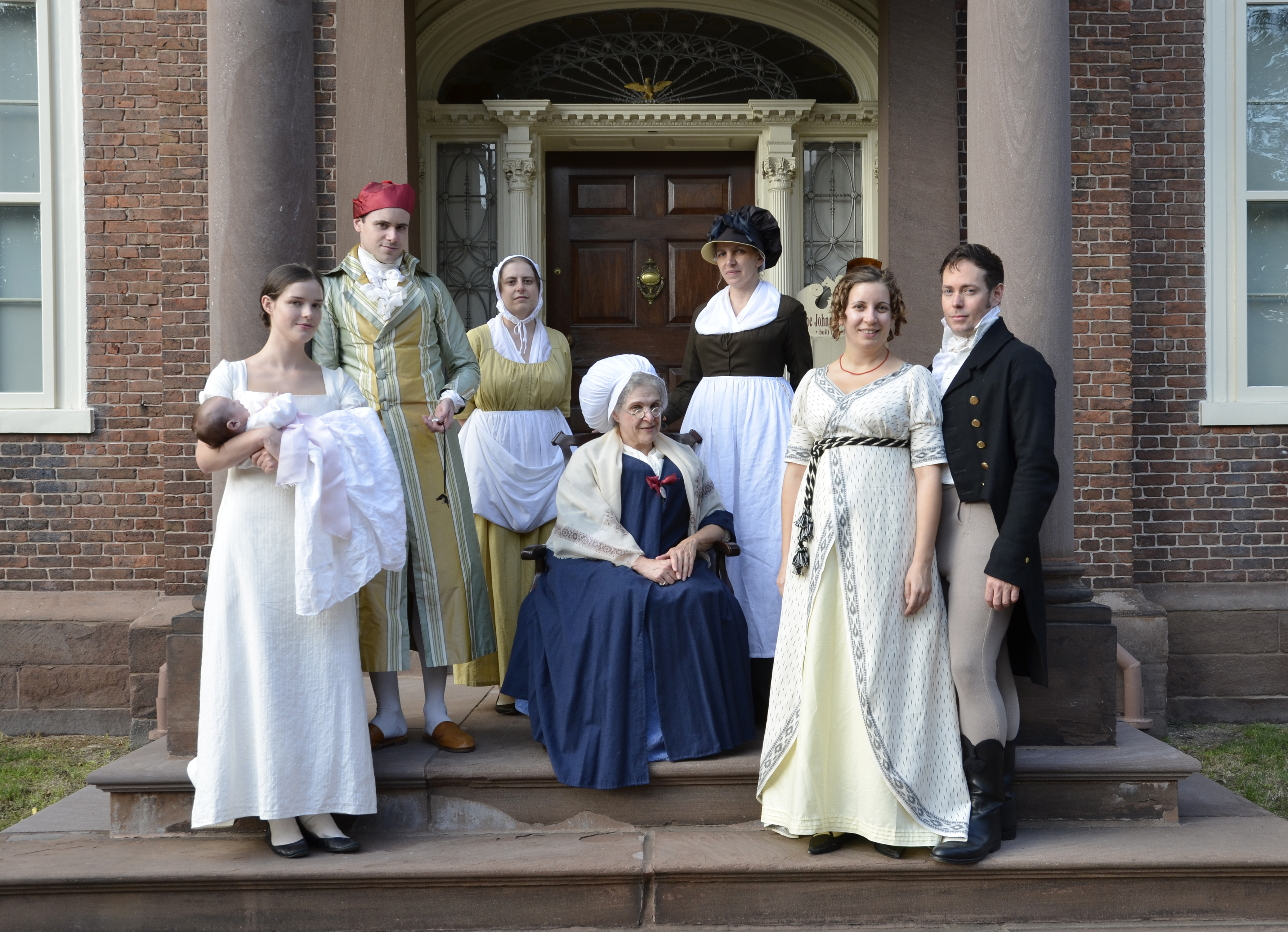
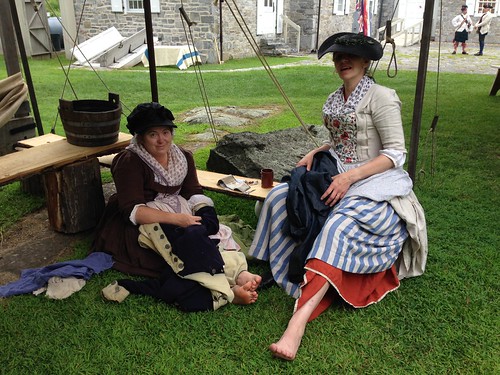
The cast at the end of the day

The cast at the end of the day

Where are you going this weekend? I’m going to Providence in 1800, along with my family and friends.

The mantua maker is coming, and writes a very pretty letter about the new fashions she has found for the young ladies.

Mr Herreshoff and Miss Brown hope soon to be married

Mr Herreshoff and Miss Brown hope soon to be married

Mrs Brown will be in, and receiving guests, and we hear that Mr Herreshoff will come to call as well. While he may decry the state of the roads, we expect him to have news of business conditions in New York, and his prospects for the future.

Miss Alice– Mrs Mason, now– will be at home with her sister, Miss Brown, and Mr Mason is living here now as well. I do not know how I shall keep their room in order, since he is hardly outside of it!

There are other visitors I expect as well; there is a man (I cannot call him a gentleman) who has been doing jobs for us, though he does not live here at the house. He seems extraordinarily interested in the house, and will not stay away. Whatever can be his interest? There may also be a tailor and his apprentice– though the apprentice tends to daydreaming, and looks above his station, studying Latin at all hours. I think he will not be long in his apprenticeship if he will not pay attention.

If you have not visited us before, you can find directions here.
 

Share this:

  • Share on Facebook (Opens in new window) Facebook
  • Share on Pinterest (Opens in new window) Pinterest
  • Email a link to a friend (Opens in new window) Email
  • Share on X (Opens in new window) X
Like Loading...

Coats and Cooking

11 Monday Aug 2014

Posted by kittycalash in Clothing, Events, Food, History, Living History, Making Things

≈ Comments Off on Coats and Cooking

Tags

10th Massachusetts, 18th century clothes, 18th century clothing, authenticity, Bennington, Brigade of the American Revolution, Clothing, common dress, common soldier, cooking, Costume, dress, Events, food, living history, menswear, Reenacting, Revolutionary War, style

And happy not to be walking to Walloomsac, since we can’t leave till Friday.

Before we leave, there’s plenty to done, of course, and most of it in men’s wear.*

The first piece on brown linen

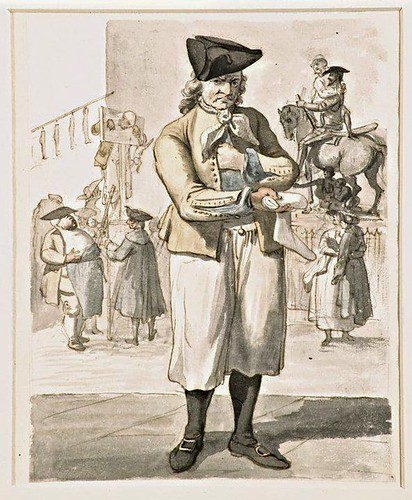
The Young Mr needed a new jacket, a proper one, with pockets and everything, correct for a scalawag. So that meant patterns and muslins and fittings and questions, until neither of us could really stand the other and his father called me an ambush predator of fittings. The only way to fit these wily creatures is, as they amble through the room, to leap out and toile someone.

With the pattern more-or-less fitted to the wiggly Young Mr, I cast about for fabric: there was not enough of a striped piece for both waistcoat and jacket; waistcoat won, because matching stripes on a jacket seemed too risky in this great a hurry. Instead, I sacrificed the last yardage once meant for a gown.

The Stocking Seller, by Paul Sandby, 1759

The Stocking Seller, by Paul Sandby, 1759

This is the inspiration for the kid’s new garment, along with Sandby’s fish monger. It seems a plausible garment to work from, and the brown linen is in keeping with the brown linen jacket at Connecticut Historical Society and the unlined linen frock coat recently sold at auction. It will also match his trousers, but this is what happens when you sew from the stash.

One pair of breeches altered, one waistcoat wanting the last seven newly-made buttons, one waistcoat in production, one jacket in production: you’d think that would be enough to get done. But I’m also working to expand my cooking repertoire, as bread and cheese gets tiresome and scrounging broken ginger cakes from the Sugar Loafe Baking Co.— while potentially good theatre–is not a solid plan for sustenance.

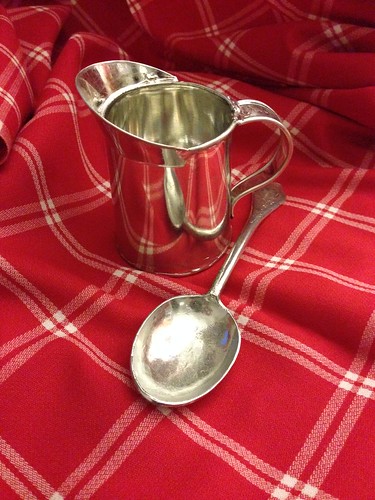
half pint and spoon measures

Half-pint and spoon

Boiling food in summer- sounds awful, right? But it’s an easy and correct way to cook,once you translate recipe measures and control the amount you’re making. I like to use Amelia Simmons’ cookbook, because it is specifically American, and my more skillful friends cooked from it at the farm.

From Enos Hitchcock’s diary, I know that he ate a boiled flour pudding with some venison stew (near the Saratoga campaign, I think) so I consider this a plausible recipe for the field, pending eggs, of course.

A boiled Flour Pudding.

One quart milk, 9 eggs, 7 spoons flour, a little salt, put into a strong cloth and boiled three quarters of an hour.

Simple enough, though Simmons later corrected the receipt to 9 spoons of flour, and boil for an hour and a half. I got out the spoon, and looked online at modern boiled pudding recipes, and will give a modified version a whirl sometime this week (always better to fail at home than in the field). Boiling the pudding in a linen cloth in a stew would make a savory bread substitute…and I really liked the one we had at the farm. Will the gentlemen at Bennington like it? Perhaps we’ll find out. If we’re not cooking with hosewater, almost anything should be edible.

*Yes, it’s a terrible and terribly dated show, but I always hear  this in Mr Humphries‘ voice from Are You Being Served?

Share this:

  • Share on Facebook (Opens in new window) Facebook
  • Share on Pinterest (Opens in new window) Pinterest
  • Email a link to a friend (Opens in new window) Email
  • Share on X (Opens in new window) X
Like Loading...

Hand-woven Linens by Subscription

06 Wednesday Aug 2014

Posted by kittycalash in Clothing, Living History, Making Things

≈ 2 Comments

Tags

18th century clothes, authenticity, Costume, dress, fashion, interpretation, Justin Squizzero, living history, Making Things, resources, sewing, style

In the few short years I have been doing costumed interpretation and living history, I have made three shifts and four shirts and am making up a fifth shirt, with a possible sixth needing to be made, as well as four aprons. I’m not crazy, I just sew that way…for three people (one still growing) who dress for the decades between 1763 and 1812.

linen sample

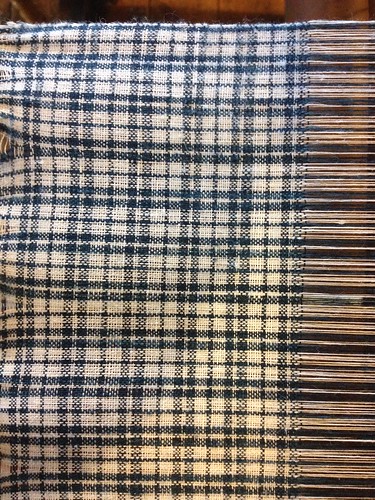
Hand-woven linen: the top edge is the selvedge

There are several annoying factors when sewing historic clothing with modern materials– mostly that the modern materials aren’t quite right, and can be quite wrong. As Sharon Burnston explains on her website, much of this has to do with selvedges— which are not hard, and rarely tucked, now. The other trouble is width: many fabrics now come 54 to 60 inches wide, which means that you have to cut them down when making shift.

There is a solution: hand-woven, period-correct linen, available now by subscription from Justin Squizzero [email to order: justin(dot)levi(at)ymail(dot) com].

Mr Squizzero will weave both plain and check to the width you want: 3/4 (27″), 7/8 (31.5″) and yard (36″) widths, perfectly correct for period clothing.

Hand-woven checked linen

Hand-woven checked linen

The prices are $130/yard for plain bleached, $160/yard for checks– and what checks! Indigo dyed blue and white check in a pattern documented to New England at the turn of the 19th century? Oh, yes, please: I must save my allowance and sew only from my stash.

Although we debated fabric weights this past weekend, here’s what I think, and have found through wearing: shirts for soldiers and artisans– but not the elite–can certainly be made of the white and the check; I would made a shift from the white, but I prefer how my heavier shift body feels and behaves under stays. The check would be ideal, too, for an apron, which would require only one yard.

If you’re wearing a coat made from $120/yard wool dyed with documented colors, shouldn’t you wear the most correct shirt possible underneath? Entirely hand-woven (and hand-dyed in the case of the checks), you’re buying art– but isn’t that what you’re making and creating when you hand-sew your clothes and step into the past?

Share this:

  • Share on Facebook (Opens in new window) Facebook
  • Share on Pinterest (Opens in new window) Pinterest
  • Email a link to a friend (Opens in new window) Email
  • Share on X (Opens in new window) X
Like Loading...

Stony Point: The Overview

28 Monday Jul 2014

Posted by kittycalash in Events, History, Living History, Reenacting

≈ 2 Comments

Tags

10th Massachusetts, 18th century clothes, Brigade of the American Revolution, common dress, common people, common soldier, Events, living history, Reenacting, Revolutionary War

Stony Point Battle Field

In a word: hilarious.

The Young Mr started the weekend with a 5 Hour Grump (no sugar crash!) that started at home and lasted until he spotted a deer in the woods near West Point at 7:17 PM. The situation improved somewhat when we arrived at Stony Point Battlefield and saw Mr and Mrs P. Perhaps at that point he finally believed me that this was going to be similar to Saratoga or Sturbridge: people he knew, doing the things we normally do, in the usual funny clothes.

There’s a rhythm to these that is predictable and therefore comforting: Mr and Mrs P arrive first, then we show up with our traveling circus, and once we are set up and in bed, we stay awake because Mr HC will arrive after dark, and we keep the mallet out to help him, even though he doesn’t really need our help.

I made new IRL friends with people I’d seen on the interwebs, which is always nice, and made solid progress on that 1812 coat, which also passed a fit inspection (thank goodness! I can be taught!).

Cat and Kitty at Stony Point

But the Young Mr really stole the show on Saturday.

Mr FC arrived on Friday morning with his Young Master W in tow, and they were welcome additions, especially when the Young Mr loitered in his tent after nooning, shirking a fatigue. Mr FC and Mr HC each grabbed one of those enormously long legs, and pulled the giggling private from his tent, the sergeant yelling at him all the while. When the kid got on his feet, his slick leather soles betrayed him and he went ass over teakettle in a classic 360 degree Stan Laurel or Harold Lloyd slapstick maneuver that left him unscathed and back upright with surprising rapidity…and all the while, the sergeant yelled at him, “Hurry up! Get dressed and into line! Don’t tell me you still don’t know how to put on your equipment!” which only makes the kid laugh harder, but fortunately also makes him work harder.

I skipped the battle, though I’m told there were some very satisfying deaths at a cedar tree on a small rise; Mr S went down, and the Young Mr tried to revive him with water, but succeeded only in soaking his hunting frock.

The Usual View of the Usual Suspects

Afterwards the battle and a great deal of water, there were not the usual cooking and fire minding chores, since the site provided dinner. Mr FC’s Young Master W had charge of his mother’s camera for the weekend, and since his brother had declined to come, Master W thought it would be a fine thing to take photos of the frequent trains to torment his train-loving brother with.

So Mr FC, Young Master W, Mr S, the Young Mr and I all trooped down the hill to the train tracks, accompanied by Lambchop, who was, in fairness, only wearing a wig and a round hat and not Lambchop itself, and should therefore be known here as Mr M.

So yes: four Continental soldiers and their laundress trooped down the hill with a boy to watch a freight train go by, and to say, Wow! and Oooh! as it sped past hauling containers, some stacked double height, and barely missing the railroad bridge, or so it seemed to us.

Share this:

  • Share on Facebook (Opens in new window) Facebook
  • Share on Pinterest (Opens in new window) Pinterest
  • Email a link to a friend (Opens in new window) Email
  • Share on X (Opens in new window) X
Like Loading...

Fashionable Friday: Floral Embroidery Galore

27 Friday Jun 2014

Posted by kittycalash in Clothing, Frivolous Friday, History, Museums, Research

≈ Comments Off on Fashionable Friday: Floral Embroidery Galore

Tags

18th century clothes, 18th century clothing, 19th century clothing, Bostonian Society, Costume, Events, exhibits, fashion, Massachusetts, museum collections, Museums, style

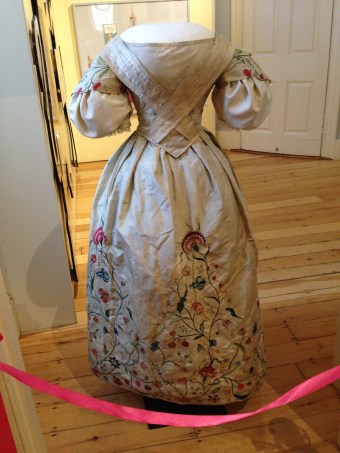
Colonial Wedding dress altered 1830

Elizabeth Bull Price’s Wedding Dress. Bostonian Society, 1910.50.35

On Tuesday evening, sensibility won over sense as my friend and I boarded the T for Boston to make a long day longer. The trip was worth it, though, for the One Night Only engagement of Elizabeth Bull’s wedding dress at the Bostonian Society. In truth, I bought the tickets for the event before I was even back at work and navigating our Fair City on my own– and who wouldn’t? That dress is amazing! (Tons more images of the embroidery are in the catalog record.)

Perhaps even more wonderful than the 14-year-old ElizabethBull’s needle skills is that the dress remains with us today. Kimberley Alexander and Tricia Gilrein reminded us on Tuesday of the many ways this dress, and other remnants of Bull’s wardrobe (oh, the petticoat, and the wonderful kerchief) connect us to the past in surprising ways. Elizabeth Bull was wealthy, married to Roger Bull, a Church of England official 22 years her senior: though they lived in Boston, they were British. (They were married in the 1730s, and Elizabeth died in 1780 at about 67.)

It’s a little hard to see past the 1830s alterations, but the embroidery of the gown helps chart that course, as well as the petticoat. As important to remember is that this wedding gown was not white: it has faded from a celadon green to its current off-white color. Wedding dresses weren’t white in the 18th century, or even long into the 19th, and it’s helpful to remember that as we look at what remains and reconstruct this in our mind’s eye.

It’s easy to forget we were British first here in the United States, and that the American War for Independence did not have a foregone conclusion. We forget, too, that churchmen and their wives were socialites as much as they were people of the cloth. Put Mr Collins out of your mind, and remember (my favorite minister & fashion maven) Reverend Enos Hitchcock and his pink satin waistcoat and suits of black silk.

Photograph of the altered gown. Bostonian Society, 1910.0050.057

Photograph of the altered gown. Bostonian Society, 1910.0050.057

Like many 18th century gowns, this one was remodeled in the 19th century, its shape altered to reflect the current fashion. We are lucky to have so much preserved, not just in the gown but also in the petticoat. Paths to understanding of women’s education, the customs and habits of Boston’s colonial elite, and the persistence of past can all be found within this object.


Share this:

  • Share on Facebook (Opens in new window) Facebook
  • Share on Pinterest (Opens in new window) Pinterest
  • Email a link to a friend (Opens in new window) Email
  • Share on X (Opens in new window) X
Like Loading...
← Older posts
Newer posts →

Archives

wordpress statistics

Creative Commons License
Kitty Calash blog by Kirsten Hammerstrom is licensed under a Creative Commons Attribution-NonCommercial-ShareAlike 4.0 International License.

Website Built with WordPress.com.

  • Subscribe Subscribed
    • Kitty Calash
    • Join 621 other subscribers
    • Already have a WordPress.com account? Log in now.
    • Kitty Calash
    • Subscribe Subscribed
    • Sign up
    • Log in
    • Report this content
    • View site in Reader
    • Manage subscriptions
    • Collapse this bar
 

Loading Comments...
 

    %d