• Home
  • Completed Costumes/Impressions
  • Emma and Her Dresses
  • Free Patterns and Instructions

Kitty Calash

~ Confessions of a Known Bonnet-Wearer

Kitty Calash

Tag Archives: 18th century clothing

Muff-ed Up

11 Wednesday Dec 2013

Posted by kittycalash in Clothing, Making Things, Museums, Research

≈ 2 Comments

Tags

18th century, 18th century clothes, 18th century clothing, authenticity, Costume, dress, fashion, fashion plates, museum collections, Research, satire, sewing

Remember the Amazon? She has the dressed-up dog and the Muff of Doom. I’ve gotten a little obsessed with her, and that obsession has led to some interesting places.
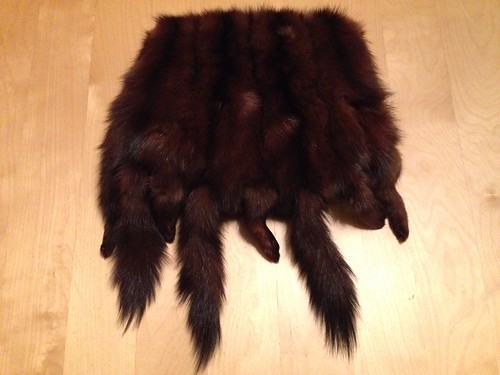
The Muff of Dooms Past. Poor minks.

For one thing, it’s winter, and everybody has cold hands, so everybody is making muffs.

Here at Crazy Scheme Central, I had thought about making the great Ikea sheepskin Muff of Doom, but that’s a place I generally don’t go until after the Christmas madness, when the store in Stoughton does look as if it had been plundered by orcs.

Instead, I bought a Muff of Dooms Past at an antique store. I wouldn’t buy a new real fur anything, and I do feel bad about the poor minks, but at least no new minks were harmed. Or sheep. But golly, it’s soft and delicious and it’s easy to see why people wanted fur, given that we’re essentially hairless mammals. It measures 11 inches high (not including decoration) by 11 inches wide at the narrowest point, and 14 inches wide at the base.

Pupils of nature Maria Caroline Temple delt. ; TS. sculp. London] : Pubd. April 30, 1798, by S.W. Fores, No. 50 Piccadilly, corner of Sachville [sic] St., [1798]. Lewis Walpole Library Call Number 798.04.30.01+

Pupils of nature Maria Caroline Temple delt. ; TS. sculp. London] : Pubd. April 30, 1798, by S.W. Fores, No. 50 Piccadilly, corner of Sachville [sic] St., [1798]. Lewis Walpole Library Call Number 798.04.30.01+

The Muff of Dooms Past is not nearly as large as the Amazon’s muff, or as large as the ones seen in fashion plates and satires.  The sad little tail-and-paw fringe has precedent (see left), though I believe at least one tail has been lost. As far as I can tell, with no label, this is probably a 1950s muff of local manufacture (there is a fur company, now in Warwick, that started in Providence, and is now going out of business). It could be earlier, but the flexibility of the pelts suggests a more recent vintage.

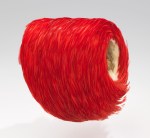
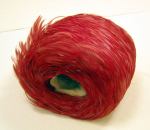
The Met has some fantastic late 18th/early 19th century muffs of a color that screams warmth. The size of the brighter one is just 8 by 7 inches. In case you think that’s anomalous, here’s another muff of similar type and size.

Muff, early 19th century. French, of feathers, wool MMA 2009.300.1397
Muff, third quarter 18th century. British of feathers, fur MMA 1984.101

They seem small compared to the Amazon’s muff, and even the Student of Nature’s. And yet, there they are. It’s hard to know exactly where the measurements were taken, and if they include the extreme fluff of the feathers; I tend to think not, but that the measurements are for the firmest part of the muff. (That’s how we would measure, and then include the largest “fluff” measurements in a ‘special measurements’ field with a note.) There is a 1780-1820 swan’s down muff at the V&A with a record but no photo or measurements.

Satires are hard to use: we know they’re depicting some grain of truth, usually in the background details, but also in what they’re portraying. How do we interpret those enormous muffs? They appear over and over, in consecutive years of satirical engravings and fashion plates. Maybe the way to interpret them is to see those muffs as the extreme end of fashion– Alexander McQueen muffs, if you will– and the extant muffs represent the more reasonable dimensions of fashion. I wouldn’t call red feather muffs typical, and I wouldn’t suggest we all carry them. But based on what exists in museum collections, maybe a smaller-than-satire muff is within the bounds of reason for actual use.

Share this:

  • Share on Facebook (Opens in new window) Facebook
  • Share on Pinterest (Opens in new window) Pinterest
  • Email a link to a friend (Opens in new window) Email
  • Share on X (Opens in new window) X
Like Loading...

“Unsuspected Cat”

04 Wednesday Dec 2013

Posted by kittycalash in Clothing, History, Museums, Research

≈ 4 Comments

Tags

18th century clothes, 18th century clothing, cats, Clothing, Costume, dogs, domestic pets, Emma, fashion, lewis walpole library, material culture, Mr Knightley, Research, satire

Squatting plump on an unsuspected cat in your chair!! George Cruikshank [1800]. Lewis Walpole Library, Image ID lwlpr09721 Call Number 800.00.00.176+

The Lewis Walpole Library provides endless amusement, and searching by subject yields some fun. People have had curious relationships with domestic pets for a centuries, and thank goodness cats invented the interwebs so we could get real perspective on this.

Quite aside from the minor domestic comedy of this engraving (I dislike the dark of winter and take my fun where I can), we can learn a lot. The domestic comedy itself helps remind us that while the people of the past saw the world differently, they were as foolish, bawdy and rude (or more so) than we are.

From a material culture perspective, we have (among many things):

  • a geometrically-patterned floor covering, probably a carpet but possibly painted.
  • floor-length curtains
  • looking glasses, paired
  • a slip-covered easy chair, matching the curtains and the cat’s cushion
  • two candles (only two!)
  • glasses with the characteristic straight temple pieces that end in loops
  • a colored open robe over a white muslin petticoat
  • a young gentleman in trousers, an old gentleman in breeches

I can imagine this depicting Emma and Mr Knightley (after their marriage) at home after dinner with her father and their young son: Mr Woodhouse in his nightcap and banyan, reading; Mr Knightley upset by the cat, while the Spaniel barks at the excitement.  All in all, highly satisfying.

Share this:

  • Share on Facebook (Opens in new window) Facebook
  • Share on Pinterest (Opens in new window) Pinterest
  • Email a link to a friend (Opens in new window) Email
  • Share on X (Opens in new window) X
Like Loading...

A Good Day for a Greatcoat

27 Wednesday Nov 2013

Posted by kittycalash in Clothing, History

≈ 7 Comments

Tags

18th century clothing, Clothing, common dress, menswear, weather

A greatcoat or driving coat from 1812

A greatcoat or driving coat from 1812

It is lashing rain on the windows chez Calash, and soon enough the present-day chariot known as the Subaru will commence hauling Mr S to the train station and the Young Mr to school. Bikes and buses are unpleasant in the rain, though the Young Mr is always (and only) driven to school on Wednesdays due to a peculiar busing and schedule arrangement.

But what if they lacked this luxury, and had to venture out? The way it sounds out there, the smartest choice would be to stay at home by the fire, but someone  has to fetch the wood and the water, and someone has to milk the cow and fetch the fool cat in.

b201bb1306af9b5d4dfbbe8fdb321ea8

Greatcoat, Chester County Historical Society. from Fitting and Proper, by Sharon Burnston. Scurlock Publishing, 1999.

If you could afford one, you’d wear your greatcoat (new or second-hand).

Made of broadcloth, this would be your non-flammable water-resistant choice for inclement weather. Woven and then milled, the fabric would be dense enough to resist water and hold a cut edge, which makes those capes a more winning proposition.

Over a slim-cut body, layered capes can emphasize and exaggerate shoulder width, making these utilitarian garments sexier than you’d expect. (Of course, I have a thing for guys dressed like this, so your mileage may vary. But by the Civil War, the lines are boxy and, well, yawn.)

Greatcoats aren’t even remotely on my list for this year, but someday I’d like to make one, if only to borrow it. Baby, it’s cold outside.

Share this:

  • Share on Facebook (Opens in new window) Facebook
  • Share on Pinterest (Opens in new window) Pinterest
  • Email a link to a friend (Opens in new window) Email
  • Share on X (Opens in new window) X
Like Loading...

Sacque Rationalizations

28 Monday Oct 2013

Posted by kittycalash in A Silk Sacque

≈ 1 Comment

Tags

10th Massachusetts, 18th century clothing, authenticity, Costumes, fashion, gown, LACMA, living history, Museums, Reenacting, sacque, sewing, silk taffeta

Sacque-Front
Sacque-Back

Before I get any farther along in the process of making a sacque (and I have not made much progress) I thought I should start to really look at gowns, and try to understand them.

Not only do I need to understand how they’re made, I want to understand how they change over time, and what’s appropriate for different time periods and situations. This will, or could, have some bearing on what I make for the gentleman accompanying me to the celebrations for which this gown is being made. If I start from Mr S, whose best coat right now is the 1777 Saratoga private’s coat, then I ought to have nothing better than a second-hand sacque several years out of date, and that is reaching indeed.

SacqueBySacque_back
What good fortune it is that the LACMA dress seems to be a gown in flux! This is the brown silk cross-barred gown with an assigned date of ca. 1760, which seems to have been abandoned in mid-alterations. Trim down the rights and left fronts ends abruptly at the waist, and two halves of what might have been a compère front lack any trim but boast plenty of holes. The front skirts come close together, but it’s hard to tell if they are meant to nearly close, or if the gown is fitted to a mannequin that’s too small and not adequately padded out.

Replicating a gown in mid-alterations would be interesting, but not what you’d wear to a ball, so I kept looking. In Hamburg there is another cross-barred sacque-back gown from about this era. There are similarities and differences, and never as much information as you’d like to have. Who owned and wore these? Who made them? When and where were they worn? We’ll never know, but at least with two similar gowns one can fill in some details for another, or help us understand them both.

The serpentine trim on the pink gown in Hamburg makes clear how unfinished or mid-alteration the brown gown in LA really is despite the visual interest created by the fabric itself.

Sacque_by_SacqueFront

So, what to do for my gown? And when will it be from? LACMA is hedging their bets with ca. 1760. I think Hamburg is pushing it a bit late with ca. 1775, but a ca. 1770 date for a gown based on the two seems reasonable. That would mean that the coat Mr S wears should also be ca. 1770, or newer than his green linen coat and older than his Saratoga coat. And luckily, I already have a plan, some fabric, and a pattern as a place to start.

While the ball itself has no date per se, it is in celebration of Washington’s Birthday, which puts it after 1775 at the earliest (think transfer of command of the Continental Army in Cambridge). Does that make a ca. 1770 gown too early? It would depend, I think on how one imagined the ball and oneself. If you’re a frugal woman who has lost much in the war, you’ll remake your gown; should the flounces become the shirred cuffs of later gowns? Could the kind-of compère front of the LACMA gown be a stomacher cut in half and stitched to the sides, with the pin hole indicating where trim had been removed from a once-was stomacher? Is it reasonable to make a compère front for a ca. 1770 gown? I want one mostly to avoid the stomacher angst I always seem to have, and in a way it marks a place between stomacher-front and front-closing gowns.

These unprovenanced gowns stand without the particular context and personality of their owners; the fun and the challenge for us, as costumers and reenactors, is in trying to bring our personalities to the fact-based garments we create.

Share this:

  • Share on Facebook (Opens in new window) Facebook
  • Share on Pinterest (Opens in new window) Pinterest
  • Email a link to a friend (Opens in new window) Email
  • Share on X (Opens in new window) X
Like Loading...

Sacque it to Me

12 Saturday Oct 2013

Posted by kittycalash in A Silk Sacque

≈ 8 Comments

Tags

18th century clothing, better sorts, party clothes, robe a la francaise, sacque, silk taffeta

Every now and then, by which I mean quite regularly, I lose my mind and agree to participate in something that I know little about (tallow candles? hadn’t dipped a candle in decades), haven’t really got time for (Saratoga coats, though I managed one in a week), or feel woefully unprepared for (my life in general). This is either madness or a form of life-long learning.

When the lovely Mrs B proposed the group Sacque-a-palooza, I said, “Sure! What fun!” and meant it, too. (We nearly went to an 18th century party last year, but it was snowed out. We would have had to wear our tenant farmers’ clothes, and we would have been embarrassed.) A sacque with a venue? What’s not to like? (For sacques-piration, which is different from what you do while dancing in a fancy silk gown, I’ve started a Pinterest Board.)

Brown Silk cross-bar sacque, 1760s. LACMA
Really, how lucky was this find? And I got 10% off!

What was not to like at first was the yardage requirement: 10+ yards, and I really can’t skimp because of my height. I looked and did not find enough silk (though that didn’t stop me from picking up 7 yards of lovely pinky-lavender taffeta, because you never know when you’ll need to become a Ralph Earl painting). But, I got an afternoon when I could leave work early, and Sew 18th Century and I headed up to Boston to hit the fabric store before descending upon Mr and Mrs B. We did quite well and I like to think we were rawther restrained, considering the table of tropical weight wools at $2.99/yard…thank goodness there wasn’t enough of a grey cross-bar to make a gown for me! Despite my initial dithering, Sew 18th Century talked me into a cross-bar silk taffeta after we confirmed a very similar extant example.

Mrs B is a patient teacher, and helped guide us through the beginning construction steps. This was fortunate for me, because I’m not sure I was qualified to  open an envelope last night, let alone pleat silk. Making a gown under tutelage is a far different and far better experience than wrangling fabric yourself on the back of a recalcitrant and unyielding dress form.

Getting the party started: find your center.

Get the party started: find your center. (Thank you, Mrs S!)

This morning, though I am a trifle bleary-eyed since the tsunami of What Cheer Day finally hit me on Thursday, I am in proud possession of a back lining and a pinned back ready to have the pleats sewn to the lining. That is quite good for a few hours work among congenial company.

I also learned a new mantra, which will be good for me, and a change from wielding the center-finding ruler: Done is better than perfect.

Share this:

  • Share on Facebook (Opens in new window) Facebook
  • Share on Pinterest (Opens in new window) Pinterest
  • Email a link to a friend (Opens in new window) Email
  • Share on X (Opens in new window) X
Like Loading...
← Older posts
Newer posts →

Archives

wordpress statistics

Creative Commons License
Kitty Calash blog by Kirsten Hammerstrom is licensed under a Creative Commons Attribution-NonCommercial-ShareAlike 4.0 International License.

Website Built with WordPress.com.

  • Subscribe Subscribed
    • Kitty Calash
    • Join 621 other subscribers
    • Already have a WordPress.com account? Log in now.
    • Kitty Calash
    • Subscribe Subscribed
    • Sign up
    • Log in
    • Report this content
    • View site in Reader
    • Manage subscriptions
    • Collapse this bar
 

Loading Comments...
 

    %d