• Home
  • Completed Costumes/Impressions
  • Emma and Her Dresses
  • Free Patterns and Instructions

Kitty Calash

~ Confessions of a Known Bonnet-Wearer

Kitty Calash

Tag Archives: 18th century

In Tents Tuesday*

06 Tuesday Jan 2015

Posted by kittycalash in History, Living History, Making Things, Reenacting, Research

≈ Comments Off on In Tents Tuesday*

Tags

10th Massachusetts, 18th century, common soldier, Continental Army, Research, Revolutionary War, sewing, tents

You know The Tent Article, don’t know? You do, if you’re camping 18th century private soldier style in your hand-sewn coat.
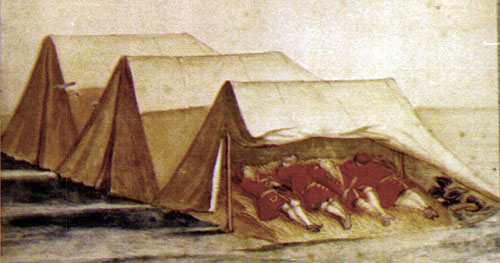
Scene of the Camp on Hampton Green, 1781

Scene of the Camp on Hampton Green, 1781

The Tent Article (hereafter The Document) pulls together documentation and research assembled by a team of living history enthusiasts dedicated to replicating the 18th century enlisted army experience in an accurate manner. Though the PowerPoint format affects the overall length, be warned: we are talking 300+ pages here.

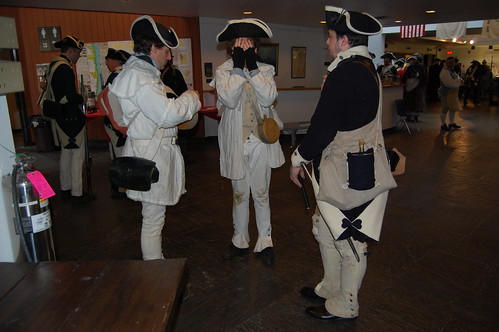
No strangers to the pursuit of the accurate and never ones to shy away from an arduous task involving pointy objects and string, the 10th Mass assembled on Saturday afternoon for a round of tent sewing.

I first read The Tent Article in 2012, and was promptly ashamed of our hand-me-down tent which had everything to recommend it in terms of price, but wanted in terms of accuracy. In response, I began making 1/8″ scale models of tents to figure out how much linen I would need to buy in order to make a truly correct tent. Finally, all that edumacation in art and architecture had utility! Alas: distractions arose, cost overwhelmed, our then-primary regiment scoffed, and I abandoned hand-sewn tent plans.

Fast forward to Tyler Putnam’s blogging on The First Oval Office project, and I was once again intrigued. I began calculating how much vacation time I might need to complete a tent by hand in our living room. Well, thank goodness for finding fellow travelers, because lo and behold! The 10th Mass had tents in want of sewing, so I could learn a great deal without filling our home with excessive yardage.

“Sails.”

Progress was made last August in Newport, where the tents masqueraded as sails, but the canvas languished unsewn until last Saturday, when we duly assembled in Hopkinton and unfurled the vast expanse of linen. It was suggested that I might know some people with access to sail lofts (!), but in about 4 hours, a number of us managed to finish the final foot of backstitching and to flat-fell a little more than 60 feet of tent seams.

It's a vast expanse of linen.

It’s a vast expanse of linen.

The Document was consulted to make sure we were proceeding correctly, though the iPad misbehaved and forwarded us many pages to grommets. (I’m looking forward to those, as I enjoy sewing eyelets– and have just earned myself the dubious honor of sewing at least half of them, I’m sure.) We checked the images, threaded our needles, and off we went.

A few inches (feet) of felling had to be unstitched and resewn, but heavy linen is wily and some stitchers were newer to the process than others. But by the close of day, all seams were felled, needles packed, and tentage folded.

Next up, per The Document, are mud flaps. This should get interesting, as math in front of an audience usually is.


IMG_2728

I promised a pun, so here’s the worst. Somehow we got on to unfortunate reenactorisms, which collided with Star Wars, and brought us to the realization that what we needed were light sabres… ’cause it’s the 10th Massachusetts Regiment Light Infantry Company. We were punished for this hilarity by having to drive home on untreated roads into snow that looked like we were trying to take the Millenium Falcon to hyperspeed.


*It really happened on Saturday.

Share this:

  • Share on Facebook (Opens in new window) Facebook
  • Share on Pinterest (Opens in new window) Pinterest
  • Email a link to a friend (Opens in new window) Email
  • Share on X (Opens in new window) X
Like Loading...

A Matter of Interpretation

17 Monday Nov 2014

Posted by kittycalash in Events, History, Living History, Museums, personal, Philosophy, Reenacting

≈ Comments Off on A Matter of Interpretation

Tags

18th century, common soldier, interpretation, living history, Reenacting, Revolutionary War

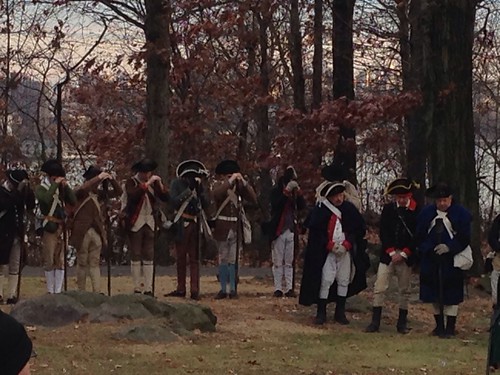
On the way to Southbridge, Mr S and I were discussing the last “big” event for the year, and whether or not we wanted to go. It’s an annual event grounded in ceremony, and somewhat repetitive.

The landing of the British forces in the Jerseys on the 20th of November 1776 under the command of the Rt. Honl. Lieut. Genl. Earl Cornwallis. Watercolor, attributed to Thomas Davies. NYPL

Mr S would like to go if he had the proper wool coat– it will be easy enough to make, once he gets a kit– but which he does not now have. I find it’s usually a day alone wishing I was across the river in a museum or fabric shop. In the end, it’s a long drive to a day spent in the cold and wind followed by a dash home in the dark, with Sunday spent catching up on chores and cleaning muskets, and now with an added measure of homework stress.

I have painted this as a grimmer day than it usually is, but considering that it’s been 7 months since we had any non-medical time off from work, squeezing this into a busy and stressful schedule is not as appealing as it once was. In part, I think it is because there is a lost opportunity in the interpretation, which is surely limited by the size and nature of the site, and by the loss of the historic fabric of the area.

Nestled in a densely settled and very urban area, the park site has a block house, hut, and fortification as well as a museum. Sutlers and others set up in the museum for the day, including some demonstrations of women’s work…like spinning. Spending the day inside spinning is not for me: not only can I not spin, I cannot imagine fleeing the British with a spinning wheel, which is an annoying contraption to move even with assistance, plenty of time, and a Subaru.

The Young Mr hides

But more than my impatience with Ye Olde Colonial Spinning Wheel at too many military camps this past year, I think what stops me from wanting to go is the repetitive formality of the interpretation, with the the march to the monument and the post-prandial “battle” for the blockhouse, with the Americans sometimes winning, despite the fact that the fall of this site marked the beginning of Washington’s retreat to Pennsylvania, and despite the fact that three days earlier, when the companion fort across the river fell to the British and Hessian troops, nearly 3,000 Americans were taken prisoner in 1776, and of those, only 800 survived. In what way is this ritualistic commemorative event remotely authentic? And if the only way people get the actual history and importance of the event is through the event narration or museum exhibit, hasn’t the reenactment or living history portion then failed?

Ritualistic, commemorative.

The more I think about interpretation and presentation, the more Ye Olde Colonial things annoy me and the more important I think it is to be accurate and correct.

Forcing a passage of the Hudson River, 9 October 1776. oil on canvas by Thomas Mitchell from an original by Dominic Serres the Elder. Royal Museums Greenwich

That does not mean that I expect a naval engagement (though a girl can dream) or a cross-Hudson rowing affair, but I do think it could be interesting to see troops at a fort packing up and evacuating the site, with the confusion that could result. But it’s not my circus, and not my monkeys, and in any event, I shall probably stay home to make sure that homework and housework alike are done in this current century.

Share this:

  • Share on Facebook (Opens in new window) Facebook
  • Share on Pinterest (Opens in new window) Pinterest
  • Email a link to a friend (Opens in new window) Email
  • Share on X (Opens in new window) X
Like Loading...

Why Do We Buy Things?

10 Monday Nov 2014

Posted by kittycalash in Collecting, History, personal

≈ 2 Comments

Tags

18th century, 19th century, antiques, chairs, collecting, Federal style, furniture

The Sunday, November 9th Guardian had a series of short articles on collecting, including one on why people collect things. This was similar to the New York Times’“Room for Debate” series on Why We Collect Stuff.

Chair, table, chair.

I liked the Guardian’s “Love, anxiety or desire?” question, and asked it of myself: why do I collect?

Collecting is something that I had given up for a while, given that so much of what Mr S and I had collected was stashed in boxes in our basement after an apartment move nine years ago. Nine years! If you haven’t unpacked in that time, do you really even care about those things?

No, not really. Many the things I unpacked recently as we went through the basement again are destined for Etsy: McCoy pottery vases, colorful Pyrex, FireKing glassware. I bought it at a time when I liked green pottery—it was an outgrowth of the blue and yellow creamware I’d begun collecting when I first lived in Rhode Island.

But now, I’m done with it: done with the mid-century modern, and going back to the early American things. There’s an aesthetic quality I like in both styles: simple lines, bright colors.

The most recent acquisition is a drop-leaf table in a very country Sheraton style, with a tiger maple skirt. I watched this table for months before finally committing to it, and dragging Mr S up there late Saturday afternoon. He was game, and in the past day the table has grown on him.

Why did I want it? For one thing, it reminds me of a maple drop-leaf Sheraton-style table my mother has, so perhaps there’s an element of nostalgia, or a desire for approval. I also imagined it exactly where it is, though it will require some adjustment in lighting. Did I buy a piece not only of the American past, but of my own? Is this what adulthood looks like? Or am I just responding to shape and color?

The table and chairs are low, and not comfortable in the way that modern furniture is: I wouldn’t want to sit in the chairs or work at the table every day, but these things give me pleasure, whether bought for love, anxiety, or desire.

Share this:

  • Share on Facebook (Opens in new window) Facebook
  • Share on Pinterest (Opens in new window) Pinterest
  • Email a link to a friend (Opens in new window) Email
  • Share on X (Opens in new window) X
Like Loading...

Things Won’t Make You Happy…

08 Saturday Nov 2014

Posted by kittycalash in History, Living History, personal

≈ 7 Comments

Tags

18th century, 19th century, China trade, Chinese export porcelain, collecting, Federal style, porcelain, tea party, tea pot

DSC_0455except when they do.

I try hard not to be acquisitive, though our home is perhaps more crowded than it might be if I were better at the task or cleaned at work less and at home more. Around the time of What Cheer Day, I became rather obsessed with teapots.

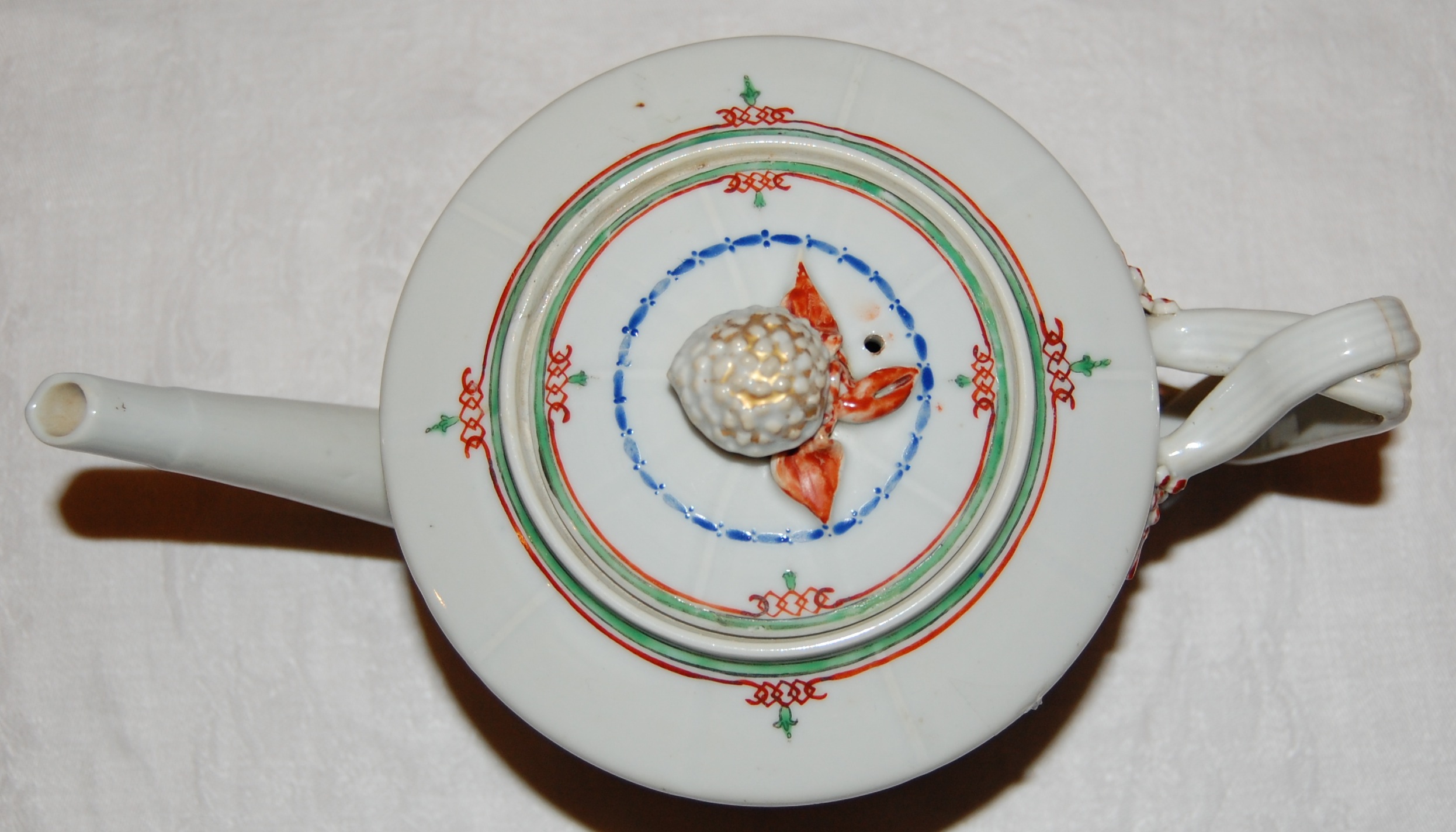
At the local antique mall, I found an attractive Chinese export porcelain cylinder or barrel-form teapot with crossed strap handles, suitable in design and shape for use in 1800 Providence. I made a special mid-week trip fully intending to buy the teapot and free poor Mr S from ever hearing “teapot” again in endless conversation. When the item was out of the case, though, it turned out to have a mended crack right across the bottom, and as I told the woman, “It matters because I intend to use this.”

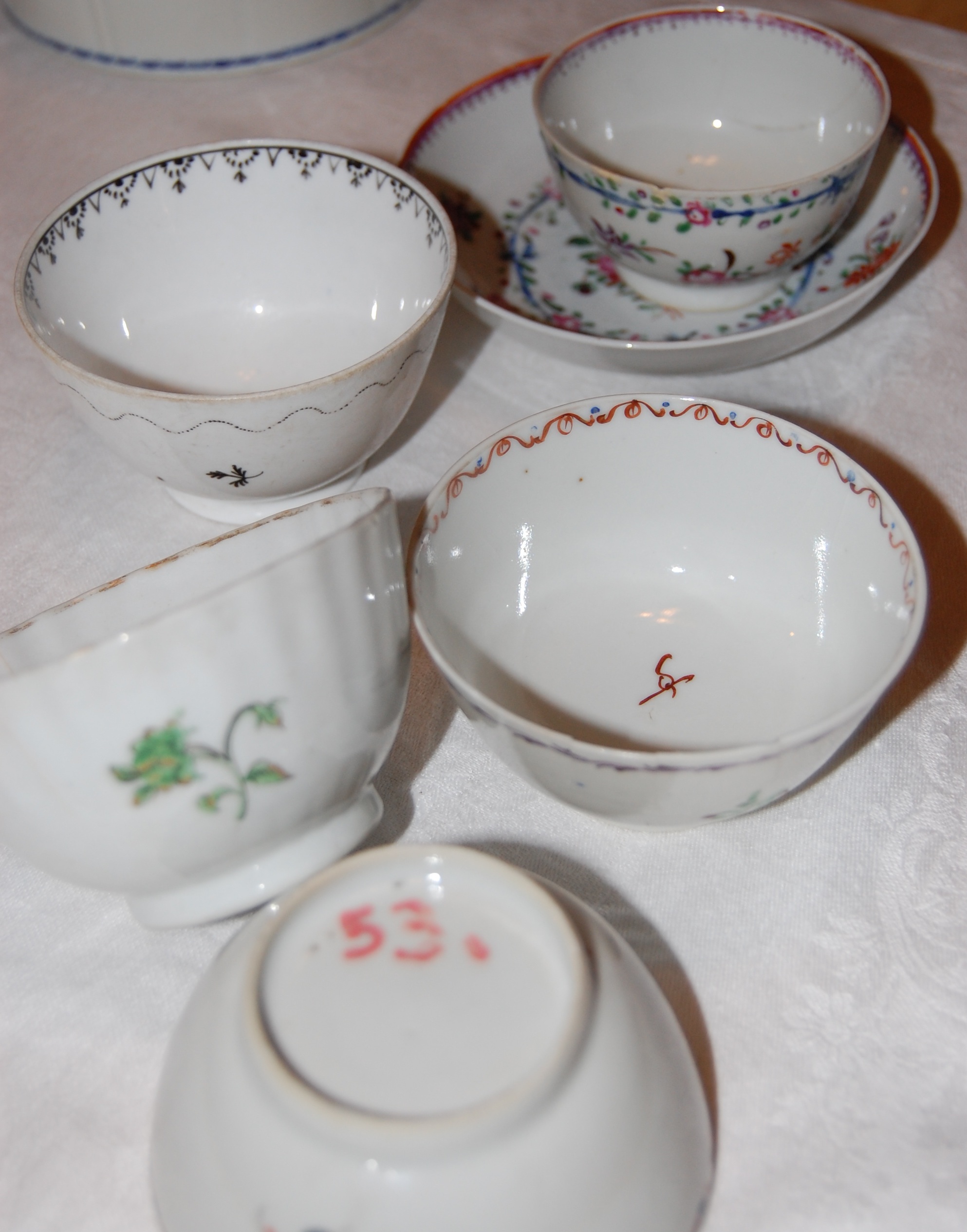
DSC_0450In the end, I did not have my fabulous teapot for What Cheer Day. In fact, my fabulous teapot arrived just this past Thursday, after patient stalking on eBay. It arrived with a bonus of five cups and a saucer, most with mends, but the pot itself has just a handle flaw or mend (typical, and seen, along with wear, in some museum pieces, too). The quantity of cups suggests that the previous owner had a relationship with them not unlike the one you might develop with a large litter of kittens you were fostering…adopt one, get another! Just to get them out from underfoot.

DSC_0470The cups and pot reminded me of the difficult meals and teas Elizabeth Bennett takes with Maria Lucas and Lady Catherine whilst visiting Mr Collins and his new bride Charlotte Lucas. There’s a tension in these cups, some combination of the dainty and the strong, some slightly misshapen (not all makers were equally skilled) that calls to mind the polite verbal combat of tea parties.

I washed the cups, and was reminded of the duties of maids to clean and care for these delicate items, the kind of thing they were unlikely ever to acquire, though there were grades of china then as now: what sat on John Brown’s table was not what sat on the Dexter’s table, or at least not in the same quantity.

DSC_0452The quantities of china coming into Providence and the rest of the Eastern seaboard after 1788 were enormous: in 1797, dinner sets of 172 pieces could be ordered at Canton for $22, and included 6 dozen large flat plates, 2 dozen large soup plates, 2 dozen small dessert plates, 8 pudding dishes, 2 large tureens, dishes and tops, 2 smaller ditto, 16 dishes of various sizes, 6 sauce boats and stands, and 4 salt cellars. Tea and coffee sets of 81 pieces were bought in Canton for $6 to $9! Just for dinner and tea, you could have 253 pieces of china, and we haven’t even begun to get into custard cups, cache pots, and garnitures!

DSC_0473The indifferent pieces I have acquired may have started out as kaolin, feldspar and quartz in Ching-te-Chen, 200 miles west-southwest of Shanghai. There were important porcelain manufactories there, and porcelain wares traveled by road and boat to Canton, where sets were customized to meet specific orders and then loaded onto ships bound back to America, six months or so after the order was placed in Providence, Salem, or Boston. It’s a lot of work for a fashionable sip of Hyson or oolong, and no wonder cups and pots were mended, saved, and reused.

Share this:

  • Share on Facebook (Opens in new window) Facebook
  • Share on Pinterest (Opens in new window) Pinterest
  • Email a link to a friend (Opens in new window) Email
  • Share on X (Opens in new window) X
Like Loading...

Miss Juniper Fox

23 Thursday Oct 2014

Posted by kittycalash in Research

≈ 5 Comments

Tags

18th century, engravings, fashion, hairstyles, lewis walpole library, satire, squirrels, style

Miss Juniper Fox. [London] : Pub. by MDarly 39 Strand, Mar. 2, 1777. Lewis Walpole Library , 777.03.02.01.

Miss Juniper Fox. [London] : Pub. by MDarly 39 Strand, Mar. 2, 1777.
Lewis Walpole Library , 777.03.02.01.

If you’re not wearing an inverted rooster held down by two foxes on your head, you’re not living 1777.

I have no idea what, beyond extreme hairstyles, this print is satirizing. It’s not the Wedding of Mrs Fox (as interesting a read as that is), and it’s really 100 years too late to be about Quakers.

The thing about those foxes is that at first glance on my phone, I thought they were the muscular lycanthropic squirrels of historic house wallpaper, but what two squirrels would be doing with a rooster– supporting him in illness? holding him hostage for an acorn ransom?– was beyond me.

At least as roosters, this headdress makes a bit more (morbid) sense, but it’s still a satirical engraving that makes less sense to us in 2014 than it did in 1777.

Share this:

  • Share on Facebook (Opens in new window) Facebook
  • Share on Pinterest (Opens in new window) Pinterest
  • Email a link to a friend (Opens in new window) Email
  • Share on X (Opens in new window) X
Like Loading...
← Older posts
Newer posts →

Archives

wordpress statistics

Creative Commons License
Kitty Calash blog by Kirsten Hammerstrom is licensed under a Creative Commons Attribution-NonCommercial-ShareAlike 4.0 International License.

Website Built with WordPress.com.

  • Subscribe Subscribed
    • Kitty Calash
    • Join 621 other subscribers
    • Already have a WordPress.com account? Log in now.
    • Kitty Calash
    • Subscribe Subscribed
    • Sign up
    • Log in
    • Report this content
    • View site in Reader
    • Manage subscriptions
    • Collapse this bar
 

Loading Comments...
 

    %d