• Home
  • Completed Costumes/Impressions
  • Emma and Her Dresses
  • Free Patterns and Instructions

Kitty Calash

~ Confessions of a Known Bonnet-Wearer

Kitty Calash

Tag Archives: 19th century

Under the Green Umbrella

06 Saturday Jun 2015

Posted by kittycalash in Clothing, Research

≈ 5 Comments

Tags

19th century, 19th century clothing, British Museum, Costume, fashion, fashion plates, menswear, Metropolitan Museum of Art, museum collections, Museums, style, umbrellas

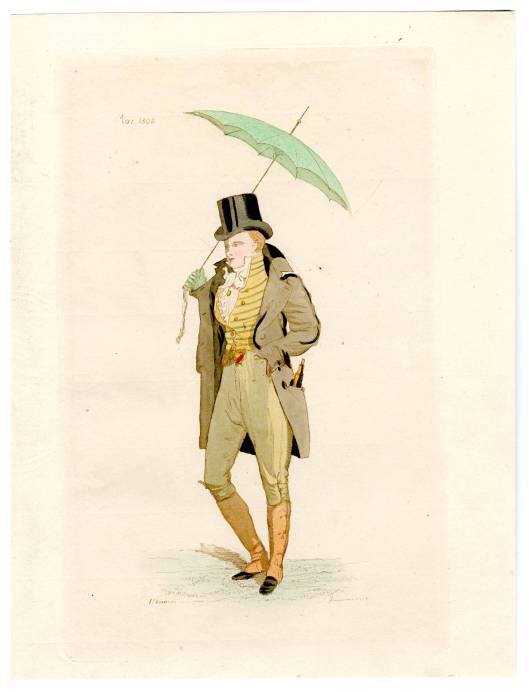
May, 1802. Gift of Woodman Thompson, Costume Institute Fashion Plates, Metropolitan Museum of Art

May, 1802. Gift of Woodman Thompson, Costume Institute Fashion Plates, Metropolitan Museum of Art

How do you like this gentleman? He’s from the Met’s online collection of fashion plates, in Men’s Wear 1790-1829, Plate 032.

I know a gentleman with a similar waistcoat and a similar smirk who needs only the umbrella and spy glass to complete this picture.

In case you’re wondering, the Hull Museum (UK) has a page devoted to a brief history of the umbrella. While classically and stereotypically British, it certainly rains enough here to justify carrying one. The British Museum has 46 trade cards that include umbrellas, with a few pre-1800 examples.

Share this:

  • Click to share on Facebook (Opens in new window) Facebook
  • Click to share on Pinterest (Opens in new window) Pinterest
  • Click to email a link to a friend (Opens in new window) Email
  • Click to share on X (Opens in new window) X
Like Loading...

Can it!

13 Wednesday May 2015

Posted by kittycalash in Food, History, Living History, Research

≈ 3 Comments

Tags

18th century, 19th century, common people, cooking, food, food preservation, Museums, Research, resources

Jar. Paul Cushman, 1805-1833. Stoneware. 20032.475


Or, how do you keep your pickles?

At work, we have found that the road to history is paved with unexpected documents. As often happens, while looking for something completely different, m’colleague and I found two documents that might help illuminate the question of food preservation and storage in the 18th century.

Probate inventories: I read all the way through and had one of those d’oh! moments. Why? Because at the end, there’s all the kitchen stuff. Andirons, warming pans, roasting pans, kettles, firkins, kneading trays, piggins, barrels, casks, bottles. This is the stuff of cooking and keeping food.

There are clues in the receipts (recipes): Amelia Simmons gives a hint in the final instructions “To pickle or make Mangoes of Melons.”

“put all these proportionably into the melons, filling them up with mustard-seeds; then lay them in an earthen pot with the slit upwards, and take one part of mustard and two parts or vinegar, enough to cover them, pouring it upon them scalding hot and keep them close stopped.”

To pickle Barberries ends thusly:

“let it stand to cool and settle, then pour it clear into the glasses; in a little of the pickle, boil a little fennel; when cold, put a little bit at the top of the pot or glass, and cover it close with a bladder or leather.”

Jar, Thomas Commeraw.1797-1819. Stoneware. 18.95.13

To pickle cucumbers:

“put them into jars, stive them down close, and when cold, tie on a bladder and leather.”

To keep Green Peas till Christmas:

“have your bottles ready, fill them, cover the them with mutton suet fat when it is a little soft; fill the necks almost to the top, cork them, tie a bladder and a leather over them and set them in a dry cool place.”

If we tease these apart, we come up with some basics: preservation is done with pickling and “putting up” foodstuffs in pots, jars, bottles, and glasses. These are sealed with bladders, which are tied on; there is a sense in the first receipt that “close stopped” might imply corkage, but the repetition of bladders in the following receipts suggests otherwise for most of these; the entry for Emptins does state “will keep well cork’d in a bottle five or six weeks.”

Covered jar, Connecticut. Earthenware, 1800-1830. 18.27.1a, b

The other key? You’ve probably come across food packages that require storage in a “cool dry place,” and as we have cupboards in our kitchens, or perhaps in our pantries, early cooks also had pantries or butteries (say it but-trees). How’d they do it?
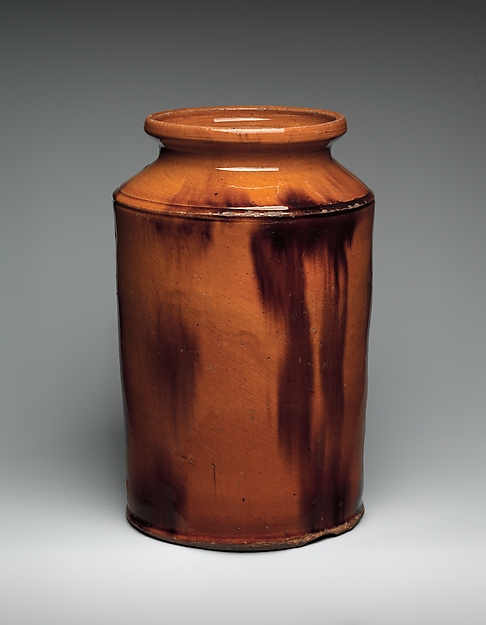
Jar,. Earthenware, 1800-1900. 18.95.11

Jar,. Earthenware, 1800-1900. 18.95.11

The 18th century house was not centrally heated. 18th century Providence residents recorded temperatures of 48 and 58 degrees indoors in the winter, in rooms with fireplaces. An unheated room or cellar would be cool, too; here in the Ocean State, maintaining dry conditions could be the bigger challenge.

What did those jars and pots look like? As you can see in this post, the Met has a few– fortunately, these appealed to collectors and wound up in museums. Closer to home for the original question, the Missouri History Museum has a collection with a number of jars. A cursory look showed dates in the 1830-1860 range, but the shares are consistent with those seen at the Met.

I’m not a food historian, and I don’t pretend to be, but as I think about answering a question, these are the steps I take. Recipes, collections, and then more looking. I just hadn’t remembered that probate inventories would list everything, so one might get a sense of a household’s contents and thus its eating and storage habits.
Share this:

  • Click to share on Facebook (Opens in new window) Facebook
  • Click to share on Pinterest (Opens in new window) Pinterest
  • Click to email a link to a friend (Opens in new window) Email
  • Click to share on X (Opens in new window) X
Like Loading...

Lighting Out for the Territories

10 Tuesday Mar 2015

Posted by kittycalash in Art Rant, History, personal

≈ 2 Comments

Tags

19th century, George Caleb Bingham, Karl Bodmer, landscape, light, Missouri River, paintings, weather

I don’t know about you, but the end of winter often seems harder than the beginning: will this ever end? The snow begins to melt, the dirt turns to mud and you’re walking on ice suspended in pudding. It’s claustrophobic.

George Caleb Bingham (American, 1811–1879). Boatmen on the Missouri, 1846. Oil on canvas. Gift of Mr. and Mrs. John D. Rockefeller 3rd. Fine Arts Museums of San Francisco, 1979.7.15

George Caleb Bingham (American, 1811–1879). Boatmen on the Missouri, 1846. Oil on canvas. Gift of Mr. and Mrs. John D. Rockefeller 3rd. Fine Arts Museums of San Francisco, 1979.7.15

The weather turns here and the lid finally comes off the sky and reveals that blue above and I think of the vistas of the west, the fields that open up along the rivers of the center of this continent, the fields rough with corn stubble punctuated by trees that pass your car window like drum beats in a song, so regular.

I wonder about the people in the past, wonder what they thought and knew about. Of course it was different for the uneducated and the poor then as now, but if you were wealthy, oh, the places you could go.

Karl Bodmer (Swiss, 1809-1893),  White Castles on the Missouri , 1833  watercolor on paper, 9 x 16 3/8 in.; 22.86 x 41.59 cm  gift of Enron Art Foundation, Joslyn Art Museum, 1986.49.176

Karl Bodmer (Swiss, 1809-1893),
White Castles on the Missouri , 1833
watercolor on paper, 9 x 16 3/8 in.; 22.86 x 41.59 cm
gift of Enron Art Foundation, Joslyn Art Museum, 1986.49.176

At the dawn of time back in Missouri, I never had the pleasure to hold but I did get to order 8×10 color transparencies* of things as wonderful as the Karl Bodmer watercolors of the trip he took up the Missouri River, and George Caleb Bingham’s Fur Traders Descending the Missouri.

Art history classes will teach you to recognize painters and images, styles and eras, but they won’t teach you the kind of seeing you can only get by being in the same place at the same time in the same light.

Fur Traders Descending the Missouri. Oil on canvas, George Caleb Bingham, 1845. Metropolitan Museum of Art, 33.61

Fur Traders Descending the Missouri. Oil on canvas, George Caleb Bingham, 1845. Metropolitan Museum of Art, 33.61

Far from the wide Missouri, I have to be content with images in books and the internet, but I can tell you from looking: Bingham got it right. The sky really does look like that above those rivers and plains; the light is rosy and grey at once, the river swift and glassy. I don’t know how it works, I only know how happy it makes me.

Come, spring: bring us the river and the light.

*Yes, and we had the printers run separations and then FedExed them to other museums for approval. Can you imagine!

And, if you’re handy to the place, the St Louis Art Museum (SLAM) is having a Bingham show. 

Share this:

  • Click to share on Facebook (Opens in new window) Facebook
  • Click to share on Pinterest (Opens in new window) Pinterest
  • Click to email a link to a friend (Opens in new window) Email
  • Click to share on X (Opens in new window) X
Like Loading...

An Afternoon in N’port

15 Sunday Feb 2015

Posted by kittycalash in Events, History, Living History, Museums, Reenacting

≈ 4 Comments

Tags

#WalkNPT, 1820s, 19th century, 19th century clothing, common people, Costume, dress, Events, Kitty Smith, living history, millinery shop, Nathaniel Sweet, Newport, Newport Historical Society, Rhode Island history, Whitehorne House

IMG_3041

New coat!

I set off for Newport yesterday to spend the day at Whitehorne House with Sew 18th Century. I was pleased to have my coat, and pleased as well to see the ads for “lead colored pelisse cloths” at Nathaniel Sweet’s shop at 112 Cheapside in N’port. Everything fits better when you have some documentation.

We occupied the kitchen at Whitehorne House, interpreting the lives of mythical maids and cousins Eliza and Kitty Smith.

DSC_0607

The Whitehorne Kitchen

We hope to save enough to reopen our millinery shop, which flourished once in Salem just a few years ago. Times are hard in Newport, but there are some promising lotteries–a $10,000 prize in the Kennebec Bridge lottery and an incredible $25,000 prize in the New York Literature Lottery! We will have to save our wages to buy even one ticket– difficult to do with so many tempting’ wares in the shop–but the rewards would well worth our efforts.

A shop on Thames Street is to let not far from the Great Friends Meeting House. We think ’tis a fine location, for while Friends may be plain, they are well dress’d. One of our visitors offered to spread the rumor that the shop is haunted, so no one else will rent it, but I worry that such a tale might drive off custom.

DSC_0611

Gingerbread, bread-and-cheese and apples form’d our repast

Visitors called from as far away as New Jersey, New York and Connecticut, but found Mr Whitehorne at the Coffee House and Mrs Whitehorne out makin’ calls. As prominent citizens, they are busy about the town. Mrs Whitehorne is well-known for her receipts, and we were pleased to offer callers a sample of her fruited gingerbread. Indeed, ’tis delicious, though not as sticky as the late Mr S preferred.

Some visitors thought our plan to invest in woolen mills was a fine idea, and in addition to the mills on the island (there is one in Portsmouth), we hear there are several in Hartford. Providence has not the monopoly on industry she imagines.

DSC_0615

There is much washin’ and mendin’

The laundry does pile up in a household of seven children, and since we have run out of wood, I suspect the laundress has as well. The island is short of lumber now, and wood must come from Swansea. Still, there is always mending’ to be done.

Perhaps if we had known how many visitors would call, I might have taken more care in tidyin’ up the kitchen. ‘Twas a surprise to see so many, from so far away, but we do think N’port is due for a revival. ‘Tis a busier day of visitin’ than I was accustomed to in winter at the farm on Poppasquash Neck, but with Mr Smith now dead, and our lad on a brig in the coastal trade, we could not keep the lease. I am grateful to my cousin for helpin’ me find work in such a lovely house.

IMG_3043

Share this:

  • Click to share on Facebook (Opens in new window) Facebook
  • Click to share on Pinterest (Opens in new window) Pinterest
  • Click to email a link to a friend (Opens in new window) Email
  • Click to share on X (Opens in new window) X
Like Loading...

A Valentine’s Puzzle Purse

14 Saturday Feb 2015

Posted by kittycalash in Events, History, Living History, Making Things, Museums

≈ 2 Comments

Tags

1820s, 19th century, common people, living history, Making Things, Museums, Newport, Rhode Island, Rhode Island history

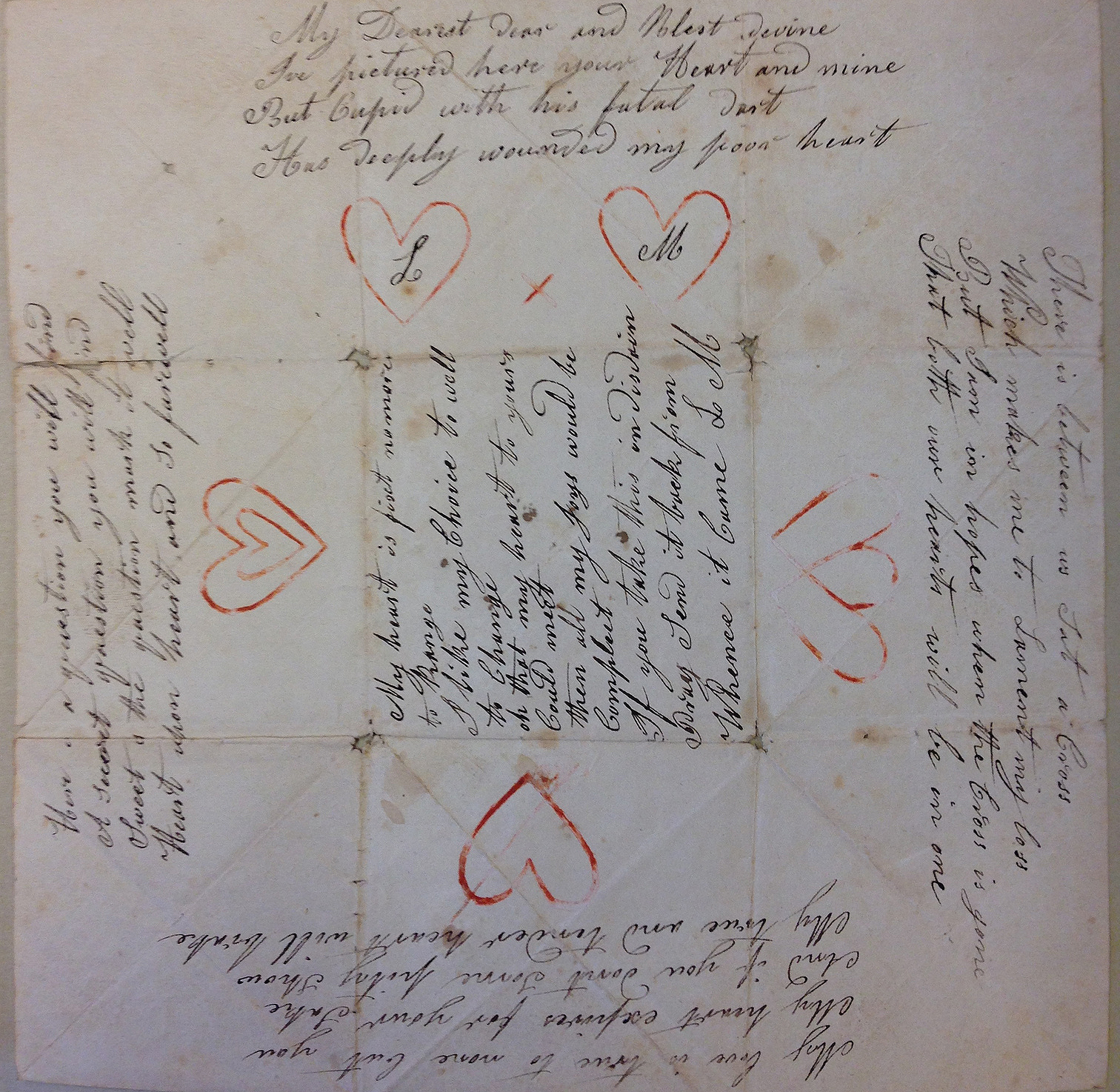
Puzzle Purse Valentine. RIHS Graphics Collection Lot 42

Puzzle Purse Valentine. RIHS Graphics Collection Lot 42

Here’s a nifty little thing you can make: A puzzle purse. This is from the collections of the Rhode Island Historical Society, but the form seems to have been fairly common; I know I’ve seen other fancifully-folded letters.

Because I’ll be spending Valentine’s Day in 1820, I thought I’d try to replicate this token. News on how it turned out later… I don’t feel clever enough to write my own verse, but here is the Rhode Island example transcribed.

My love is true to none but you
My heart expires for your sake
And if you don’t me pity show
My true and tender heart will brake

Here a question you will find
A sweet question you will find
Sweet is the question mark it well
Heart upon heart and so farewell

My Dearest dear and Blest Devine
I’ve pictured here your Heart and mine
But Cupid with his fatal dart
Has deeply wounded my poor heart

There between us sat a Cross
Which makes me to Lament my loss
But I am in hope when the Cross is hone
That both our hearts will be in one

My heart is fix’t no more to Range
I like my Choice to well to Change
Oh that my Heart to yours could meet
Then all my joys would be compleast
If you take this in disdain
Pray send it back from
Whence it Came L M

Share this:

  • Click to share on Facebook (Opens in new window) Facebook
  • Click to share on Pinterest (Opens in new window) Pinterest
  • Click to email a link to a friend (Opens in new window) Email
  • Click to share on X (Opens in new window) X
Like Loading...
← Older posts
Newer posts →

Archives

wordpress statistics

Creative Commons License
Kitty Calash blog by Kirsten Hammerstrom is licensed under a Creative Commons Attribution-NonCommercial-ShareAlike 4.0 International License.

Website Built with WordPress.com.

  • Subscribe Subscribed
    • Kitty Calash
    • Join 621 other subscribers
    • Already have a WordPress.com account? Log in now.
    • Kitty Calash
    • Subscribe Subscribed
    • Sign up
    • Log in
    • Report this content
    • View site in Reader
    • Manage subscriptions
    • Collapse this bar
 

Loading Comments...
 

    %d