• Home
  • Completed Costumes/Impressions
  • Emma and Her Dresses
  • Free Patterns and Instructions

Kitty Calash

~ Confessions of a Known Bonnet-Wearer

Kitty Calash

Tag Archives: Clothing

More Banyan Business

12 Friday Jul 2013

Posted by kittycalash in Clothing, History, Museums

≈ Comments Off on More Banyan Business

Tags

18th century clothes, banyan, Clothing, fashion, menswear, Museums, RISD Museum of Art

Prince of Wales' banyan, ca. 1780. Royal Pavilion & Museums, Brighton. ID CT002728

Prince of Wales’ banyan, ca. 1780. Royal Pavilion & Museums, Brighton. ID CT002728

Soooo, what about that banyan?

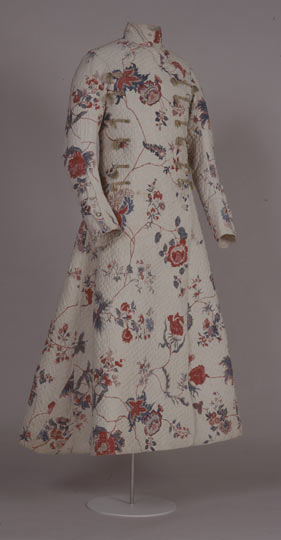
Cotton chintz printed in red, brown and purple with blue pencil. Batting seems to be cotton by the way it has bunched in the diamonds, but I expected wool. If it is wool, it is super fine lambs’ wool. Since it was for the Prince of Wales, I think that’s possible.

The mariner’s cuffs are pieced onto the end of the sleeves, reducing bulk (no double layer). The buttons at the cuffs are round, domed, self-covered buttons.

The double breasted closure is made with multi-colored silk braid frogs and silk dome-shaped buttons.

The collar is quilted, too.

The center back seam does not bother to match the pattern; it’s just sewn up the center.

Triangular piecing at the side seams helps give this flair in the skirts. You can see this in the photo at left.

The sleeves are set in, two-piece sleeves typical of menswear.

That’s everything I can remember from my visit on Saturday with Sew 18th Century. I really do have to go back with a notebook and a stool!

Share this:

  • Share on Facebook (Opens in new window) Facebook
  • Share on Pinterest (Opens in new window) Pinterest
  • Email a link to a friend (Opens in new window) Email
  • Share on X (Opens in new window) X
Like Loading...

Independence Day Projects

05 Friday Jul 2013

Posted by kittycalash in Clothing, Events

≈ 1 Comment

Tags

Clothing, common dress

20130705-055833.jpg

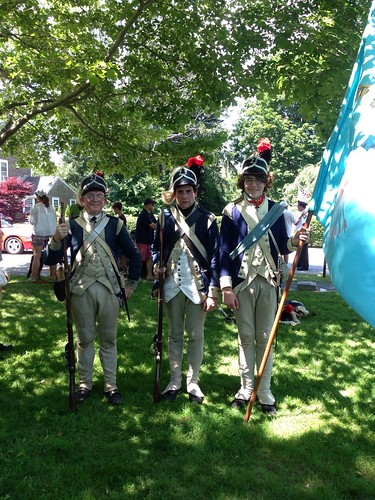
The guys love a parade, but I do not. So they went off at 7AM for Manchester-by-the-Sea and I stayed home after they were safely and mostly kitted up and in the car. Here they are with the Adjutant, the Young Mr literally a giant among men. The overalls for Mr S were finished at lunch on Wednesday, and lack only in- and out- seam finishing plus a strap for the instep…as well as a waistband alteration, but he doesn’t bust them squatting, so for now, these are completely wearable. And they fit like tights.

Of course, the lads want regimentals. And you can’t blame them: the more they look like soldiers, the more they act and feel and behave like soldiers. This bit of psychology is particularly useful in dealing with the Young Mr who was lured to the car at that early hour by the promise of a) doughnuts, b) an officer’s coat and sword, and c) not having to drum. He’s so close, and yet light years away, from carrying a musket. And when he is old enough to join a regiment on his own, I predict defection to the bridge-jumping 40th with their short red jackets and ostrich plumes.

(Historically, Mr S’s ancestors were on both sides during the Revolutionary period. One decamped to Nova Scotia after Stamp Act riots, another marched from Connecticut to be part of the Army of Observation, and still yet another ratted out American actions on Long Island to the British. Once we’d researched this, my threats to sell the Young Mr to the British carried no weight whatsoever, though technically, he should settle for a green Loyalist’s coat. My people were in Sweden, wearing wool and eating fish, tending their cows and carpentry.)

I spent the holiday nearly banging out an entire gown: entirely cut out, the bodice, back, and one front skirt are assembled. It’s the same pattern as the Richard III/How Now Brown Gown, but without the center back seam wiggle. Burley & Trowbridge’s cotton-wool “Virginia Cloth” is much easier to sew than the heavier wool from Wm Booth. I hope to have it done by Sunday’s event in Swansea, but cannot swear it will be.

Also to be sewn this week: alterations to the Horrid Green Frock Coat, and one complete, from-the-table-up blue linen unlined jacket based on an extant RI example. (Thanks to a pattern from the Adjutant, about which I am very excited.) We (along with many others) have a date with George Washington in Cambridge on Sunday. If you’re in the area, join us.

ETA: That’s next Sunday, July 14. It feels closer than it is….

41.839192 -71.394608

Share this:

  • Share on Facebook (Opens in new window) Facebook
  • Share on Pinterest (Opens in new window) Pinterest
  • Email a link to a friend (Opens in new window) Email
  • Share on X (Opens in new window) X
Like Loading...

Monmouth Millinery

25 Tuesday Jun 2013

Posted by kittycalash in 1763 Project, Clothing, Making Things, Reenacting, Research

≈ 6 Comments

Tags

18th century, 18th century clothes, 2nd Rhode Island, Clothing, Costume, fashion, Revolutionary War, Rhode Island

New hat!

New hat!

As Eloise or her Nanny might say, It is rawther warmer than I care for. Lucky for me, I have a new hat. It’s a black straw hat of a kind you might see called a bergère, along with 4 yards of silk ribbon, purchased at Burnley & Trowbridge’s tent at Monmouth. Jim and Angela and their assistants were very helpful, and this was rawther a splurge for me, as I mostly buy my ribbon from Wm Booth’s remnants, when they are available. (We are tenant farmers. Mostly.)

Coromandel Coast lined hat, from an auction.

Coromandel Coast lined hat, from an auction.

But in this instance, I wanted a lady’s hat, so I pleated up about two yards of green silk ribbon, and added a bow. To get the multi-vector bending effect, I stitched millinery wire from Abraham’s Lady around the brim. The inside of the brim is lined with pieced scraps of the purple “Fleurs d’Inde” I used for a jacket (also made from a Wm Booth remnant). It ties on with yet another yard or more of ribbon. This is really a frivolous hat, for me. There are extant examples of straw hats lined with chintz, as you can see.

As luck would have it, I got to wear it right off, the very day I made it. How often do you get the chance to do without panic and pain? We attended the Saturday version of the Rochambeau Tea on Joy Homestead, an event which has its dedicated fans.

First hat outing

First hat outing

I wore this same gown last year, and to Nathan Hale; to my delight, I am enjoying it more each time I wear it. I think this petticoat is the right one; madder was too close and black too contrasty. Since the Rochambeau Tea “year” is 1780, this dress passes (ahem) muster; for many of the events I attend, it is too fashion forward.

London Cries: the Fishmonger. Paul Sandby ca. 1759. YCBA B1975.3.210

This hat will, I think, also work for the 1763 event, as the woman in yellow here is wearing a similarly dual-plane twist hat. I’ll never have a yellow gown though: I look pretty horrid in yellow.

Share this:

  • Share on Facebook (Opens in new window) Facebook
  • Share on Pinterest (Opens in new window) Pinterest
  • Email a link to a friend (Opens in new window) Email
  • Share on X (Opens in new window) X
Like Loading...

Citizens of Boston

21 Friday Jun 2013

Posted by kittycalash in 1763 Project, Events, Living History, Research

≈ 2 Comments

Tags

1763, 18th century clothes, Boston, Clothing, common dress, living history, Peace of Paris, Reenacting, Research, Seven Years War

John Collet, May Morning, 1761-1770. Museum of London

John Collet, May Morning, 1761-1770. Museum of London

I find myself involved in an event scheduled for August 10 in Boston, though I know this could go awry because I worked for a number of years with DC, the organizer of this extravaganza. He’s got a style all his own, and for a taste of the madness, you can see him here (~5:26) with unmistakable and inimitable mannerisms, at Louisbourg.

While the Adjutant is arranging and training the militia, the event still needs civilians, and as the interpretive consultant, my task is to create the context of the day and hammer into DC’s head that when organizing something like this, you can hardly over-communicate, though having been on the receiving end of his phone calls, actually, you can… but that’s where I come in with the editor’s sharpened pencil and cut, cut, cut.

Mr S has signed right up for this event, though he lacks suitable garb, and thus it will soon be time to break out the wool broadcloth. I really liked Sharon’s waistcoat-conversion suggestion, and happily Wm Booth had a lovely dark-green wool remnant of just enough yardage for a skinny man’s frock coat that very morning. Add the brass buttons in the stash, and I thought we were off and headed for 1770 with a regression to 1763.

Except… in doing more looking at 1760/1763 images, I began to wonder if it was better to beat the green linen into an earlier coat, consider it a lesson learned, and move on, since it is only a one-day event. (I saw some small remnants of that same green linen in the Adjutant’s stash, and perhaps I can get them for cuffs.)

My logic is this: it can be tricky to walk a coat backwards in time, especially in sleeve width, and Mr S is in serious need and want of a lovely coat for Battle Road. (Except yes, heh heh, he needs it by July 14 for an event at Washington’s HQ in Cambridge. There’s not even time for gnashing of teeth!) I don’t think it means more sewing, really, it only means penance with alterations and begging for fabric scraps. It also mean focusing, and letting the Monmouth-acquired cuts on my fingertips heal.

John Collet, Scene in a London Street, 1770. YCBA, B1981.25.110

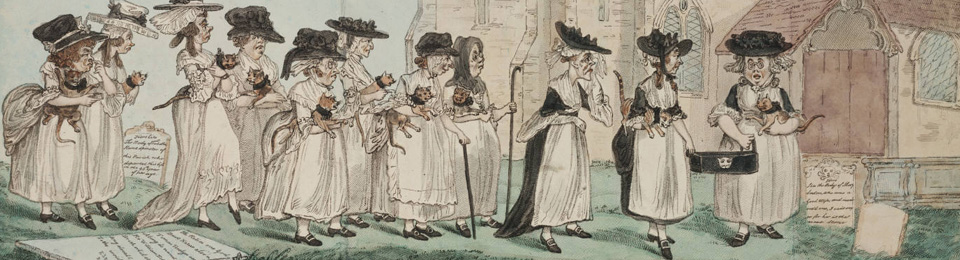
Mr S will be just one of a number of men who will be militia in the morning and civilians in the afternoon. In thinking about the Boston street of 1763, I’m reading the Boston Gazette and Country Journal (which DC had not done beyond the main articles…) and looking at images from London. Maybe the scene won’t be as chaotic, since it is a happy celebration, but it needs to be busy, and populated with men, women, and children of various ages, races, and class levels. There’s a nice way to search for “street” at the Yale Center for British Art, and you get a sense of the crowds and busy-ness of the 18th century street.

To that end, I have asked my silk-gown friends, and I plan to be the cherry seller. (I should so like to have that done by Sturbridge to acquire some patina, but doubt I shall.) For the Young Mr, I see runaway apprentices as a possibility. In the Boston Gazette of August 8, 1763, There is a 16 year old mulatto fellow, “large of his age,” who had on “a brown camblet coat with red lining, a white linnen and a mixt colour’d flannel vest” as well as a blue great coat with yellow metal buttons and leather breeches. There won’t be leather breeches by August, but a camblet coat lined in red may be possible.
Share this:

  • Share on Facebook (Opens in new window) Facebook
  • Share on Pinterest (Opens in new window) Pinterest
  • Email a link to a friend (Opens in new window) Email
  • Share on X (Opens in new window) X
Like Loading...

To Wash or Not to Wash

20 Thursday Jun 2013

Posted by kittycalash in Clothing, Events, Living History, Reenacting

≈ 2 Comments

Tags

18th century clothes, Clothing, common dress, laundry, Reenacting, Revolutionary War

Mr S and his waistcoat at Monmouth

Mr S and his waistcoat at Monmouth

Sometimes I can almost hear, “Good God woman, what are you thinking?!” but so far I have only seen it in a man’s eyes. This is usually in regard to laundry.

I erred once in asking if one wanted his hunting shirt laundered, and I had planned only on cold water and hand washing, as the item seemed a bit crunchy and crumpled to my eye and hand. But, no, some other woman had washed that shirt some time ago, and it had taken considerable time—years—to reestablish fringe from fluff.

Well patinated now, formerly embarrassingly white.

Now, I give you Mr S’s waistcoat and overalls. Mr S’s waistcoat was completed on the New Jersey Turnpike in November 2011 while headed to Fort Lee. Since then, it has a acquired a smattering of powder specks, a patina of grunge, a stain or two of greasy beaver (curry, actually) and, most recently, spots of toothpaste. This is where I draw the line: the toothpaste spots must go, as they are inauthentic.

Shirts, shifts, stockings, aprons, and waistcoat

One doesn’t want one’s clothes too clean for reenactments or living history events: you’re “living” in the pre-detergent era, but that doesn’t mean you should never wash your clothes. We know that the armies employed women to wash clothing, and we know that linens–shirts, shifts, and drawers–were washed more frequently than outerwear like breeches, waistcoats, and gowns. It’s not so different from today, when we don’t clean business suits as often as we launder shirts or underwear. Still, we do clean our clothes, and there comes a point when those overalls will get washed. Right about when you figure you need gloves to handle them…

Share this:

  • Share on Facebook (Opens in new window) Facebook
  • Share on Pinterest (Opens in new window) Pinterest
  • Email a link to a friend (Opens in new window) Email
  • Share on X (Opens in new window) X
Like Loading...
← Older posts
Newer posts →

Archives

wordpress statistics

Creative Commons License
Kitty Calash blog by Kirsten Hammerstrom is licensed under a Creative Commons Attribution-NonCommercial-ShareAlike 4.0 International License.

Website Built with WordPress.com.

  • Subscribe Subscribed
    • Kitty Calash
    • Join 621 other subscribers
    • Already have a WordPress.com account? Log in now.
    • Kitty Calash
    • Subscribe Subscribed
    • Sign up
    • Log in
    • Report this content
    • View site in Reader
    • Manage subscriptions
    • Collapse this bar
 

Loading Comments...
 

    %d