• Home
  • Completed Costumes/Impressions
  • Emma and Her Dresses
  • Free Patterns and Instructions

Kitty Calash

~ Confessions of a Known Bonnet-Wearer

Kitty Calash

Tag Archives: Clothing

Coats and Cooking

11 Monday Aug 2014

Posted by kittycalash in Clothing, Events, Food, History, Living History, Making Things

≈ Comments Off on Coats and Cooking

Tags

10th Massachusetts, 18th century clothes, 18th century clothing, authenticity, Bennington, Brigade of the American Revolution, Clothing, common dress, common soldier, cooking, Costume, dress, Events, food, living history, menswear, Reenacting, Revolutionary War, style

And happy not to be walking to Walloomsac, since we can’t leave till Friday.

Before we leave, there’s plenty to done, of course, and most of it in men’s wear.*
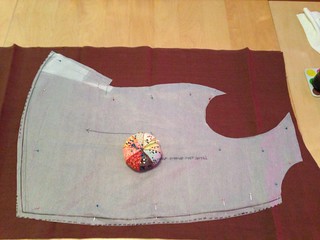
The first piece on brown linen

The Young Mr needed a new jacket, a proper one, with pockets and everything, correct for a scalawag. So that meant patterns and muslins and fittings and questions, until neither of us could really stand the other and his father called me an ambush predator of fittings. The only way to fit these wily creatures is, as they amble through the room, to leap out and toile someone.

With the pattern more-or-less fitted to the wiggly Young Mr, I cast about for fabric: there was not enough of a striped piece for both waistcoat and jacket; waistcoat won, because matching stripes on a jacket seemed too risky in this great a hurry. Instead, I sacrificed the last yardage once meant for a gown.
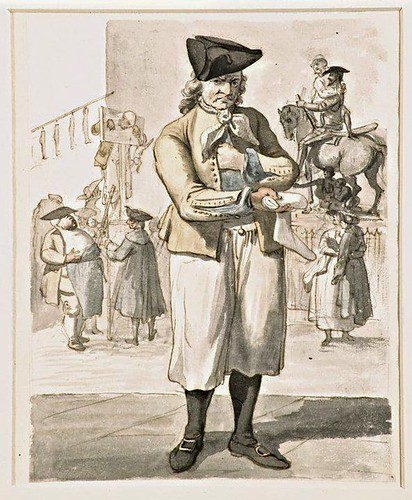
The Stocking Seller, by Paul Sandby, 1759

The Stocking Seller, by Paul Sandby, 1759

This is the inspiration for the kid’s new garment, along with Sandby’s fish monger. It seems a plausible garment to work from, and the brown linen is in keeping with the brown linen jacket at Connecticut Historical Society and the unlined linen frock coat recently sold at auction. It will also match his trousers, but this is what happens when you sew from the stash.

One pair of breeches altered, one waistcoat wanting the last seven newly-made buttons, one waistcoat in production, one jacket in production: you’d think that would be enough to get done. But I’m also working to expand my cooking repertoire, as bread and cheese gets tiresome and scrounging broken ginger cakes from the Sugar Loafe Baking Co.— while potentially good theatre–is not a solid plan for sustenance.
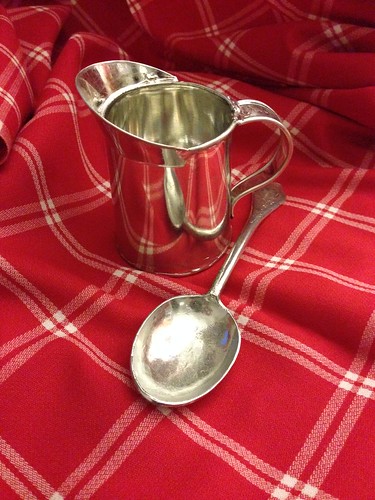
half pint and spoon measures

Half-pint and spoon

Boiling food in summer- sounds awful, right? But it’s an easy and correct way to cook,once you translate recipe measures and control the amount you’re making. I like to use Amelia Simmons’ cookbook, because it is specifically American, and my more skillful friends cooked from it at the farm.

From Enos Hitchcock’s diary, I know that he ate a boiled flour pudding with some venison stew (near the Saratoga campaign, I think) so I consider this a plausible recipe for the field, pending eggs, of course.

A boiled Flour Pudding.

One quart milk, 9 eggs, 7 spoons flour, a little salt, put into a strong cloth and boiled three quarters of an hour.

Simple enough, though Simmons later corrected the receipt to 9 spoons of flour, and boil for an hour and a half. I got out the spoon, and looked online at modern boiled pudding recipes, and will give a modified version a whirl sometime this week (always better to fail at home than in the field). Boiling the pudding in a linen cloth in a stew would make a savory bread substitute…and I really liked the one we had at the farm. Will the gentlemen at Bennington like it? Perhaps we’ll find out. If we’re not cooking with hosewater, almost anything should be edible.

*Yes, it’s a terrible and terribly dated show, but I always hear  this in Mr Humphries‘ voice from Are You Being Served?

Share this:

  • Share on Facebook (Opens in new window) Facebook
  • Share on Pinterest (Opens in new window) Pinterest
  • Email a link to a friend (Opens in new window) Email
  • Share on X (Opens in new window) X
Like Loading...

Dating Mr Darcy…

18 Wednesday Jun 2014

Posted by kittycalash in Clothing, History, Museums, Research

≈ 7 Comments

Tags

1812, 19th century clothing, Clothing, Costume, fashion, frock coats, menswear, museum collections, Rhode Island, Rhode Island Historical Society, style

1996.66.4, RIHS Museum Collection

1996.66.4, RIHS Museum Collection

Or at least his coats.

I don’t know about you, but as the summer weather warms up, I like to think wool. I’ve got menswear to sew and desires beyond my knowledge, skills and abilities. Making a wool coat for an event in August seems like a patentable Bad Idea, so it’s a good thing that I have a nice piece of Italian linen-cotton denim-like fabric that I’ve set aside to make a summer-suitable coat for Mr S.

There is a Rhode Island coat, in a Rhode Island collection, of which I am particularly fond. I’ve had this coat in mind for some time now, and have inflicted it upon have shared it with experts several times.  It has a lot to recommend it: a soil mark on the collar, extensive damage and repairs to the left sleeve, fading and wear on the back, fragments of botanical material in the pocket lint, and the nicest linen fabric I’ve ever felt.

This is the coat I wanted to make for Mr S, but then I started thinking about that waist seam, which eliminates this from the style competition for 1812. Rats! But, OK, no reason that we can’t use this as inspiration and make a coat using the fabric but not the waist seam.

1956.9.3, RIHS Museum Collection

1956.9.3, RIHS Museum Collection

So I looked at another coat that just happened to be handy (I know, I am very lucky, and that’s part of why I’m sharing this with you). At first glance, I thought I was good. And by glance, I mean extended looking. But look again: there is a waist seam, it’s just harder to see. So much for the iPhone and lousy light, right? (I noticed the seam today, in even less light, so go figure.) This coat is made of a single twill off white wool can easily be mistaken for plain weave and that is rather light. Very summery, in a way.

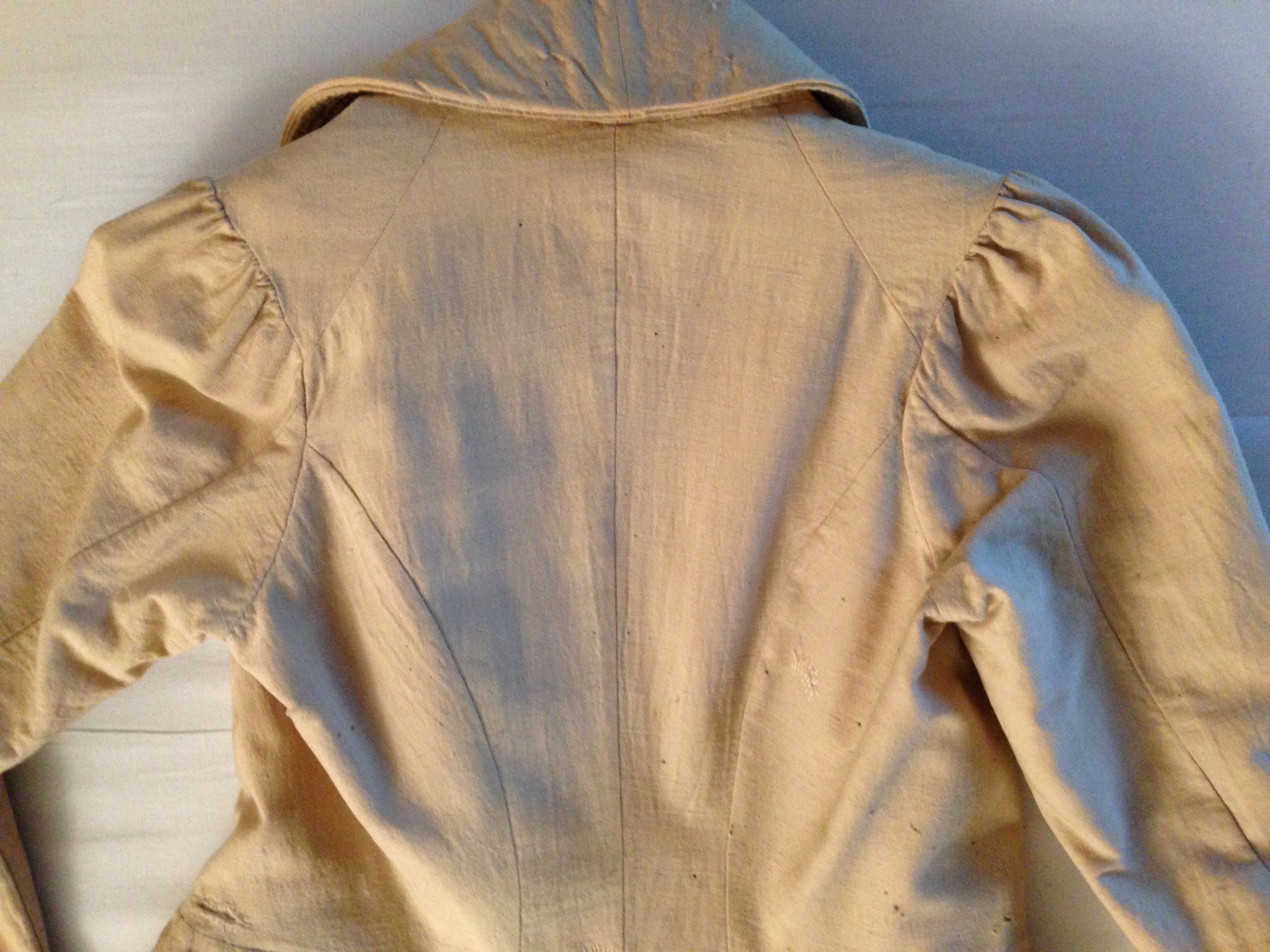
Coat style found? Maybe. But I was wondering about the sleeves. I spend a great deal of time looking at sleeves and backs of much earlier coats, so I’m accustomed to a smooth sleeve head. That’s not what you’ll find on this garment, though. This one has gathers, and I thought that was pretty exciting. My closest expert probably had a weird twinge at that moment that he will soon learn to associate with an incoming email from me…

Sleeves, 1956.9.3 RIHS Museum Collection

Sleeves, 1956.9.3 RIHS Museum Collection

This is a nice detail, but one I’m not familiar with. The fashion plates on Serendipitous Stitchery’s post do show increasingly full sleeves in the early years of the 19th century, but that detail didn’t fully register with me until I looked at this coat and processed what Mr C had told me about sleeves and shoulders. Seeing an extant example always makes principles more real.

So what next? At work, I’ve started updating the catalog records for these coats, and they’ll go live early next month. Every time we learn something new, we try to update and correct records so that everyone can benefit. That’s the easy part.

The hard part is reconciling style details for Mr S’s coat. In comparing these examples with fashion plates, I think it’s clear that they are both later than 1812 (waist seam) and nodding to but perhaps not fully embracing high style (see the gathers on the white coat, but the blue coat has only one gathered sleeve, which I attribute to maker error). Plausible dates for both might be 1818-1826, bearing in mind that these will be interpretations of styles, the way Old Navy knocks off adapts its sibling Banana Republic’s styles.

I may be back at that fabulous checked linen coat at the Met, with inspiration drawn from Providence’s plainest blue coat. The process always seems a compromise, in part because I do not think Mr S wants a checked coat, and in part because I’d like to use fabric I already have. Still, there is yet another coat to think about…but tomorrow is another day.

Share this:

  • Share on Facebook (Opens in new window) Facebook
  • Share on Pinterest (Opens in new window) Pinterest
  • Email a link to a friend (Opens in new window) Email
  • Share on X (Opens in new window) X
Like Loading...

Interpreting Bridget

24 Thursday Apr 2014

Posted by kittycalash in Events, History, Living History, Reenacting

≈ 3 Comments

Tags

10th Massachusetts, Bridget Connor, Brigade of the American Revolution, Clothing, common people, common soldier, Reenacting, Research, Revolutionary War

Shirts? What shirts?

Shirts? What shirts?

This weekend, we’ll be at the Brigade of the American Revolution’s School of Instruction, taking anxiety to the Hudson Highlands as I give a presentation on interpretation. Sure, it’s part of my day job to interpret objects and documents and even, sometimes, to do costumed interpretation, but experience has never prevented me from worrying. It has allowed me to focus my worries more productively and specifically. One of the things we’ll be trying, or attempting to try, are vignettes based on the shirt-stealing and selling ring of 1782.

Events from Captain Abbot’s Orderly Book for interpretive vignettes

Soldiers Steal a Shirt and dispose of same (~July 13-14, 1782)*
Cast: Two soldiers, officer who catches them
Props: shirts

Court-Martial July 15, 1782: Paul Poindexter and Titus Tuttle, for theft of a shirt
Cast: Two soldiers, accusing officer, three officers of the court
Props: Shirt; table and seats, orderly book (optional)

Discovered buying a shirt (~July 21-22, 1782)*
Cast: Bridget, soldier selling shirt, officer who catches them
Props: Shirt(s), money

Court-Martial July 23, 1782: Bridget tried for buying a ‘publick shirt’
Cast: Bridget, accusing officer, three officers of the court
Props: Shirt & money; table and seats, orderly book (optional)

Insolence to Officers of the 10th Mass (~July 23-24, 1782)*
Cast: Bridget, officers (two preferable, one adequate)
Props: None required, large stick probably handy

Court-Martial July 25, 1782: Bridget tried for insolence
Cast: Bridget, accusing officer, three officers of the court
Props: Table and seats, orderly book (optional)

Expelled from camp, July 25, 1782*
Cast: Bridget, drummer, officer(s), jeering onlookers; Francis skulking at the edge
Props: Drum, Bridget’s chattel

* Events are extrapolated from the Orderly Book as things that must have happened to cause the events that followed.

We’ll see…in the meantime, I’m finishing up a shirt for the Young Mr, so that his small clothes will no longer be too-small clothes, and so we have extra shirts for this black market ring.

Share this:

  • Share on Facebook (Opens in new window) Facebook
  • Share on Pinterest (Opens in new window) Pinterest
  • Email a link to a friend (Opens in new window) Email
  • Share on X (Opens in new window) X
Like Loading...

Use it Up, Wear it Out, Make it Do

07 Monday Apr 2014

Posted by kittycalash in Clothing, History, Museums, Research

≈ 2 Comments

Tags

18th century clothes, 18th century clothing, alterations, Clothing, dress, fashion, Global Encounters, John Brown House Museum, Metropolitan Museum of Art, Research, Rhode Island, Rhode Island Historical Society, style

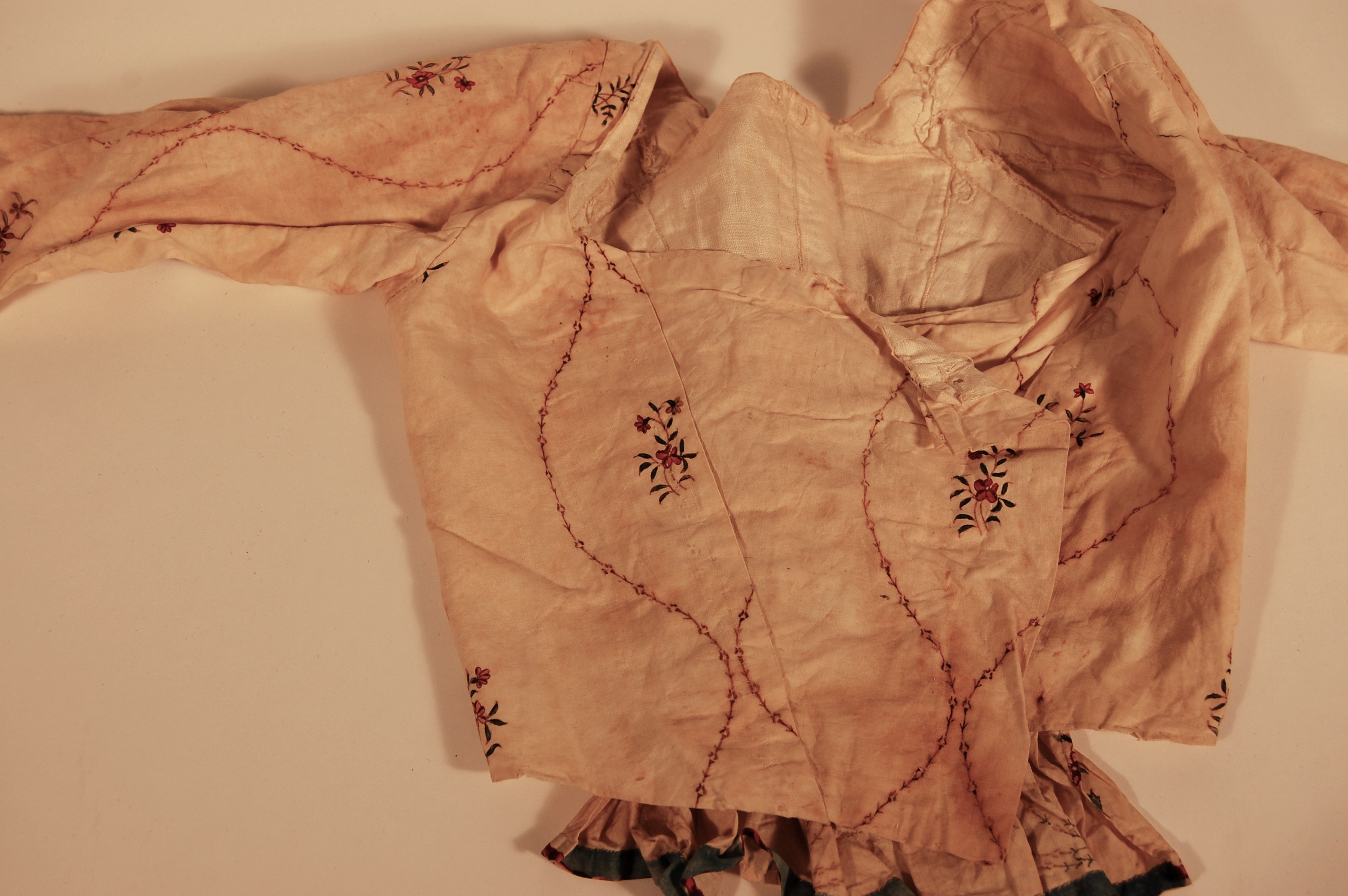
Bodice, painted Indian cotton, 1780-1795 RIHS 1990.36.27

Bodice, painted Indian cotton, 1780-1795
RIHS 1990.36.27

I’ve fallen behind again, as I spent considerable early morning time this past week working on a short presentation for a program in Worcester this past weekend. If you are among the people who do not wake at 4:00 AM panicking about the organization of your thoughts, or whom, exactly, might have worn a heavily-remade bodice, you are lucky indeed.

But I managed to present without falling all over myself, putting out someone’s eye, or causing mayhem and self-embarassment, so, phew! (I do this so much less often than I used to that my anticipatory anxiety is always high.)

Above you can see one of the items I talked about: a re-worked bodice from the collection of the Rhode Island Historical Society.

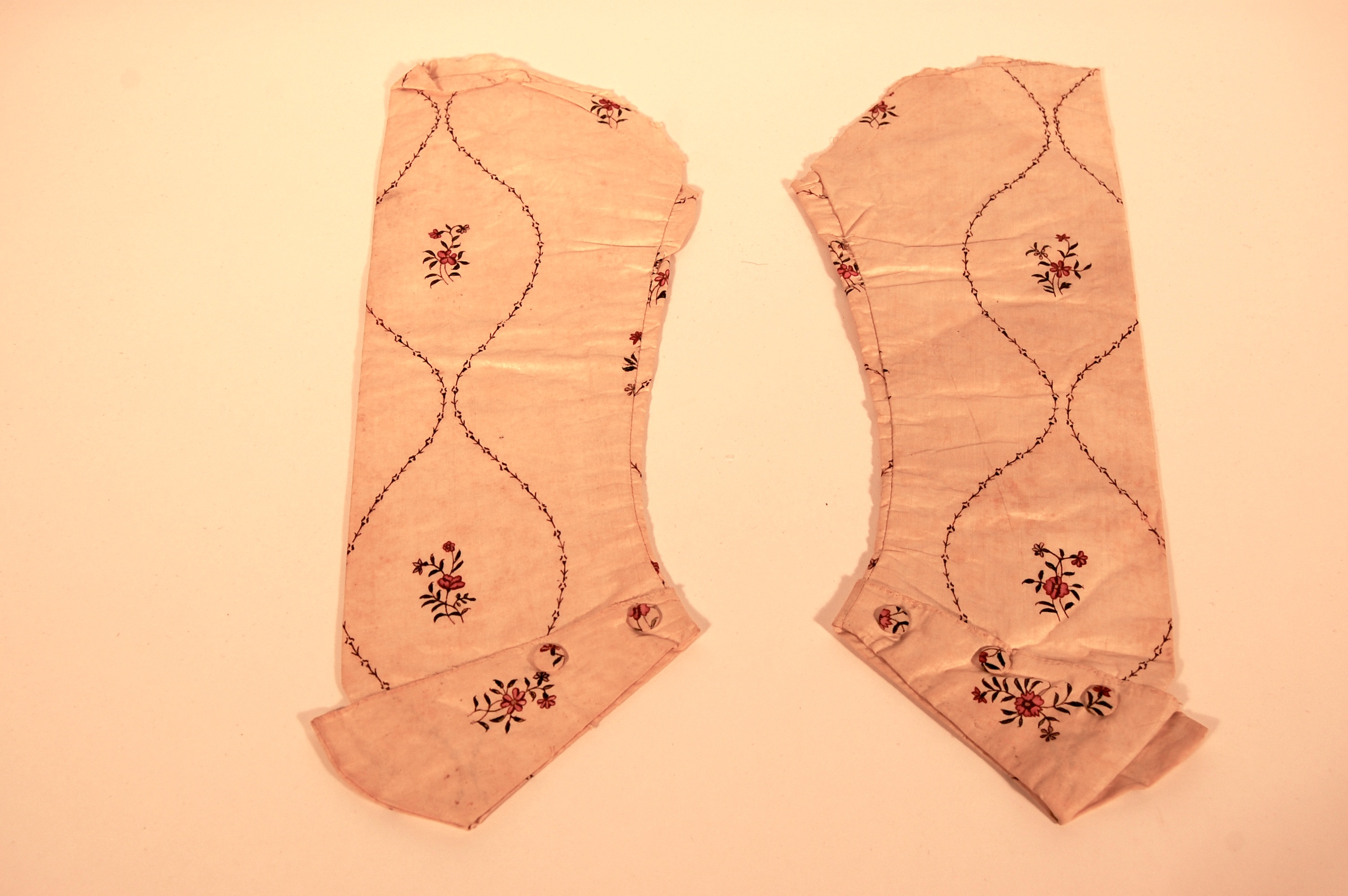
Sleeves, removed from bodice 1990.36.27. RIHS 1990.36.25A-B

Sleeves, removed from bodice 1990.36.27.
RIHS 1990.36.25A-B

I think, once upon a time, that bodice was part of a pieced-back closed-front gown with a matching petticoat.

And then I think someone decided (quite rightly) that the style was too passé for 1795, and altered the gown significantly.

Not only is there evidence of new sleeves being fitted into the gown’s armscyes, we have the sleeves-that-used-to-be. And my dear! No one is wearing sleeves like that this season!

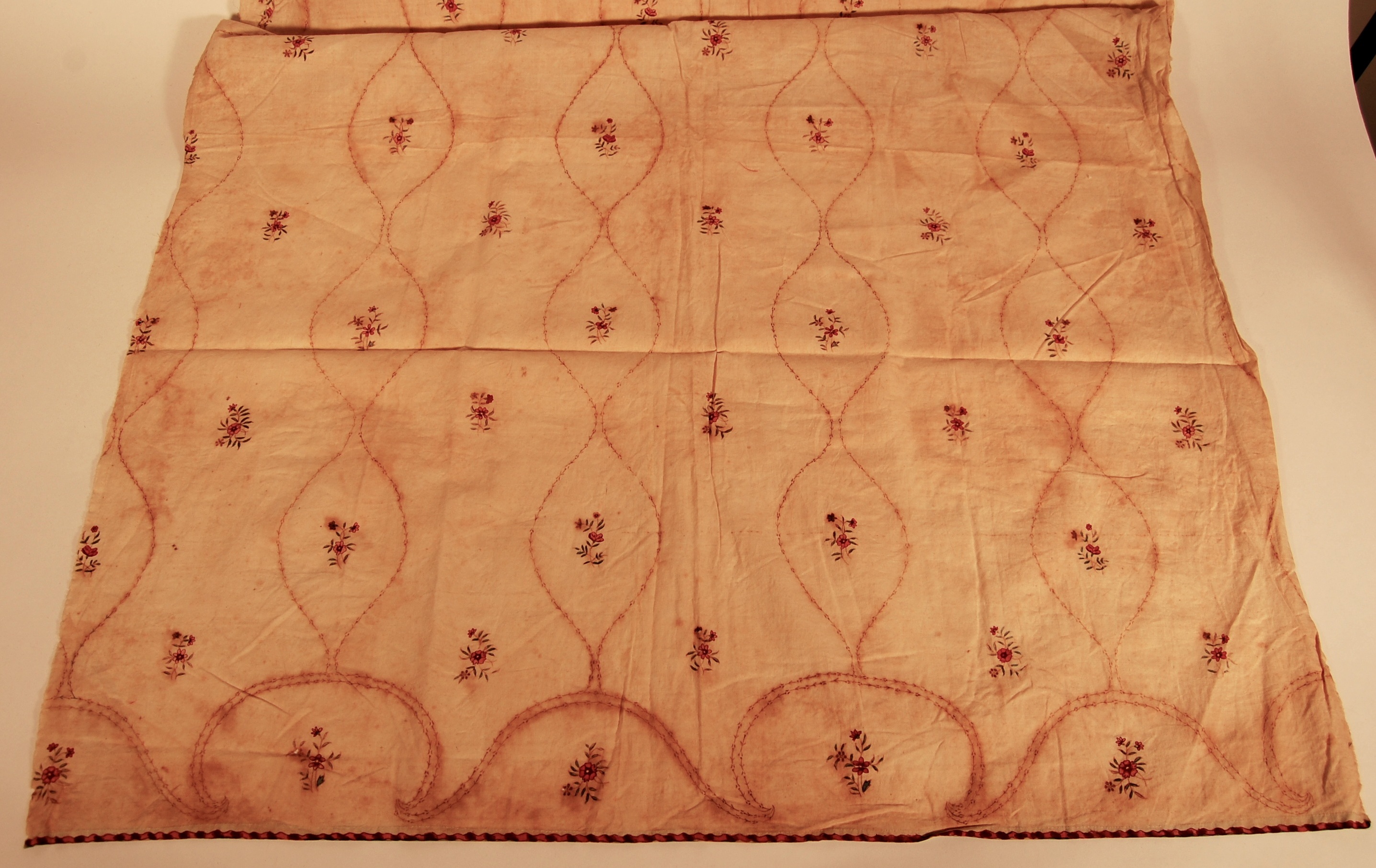
I find these garments in limbo really fascinating. Was that bodice finished and worn with a matching petticoat? (Yes, there’s a panel of that left, too; what a lovely hem!)

Skirt panel, painted Indian cotton. RIHS 1990.36.33

Skirt panel, painted Indian cotton.
RIHS 1990.36.33

Who wore the gown? Was the woman who wore it originally the same woman who wore it altered? I can only guess at this point, and may never find the smoking diary or mantua-maker’s bill. The alterations are not as finely done as the original gown, so I think there are two hands at work here– whose were those hands? There’s always more to think about and learn.

In case you’re wondering, thanks to the Met, we can see what the gown probably looked like in its first incarnation, and then what the alterations were meant to achieve. (Link to the gown on the left; link to the gown on the right.)

Robe a l'anglaise, 1785-1795 MMA 2009.300.647
Robe a l’anglaise, 1785-1795 MMA 2009.300.647
Gown and petticoat, 1790-1794 MMA C.I.45.6a,b

Share this:

  • Share on Facebook (Opens in new window) Facebook
  • Share on Pinterest (Opens in new window) Pinterest
  • Email a link to a friend (Opens in new window) Email
  • Share on X (Opens in new window) X
Like Loading...

Pockets of Evidence

02 Wednesday Apr 2014

Posted by kittycalash in Clothing, Reenacting, Research

≈ Comments Off on Pockets of Evidence

Tags

18th century clothes, 18th century clothing, Clothing, common dress, common people, Costume, living history, Metropolitan Museum of Art, Museums, Reenacting, Research, Rhode Island Historical Society, Wintherthur Museum

Or is it evidence of pockets?

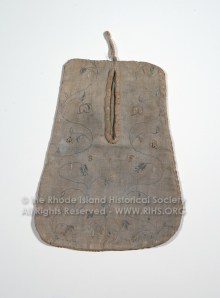
Pocket, 1770-1780 Rhode Island Linen, cotton and silk RIHS 1985.1.9

Pocket, 1770-1780
Rhode Island
Linen, cotton and silk
RIHS 1985.1.9

In any case, I thought it time to upgrade my pockets, since I have given so much attention to the rest of Bridget’s clothing. I have also been talking with a colleague about a pocket game activity, similar to the process I’ve used in thinking about Bridget: what is in your pocket? If I’m going to try that out in public, then I’d like not to be embarrassed about my pockets.

The first pocket I made was based completely on one in the RIHS Collection, and it annoyed the daylights out of me as it had exactly the same loop on top and twisted around under my petticoats, making the opening hard to find. I also realized that it was too small to be really correct for a woman’s pocket: those tend to be larger. Sew 18th Century has a really nice article on pockets here.

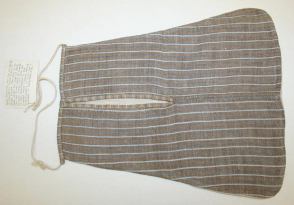
Pocket, 1789 American  linen  Gift of Miss Blanche Vedder-Wood, 1940  MMA Costume Institute C.I.40.159.4

Pocket, 1789
American
linen
Gift of Miss Blanche Vedder-Wood, 1940
MMA Costume Institute C.I.40.159.4

So I made a larger pocket based on this one at the Met, and made of a grey and cream striped linen with the slit bound in red calico. It’s dated to 1789, and technically that’s too late for my uses.

Pocket 1720-1730 block printed cotton and linen

Pocket
England, 1720-1730
Cotton; Linen
Winterthur Museum Collection 1960.0248

But the next one is too early.

Well, it has survived this long, and Wm Booth has that lovely shell print cotton, so what’s a sister to do? Pockets don’t take much fabric, so making a matched pair of printed pockets seems the thing to do.

Now the question is, what should be in those pockets?

Share this:

  • Share on Facebook (Opens in new window) Facebook
  • Share on Pinterest (Opens in new window) Pinterest
  • Email a link to a friend (Opens in new window) Email
  • Share on X (Opens in new window) X
Like Loading...
← Older posts
Newer posts →

Archives

wordpress statistics

Creative Commons License
Kitty Calash blog by Kirsten Hammerstrom is licensed under a Creative Commons Attribution-NonCommercial-ShareAlike 4.0 International License.

Website Built with WordPress.com.

  • Subscribe Subscribed
    • Kitty Calash
    • Join 621 other subscribers
    • Already have a WordPress.com account? Log in now.
    • Kitty Calash
    • Subscribe Subscribed
    • Sign up
    • Log in
    • Report this content
    • View site in Reader
    • Manage subscriptions
    • Collapse this bar
 

Loading Comments...
 

    %d