• Home
  • Completed Costumes/Impressions
  • Emma and Her Dresses
  • Free Patterns and Instructions

Kitty Calash

~ Confessions of a Known Bonnet-Wearer

Kitty Calash

Tag Archives: common dress

Pockets of Evidence

02 Wednesday Apr 2014

Posted by kittycalash in Clothing, Reenacting, Research

≈ Comments Off on Pockets of Evidence

Tags

18th century clothes, 18th century clothing, Clothing, common dress, common people, Costume, living history, Metropolitan Museum of Art, Museums, Reenacting, Research, Rhode Island Historical Society, Wintherthur Museum

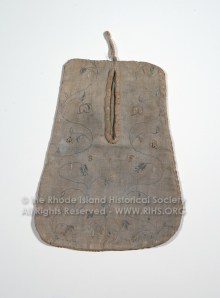
Or is it evidence of pockets?

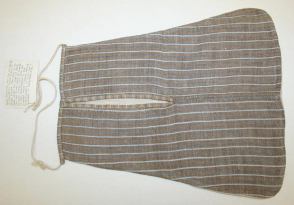
Pocket, 1770-1780 Rhode Island Linen, cotton and silk RIHS 1985.1.9

Pocket, 1770-1780
Rhode Island
Linen, cotton and silk
RIHS 1985.1.9

In any case, I thought it time to upgrade my pockets, since I have given so much attention to the rest of Bridget’s clothing. I have also been talking with a colleague about a pocket game activity, similar to the process I’ve used in thinking about Bridget: what is in your pocket? If I’m going to try that out in public, then I’d like not to be embarrassed about my pockets.

The first pocket I made was based completely on one in the RIHS Collection, and it annoyed the daylights out of me as it had exactly the same loop on top and twisted around under my petticoats, making the opening hard to find. I also realized that it was too small to be really correct for a woman’s pocket: those tend to be larger. Sew 18th Century has a really nice article on pockets here.

Pocket, 1789 American  linen  Gift of Miss Blanche Vedder-Wood, 1940  MMA Costume Institute C.I.40.159.4

Pocket, 1789
American
linen
Gift of Miss Blanche Vedder-Wood, 1940
MMA Costume Institute C.I.40.159.4

So I made a larger pocket based on this one at the Met, and made of a grey and cream striped linen with the slit bound in red calico. It’s dated to 1789, and technically that’s too late for my uses.

Pocket 1720-1730 block printed cotton and linen

Pocket
England, 1720-1730
Cotton; Linen
Winterthur Museum Collection 1960.0248

But the next one is too early.

Well, it has survived this long, and Wm Booth has that lovely shell print cotton, so what’s a sister to do? Pockets don’t take much fabric, so making a matched pair of printed pockets seems the thing to do.

Now the question is, what should be in those pockets?

Share this:

  • Share on Facebook (Opens in new window) Facebook
  • Share on Pinterest (Opens in new window) Pinterest
  • Email a link to a friend (Opens in new window) Email
  • Share on X (Opens in new window) X
Like Loading...

Any old Shirts?

24 Monday Mar 2014

Posted by kittycalash in Clothing, History, Laundry, Living History, Making Things

≈ 6 Comments

Tags

10th Massachusetts, 18th century clothes, Bridget Connor, common dress, common people, fashion, interpretation, laundry, living history, shirts, style

DSC_0041
The photos people have of the Millinery Conference at Williamsburg– well, they’re a little envy-inducing. All the silks gowns on such a beautiful site are a little overwhelming if you like historic costumes, but if I was all about silk gowns it might be harder to do what I am doing.

I did discover a fool-proof way to unnerve the teenager in the living history household. If you get dressed in your 18th-century clothing early enough on a Sunday morning, the child will ask, “Um, Mom? Are you just fitting, or do we have an event?” You get one glorious moment to decide whether or not to torture the child before he figures out that even you are not crazy enough to go to an event in March without stockings.

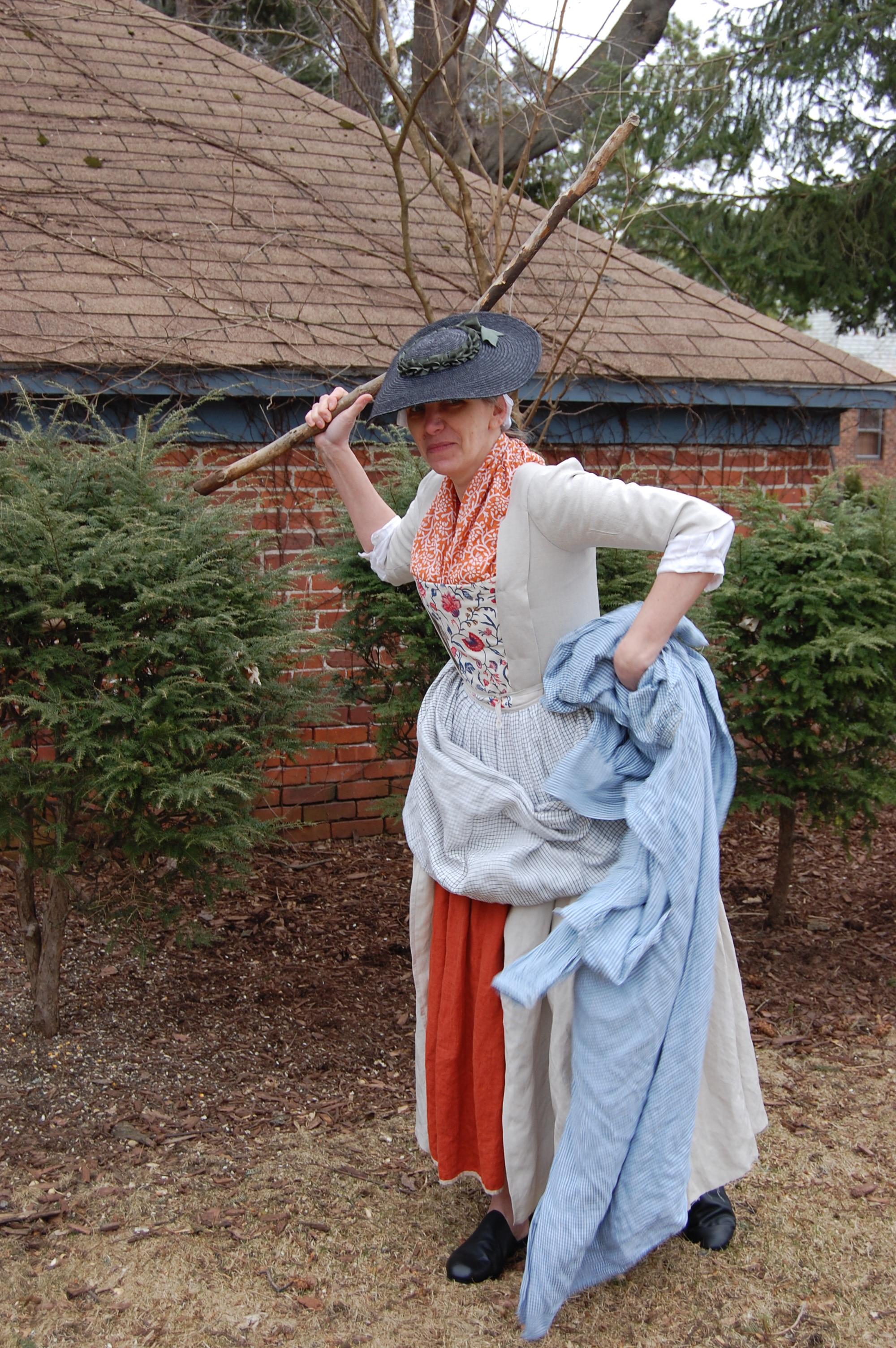
Bridget’s gown is done, but for the hem, which is turned up and about a quarter sewn. I tried it on yesterday to make sure it fit. I threw most caution to the wind and made up the new Golden Scissors English Gown pattern without making  a muslin because I’d checked my own self-fitted pattern pieces to the English Gown pieces and found them nearly identical. Anything likely to need work– shoulder straps– I knew could be done in the lining and not matter terrifically.

Why, you ask, did I bother with a new pattern? In part because my own has migrated (my backs have been trending too wide of late) and because I needed a solid, step-by-step guide to more correct assembly. The sleeve pleats still annoy me, mostly because they get done on a dress form and not on me, but they allow movement and that really counts. DSC_0047

The stomacher front style is a compromise: I want to be able to wear this at events earlier than 1782, so I’m working on the assumption that Bridget didn’t migrate to the more fashionable center-front closing style in the 1780s because she couldn’t.

The accessories are chosen because they were affordable ways to upgrade appearance: it takes hardly any chintz for a stomacher, and a handkerchief is bright but small. The hat is more common than a bonnet among working women, and the mules were chosen because they appear in an engraving of a crippled soldier and his family. All Sandby’s women wear heeled and buckled shoes in styles not to be found ready-made in my size, so  mules are my compromise.

I still think Bridget looks too clean and too pretty, but until I find fabric I like for a bedgown, this will have to do. The details, should you care for them:

Hat, Burnley and Trowbridge, lined with a Wm Booth remnant, trimmed with B&T ribbon. My hair is out up with straight pins from Dobyns & Martin, and under the hat in a lappet cap with the strings tied on top of my head.

The coral necklace is from In the Long Run, I’ll replace the grey poly ribbon with black silk ribbon once it’s in from Wm Booth.

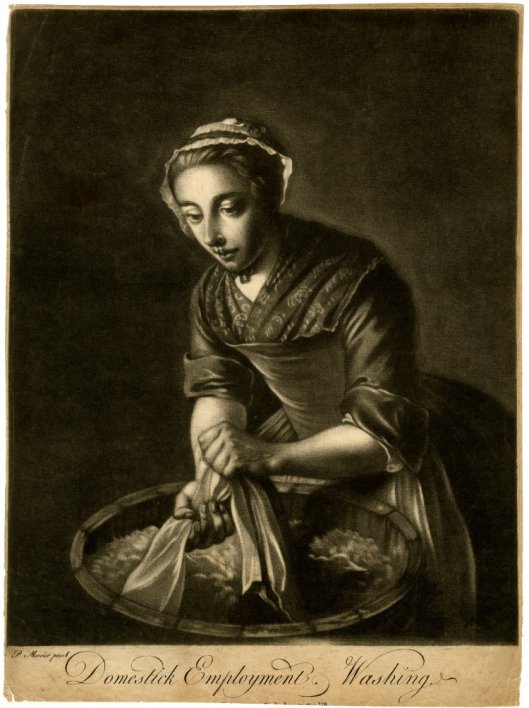
The neckerchief is from B&T, again, and selected because the pattern was similar to the one worn by the young woman in the Domestick Employment: Washing print.

DSC_0051The gown fabric is from the second floor discount loft at the Lorraine mill store in Pawtucket. It’s 100% cotton, yes, it really does flame, and I’ll just have to be careful. (The women who cook in cotton at OSV are probably vastly more graceful than I, and do not fall into things.) It’s a light brown and white tiny check weave, and looks a great deal like a homespun gingham. I chose it because it tends to wrinkle badly and should show the dirt well: in short, I chose it because I don’t expect it to wear particularly well.

The petticoat is from the last of some ‘madder’ linen Burnley & Trowbridge had a few years ago, and the mules are from them; I think the apron linen was, too, but I can’t remember.

Those shirts are blue and white check from Wm Booth, and I have no idea how they got into my apron. Stop asking, or I’ll get my stick.

Share this:

  • Share on Facebook (Opens in new window) Facebook
  • Share on Pinterest (Opens in new window) Pinterest
  • Email a link to a friend (Opens in new window) Email
  • Share on X (Opens in new window) X
Like Loading...

The Birth-Night Ball (a preview)

24 Monday Feb 2014

Posted by kittycalash in Clothing, Events, Living History, Reenacting

≈ Comments Off on The Birth-Night Ball (a preview)

Tags

10th Massachusetts, 18th century clothes, 18th century clothing, authenticity, common dress, common people, dress, fashion, Grand Ball, living history, patience, style

Fully done up.

Photos by a real photographer won’t be available for another two weeks (patience, Iago, patience) but  Mr S and I had a lovely time, high-heeled shoes excepted. The gowns were dramatic, the gentlemen dandy, and the dancing elegant, if bumpy at the start. There are some videos here, both of the assembled company dancing, and of the lovely minuet demonstration.

Selfie, and ready for bed!

I managed a phone photo just before I crashed into bed, and am generally satisfied with how the dressed-up laundress appeared. Clearly my laundry business is doing very, very well, or I have liberated some earrings from a client. One of the most challenging things about this event (aside from my over-thinking freak outs) was not having a persona to hold onto. We started reenacting as lower-class 18th century types, and spent some time as tenant farmers and maids. Mr S and I do not have clothes for the gentry, but can inch into the middling sorts when we want to.

That’s fine, and it’s comfortable– we’ve not yet really reached all the way down the lower sorts, either–but it does mean that when we’re presented with the opportunity to dress above our station, the need to really understand the new station kicks in, and delays the process.

I’ll finish that silk sacque someday, and sooner rather than later, but I’m glad I held off so I can really get the gown right, as well as the shoes, hair style, and other accessories.

Share this:

  • Share on Facebook (Opens in new window) Facebook
  • Share on Pinterest (Opens in new window) Pinterest
  • Email a link to a friend (Opens in new window) Email
  • Share on X (Opens in new window) X
Like Loading...

Pinner Aprons

23 Thursday Jan 2014

Posted by kittycalash in Clothing, History, Laundry, Making Things, Reenacting, Research

≈ 3 Comments

Tags

18th century clothes, apron, Clothing, common dress, Costume, fashion, laundry, Paul Sandby, pinner apron, style, watercolors

Mr & Mrs Thomas Sandby. Watercolor by Paul Sandby. RCIN 917875, Royal Collection Trust.

Mr & Mrs Thomas Sandby. Watercolor by Paul Sandby. RCIN 917875, Royal Collection Trust.

On Saturday, Sew 18th Century and I went out for lunch and fabric shopping. Along the way, I brought up pinner aprons, and that I’d seen them in British prints. She said, “You should blog about that!” and I went back to check my sources. Fail! There was an English print after a French original, and that doesn’t count!

So I shelved that idea, and went about looking for more Paul Sandby images of soldiers and maids and tents, and found instead Mr and Mrs Thomas Sandby. Ahem. Pinner apron alert.

Fluke, right? Well, no, not exactly.

Lady Chambers and child. Watercolor by Paul Sandby, RCIN 914409. Royal Collection Trust.

Lady Chambers and child. Watercolor by Paul Sandby, RCIN 914409. Royal Collection Trust.

Because here is Lady Chambers and child, with Lady Chambers in a pinner apron.

The thing to note, though, is that “apron” here is a decorative, almost ceremonial garment made of black silk, while the maid engaged in Domestick Employment is wearing a working garment of [probably white] linen.

Domestick employment, washing. Mezzotint by Richard Houston after Phillipe Mercier, 1736-1775. British Museum 1876,0708.23

Domestick employment, washing. Mezzotint by Richard Houston after Phillipe Mercier, 1736-1775. British Museum 1876,0708.23

Well, can I wear a pinner apron as a Continental army laundress or not? Probably not, though I will be going back through all the images of laundering I can find. It would be so useful and protective a garment!

No, instead, it looks as if the black silk pinner apron was a fashion adopted by the British upper class probably in imitation of the aprons worn by young girls. These fleeting, black silk accessories were probably adapted to some other use when the fashion had fallen from favor. (You could make a lot of mitts out of one of those.) Sadly, I don’t care enough about the elite to go chasing inventories and more images, but someone else can. I think I have seen a few other examples of this style, but cannot immediately place them. My sense is that these are not common.

I’m much more interested in laundresses and maids. Doesn’t she look sassy? We could call her Bridget. 

A country girl, full-length, facing front, leaning against a fence & a tree. Watercolor by Paul Sandby. RCIN 914438. Royal Collection Trust

A country girl, full-length, facing front, leaning against a fence & a tree. Watercolor by Paul Sandby. RCIN 914438. Royal Collection Trust

Share this:

  • Share on Facebook (Opens in new window) Facebook
  • Share on Pinterest (Opens in new window) Pinterest
  • Email a link to a friend (Opens in new window) Email
  • Share on X (Opens in new window) X
Like Loading...

Families and Hatters: more sale portraits

15 Wednesday Jan 2014

Posted by kittycalash in Clothing, History, Living History, Research

≈ Comments Off on Families and Hatters: more sale portraits

Tags

18th century clothes, 18th century clothing, american art history, art history, auctions, Clothing, common dress, common people, fashion, Sotheby's

Lot 627, Sale N09106, "Esmerian."

Lot 627, Sale N09106, “Esmerian.”

Another lot from the Sotheby’s American Folk Art sale is this pair of paintings by Jacob Maentel. (There’s an entire series of paintings by Maentel, all worth checking out.)

Particularly fun in this family portrait? The two little girls wearing dresses made of the same fabric. One of my former colleagues and co-conspirators always wanted to dress interpreters in clothes made of the same fabric, dresses, waistcoats and other items, as if we’d bought a sole bolt of fabric one year. Well, there it is, above: one length, two little gowns.

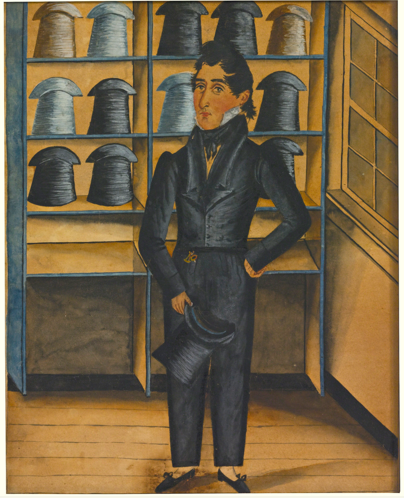
Lot 576, Sale N09106, "Nesmerian"

Lot 576, Sale N09106, “Nesmerian”

For my friend who makes hats, here is the portrait of Hatter John Mays of Schaeffertown, also painted by Jacob Maentel.

Top hats aplenty, bows on his shoes, and gold watch fobs. I’d say Mr Mays is doing quite well.

Share this:

  • Share on Facebook (Opens in new window) Facebook
  • Share on Pinterest (Opens in new window) Pinterest
  • Email a link to a friend (Opens in new window) Email
  • Share on X (Opens in new window) X
Like Loading...
← Older posts
Newer posts →

Archives

wordpress statistics

Creative Commons License
Kitty Calash blog by Kirsten Hammerstrom is licensed under a Creative Commons Attribution-NonCommercial-ShareAlike 4.0 International License.

Website Built with WordPress.com.

  • Subscribe Subscribed
    • Kitty Calash
    • Join 621 other subscribers
    • Already have a WordPress.com account? Log in now.
    • Kitty Calash
    • Subscribe Subscribed
    • Sign up
    • Log in
    • Report this content
    • View site in Reader
    • Manage subscriptions
    • Collapse this bar
 

Loading Comments...
 

    %d