• Home
  • Completed Costumes/Impressions
  • Emma and Her Dresses
  • Free Patterns and Instructions

Kitty Calash

~ Confessions of a Known Bonnet-Wearer

Kitty Calash

Tag Archives: common people

‘Countryside at War’ Saturday

26 Monday Aug 2013

Posted by kittycalash in Clothing, Events, Living History, Research

≈ 3 Comments

Tags

10th Massachusetts, 18th century clothes, authenticity, common dress, common people, living history, Massachusetts, Revolutionary War, Rhode Island
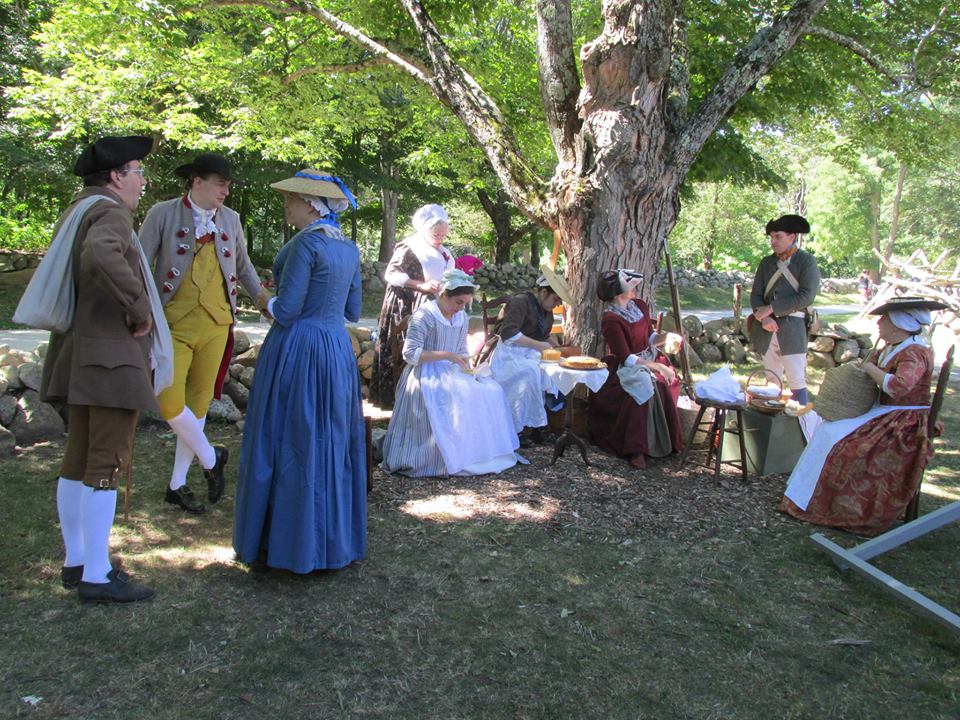
The Countryside at War, Hartwell Tavern, MMNHP, August 24, 2013

The Countryside at War, Hartwell Tavern, MMNHP, August 24, 2013

We came, we saw, we sewed, we ate cake. No, it was more than that, though there was any quantity of excellent cake on a lovely Saturday.

I had a chance to spend the whole day with people I really enjoy talking to, like Sharon Burnston and Sew18thCentury. (I love that silk gown. I really do.) We are all preparing for an event we will be part of in Providence in October, and I think and hope it will be great fun! But I’m getting several weeks and 25 years ahead of myself.

On Saturday, Sharon was a widow who had traveled from New Hampshire to visit her daughter, who was but one month from her confinement. She had a portmanteau of clothes for the soon to be born child, and food, as the blockade and closing of the city had made obtaining anything very difficult.

Before the jacket was applied

Visitors came and asked interesting questions, but there wasn’t much I could answer. Reader, I had not studied. I had sewn instead, vain woman that I am, laboring to produce new trousers and a new waistcoat for the Young Mr. He spent the day reading his school book, recovered in craft paper and blue check linen. Saving grace, that cover, and I plan to make many more. The Young Mr (after hauling carts and goods for people) found  some handy stones and settled in to get his work done.

His father plans to make him a full-size wooden musket from some mahogany that was left over from construction at work: there are no rules to prevent him learning to drill will a dummy musket. At events when he’s not trying to do his school work, he does enjoy being put to work. He likes to feel useful, and I am grateful to people who recognize that, and help me keep him in the hobby. This was all his idea in the first place…
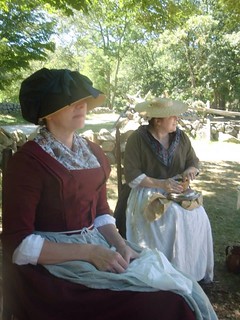
Sew18thCentury and I had a long walk on the bike path, which was mildly dangerous. Bonnets block a great deal of your vision, and change your hearing, so bicycles are particularly troubling. And when wearing a bonnet, one has to peer out from under it to see anything above you, or your lap, as you can see here.

Our clothing was documented, as you know from posts on this blog. I assembled sheets for each of us, and they can be found here: The Young Mr, Mr S and Kitty. I finished it all late on Friday night, so by the time I reached my own, well…there’s always next year to tidy that up. I still like the gown, and I really like the lightweight wool olive/brownish petticoat with the gown. Hooray! Clothing I like, in wool, that can be worn in summer. What’s not to like? (Well, pins, for one thing. They bend and pop out.)
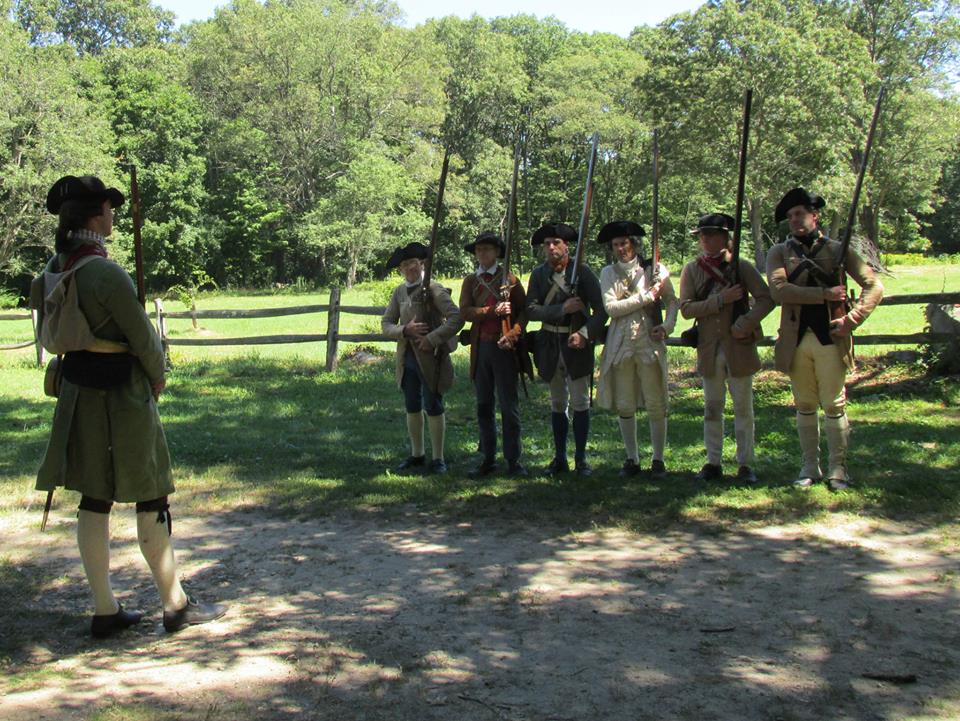
Drilling in the shade, Shirley-style

Drilling in the shade, Shirley-style

The men were drilled for the September 28 event, which rolls forward, sort of. I expect or hope for a schedule this week, which will be helpful. Fingers crossed…though no matter what, I will have to hope a train back to Providence by 3 to make rehearsal for the event at work. That should be interesting…

Now it’s down to finishing and fixing projects in process, and deciding on fabric for a housekeeper’s gown from 1800. I think I’ve settled on a year and style, but the fabric eludes me still. I have to find it pretty soon, because on Saturday, I’ll start making coats for Saratoga. I’m a sucker for beauty, and the Adjutant got me with sea foam green and dark brown wool. The facings are false, so really, a button-hole-free, single-year, described in a letter, regimental coat? The artist in me won, and I am so making that.

Many, many thanks to Sharon Burnston and Friends of Minute Man National Park for the photos! I took none, except of the Young Mr in our yard.

Share this:

  • Share on Facebook (Opens in new window) Facebook
  • Share on Pinterest (Opens in new window) Pinterest
  • Email a link to a friend (Opens in new window) Email
  • Share on X (Opens in new window) X
Like Loading...

Documenting Mr S

16 Friday Aug 2013

Posted by kittycalash in Clothing, Events, Research

≈ 7 Comments

Tags

18th century, 18th century clothes, authenticity, Clothing, common dress, common people, Costume, Events, fashion, living history, menswear, Reenacting, Research, sewing

The guys are usually easy: they wear what the sergeant tells ’em to wear, and they like it, because that’s what soldiers do.

Mr S in Cambridge

Sergeant’s not a sergeant in quite the same way in 1774-1775: he’s a militia sergeant, and while we can still get up to tricks that get us yelled at, the clothing we wear is more personal. Mr S’s clothes seemed, at first, to be completely undocumentable.

Really? Yes, I have been known to have some anxiety issues over small matters. So I calmed down, re-read the standards, and looked again.

The shirt is checked linen, see here for details. The stockings, which will be replaced by hand-knit blue stockings, are also documented to Rhode Island.  But wait! That’s 1777, can it count for 1775? How long do stockings last, anyway?

I’ll own up to having been described as “literal and precise,” and I’m taking that comment to heart. Reader: literal is where one gets into trouble when one is precise. Literal interpretations can lead you, almost hubristically, into creating replicas of runaway ads  or extant garments that don’t reflect who you are, or what time you are portraying, not really.

bluestockings_whitebreeches

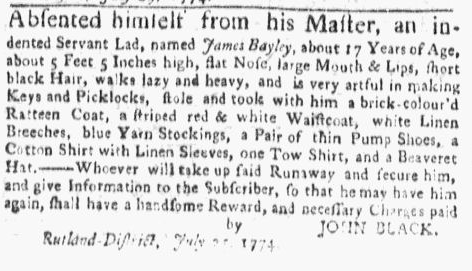
Boston Post Boy, 7/25/1774

But not to worry, I dug up the blue stockings. This is from the Boston Post Boy, July 25, 1774. “White Linen Breeches, blue yarn stockings.” This is not too bad: Mr S has got his basic extremities covered now. It’s hard not to be distracted by the Cotton Shirt with Linen Sleeves, which reminds me of women’s shifts with finer sleeves, or sleeves to pin on.

browncamblet Waistcoat 7-4-1772 providence

Providence Gazette, 7/4/1772.

Keeping focused, let’s get Mr S more fully dressed, more proper, and warmer, since this is late August. You can’t see his waistcoat under the green jacket, but here you can. I know this broadcloth fabric, and its color, are from the acceptable palette for the last quarter of the 18th century, but can I find one in Providence or Massachusetts? Just about. The waistcoat described in this ad is camblet. There’s no goat or camel in Mr S’s camel-colored waistcoat, but I think we’ll call it found and be grateful that Mr S has not taken any action despite the numerous photos I have posted of him in various “poofy shirts” and “funny outfits,” as some of my friends describe them.

What’s left? There’s John Appleton’s ad in the Essex Gazette of May 17, 1774 for “blue, green and cloth colored bandannoes,” which pretty much takes care of the neck cloth; we’ve a brownish one, and a blue one; the Young Mr likes the orangey one, but I think we have those documented.

1774_greenJacket

Essex Gazette, 12/6/1774

1774_Prov_greenJacket

Providence Gazette, 1/29/1774

The green jacket, that’s what’s left. In the Essex Gazette of December 6, 1774, we find a “green jacket, light breeches, and yard Stockings,” much like what Mr S is wearing.  Nice! Multiple sources of documentation for items are always welcome chez Calash.

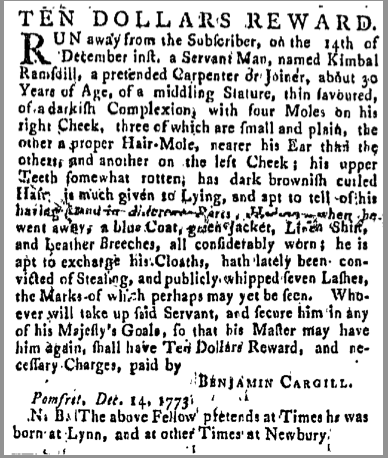
And, knowing that, you will not be surprised that I have found another jacket, closer to home. In the Providence Gazette of January 29, 1774, the man with the “proper hair mole” runs away in a green jacket. He’s also got leather breeches, and they’re on my wish list, though other things must come first, given their expense–things like tires, and allergy drops for the Young Mr.

Share this:

  • Share on Facebook (Opens in new window) Facebook
  • Share on Pinterest (Opens in new window) Pinterest
  • Email a link to a friend (Opens in new window) Email
  • Share on X (Opens in new window) X
Like Loading...

The Authenticity Challenge

14 Wednesday Aug 2013

Posted by kittycalash in Clothing, Events, Research

≈ 3 Comments

Tags

18th century clothes, authenticity, Clothing, common dress, common people, Events, gowns, newspapers, Research, resources, sewing

We’re going up to Minute Man on August 24, or at least that’s the plan. We have hostages to exchange (one ends up with other folks’ spoons and bowls when one does the dishes) and drilling to do for the September 28 event in Boston.

Immediately after Sturbridge, the authenticity question blossomed on the interwebs, as there was an unusually fine crop of bodices on view in the village that weekend. (To be clear, I am pro-authenticity and anti-bodice, but I am still working over my thoughts on authenticity, which veered into hermeneutics, and are therefore not really germane to the conversation.)

Authenticity and standards are in the ether, and for this year’s event, all participants are asked to provide documentation, not just the people taking part in the challenge. I plan attend but not to partake of the challenge, as I have no desire to relive my childhood of never-even-third-place, thank you. Instead, I’m merely queasy and scrambling, as the only person in our household who seems really documented to me is the Young Mr, with his snuff-colored trousers  currently under construction, and two jackets from which he may be able to choose (presuming I get all buttonhole inspired). So he’s good. Run away!

I’ve been working on a ‘secret’ gown that’s not totally secret, but don’t feel I can adequately document it for this event. I have examples of the fabric advertised for sale, and a period print. But so far, the only gowns of this fabric type described in runaway ads have dark grounds. Granted, servants might tend to wear darker, more dirt-hiding colors, but I don’t feel that one print and some wrong-ground ads are enough. Next!

Anne Carrowle is Philadelphia, not New England: she’s passable for Monmouth and other Mid-Atlantic events. Chintz jackets: also fine for those runaway Dutch servants in NY and Philadelphia. Next!

Brown wool seemed too heavy for August, but the way the weather has been of late, maybe not. Well, anyway, it could get hotter. Next!

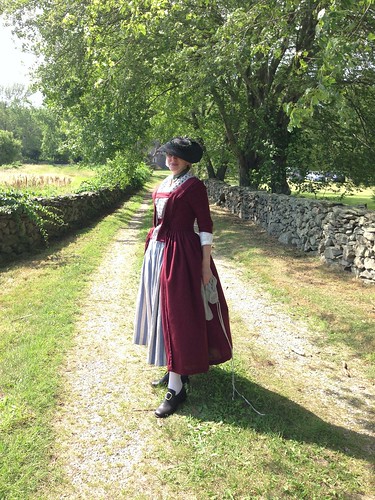
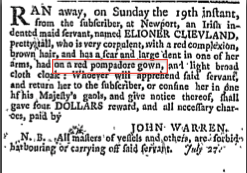
1772 red pompadoreThat leaves me with the New Favorite Gown, which I like, but which is based on an earlier British watercolor, so must be slightly altered at the sleeve or cuff as well as documented. At first I could find nothing to suggest that the color and fabric were within the realm of documentary possibility. Eventually I did find an ad in the Newport Mercury for what might be a likely candidate.

“Ran away on Sunday the 19th instant, from the subscriber at Newport, an Irish indented maid servant, named Elioner Clievland, pretty tall, who is very corpulent, with a red complexion, brown hair, and has a scar and a large dent in one of her arms, had on a red pompadore gown, and light broadcloth cloak: ” Newport Mercury, 8-10-1772

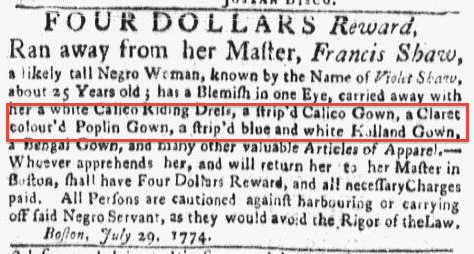
claret poplinTwo years later, “ a likely tall Negro Woman, known by the name of Violet Shaw, about 25 years old; has a Blemish in one Eye, carried away with her a white Calico Riding Dress, a strip’d Calico Gown, a claret colour’d Poplin Gown, a strip’d blue and white Holland Gown, a Bengal Gown, and many other value Articles…” Boston Evening Post, 8-1-1774

Well, I’m tall, and far from 25, but thankfully, I am not corpulent. But here are two wool or wool-blend, gowns, in reddish colors, in the right time period and place. Unfortunately, I have not yet found striped, or striped linsey, petticoats in Rhode Island, Connecticut or Massachusetts in 1772-1775—plenty in Philadelphia, where there are more servants running away—so what to do? I’ll look a damn fool without a petticoat.
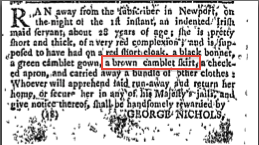
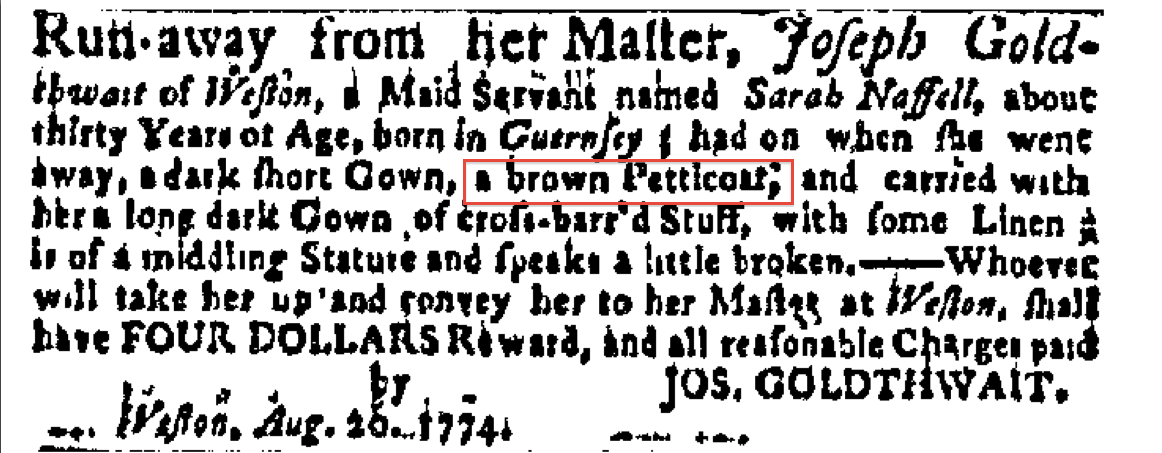
brown petticoat newport

ShortGown There’s the brown petticoat solution. There is one in Boston (Weston), in August, 1774, and another in Newport, in January, 1773. I like the “brown camblet skirt;” I don’t have camblet, but at least the drape of the lightweight wool and cotton will be closer to camblet than to wool. I can agonize over the suitability of fabrics (and the vagaries of style) in some other post.

I made the gown intending to wear it with a blue and yellow striped as-yet-unmade petticoat (to look like the watercolor), but have some brown wool I can make up instead. Better documented than not (or nude).

Share this:

  • Share on Facebook (Opens in new window) Facebook
  • Share on Pinterest (Opens in new window) Pinterest
  • Email a link to a friend (Opens in new window) Email
  • Share on X (Opens in new window) X
Like Loading...

Apprehending Chicken

27 Thursday Jun 2013

Posted by kittycalash in Events, Food, Living History, Reenacting, Research

≈ 4 Comments

Tags

10th Massachusetts, 18th century, 2nd Rhode Island, common people, common soldier, cooking, food, living history, Reenacting, Revolutionary War

Living History Chickens. Don’t mess with them.

I have written in the past about the Living History Chicken, ripped and delicious, and the joys of making such a creature fit into a cast-iron pot. While “chicken ripper” might be the appellation you desire, it’s not what I want to be known for.

Last time, I dissed the modern ham as an item ill-suited to camp cooking (tasty, but it doesn’t look right). I have also seen hams on a spit cooked slowly (too high above) a fire, and heard a rumour about a very authentic ham-dining experience with a very authentic digestive result. That’s taking things farther than I care to take any regiment, so what to do?

Continental Army rations included, among other things, a pound of flour and a pound of beef a day per man. In Rhode Island at least, that beef might also have been fish, and I have seen chicken listed, too, as it is, technically, meat. Not wanting to inflict our fishy Ocean State customs on all comers, I think I’ll spare the regiments a pound of fish a day. But chicken? What to do? Hope to cook it?

Or maybe we should eat more fruit.The Afternoon Meal by Luis Meléndez, ca. 1772. MMA, 1982.60.39

One option is to rip the carcass apart (see above) and boil it. That would get the job done, for a bone-in chicken stew. However, I am thinking of string roasting chicken (or cornish game hens, since modern grocery store chickens are awfully large).

To be quite technically correct, I could only cook chicken for the Second Helping Regiment. They had a documented poultry thief among their number, one John Smith, who apprehended poultry if it failed to give the correct countersign when challenged. However a chicken is prepared, it will be a messy business, as we have no forks. It’s fingers, knives and spoons for us, as we have no forks. That does increase the appeal of boiling, since the meat would come off the bone more easily.

Share this:

  • Share on Facebook (Opens in new window) Facebook
  • Share on Pinterest (Opens in new window) Pinterest
  • Email a link to a friend (Opens in new window) Email
  • Share on X (Opens in new window) X
Like Loading...

Fog on the Hudson

21 Sunday Apr 2013

Posted by kittycalash in Museums

≈ 1 Comment

Tags

common people, historic houses, history, imperfections, Museums, tours, vacation

20130421-072045.jpg Up on the Hudson, it gets foggy. We drove through fog, which was probably a cloud, and remarked on how very different from home it is here. And once again, I demonstrated an inability to navigate through anything but a conventional New England rotary: I have over-adapted.

We went to the West Point Museum (far too warm, folks; artifacts and visitors alike will cook at 72+ F) and enjoyed the artifacts and dioramas. It’s a classical museum, chronological and linear as you would expect it to be. I don’t object to this format at all: it supports limited labeling, which I consider a blessing, really, and allows the objects to speak for themselves and leaves room for the visitor to wonder, find a label, and read more. I did take photographs, but forgot the adapter for downloading the camera.

From there we visited Fort Montgomery, which may well be the site of future shivering.
Here, I did not take photos, especially after I was warned off touching the glass by the curator or site superintendent (honest, I didn’t leave a smudge).

The last stop on Friday was at Boscobel, which I knew of from a book at work. The house is as lovely as you would expect from a place furnished by the former curator of American Decorative Arts at the Met, and funded by Lila Wallace’s fortune. It’s a guided house tour, with an audio tour for the grounds. We lasted through the guided tour (there were only the three of us) and a portion of the grounds.

I’m really glad I lifted the no photography rule at work. Boscobel has some lovely objects. I was interested in several for which there are no catalog images online, no postcards, and no images in their books. I couldn’t capture the sense of place in the house, or the room the way I saw it, and I find that archaic and frustrating.

The tour itself was everything you’d expect a tour given by retired women of means to be: genteel, focused on furniture, and docile. To their credit, they do a good job with photographs to explain how the commodes work, and by the second floor our guide had loosened up a little bit in her blue blazer. But there was little about the family and their lives, nothing about the servants, and some basic misapprehensions about how a house of that size worked. (The cast iron cylinder in a water or tea urn was never heated in the parlor fire, and never by the mistress; sparks! fire! mess on mahogany! Nope, it all happened in the kitchen.)

In the end, Boscobel was lovely and I am envious of the decor and some of the objects and details, but as the tour guide noted, I most liked the “imperfect rooms” (the pantry, the kitchen, the bathing area and the servant’s bedroom).

Huzzah for imperfections! Time to dress for the last day of the common, imperfect soldier before we tear off for home.

Share this:

  • Share on Facebook (Opens in new window) Facebook
  • Share on Pinterest (Opens in new window) Pinterest
  • Email a link to a friend (Opens in new window) Email
  • Share on X (Opens in new window) X
Like Loading...
Newer posts →

Archives

wordpress statistics

Creative Commons License
Kitty Calash blog by Kirsten Hammerstrom is licensed under a Creative Commons Attribution-NonCommercial-ShareAlike 4.0 International License.

Website Built with WordPress.com.

  • Subscribe Subscribed
    • Kitty Calash
    • Join 621 other subscribers
    • Already have a WordPress.com account? Log in now.
    • Kitty Calash
    • Subscribe Subscribed
    • Sign up
    • Log in
    • Report this content
    • View site in Reader
    • Manage subscriptions
    • Collapse this bar
 

Loading Comments...
 

    %d