• Home
  • Completed Costumes/Impressions
  • Emma and Her Dresses
  • Free Patterns and Instructions

Kitty Calash

~ Confessions of a Known Bonnet-Wearer

Kitty Calash

Tag Archives: common people

Mopping Up

14 Monday Mar 2016

Posted by kittycalash in Living History, Making Things, Research, Uncategorized

≈ 4 Comments

Tags

18th century, cleaning, common people, Fort Ticonderoga, interpretation, living history, mops, women's history, women's work

A City Shower. Oil on canvas by Edward Penny, 1764. Museum of London

A City Shower. Oil on canvas by Edward Penny, 1764. Museum of London

Springtime sadness is best remedied by scouring[1], so in the best Scandinavian fashion, I have been looking into 18th century cleaning. Dem barracks, right?

First of all, were you wondering about what exactly they “smoked and cleansed” smallpox victims’ rooms with? Brimstone and frankincense.[2] Now you know what Edward Langford would wake up smelling when the house next door was free of smallpox.

But what about those floors? They need to be cleaned. Swept, yes, and scrubbed with sand. But also mopped, and the doorstep mopped.

Tit for Tat. stipple etching, London, Printed for R. Sayer Map, Chart & Printseller N° 53 Fleet Street, as the Act directs Novr 24. 1786. British Museum 1861,0518.958

Tit for Tat. stipple etching, London, Printed for R. Sayer Map, Chart & Printseller N° 53 Fleet Street, as the Act directs Novr 24. 1786. British Museum 1861,0518.958

I have a broom and a whisk broom, and can substitute a kettle for my sad bucket[3] but I lack a suitable mop. Lack never deterred me, whether of skills, knowledge, or supplies, so off to the interwebs and library I went.

I started with Foul Bodies, the 2009 monograph by Kathleen M. Brown. Nothing on floors, sadly.

I remembered the 10th Massachusetts Orderly book from 1782, that was more helpful.

Some part of the Camp and about the long Barracks in particular is relaxing into nastiness. Regimental QuarterMasters have been ordered to have them Clean and keep them so. An Officer of each Company has been ordered to visit the Barracks every day and to Confine & Report those who throw bones of meat Pot Liquor or filth of any kind near the Barracks. Yet all this has been done and no report has been made. it is hatefull to General Howe to Reitterate orders as it ought to be shamefull those who make it necessary.
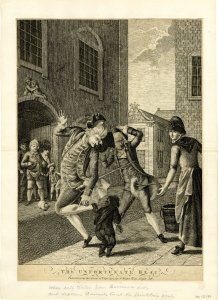
The Unfortunate Beau, etching, Publish'd as the Act directs 12th Sept 1772, by S.Hooper, No.25 Ludgate Hill. British Museum 1991,1214.20

The Unfortunate Beau, etching, Publish’d as the Act directs 12th Sept 1772, by S.Hooper, No.25 Ludgate Hill. British Museum 1991,1214.20

Nastiness. Those barracks sound noisome, don’t they? We can’t have that.

So let’s cast out the bones, sweep the floors of the branches and dirt and grit the men have brought in, and mop them, too, now that it’s spring.

Mop, you say?

What did mops look like the in 18th century?
And how on earth will we acquire one?

Tune in next time for another exciting installment of “historical cleaning instead of cleaning my own house.”


[1] Dude, I have scrubbed baseboards with a toothbrush. Not one of my finer moments, but a memorable one.

[2] Kathleen Brown, Foul Bodies: Cleanliness in Early America. (New Haven: 2009) p. 129

[3] Really really: I meant it when I said keep the bucket wet.
Share this:

  • Share on Facebook (Opens in new window) Facebook
  • Share on Pinterest (Opens in new window) Pinterest
  • Email a link to a friend (Opens in new window) Email
  • Share on X (Opens in new window) X
Like Loading...

Frugal Friday: Make Do and Mend

11 Friday Mar 2016

Posted by kittycalash in Clothing, Living History, Making Things

≈ Comments Off on Frugal Friday: Make Do and Mend

Tags

18th century clothes, 18th century clothing, Clothing, common dress, common people, Costume, dress, sewing

In a world of fast fashion, mending is quite out of date (unless you’re a hipster, and I am one of the trilobites of hipsterism), so it is all the more appropriate that I have a gown in need of mending.

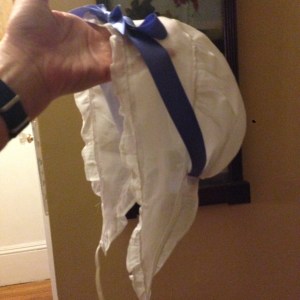
I am still making new things, like the “Bad Squishy” jellyfish cap. It didn’t look so tentacular until I held it up to show it off. As with any cap, the main goal is merely to keep it upon my head–always in doubt.

Tenactularly good. And now I can whip gather.

Tenactularly good. And now I can whip gather.

In just a week I’ll be headed up to Fort Ticonderoga to clean the officers’ quarters and generally represent the women who accompanied the 26th Regiment of Foot— and yes, I know I’m old enough to be the mother of any number of those folks, but there’s no need to point it out all the time. The main thing is the cleaning. And the weather, which looks like it could once again be unseasonably warm. That won’t stop me making another wool gown, which I am making up in a drab wool specifically for dirt and distracting my unsettled mind.

Washing, wearing, and airing

Washing, wearing, and airing

All the same, I pulled out the mother of all wrecked and wreckable gowns, the cotton gingham made for Bridget Connor. This has achieved a pretty nice patina, though I will confess to having washed it last fall after repeated wearings over the course of the summer. I know– not so necessary, but I did. Fear not: the stains remain.

I have no idea how that happened
Pop goes the sleevil

But I wore it vigorously and made it up quickly– to the point of needing to take it off and mend it at Stony Point (was that really two years ago?). Mending is required once again, so that small seam ruptures do not become actual sleeve separations as I dust, sweep, and mop. Yes, of course I’ll be making experimental mops this weekend, why not? There just isn’t enough distraction in the world.

1750-1770 gown, Fashion in Detail
Eyelets help me stay dressed

I worried about those eyelets I installed way back when, but was relieved to discover that I had seen a precedent, and that the date was within tolerances for someone of my age to retain in her clothes. The lacings also make dressing significantly easier for me; some days, putting on an open robe takes me back to the button-up and lace-up toys of pre-school, when tying shoelaces was a major accomplishment.

Share this:

  • Share on Facebook (Opens in new window) Facebook
  • Share on Pinterest (Opens in new window) Pinterest
  • Email a link to a friend (Opens in new window) Email
  • Share on X (Opens in new window) X
Like Loading...

Zen and the Art of Living History

08 Tuesday Mar 2016

Posted by kittycalash in Events, History, Living History, Philosophy, Reenacting

≈ 2 Comments

Tags

authenticity, common people, history, interpretation, living history

sandpitGate

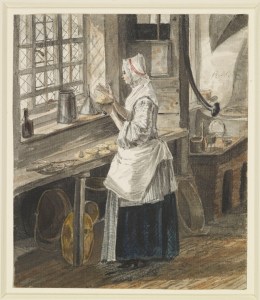
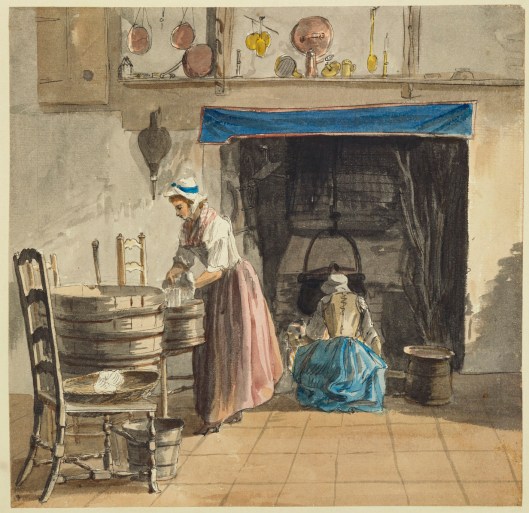
Paul Sandy. The Kitchen at Sandpit Gate, ca 1752 RCIN 914333

or, Embrace the Everyday

Chop Wood, Carry Water is taken from a Zen saying: Before enlightenment, chop wood, carry water. After enlightenment, chop wood, carry water.

Yes, I read the classic book decades ago when my life had fallen apart pretty completely, and when I dismantled it again recently, similar principles applied. After processing archival collections, sorting sewer bills and love letters– toiling in the salt mines of the mundane–I came to appreciate Chop Wood, Carry Water even more. The world isn’t really binary, but it can feel that way.

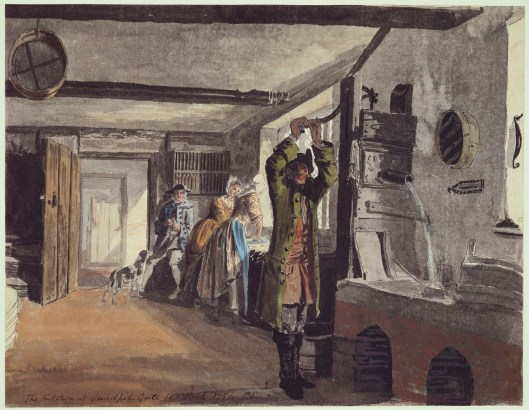
Paul Sandby. At Sandpit Gate circa 1752 Pencil, pen and ink and watercolor. RCIN 914329

Paul Sandby. At Sandpit Gate, ca 1752 RCIN 914329

We look up out of the trench of daily life and think we see giant, heroic figures doing great things, and we feel jealous. We want to feel special. Some of us want to feel pretty, or handsome, or important.

Some of us want to chop wood, carry water.

Paul Sandy. The Kitchen at Sandpit Gate, 1754. RCIN 914331

Paul Sandy. The Kitchen at Sandpit Gate, 1754. RCIN 914331

The way to make living history more interesting and more relevant is to go deep into the everyday. I don’t mean spinning– unless you tell me why you’re spinning, and I hope it’s part of Boston’s failed “We’ll make it all ourselves!” Little-Red-Hen experiment of the late 1760s–I mean living. Everyday things.

Dishes, laundry, three meals, sweeping, making up beds, mending, chucking the cat out the window, checking on dinner, chucking the cat out the window again. That’s the background against which all of the Great Men and Remembered Ladies stride and saunter. Us. You and me. Waking up with frowzy hair, blinking in the pale light of dawn. That’s the world the Great Men woke up in. That’s the world they occupied most of the time.

When we recreate Great Moments, we’re only replaying the highlight reel. Without context, those moments have less meaning. You’ve heard this sentiment before.

Chop wood, carry water. Embrace the everyday, bring everyone back into history.

Share this:

  • Share on Facebook (Opens in new window) Facebook
  • Share on Pinterest (Opens in new window) Pinterest
  • Email a link to a friend (Opens in new window) Email
  • Share on X (Opens in new window) X
Like Loading...

Peddling a Myth

23 Tuesday Feb 2016

Posted by kittycalash in Events, Fail, History, Living History, Reenacting, Research

≈ 13 Comments

Tags

18th century, Boston, common people, Events, fail, interpretation, Research, Revolutionary War

Paul Sandby RA, 1731–1809, British, London Cries: Last Dying Speech and Confession, ca. 1759, Watercolor over graphite on medium, cream, slightly textured wove paper, Yale Center for British Art, Paul Mellon Collection

Paul Sandby RA, 1731–1809, British, London Cries: Last Dying Speech and Confession, ca. 1759, Watercolor over graphite on medium, cream, slightly textured wove paper, Yale Center for British Art, Paul Mellon Collection

Every now and then, I reach the dammit! point of my research, where I am forced to realize that Everything I Assumed Was Wrong. I try to make those moments a cause for celebration, even though they’re often deeply frustrating. Do not pass GO, Do not collect $200, Go directly to the Library.

What now?

Well… Boston ain’t London. And the North American colonies ain’t Great Britain. The business structure, the size of the cities, is different. Distribution of goods is different, thanks to tariffs and non-import/export laws. Which means?

Peddling. It’s not a thing. Or it’s a very difficult thing to document.
Which means that all the things I’d thought about doing for the Massacre (day or night) are probably wrong. (Remember, this is when we celebrate!)

Hey, I’m not the only one rethinking my approach.

But there it is: I’ve looked in the Boston Selectmen’s Minutes for 1768-1771, and while there is plenty of small pox (yay!) and many lemons being imported (yay! punch!) and there are licenses being granted for selling strong drink in inns and houses, there are no peddlers licenses. There are no licenses for street vendors of any kind. Hmmmm….

I’ve also read the Dublin Seminar publications Itinerancy in New England and New York (1984) and Life on the Streets and Commons, 1600 to the Present (2005). Not looking good here for street vendors and hawkers pre-1800.

While I never particularly trust early 20th century monographs and articles without footnotes, the somewhat entertaining Hawkers & walkers in early America : strolling peddlers, preachers, lawyers, doctors, players, and others, from the beginning to the Civil War informed me that street vending was not common in North American British Colonies, and in fact, was not commonly seen until after 1800.

What the ever-loving heckers?

I found peddlers’ licenses in Philadelphia for 1770: all men. But so far, nothing in Providence, Boston, or Newport (or Connecticut). The theory is that itinerant sales people didn’t pay taxes the way merchants did, and that merchants therefore lobbied against them. In Providence, the earliest mention I’ve found thus far is a lobster and fish man at the Great Bridge in 1818.

Just as the watch of Boston differed from the watch in London, so too, it seems, did the petty retailers. I still can’t quite believe there were no street peddlers and hawkers in colonial cities, but I’ll need a new way to approach this question.

Share this:

  • Share on Facebook (Opens in new window) Facebook
  • Share on Pinterest (Opens in new window) Pinterest
  • Email a link to a friend (Opens in new window) Email
  • Share on X (Opens in new window) X
Like Loading...

On the Street Corner

10 Wednesday Feb 2016

Posted by kittycalash in History, Living History, Reenacting, Research

≈ 2 Comments

Tags

18th century, cats, common people, Events, history, interpretation, living history, Paul Sandby, Research

Paul Sandby RA, 1731–1809, British, London Cries: "Turn your Copper into Silver Now before Your Eyes" (Title Page Design), 1760, Watercolor, pen and gray and brown ink over graphite on medium, cream, slightly textured laid paper, Yale Center for British Art, Paul Mellon Collection

Paul Sandby RA, 1731–1809, British, London Cries: “Turn your Copper into Silver Now before Your Eyes” (Title Page Design), 1760, Watercolor, pen and gray and brown ink over graphite on medium, cream, slightly textured laid paper, Yale Center for British Art, Paul Mellon Collection

Not everyone who’s standing on the corner is up to no good. Some have legitimate business.

In the London of the past, just as in, say, the Manhattan of today, street vendors hawked a variety of goods. Having gone through multiple versions of Cries of London, I’ve come up with a basic list of the items sold on the street.

Love songs
Stationery
Oranges
Boot laces
Reeds for chair mending
Saloop See also salop.
Gingerbread
Muffins
Hot cross buns
Doormats
Cats’ and dogs’ meat
Coal
Lavender
Ribbons

Paul Sandby RA, 1731–1809, British, London Cries: A Girl with a Basket on Her Head ("Lights for the Cats, Liver for the Dogs"), ca. 1759, Watercolor, pen and brown ink, and graphite on medium, cream, slightly textured laid paper, Yale Center for British Art, Paul Mellon Collection

Paul Sandby RA, 1731–1809, British, London Cries: A Girl with a Basket on Her Head (“Lights for the Cats, Liver for the Dogs”), ca. 1759, Watercolor, pen and brown ink, and graphite on medium, cream, slightly textured laid paper, Yale Center for British Art, Paul Mellon Collection

Boot black
Brushes
Flounders
Rhubarb
Walnuts to pickle
Cucumbers
Bandboxes
Baskets
Brooms
Rabbits
Pins
Mops
Wash balls (soap)
Strawberries
New peas
Rosemary and bay
Strings of onions
Turnips and carrots

There’s seasonality to this, of course. Strawberries and cucumbers are not being hawked on the streets of London, Boston, Newport or New York in February. I’ll tell you: being a Cat’s-meat-[wo]Man is practically a childhood dream, since I knew I could never really learn to speak to the animals, and as it happens, Sandby depicts one. It seems there was gender equity in supplying food for pets and stinking of meat.

Paul Sandby RA, 1731–1809, British, London Cries: A Milkmaid, ca. 1759, Watercolor, pen and brown ink with graphite on medium, cream, slightly textured wove paper, Yale Center for British Art, Paul Mellon Collection

Paul Sandby RA, 1731–1809, British, London Cries: A Milkmaid, ca. 1759, Watercolor, pen and brown ink with graphite on medium, cream, slightly textured wove paper, Yale Center for British Art, Paul Mellon Collection

I’ve long been fond of the milkmaid, probably because she’s relatively clean, has a cloak for warmth, and I can understand what she does. As much as I love “Turn your copper into silver,” I lack real skill at charlatanry. And gambling. I don’t play poker: my face is too easy to read. Still, if you’re doing this right, there’s a lot to invest in being a milkmaid: kettles (likely pewter), measuring cups (tin? or possibly pewter), and a yoke. It’s a commitment. Cat’s meat– if you’re good with stank and have the right basket*, you’re pretty okay.

If not stank or drank, then gaming. It looks like the object of the game is to knock down the three balls at left in the background by hitting another ball, or perhaps a stone, with the stick. Ha’penny a throw? Maybe you just throw the stick.

Paul Sandby RA, 1731–1809, British, London Cries: Throws for a Ha'penny Have You a Ha'penny, undated, Brown wash, gray wash, graphite, and black chalk on medium, cream, slightly textured laid paper, Yale Center for British Art, Paul Mellon Collection

Paul Sandby RA, 1731–1809, British, London Cries: Throws for a Ha’penny Have You a Ha’penny, undated, Brown wash, gray wash, graphite, and black chalk on medium, cream, slightly textured laid paper, Yale Center for British Art, Paul Mellon Collection

This is another instance wherein I am faced with historical things I don’t know nearly enough about: gambling and street games, pet care and keeping. Cat boxes: when we were they invented? We know cat litter is a 1947 invention, and that sand or ashes were used in cat boxes when cats were kept inside, but for the most part, they went in and out, and mostly out, until cat boxes and neutering became common, though an 1895 manual recommended that “the cat in civilization must be fed, looked after, and guarded in its moments of freedom.“**

cat care

Yes, I went there. I looked it up.

It’s more than 100 years after the time I’m investigating, but I don’t want to fall too far down this cat’s meat rabbit hole– but this does tell me that the historical images of indoor cats come with oat or straw filled baskets in sunny corners, and recommendations for galvanized pans filled with sand, clean earth, or sawdust, which may be ideal, as it can be burned.

Right, I need to focus and not entertain myself with children’s books about Old Dame Trot and her cat…dressed up. In 1810.

My point is, there’s a lot to sell on the streets of any town, images to support the material culture and reference books from which we can derive contextual clues to the impression of something as random as a cat’s meat man or woman. I don’t know that I’m leaping to be a Cat’s-meat-Woman, but it leads to a lot of interesting interpretive points about domestic life, pets, and families that visitors can relate to much more easily than street sales. Of course, if you choose to be the Cats-meat-Man, I won’t stop you from calling yourself Mr Friskies.

*See that flat do-da? I have a similar basket. It does appear one could hawk oysters from a basket like the one I have. Mmmm good.

**Huidekoper, Rush Shippen, 1854-1901. The cat, a guide to the classification and varieties of cats and a short treaties upon their care, diseases, and treatment. 1895: New York, D. Appleton and company

Share this:

  • Share on Facebook (Opens in new window) Facebook
  • Share on Pinterest (Opens in new window) Pinterest
  • Email a link to a friend (Opens in new window) Email
  • Share on X (Opens in new window) X
Like Loading...
← Older posts
Newer posts →

Archives

wordpress statistics

Creative Commons License
Kitty Calash blog by Kirsten Hammerstrom is licensed under a Creative Commons Attribution-NonCommercial-ShareAlike 4.0 International License.

Website Built with WordPress.com.

  • Subscribe Subscribed
    • Kitty Calash
    • Join 621 other subscribers
    • Already have a WordPress.com account? Log in now.
    • Kitty Calash
    • Subscribe Subscribed
    • Sign up
    • Log in
    • Report this content
    • View site in Reader
    • Manage subscriptions
    • Collapse this bar
 

Loading Comments...
 

    %d