• Home
  • Completed Costumes/Impressions
  • Emma and Her Dresses
  • Free Patterns and Instructions

Kitty Calash

~ Confessions of a Known Bonnet-Wearer

Kitty Calash

Tag Archives: common soldier

Lovers & Fighters

24 Tuesday Sep 2013

Posted by kittycalash in History, Research

≈ 1 Comment

Tags

10th Massachusetts, 18th century, common people, common soldier, Revolutionary War, women, women's history

The wife of Bob Munn, Keeper at Sandpit Gate. Paul Sandby, Royal Collection Trust  RCN 914337

The wife of Bob Munn, Keeper at Sandpit Gate. Paul Sandby, Royal Collection Trust RCN 914337

On Sunday,  Mr FC mentioned that they knew the names of at least two of the women of the 10th Massachusetts, including one notorious woman, Bridget Mahoney. I mentioned this in an email to Mr HC, and got back four solid paragraphs of information. I sincerely and earnestly wish I had those retention skills, but embedded in one paragraph was that they knew of a woman in Wallcott’s company, because the brigade chaplain, Enos Hitchcock, had baptized the child of a soldier in Wallcott’s company.

Enos Hitchcock was the pastor of the First Congregational Church in Providence, and I happen to be fairly familiar with his pastel portrait and his diaries. The Rhode Island Historical Society published his diaries in 1899, and they can be read online thanks to the Open Library.

Here’s what I found, reading and searching:

April 25, 1779
Baptized child of Richard Northover, Soldier of the Train, by the name of Mary.

May 5, 1779
Married Sgt Bates and Mrs Lucy Gun

May 9, 1779
Baptized Lydda, daughter of George Wilson and Letty, his wife, of Capt. Buckland’s Train—Baptiized Adaulph, son of John Degrove of the above company

May 31, 1779
Sent for to go aboard the Lady Washington galley to marry John Thompson and Abia Chase

June 21, 1779
Married Henry Smith and Phebe Cockswain, late Brewer’s Regt.

Three baptisms and three marriages in just over 8 weeks: that’s a busy regiment.

Of course, they did their share of fighting, and not just on the field. I did not witness the fight instigated on Sunday morning by Mr FC, against the New York troops in which there was shoving, the beating of Mr S with a hat, and the deflection of Mr McC, who upon arriving with a shovel, was put to work digging.

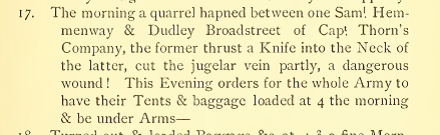
September 17, 1777. Enos Hitchcock diary.

September 17, 1777. Enos Hitchcock diary.

In Hitchcock’s diary, I found an account of a quarrel near Stillwater, NY on September 17, 1777. This was intramural knife-thrusting, but clearly, the 10th Massachusetts were very busy men.

Share this:

  • Share on Facebook (Opens in new window) Facebook
  • Share on Pinterest (Opens in new window) Pinterest
  • Email a link to a friend (Opens in new window) Email
  • Share on X (Opens in new window) X
Like Loading...

Saratoga Summary

23 Monday Sep 2013

Posted by kittycalash in Events, Living History, Reenacting

≈ 8 Comments

Tags

10th Massachusetts, 18th century, Brigade of the American Revolution, common soldier, living history, Reenacting, Revolutionary War, Saratoga, weekend

Mr S buttoning his overalls

Wow. Yet another learning experience up on the Hudson River this past weekend. It was as up-and-down a weekend as the rutted field in which we were camped, where walking felt more like swimming over the ground, and social calls were well nigh impossible. Also, we had considerable wind. By Sunday, Mrs P said we should feel grateful we never camp with a dining fly, because we knew it was wrong to feel smug that we hadn’t had to chase a fly down. Yes, every possible pun of “fly” got an outing.

Coats

The Coats, Grouped Around their Colors, Prepare for Action.

The coats turned out quite well, and there would have been one for the Young Mr if only I had not spent the past two weeks on a petticoat and patterning a gown for What Cheer Day at work. I have some regrets about that, just because they looked so very well in those unusual coats. They weren’t just a fashion statement, either: I know Mr Cooke answered a lot of questions about them, and I did, too (women ask women about the guys…). They’re a really good interpretive hook to talk about supplying the troops, and the differences in uniforms over time, and the kinds of documents historians and costume historians use in their work. Also, those coats are just plain handsome.


Down in the corner, in a lovely white gown, holding her hat on head, is Cassidy. The wind was hard on headwear.

The Battle, well, there was chaos on the public side of the battlefield, and it was difficult to see. The wrenching ground made visiting difficult (and we don’t have much of a parlor in our camp) so I did get to meet Cassidy in person but not much more.

Mr S, the Young Mr and I were grateful for Mr H’s excellent assistance with the fire.

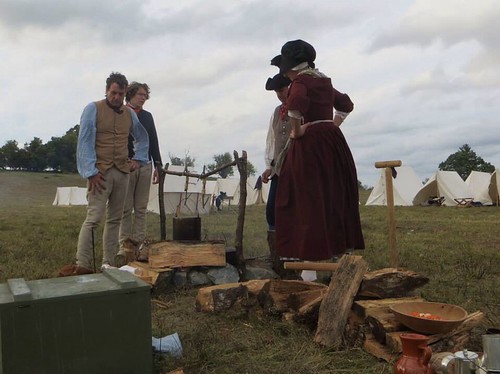
My friend Mrs H and her husband, Mr H,  and I walked back from the battlefield to work on dinner. I’m not sure what we’re contemplating here, but the kettle is on and we’re thinking about something (probably what to add next).

As you can see in the photo, we had no iron “s” hooks. I don’t know what box they’re in, but they weren’t in the kitchen box. Mr FC made us hooks from branches he discovered on the way back from his car. They held up well, and were even better and more authentic than the “s” hooks would have been. With this, we were all delighted and not at all smug.

After dinner and washing up, we participated in the hospital vignette for the public tours. (By ‘participate,’ I do sort of mean ‘first person bombed’ the scenario.) In working this out, the Adjutant wondered which of the men was the smallest and lightest. His first thought was the Young Mr, but Mr S and I soon disabused him of that notion, and after I said, “It’s you, Mr C,” and we determined that even skinny Mr S was 5 pounds heavier than Mr C, we had our victim: Mr C. He became the wounded captain carried up by Mr S, the Young Mr, Mr FC and Mr McC on a litter made from a tent and poles. I carried the lantern.

At the hospital tent, we demanded attention for our wounded captain, who had taken shot in the groin, ‘near the back.’ (We covered the wound with a coat.) The men and I were insistent upon the Captain receiving attention, despite the enlisted men requiring attention to their head wounds and amputations. Although he was given laudanum, and the ball removed (ba-thump, yes, we’re here all weekend, tip your waitress), the captain developed a fever. We demanded rum and water, but he vomited upon the very noisy private with a head wound, while down the line another private cried out, “Why, captain? Why did you do this to us?”

After he vomited, the captain’s delirium increased, and the doctor bled him. He called for his wife, and reached for me, though I am but the lowly woman with the army. I held his hand and stroked his head to ease his passing while he talked of his wife and his son, “with the angels now.” After he died, the men were summoned again to remove him from the hospital and they carried him away.

Ready to leave with the entire kitchen on my back and in my hands.

The captain’s story may have been too quiet and subtle for the public to see in the dark, but around us nurses and doctors were busy and patients were yelling, and the scene presented was one of chaos and misery (and some humor). I’ll have to analyze it more later, because there’s a strand for the reenactors and another for the public and it’s hard, sometimes, to know if they combine satisfactorily for all. I know we were pleased with our dying captain, and the boundaries it pushed for those of us newer to the first person world.

On Sunday–well, less said the better, perhaps–some of us failed to eat or drink enough and felt quite ill until mid-morning and a second cup of coffee. It’s a lesson in having protein bars stashed in pockets and haversacks, and in how wretched the soldiers and women must have felt, and how limited their decision-making capacities. That’s the argument for officers getting better food and accommodations: they make the decisions, so they need fuel and rest for their brains. The rest of us just go where we’re told.

Share this:

  • Share on Facebook (Opens in new window) Facebook
  • Share on Pinterest (Opens in new window) Pinterest
  • Email a link to a friend (Opens in new window) Email
  • Share on X (Opens in new window) X
Like Loading...

All Over but the Tugging

06 Friday Sep 2013

Posted by kittycalash in Clothing, Events, Living History, Reenacting

≈ 2 Comments

Tags

10th Massachusetts, 18th century clothes, authenticity, Brigade of the American Revolution, common soldier, Costume, living history, Reenacting, Revolutionary War, sewing

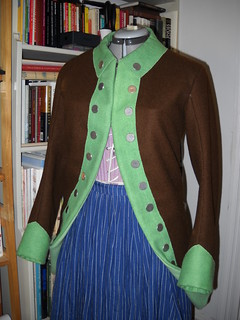
Front view on Cassandra.

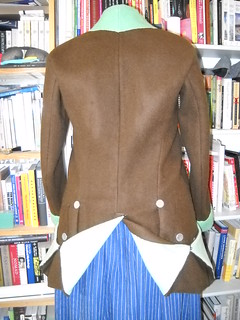
Back view, over petticoats

That’s right, it’s done, in all its brown and green glory, with not one buttonhole in sight.

I imagine Henry Cooke will tug on it, the same way my grandmother used to tug on my clothes, and find the things I need to fix that I can’t even see until he points them out. But that’s OK– what better way to learn?

You can see the progression on the project here, but there’s no tutorial or instruction manual, just visual notes as I went along. It’s Mr Cooke’s pattern and kit.

I think they’ll be glad of wool coats up at Saratoga, and if I didn’t have a new gown and petticoat, and possibly even stays, to make by October 5, I would think hard about making John Buss’s “red Queman’s pattern jacket” and “striped woolen trowsis” for the Young Mr to wear. With luck, he’ll have a borrowed coat to wear; I doubt a hunting frock will be as warm as he’d like by late September. No one, not even Mr Cooke (and I did ask), knows with certainty what a “Queman’s pattern jacket” is, but it might be a short coat or jacket. What I do know is that visions of a short red coat and grey striped trousers dance in my head, and the list of things I want to make just gets longer.

For now, though, this 1777 10th Massachusetts coatee is done, or nearly done, though on Mr S, I predict center back pleat tweaking.

Share this:

  • Share on Facebook (Opens in new window) Facebook
  • Share on Pinterest (Opens in new window) Pinterest
  • Email a link to a friend (Opens in new window) Email
  • Share on X (Opens in new window) X
Like Loading...

An Unusual Coat

03 Tuesday Sep 2013

Posted by kittycalash in Clothing, Events, Living History, Making Things, Reenacting, Research

≈ 5 Comments

Tags

10th Massachusetts, 18th century clothes, authenticity, Brigade of the American Revolution, common soldier, living history, Reenacting, Revolutionary War, Saratoga, uniforms, Wasmus diary

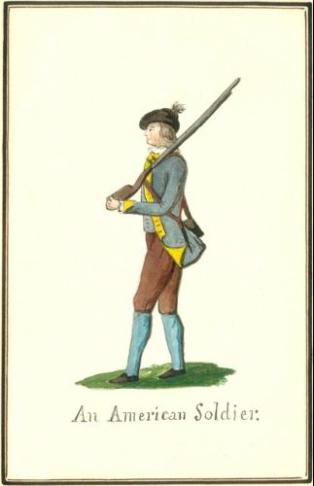
DSCN4288In 1777, the uniforms of the Continental Army remained largely uncodified and, well, non-uniform. At Ticonderoga, German accounts from the spring of 1777 state that “Few of the officers in General Gates’ army wore uniforms, and those that were worn were evidently of home manufacture and of all colors. For example, brown coats with sea-green facings, white linings, and silver dragons(epaulettes or shoulder knots), and gray coats with yellow buttons and straw facings, where to be seen in plenty.”

Brown coats with sea green facings. There’s one in our regiment, and it is a lovely thing. The Adjutant thought it would be interesting for the troops to turn out in these coats at Saratoga, an event to which the coat can be documented (being soon after Fort Ticonderoga) and an event that will take place on the historic site. So we’re making them, in a project that started Saturday, and here we are: ready to have the lapel width adjusted, because my eye tells me it is too big, and yes, I’m told that it was cut a but wide. So this morning, a lapel trim is in order.

An American Soldier. ca.1852 copy of a ca.1777 watercolor by Hessen-Hanau Captain Friedrich von Germann. Niedersächsisches Staatsarchiv, Wolfenbüttel, Braunschweig

An American Soldier. ca.1852 copy of a ca.1777 watercolor by Hessen-Hanau Captain Friedrich von Germann. Niedersächsisches Staatsarchiv, Wolfenbüttel, Braunschweig

But really, these coats.

Here you can see the style that we’re making, with applied lapels and shanked buttons, simple turn backs on the front skirts, and flat collars. The cuffs are also applied, non-functioning cuffs that come to a point in front. (Also, documented blue stockings!)

These coats will be worn with overalls, waistcoats and shoes, because we know from John Buss’s letters that the regiment was issued overalls and shoes in the summer of 1777. No visible stockings, sadly.

This is the kind of project I can get pretty stoked about, with its combination of aesthetics and documentation. A coat described in a German diary, made in pettable wool broadcloth that will be unlike anything else on the field? Of course I want to help make that vision real.

Imagine a moment on the field, with these documented coats, so unusual (the sea green may have been a faded blue, but sea green is what was seen), worn in a place where they were worn. I don’t need to remind you about the authenticity/commemoration thing, do I? Because it’s pretty clear that’s what’ll happen three weeks from now in New  York.

Share this:

  • Share on Facebook (Opens in new window) Facebook
  • Share on Pinterest (Opens in new window) Pinterest
  • Email a link to a friend (Opens in new window) Email
  • Share on X (Opens in new window) X
Like Loading...

Hunting Frocks, Again

11 Sunday Aug 2013

Posted by kittycalash in Clothing, Living History, Reenacting, Research

≈ Comments Off on Hunting Frocks, Again

Tags

10th Massachusetts, 18th century clothes, 2nd Rhode Island, common soldier, history, hunting frock, Making Things, menswear, Research, resources, Revolutionary War, uniforms

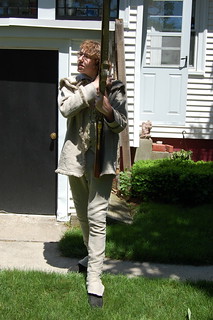
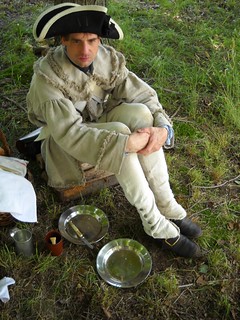
They’re not Mr S’s favorite thing, and I can understand why. Hunting frocks lack pizzazz, buttons, tape, lace, lapels, skirts and all the things that make him so fond of the Ugly Dog Coat worn by the 10th Massachusetts in 1782. (I think these are the coats captured from British supply ships and dyed at Newburgh and West Point in tanner’s vats.) But what he has right now is a hunting frock.

Here’s the kid in his new hunting frock, and a hand colored copper engraving by Johann Martin Will from 1776.

You gotta hold your tongue just right when you drill.

Americaner Soldat, Johann Martin Will. Ann S. K. Brown Collection, Brown University.

Americaner Soldat, Johann Martin Will. Ann S. K. Brown Collection, Brown University.

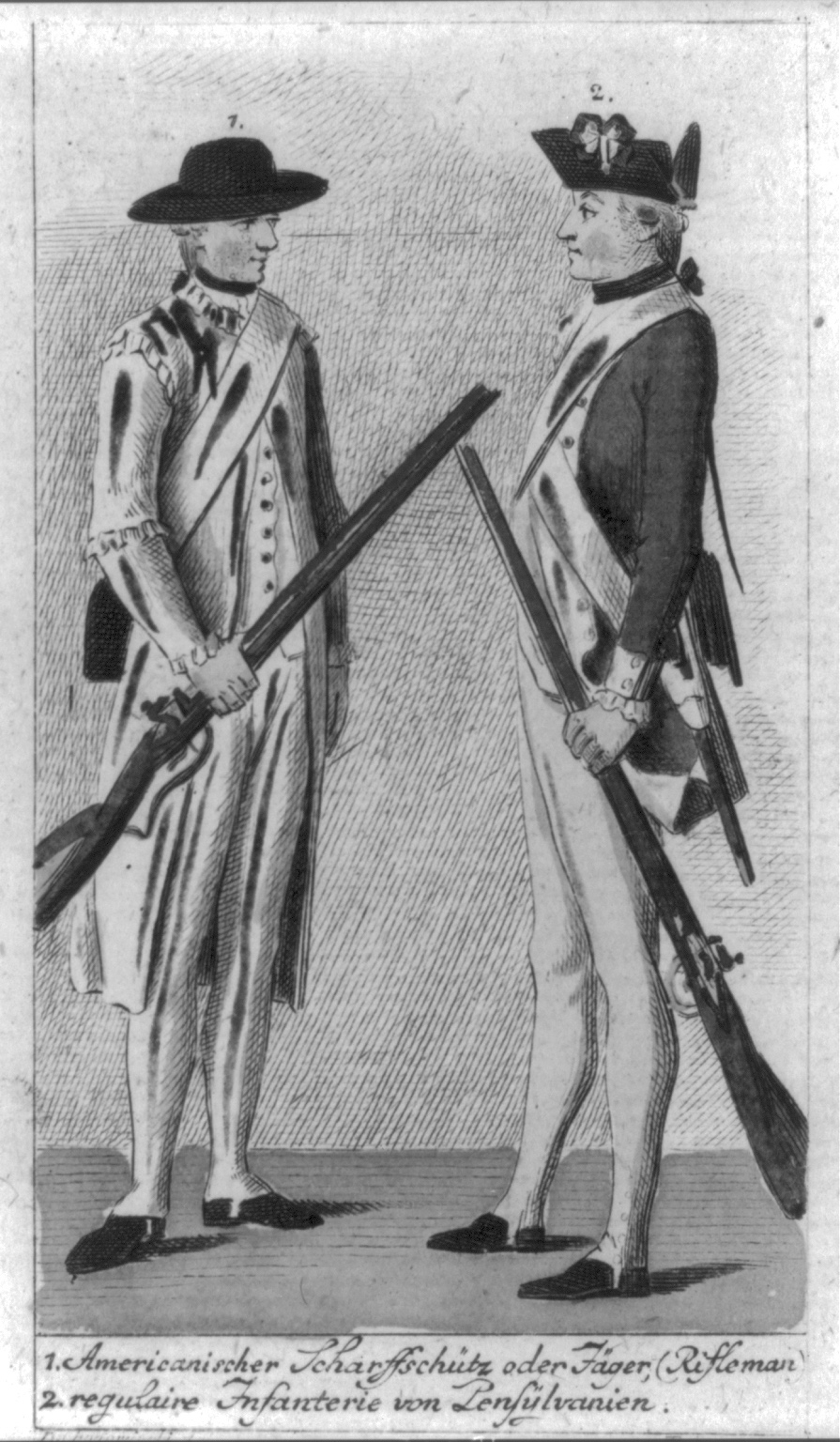
And then there are the colored and plain engravings, “1. Americanischer scharffschütz oder Jäger (rifleman) 2. regulaire infanterie von Pensylvanien,” engraved by Berger after Chodowiecki.

 Library of Congress

Library of Congress

Berger after Chodowiecki, Ann S. K. Brown Military Collection, Brown University

Ann S. K. Brown Collection

I started thinking about these again because not only am I reading Hurst’s thesis, but I’m fresh from helping the guys get dressed and arrange their capes and straps. I have been doing that as long as Mr S has been wearing historic clothing.

Early days of draping

Early days of draping


Drapey capes

The hunting frock drifts if it does not have some kind of fastening at the neck. The two halves migrate in opposite directions, and while belts help, the light infantry bayonet shoulder belt does not contain the hunting frock as well as one might like. So the thing to do, I think, is to attach a loop and button at the neck to hold the garment in place. From the period engravings, I think that’s acceptable. The garments all look as if they are closed at the neck. From the evidence in the field, and from the images, I plan to make loops and attach buttons, and hope that will limit some tendency to wander.

The image of the two soldiers together suggests another wrinkle in the hunting frock quandary, since the left hand soldier’s out garment looks like a long pocket-less coat with applied fringe and only a very small cape at the neck. Thank goodness that soldier is a rifleman, and thus outside the realm of immediate relevance. (And on a side note, I know a gentleman who very much resembles the Pennsylvania infantry man: identical calves, and even a similar face.)

Share this:

  • Share on Facebook (Opens in new window) Facebook
  • Share on Pinterest (Opens in new window) Pinterest
  • Email a link to a friend (Opens in new window) Email
  • Share on X (Opens in new window) X
Like Loading...
← Older posts
Newer posts →

Archives

wordpress statistics

Creative Commons License
Kitty Calash blog by Kirsten Hammerstrom is licensed under a Creative Commons Attribution-NonCommercial-ShareAlike 4.0 International License.

Website Built with WordPress.com.

  • Subscribe Subscribed
    • Kitty Calash
    • Join 621 other subscribers
    • Already have a WordPress.com account? Log in now.
    • Kitty Calash
    • Subscribe Subscribed
    • Sign up
    • Log in
    • Report this content
    • View site in Reader
    • Manage subscriptions
    • Collapse this bar
 

Loading Comments...
 

    %d