• Home
  • Completed Costumes/Impressions
  • Emma and Her Dresses
  • Free Patterns and Instructions

Kitty Calash

~ Confessions of a Known Bonnet-Wearer

Kitty Calash

Tag Archives: common soldier

Afternoon in Cambridge

27 Monday Jul 2015

Posted by kittycalash in Events, History, Living History

≈ 1 Comment

Tags

10th Massachusetts, Cambridge, common people, common soldier, Events, living history, Massachusetts, Revolutionary War

Cambridge. We’ve been there before to cause some mild lawn-based havoc and this year was much the same. We were on our own on the lower level, with just the six-plus-me of some abbreviated form of Soper’s company. Longfellow House is a very lovely site, and the lawn is large enough for a wall tent, drilling, eating, and general mischief.

Longfellow House, Cambridge. Photo from @longnps on Instagram

Longfellow House, Cambridge. Photo from @longnps on Instagram


I packed our lunch in a series of linen bags in the wallet, and stuffed a gown skirt and sewing box in the other end, with a bowl and a mug. I brought the small pitcher and a glass, with the intent of selling ‘gin’ to the militia, but had only one taker. They got into enough trouble themselves with filthy faces, pilfering, and stealing the captain’s books.

unknown artist, 18th century, The Encampment in the Museum Garden, 1783, Aquatint, hand-colored, Yale Center for British Art, Paul Mellon Collection

unknown artist, 18th century, The Encampment in the Museum Garden, 1783, Aquatint, hand-colored, Yale Center for British Art, Paul Mellon Collection

It’s no immersion event, what with traffic on the street and tourists dressing in Mr Townsend’s best* but there are moments at any gathering when you become so engrossed in what you are doing that you forget where you are. This time was no different: I don’t recall how it started, but we took off down Brattle Street with Sergeant Cooke crossing the yard in hot pursuit– only to be stopped by the wall. He turned the stone barricade into a large and angry goose, neaatly solving solving the problem of not being able to scale the wall.

James Sowerby, 1756–1822, A Goose, undated, Watercolor and graphite on moderately thick, slightly textured, cream wove paper, Yale Center for British Art, Paul Mellon Collection

James Sowerby, 1756–1822, A Goose, undated, Watercolor and graphite on moderately thick, slightly textured, cream wove paper, Yale Center for British Art, Paul Mellon Collection

I don’t think I’ve ever bolted that fast in stays before, and it wasn’t the best idea I’ve ever had, but who cares? It can be done, running in stays, at least for short bursts.

There was much discussion of the filth of the troops, and their need to bathe; despite our best efforts, we could not quite get a satisfactory rise out of the officers, though some soldiers had clearly rolled in dirt. (It’s of a much better quality in Cambridge, you know, where you can wear the Harvard Yard.) There was an attempt at bathing at the Great Bridge, but in the end, one private’s face was washed with an apron corner dipped in ‘gin.’

Benjamin West, 1738–1820, American, active in Britain (from 1763), The Bathing Place at Ramsgate, ca. 1788, Oil on canvas, Yale Center for British Art, Paul Mellon Collection

Benjamin West, 1738–1820, American, active in Britain (from 1763), The Bathing Place at Ramsgate, ca. 1788, Oil on canvas, Yale Center for British Art, Paul Mellon Collection

Satisfying all around, really, from the recitation of Mr Pickering’s manual with its endless repetition of ‘butt,’ meaning musket, entertaining the simpler, uncivil soldiers, to the meal of bread, cheese and cherries, to the chasing. The audience was small, but well entertained if they were paying any attention.

*Oh, NPS, what were you thinking?

Share this:

  • Click to share on Facebook (Opens in new window) Facebook
  • Click to share on Pinterest (Opens in new window) Pinterest
  • Click to email a link to a friend (Opens in new window) Email
  • Click to share on X (Opens in new window) X
Like Loading...

Room, Officers’, for the use of.

30 Thursday Apr 2015

Posted by kittycalash in Events, Food, Living History

≈ 6 Comments

Tags

10th Massachusetts, 18th century, common soldier, Events, interpretation, living history, Reenacting, Revolutionary War

IMG_3458
IMG_3461

Sometimes I feel like a third wheel at Rev War events. There is not always a lot for women to do besides chores, and the public often ignore us. Still, there is one maxim I know to be true: if you’re bored, work.

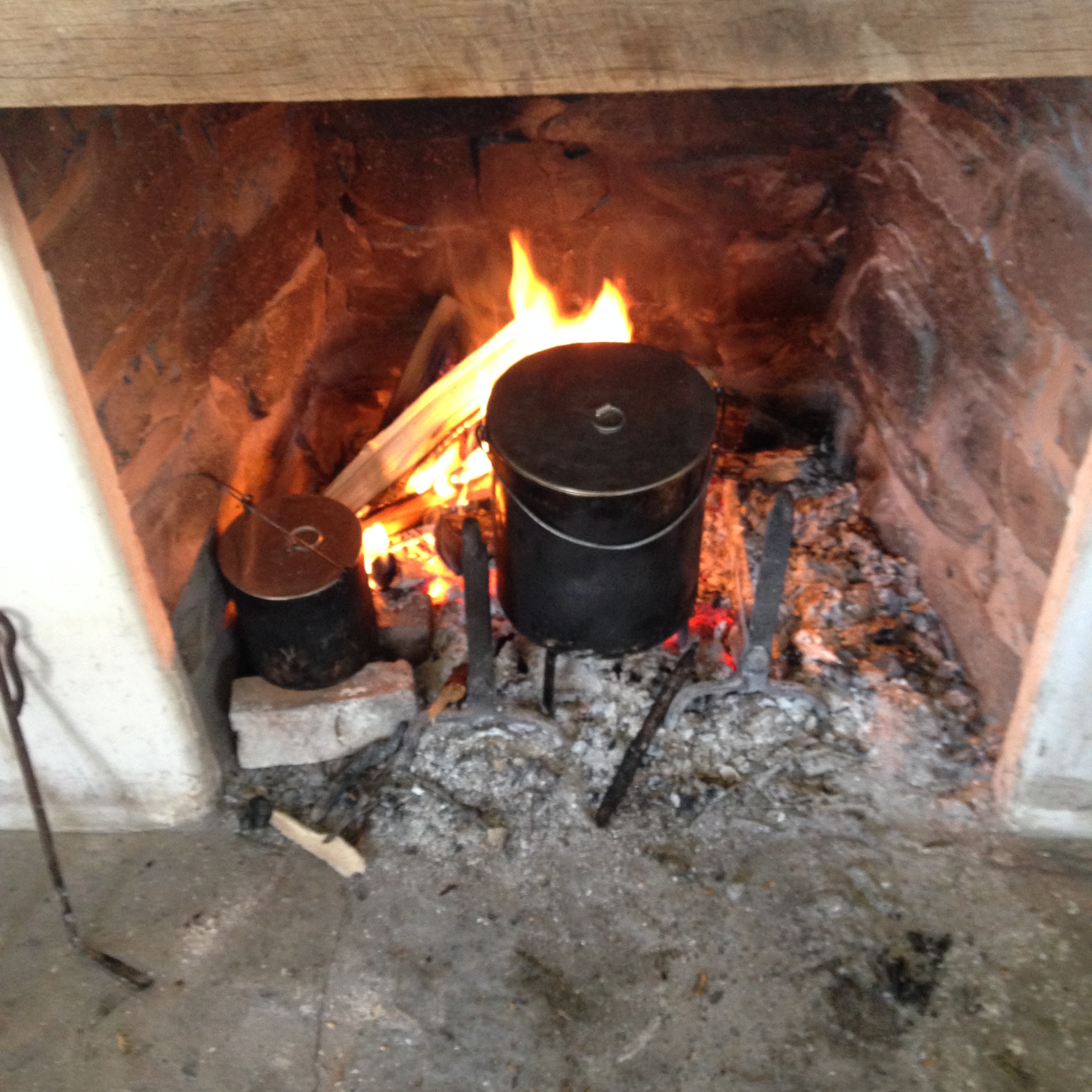
Thus, when I found myself drifting off Saturday, I started dinner. The best part was where I got to make dinner: in a chamber off the main room of the Temple at the New Windsor Cantonment. These two rooms were occupied by the 10th Mass this year. Last year, the unfinished room had been the scene of Dirt Stew.

Cutting vegetables on a table was a major upgrade; last year, I think I used the kettle lid, the floor being too gritty even for me.

IMG_3470

It’s End of Stored Root Vegetable season here, so largish carrots and parsnips went into the pot, along with potatoes, onions, and a cooked chicken disjointed by hand (a task I have experience in).

This year, we brought the only iron we own, a small trivet-like stand to put the big kettle on; the little one went on bricks from the Temple’s other fireplace. Was that slim piece of iron wrong? Probably, but in a place where we can’t dig a kitchen or make a fire outdoors, we compromised in the name of keeping supper unspilled.

IMG_3471

Why no fires outdoors? Red flag warnings, due to high winds and low RH. That all hobbies will be affected by climate change was clear on Saturday, as we discussed invasive species, transporting wood across state lines, and various site rules on using brush to build shelters. It’s not just about digging fire pits or kitchens and archaeology anymore.

Share this:

  • Click to share on Facebook (Opens in new window) Facebook
  • Click to share on Pinterest (Opens in new window) Pinterest
  • Click to email a link to a friend (Opens in new window) Email
  • Click to share on X (Opens in new window) X
Like Loading...

Surreal School

29 Wednesday Apr 2015

Posted by kittycalash in Events, Living History, Reenacting

≈ 2 Comments

Tags

10th Massachusetts, authenticity, Brigade of the American Revolution, common people, common soldier, interpretation, living history, Revolutionary War, vacation

On the King's Highway, behind Knox's HQ

On the King’s Highway, behind Knox’s HQ

The School of Instruction is always interesting, and this year was no exception. One of my favorite activities is walking with the troops (well, behind). The experience is usually surreal, and the walk we took behind Knox’s Headquarters met expectations.

Clash of the Time Periods

Clash of the Time Periods

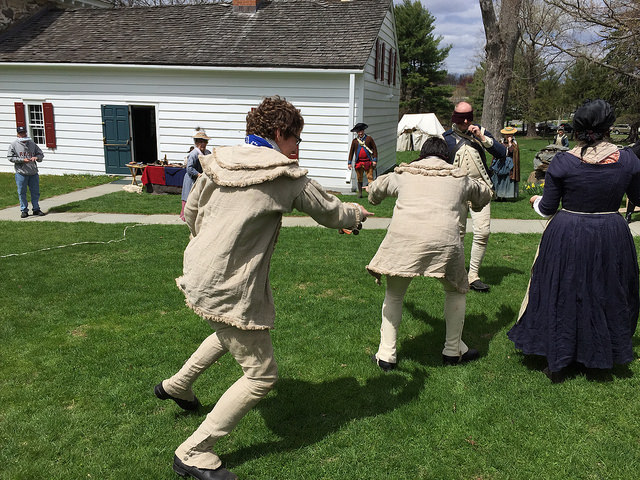
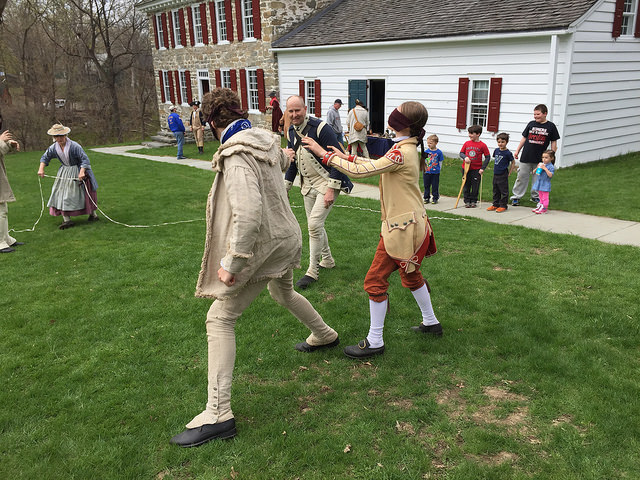
Knox’s Headquarters was a new location for us, with new activities: we played a Jingling Match, which resulted in as much giggling as jingling, and felt like the Walking Dead met the 18th Century.

Jingling without Giggling is the hard part

Jingling without Giggling is the hard part

The game is pretty simple: mark out an area, blindfold as many as are willing to play, and set one without blindfold loose. The object is to touch the person ringing the bell, and it is a hilarious and merry game indeed, though I do agree with Mr McC that playing with a number of men full in their cups, or at certain sites (Stony Point comes to mind) would be too dangerous.
WildJingling

Still, it’s simple and fun, if a little Kubrickian when you first tie on the blindfold. The person who catches the jingler is the next one to taunt the blindfolded.

tomBrianwill

Next stop? Bell research, of course. I definitely want to play this in Newport later this summer.

Share this:

  • Click to share on Facebook (Opens in new window) Facebook
  • Click to share on Pinterest (Opens in new window) Pinterest
  • Click to email a link to a friend (Opens in new window) Email
  • Click to share on X (Opens in new window) X
Like Loading...

Peale’s Progress, or, High on History

08 Thursday Jan 2015

Posted by kittycalash in Events, History, Living History, Philosophy, Reenacting

≈ 2 Comments

Tags

18th century, authenticity, common soldier, Events, interpretation, living history, New Jersey, Philadelphia Associators, Reenacting, Revolutionary War

No, we didn’t go, and I have regrets. Six weeks before the event, I thought I was working on January 3rd, and by the time the schedule changed, it was too late. Instead, you can read about Drunktailor’s experience.

Reenactors portraying Philadelphia Associators take part in the real time tour of the Battle of Princeton, Princeton, NJ, January 3, 2015. Beverly Schaefer, Times of Trenton

Reenactors portraying Philadelphia Associators. Beverly Schaefer, Times of Trenton

The background is interesting, similar to the kind of events and projects we’ve been talking about here in RI: site- and time-specific events that combine commemoration, history, and experimental archaeology, or an emotional and social archaeology, if you will.

From event co-organizer Dave Niescior, quoted in the Rutgers-Camden News Now: “The goal is to gain a better understanding of the hardships endured by individuals who lived and made a critical moment in history.It is one thing to write ‘the troops marched overnight to Princeton,’ it is yet another to understand what that physically and mentally meant to the men who had to put one foot in front of the other all night long.” Co-organizer Matt White told NJ.com, “We’re trying to stage a number of vignettes to give people a sense of what was going on in the Continental Army in this period between late December and early January of 1776 and 1777.”

that’s cold. From Daily Reenactor

These and other collected images help convey a sense of the event,  which–as far as I can tell– did provide participants with the kind of transcendent experience I know I enjoy and hope to find at events.

This is the kind of event that I think proves a belabored (and elsewhere belittled) point: accuracy matters. It is just about ALL that matters.

On a now-defunct phone, I had an old video of the Young Mr with a now-deceased reenactor of whom I was quite fond, despite our wildly divergent politics. In it, Mr D shows his Charleville to the Young Mr on the front porch of an 18th century home and asks, “Do you know what this is?” The Young Mr shakes his head, and Mr D answers, “It’s a time machine.”

Although I remain committed to reducing the degree to which living history is musket-centric, there’s truth in that statement: Mr D had an original, period Charleville and a fairly well-cut uniform, considering his generous figure. Using, showing, and interpreting actual period pieces and well-made, correct replicas is the single best way to connect the present, and the public, to the past. Accuracy matters because it’s the literal key to the past: you have to cut the pattern right.

Accurate impressions rendered in a place of shared value will transport you to the past, and give you insights you did not expect. That is the point of these exercises: insight and understanding. It’s how to get high on history.

Share this:

  • Click to share on Facebook (Opens in new window) Facebook
  • Click to share on Pinterest (Opens in new window) Pinterest
  • Click to email a link to a friend (Opens in new window) Email
  • Click to share on X (Opens in new window) X
Like Loading...

In Tents Tuesday*

06 Tuesday Jan 2015

Posted by kittycalash in History, Living History, Making Things, Reenacting, Research

≈ Comments Off on In Tents Tuesday*

Tags

10th Massachusetts, 18th century, common soldier, Continental Army, Research, Revolutionary War, sewing, tents

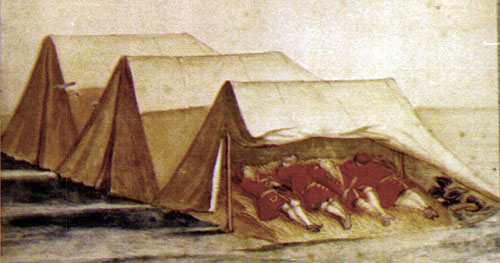
You know The Tent Article, don’t know? You do, if you’re camping 18th century private soldier style in your hand-sewn coat.

Scene of the Camp on Hampton Green, 1781

Scene of the Camp on Hampton Green, 1781

The Tent Article (hereafter The Document) pulls together documentation and research assembled by a team of living history enthusiasts dedicated to replicating the 18th century enlisted army experience in an accurate manner. Though the PowerPoint format affects the overall length, be warned: we are talking 300+ pages here.

No strangers to the pursuit of the accurate and never ones to shy away from an arduous task involving pointy objects and string, the 10th Mass assembled on Saturday afternoon for a round of tent sewing.

I first read The Tent Article in 2012, and was promptly ashamed of our hand-me-down tent which had everything to recommend it in terms of price, but wanted in terms of accuracy. In response, I began making 1/8″ scale models of tents to figure out how much linen I would need to buy in order to make a truly correct tent. Finally, all that edumacation in art and architecture had utility! Alas: distractions arose, cost overwhelmed, our then-primary regiment scoffed, and I abandoned hand-sewn tent plans.

Fast forward to Tyler Putnam’s blogging on The First Oval Office project, and I was once again intrigued. I began calculating how much vacation time I might need to complete a tent by hand in our living room. Well, thank goodness for finding fellow travelers, because lo and behold! The 10th Mass had tents in want of sewing, so I could learn a great deal without filling our home with excessive yardage.

“Sails.”

Progress was made last August in Newport, where the tents masqueraded as sails, but the canvas languished unsewn until last Saturday, when we duly assembled in Hopkinton and unfurled the vast expanse of linen. It was suggested that I might know some people with access to sail lofts (!), but in about 4 hours, a number of us managed to finish the final foot of backstitching and to flat-fell a little more than 60 feet of tent seams.

It's a vast expanse of linen.

It’s a vast expanse of linen.

The Document was consulted to make sure we were proceeding correctly, though the iPad misbehaved and forwarded us many pages to grommets. (I’m looking forward to those, as I enjoy sewing eyelets– and have just earned myself the dubious honor of sewing at least half of them, I’m sure.) We checked the images, threaded our needles, and off we went.

A few inches (feet) of felling had to be unstitched and resewn, but heavy linen is wily and some stitchers were newer to the process than others. But by the close of day, all seams were felled, needles packed, and tentage folded.

Next up, per The Document, are mud flaps. This should get interesting, as math in front of an audience usually is.


IMG_2728

I promised a pun, so here’s the worst. Somehow we got on to unfortunate reenactorisms, which collided with Star Wars, and brought us to the realization that what we needed were light sabres… ’cause it’s the 10th Massachusetts Regiment Light Infantry Company. We were punished for this hilarity by having to drive home on untreated roads into snow that looked like we were trying to take the Millenium Falcon to hyperspeed.


*It really happened on Saturday.

Share this:

  • Click to share on Facebook (Opens in new window) Facebook
  • Click to share on Pinterest (Opens in new window) Pinterest
  • Click to email a link to a friend (Opens in new window) Email
  • Click to share on X (Opens in new window) X
Like Loading...
← Older posts
Newer posts →

Archives

wordpress statistics

Creative Commons License
Kitty Calash blog by Kirsten Hammerstrom is licensed under a Creative Commons Attribution-NonCommercial-ShareAlike 4.0 International License.

Website Built with WordPress.com.

  • Subscribe Subscribed
    • Kitty Calash
    • Join 621 other subscribers
    • Already have a WordPress.com account? Log in now.
    • Kitty Calash
    • Subscribe Subscribed
    • Sign up
    • Log in
    • Report this content
    • View site in Reader
    • Manage subscriptions
    • Collapse this bar
 

Loading Comments...
 

    %d