• Home
  • Completed Costumes/Impressions
  • Emma and Her Dresses
  • Free Patterns and Instructions

Kitty Calash

~ Confessions of a Known Bonnet-Wearer

Kitty Calash

Tag Archives: Costume

To Breakfast In

13 Thursday Apr 2017

Posted by kittycalash in Clothing, Living History, Making Things

≈ 2 Comments

Tags

19th century, 19th century clothing, authenticity, Clothing, Costume, dress, fashion, Federal style, museum collections, sewing
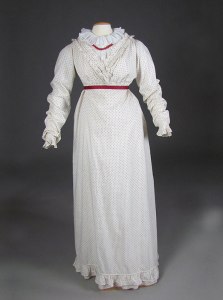
http://agreeabletyrant.dar.org/gallery/1810s/polka-dot-printed-dress/

Dress, cotton, United States, private collection; reproduction chemisette, private collection; coral necklace courtesy of Dames à la Mode.

I get ideas. And like a cat I once knew, once I have an idea, it’s hard to shake. Luckily for me, my judgement is better than the cat’s– he had a tendency to pounce without regard to results, and scars do show on furry white noses. But in this case, at least, there are no scars, just some pricked fingers.

Like so many of us early-Federal era obsessives, I fell in love with An Agreeable Tyrant, and demanded the book for Christmas. It’s not just the essays or images, it’s the patterns. Scaled patterns take at least some of the guess work out of recreating historic costumes, but not all of it. And never for me– if there’s something to mess up or guess wrong, I am right on top of it– which is to say, I learn to adapt my errors and adjust my methods to fit my materials.

Surplice-front gowns have teased and delighted me for years: My first foray was with the silk “Quaker” gown of three (!) years ago, a gown I based on digging into Quaker portraits and Nancy Bradford’s Costume in Detail. It worked well enough then– not brilliantly, but close enough for my purposes. But then the polka dot dream appears, and of course, I need one to fulfill my dream of living Persuasion and having a morning dress to breakfast in. Beats the heck out of what I eat breakfast in now, and perhaps the company would improve as well. (I’m looking at you,cats.)

Dolly Eyland, by Alexander Keith, 1808. (c) The New Art Gallery Walsall; Supplied by The Public Catalogue Foundation
Courtesy Newport Historical Society

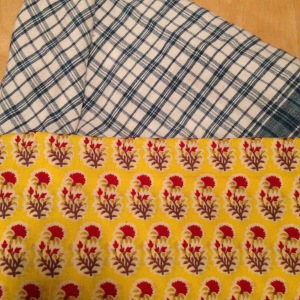
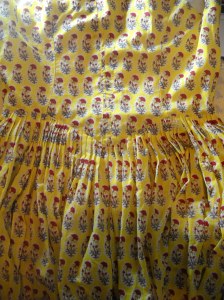
Well, so, what to do? Attempt my own, of course, since I found some fabric that seemed plausible enough and matched the color my dried blood. It’s a sheer block print cotton from India, more sheer than the original fabric, but capturing the feel well enough– and better, I suspect, than the stiff quilting cottons one is likely to find with polka dot prints. Construction and patterning fun next time on “True Confessions of the Frivolously Fashion Obsessed.”

Share this:

  • Click to share on Facebook (Opens in new window) Facebook
  • Click to share on Pinterest (Opens in new window) Pinterest
  • Click to email a link to a friend (Opens in new window) Email
  • Click to share on X (Opens in new window) X
Like Loading...

More Color, Brighter Color

12 Wednesday Apr 2017

Posted by kittycalash in Clothing, Events, Living History, Making Things

≈ 1 Comment

Tags

19th century clothing, Costume, dancing, dress, Events, fashion, Federal style, sewing

Not the side I ended up using.

“More colah! brightah colah!” was the refrain of one of the printmaking professors at my undergrad program (hilariously, I met him again last summer here in the Ocean State, and nothing much had changed). This is useful advice for someone stuck in the doldrums of late winter New England. It was late January when I got some disappointing news and set off to cure my blues at the fabric store. There’s a bodice in the plaid underway for another silk gown (eventually to be sold, I think; how many can one have?), but I grew dissatisfied with the fabric. Too pale. I wanted More Color. Brighter Color.

Lucky for me, it was on sale. Fabric Mart Fabrics has been good for me in the past, and a silk sale was a success this time, too. The bright and bold dress in the FIT collection was my inspiration, and I dearly hoped I would not manage to cut the cross-barred pattern to match, so of course I pretty much did.

IMG_9649
IMG_9650

My tried-and-true pattern based on the 1815 roller print gown at Genesee Country Village was the base pattern for the silk gown: I know how to adjust it so that I can get dressed on my own, drawstrings the saving grace for the solitary woman who wants a back-closing gown.

I didn’t alter my pattern enough to really capture that neckline, because, in truth, I wanted to get this done! I did concede to trim, of course, and while conducting Drunk Tailor on a (fruitless for him) tour of regional fabric stores, found, at last, the trim I wanted, at the Fabric Place Basement in Natick. Good thing, too, because I was convinced that we were going to die in the traffic backup on whatever that road is in Framingham that creeps in at petty pace from day to day,To the last syllable of recorded time. But no, we lived, after I was fed, and trim was found, saving the day. (Seriously, I don’t think I have ever been on that stretch between Natick and Framingham and not been in a traffic jam since I first encountered it in 1988.)

IMG_0362
IMG_0343

But the dress, that’s the point. It’s done, at least enough to wear, though I did not buy enough trim for the hem and will have to trek back up to Natick for another few yards with which I can trim the hem. A lovely young woman named Tanya did get a photo of me in full regalia, down to the gloves (yes! leather opera gloves!) but I haven’t found it yet out on the interwebs, so my hotel room selfies must suffice.

What I find most satisfying– aside from the dancing– is how versatile a very simple dress pattern can be. Fabric choices, trims, hem length, minor sleeve alterations, and accessories make this one pattern work both for a day dress and a dancing dress.

Share this:

  • Click to share on Facebook (Opens in new window) Facebook
  • Click to share on Pinterest (Opens in new window) Pinterest
  • Click to email a link to a friend (Opens in new window) Email
  • Click to share on X (Opens in new window) X
Like Loading...

A Saturday in Salem : Jane Austen Ball

17 Friday Feb 2017

Posted by kittycalash in Clothing, Events, History, personal

≈ 5 Comments

Tags

19th century, 19th century clothing, Costume, dancing, dress, fashion, Federal New England Fashion, Federal style, Salem event

Closure: green silk satin ribbon.

Closure: green silk satin ribbon.

With many thanks to the Quintessential Clothes Pen, I was not dancing with myself Saturday last at the Jane Austen Ball in Salem. I was there on a bit of a whim, knowing that the ball happened in February and looking for something to do on a winter weekend– and, as it happened, I actually had a dress to wear. Of course, it wasn’t finished until Friday night, although I had worn it in December for a photoshoot.

Dressed for the weather: I only seem to wear this pelisse in February.

Dressed for the weather: I only seem to wear this pelisse in February.

In the past year+, I’ve been trying to do more and regret less, which seems a bit contradictory: if you do more, might you regret more of what you do? The trick for me, especially in dealing with my baseline high-anxiety self, is to do more things that seem scary but are actually fun.* That’s how I found myself traveling up to Salem between snowstorms to stay in a tiny little room in a historic hotel. It’s a pretty quick ninety-minute trip on a good day, but I know myself well enough now that staying overnight is the safer, less-stressful option for an excursion like this.

Salem on a snowy Saturday was busy, streets crowded with people as I walked to the old Town Hall, feeling very much like a character in a novel. (Having just finished Remarkable Creatures, the scenes of Elizabeth Philpot walking in alone London came to mind as I did attract some attention in my pelisse and bonnet.)

Old Town Hall, Salem, MA
Rustic Dance After a Sleigh Ride, 1830. William Sidney Mount MFA Boston 48.458

The Town Hall was crowded; I arrived a little late, as dancing was beginning under patient and direct tutelage, so I had the pleasure of watching several dances before I joined in. While not everyone was wearing early-Federal/Regency clothing, the crowd still provided an excellent sense of the social mixing and festivity of a scene from the past.

Unforgivable hotel room selfie to record the dress

Unforgivable hotel room selfie to record the dress

Joining in was even better, to be in the swirl of people and skirts, to pay attention to my feet– my shoes were a little slicker than I would like– and to count the rhythm of the music. While I spent years in ballet class, it is true that those years were surpassed by years in mosh pits and on dance floors of questionable clubs. Country dances made me think of four-dimensional math, with the patterns made by the combinations of active and helper couples, the reversals of direction, and the changing positions of partners: it was like being a living fractal.

*With some exceptions including rollercoasters and sky diving.

Share this:

  • Click to share on Facebook (Opens in new window) Facebook
  • Click to share on Pinterest (Opens in new window) Pinterest
  • Click to email a link to a friend (Opens in new window) Email
  • Click to share on X (Opens in new window) X
Like Loading...

Frivolous Friday: Fashion Flashback

18 Friday Nov 2016

Posted by kittycalash in Frivolous Friday, History, Making Things, personal, Research, Thanks

≈ 3 Comments

Tags

18th century clothing, authenticity, Costume, cotton print, East India trade, fashion, friends, party clothes, sewing, thanks

IMG_6945
I don’t know about you, but the past ten days or so have been surreal in a way that I haven’t experienced in a dozen years or so. Numerous creative folks I know are working hard to find new, engrossing projects and sharing what they find with others. As always, Satchel Paige has excellent advice: Don’t look back, something might be gaining on you.

What project shall I take up again, to distract myself from the shorter days and colder temperatures?

This is actually making reasonable progress, and might even be done by early December.
dscn4571

It’s satisfying work, pleating and stitching this lightweight cotton, tiny stitches in white linen thread. I’ve made some modifications to the pattern, but not many, aiming for a 1780-1782 style. Judicious cutting and generous friends will, fingers crossed, even yield a matching petticoat, which is very exciting indeed– and an unusual fashion statement chez Calash. Here, we focus on clash, but the fabric itself takes care of that for me.

dscn4572
dscn4573

Now, if only I had bright red morocco leather shoes to wear with this, that would be a sight indeed.

Share this:

  • Click to share on Facebook (Opens in new window) Facebook
  • Click to share on Pinterest (Opens in new window) Pinterest
  • Click to email a link to a friend (Opens in new window) Email
  • Click to share on X (Opens in new window) X
Like Loading...

Hell is a Hand Basket

15 Thursday Sep 2016

Posted by kittycalash in Art Rant, Clothing, Fail, History, material culture, Research

≈ 5 Comments

Tags

18th century, 18th century clothes, art history, authenticity, baskets, Costume, dress, fashion, interpretation, John Copley, john smibert, Joseph Blackburn, portraits, Research

Gentle Reader: Remember the post on semiotics? We need to go back to that once more.

Just what are we looking at here?
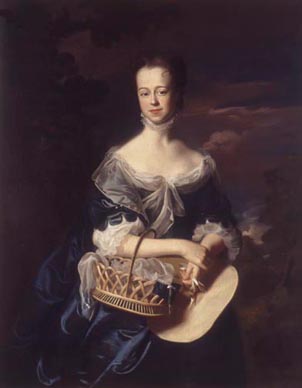
copley_john-singleton-mrs-daniel-rogers-middleton-collection

John Singleton Copley.
Portrait of Mrs. Daniel Rogers (Elizabeth Gorham Rogers), 1762
50 X 40, oil on canvas.
Middleton Collection, Wake Forest University
HC1991.1.1

Hmm…. 1762. Does that dress look like 1762 to you? Or does it resemble a 17th century garment? Check out those sleeves: scallops. The shift sleeves: super full. The line of the gown at the neck: a shallow scoop. The front of the bodice: closed.

Are those the hallmarks of a typical 1762 gown in New England, England, or France? You are correct, sir: They are not.

What’s happening here? What is Copley doing, and why?

He’s making his subject look good, reflecting her wealth and status. He’s flattering her by painting her in a faux-17th century gown, a “Vandyke costume, a popular artistic convention in England related to the vogue for fancy dress and masquerade.”* 1762 seems a trifle late for this convention, but in 1757, James McArdell produces a mezzotint of Thomas Hudson’s portrait of the Duchess of Ancaster. Henry Pelham wrote to Copley in 1776 that he had purchased one of those mezzotints, suggesting their use as references for Colonial American painters. Reynolda House has a nice explication of this style of dress in the Thëus portrait they own of Mrs. Thomas Lynch, shown below.

Mrs. Thomas Lynch, oil on canvas by Jeremiah Thëus, 1755. Reynolda House, 1972.2.1

Mrs. Thomas Lynch, oil on canvas by Jeremiah Thëus, 1755. Reynolda House, 1972.2.1

There was also a convention of portraying women in “timeless draperies,” following the school of Peter Lely and Godfrey Kneller, both late 17th-century English painters who produced portraits with generalized costumes.

Lady Mary Berkely, wife of Thomas Chambers. oil on canvas by Sir Godfrey Kneller, ca. 1700. Metropolitan Museum of Art, 96.30.6

Lady Mary Berkely, wife of Thomas Chambers. oil on canvas by Sir Godfrey Kneller, ca. 1700. Metropolitan Museum of Art, 96.30.6

This portrait by Kneller (born in Germany, he worked in England) explains a lot, doesn’t it? And this timeless convention persists for some time, and the stylization of the facial features and hair is copied by English and colonial American painters. John Smibert, long familiar to many of you, was a leading practitioner of this style of portrait, and his work would have been well known to Copley and his sitters.

Mrs Samuel Browne by Smibert, RIHS 1891.2.2

Mrs Samuel Browne by Smibert, RIHS 1891.2.2

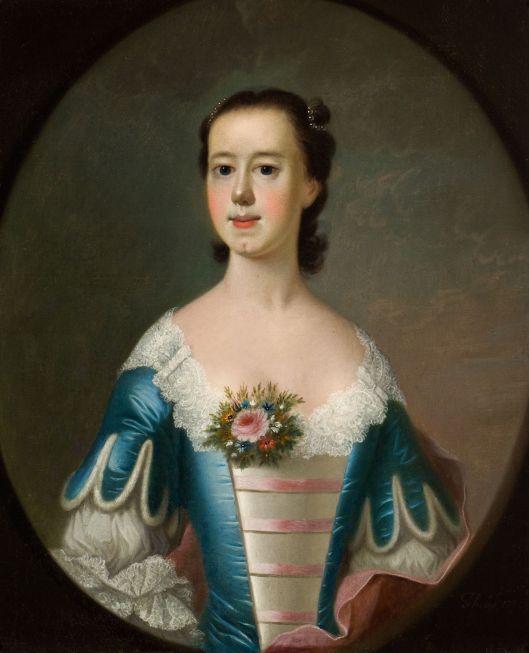
Blackburn’s portrait of Mary Sylvester adopts two conventions at once, in a way: she’s in timeless-style drapery and fancy dress as a shepherdess. Let’s remember, too, that there’s symbolism in the shepherdess imagery, referencing pastoral innocence and Mary Sylvester’s unmarried, presumably virginal, status. Don’t believe me? Read the catalog entry, written (at the very least) under the supervision of actual, degree-toting art historians.

Mary Sylvester, oil on canvas by Joseph Blackburn, 1754. Metropolitan Museum of Art, 16.68.2

Mary Sylvester, oil on canvas by Joseph Blackburn, 1754. Metropolitan Museum of Art, 16.68.2

Where does that leave us with Mrs. Rogers? She’s portrayed in what is essentially fancy dress, holding her straw hat in her left hand (much as Mary Sylvester is) with a basket over her right forearm. You will note the open work of the basket, the delicate arches and the fineness of the base. What’s in it? Something gauzy, as light as the drape around her shoulders, with a square of dark blue silk and a fine white silk ribbon. Honestly I am not entirely certain — the resolution of the image is dreadful.

But what’s NOT in the basket? A redware or pewter mug, sewing, keys, bottle, food, candy, toys, or, really, anything of a very concrete or practical nature.

Is this image a justification for carrying a [nearly empty ] basket on the streets of Boston? Of course it is–as long as you justify walking the streets of Boston in imaginary or fancy dress.

*p.106, Ribeiro, Aileen. “‘The Whole Art of Dress’: Costume in the Work of John Singleton Copley.” John Singleton Copley in America, Metropolitan Museum of Art, 1995.

Share this:

  • Click to share on Facebook (Opens in new window) Facebook
  • Click to share on Pinterest (Opens in new window) Pinterest
  • Click to email a link to a friend (Opens in new window) Email
  • Click to share on X (Opens in new window) X
Like Loading...
← Older posts
Newer posts →

Archives

wordpress statistics

Creative Commons License
Kitty Calash blog by Kirsten Hammerstrom is licensed under a Creative Commons Attribution-NonCommercial-ShareAlike 4.0 International License.

Website Built with WordPress.com.

  • Subscribe Subscribed
    • Kitty Calash
    • Join 621 other subscribers
    • Already have a WordPress.com account? Log in now.
    • Kitty Calash
    • Subscribe Subscribed
    • Sign up
    • Log in
    • Report this content
    • View site in Reader
    • Manage subscriptions
    • Collapse this bar
 

Loading Comments...
 

    %d