
• Home
  • Completed Costumes/Impressions
  • Emma and Her Dresses
  • Free Patterns and Instructions

Kitty Calash

~ Confessions of a Known Bonnet-Wearer

Kitty Calash

Tag Archives: Events

Stick-to-it-iveness

14 Thursday Sep 2017

Posted by kittycalash in Events, Living History, Making Things, Reenacting

≈ 3 Comments

Tags

18th century, 18th century clothing, authenticity, common people, Events, living history, peddler, petty sutler, Revolutionary War, sutler
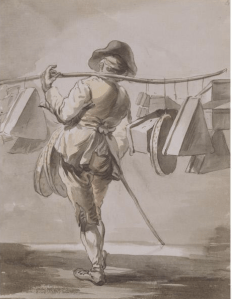
Band Box Seller, pen and watercolor by Paul Sandby, n.d. The Huntington Library, Art Collections, and Botanical Gardens, 67.18

It has been a long time since I participated in a traditional “reenacting” event, the kind with tents and pew and kettles and a TWD but here we go, borne back into the past to where it all began, more or less. I remain as uncomfortable as ever in the camp follower role, constantly questioning the likelihood of my being a follower, and the activities I would participate in. It’s a historical personality disorder, trying to figure out who one was, complicated by all the modern politics of gender roles, relationships, and unit rules.

Now that I’ve switched sides, Bridget Connor is no longer open to me. By nature I’m a townie, happiest in a mercantile endeavor if I’m not able to take on the role of an officer’s servant.

So what to do? Petty sutlery is much on my mind, for I have need of the money and a habit of making things. Lately, i’ve been band-boxing, so I was delighted to find the Huntington had digitized this Sandby drawing of a band-box seller, placing the trade firmly in the middle of the 18th century. Triangular boxes for cocked hats, circular boxes for bergeres, rectangular boxes for gloves and (neck)handkerchiefs, I presume.

Glass coral and garnet necklaces
Red wool pincushions

I’ll have band boxes and a bonnet or two in addition to a custom order delivery, coral, glass, and garnet necklaces for girls and women, pincushions, handkerchiefs, possibly garters, and, if my hands hold up, boxes for hats and bergeres, all on a stick. Look for me between the 17th and the 7th, hindering or helping laundresses.

Share this:

  • Click to share on Facebook (Opens in new window) Facebook
  • Click to share on Pinterest (Opens in new window) Pinterest
  • Click to email a link to a friend (Opens in new window) Email
  • Click to share on X (Opens in new window) X
Like Loading...

More Color, Brighter Color

12 Wednesday Apr 2017

Posted by kittycalash in Clothing, Events, Living History, Making Things

≈ 1 Comment

Tags

19th century clothing, Costume, dancing, dress, Events, fashion, Federal style, sewing

Not the side I ended up using.

“More colah! brightah colah!” was the refrain of one of the printmaking professors at my undergrad program (hilariously, I met him again last summer here in the Ocean State, and nothing much had changed). This is useful advice for someone stuck in the doldrums of late winter New England. It was late January when I got some disappointing news and set off to cure my blues at the fabric store. There’s a bodice in the plaid underway for another silk gown (eventually to be sold, I think; how many can one have?), but I grew dissatisfied with the fabric. Too pale. I wanted More Color. Brighter Color.

Lucky for me, it was on sale. Fabric Mart Fabrics has been good for me in the past, and a silk sale was a success this time, too. The bright and bold dress in the FIT collection was my inspiration, and I dearly hoped I would not manage to cut the cross-barred pattern to match, so of course I pretty much did.

IMG_9649
IMG_9650

My tried-and-true pattern based on the 1815 roller print gown at Genesee Country Village was the base pattern for the silk gown: I know how to adjust it so that I can get dressed on my own, drawstrings the saving grace for the solitary woman who wants a back-closing gown.

I didn’t alter my pattern enough to really capture that neckline, because, in truth, I wanted to get this done! I did concede to trim, of course, and while conducting Drunk Tailor on a (fruitless for him) tour of regional fabric stores, found, at last, the trim I wanted, at the Fabric Place Basement in Natick. Good thing, too, because I was convinced that we were going to die in the traffic backup on whatever that road is in Framingham that creeps in at petty pace from day to day,To the last syllable of recorded time. But no, we lived, after I was fed, and trim was found, saving the day. (Seriously, I don’t think I have ever been on that stretch between Natick and Framingham and not been in a traffic jam since I first encountered it in 1988.)

IMG_0362
IMG_0343

But the dress, that’s the point. It’s done, at least enough to wear, though I did not buy enough trim for the hem and will have to trek back up to Natick for another few yards with which I can trim the hem. A lovely young woman named Tanya did get a photo of me in full regalia, down to the gloves (yes! leather opera gloves!) but I haven’t found it yet out on the interwebs, so my hotel room selfies must suffice.

What I find most satisfying– aside from the dancing– is how versatile a very simple dress pattern can be. Fabric choices, trims, hem length, minor sleeve alterations, and accessories make this one pattern work both for a day dress and a dancing dress.

Share this:

  • Click to share on Facebook (Opens in new window) Facebook
  • Click to share on Pinterest (Opens in new window) Pinterest
  • Click to email a link to a friend (Opens in new window) Email
  • Click to share on X (Opens in new window) X
Like Loading...

Circles and Lines

10 Monday Apr 2017

Posted by kittycalash in Events, personal, Research

≈ 2 Comments

Tags

dancing, Events, Federal New England Fashion, Federal style, Regency

Merrymaking at a Wayside Inn, watercolor on paper by John Lewis Krimmel. 1811-1813. Metropolitan Museum of Art, 42.95.12

By some miracle, I did not have the Polecats in my head all weekend, despite spending most of Saturday only dancing. It has been some time since I danced (February’s adventure notwithstanding) and after two hip replacements, my Giant son is correct: I’m still re-training my muscles. My feet remember more than my hips do, but at least some of my muscles remember!

The Commonwealth Vintage Dancers Regency Weekend was this past weekend, and while I could only manage Saturday (Sundays are for chores when you’re expecting houseguests for Easter), I had a wonderful time and sincerely hope I can retain what I was taught. The company was very friendly and quite genteel, though I can report that I did experience a variety of partners, and, in one unfortunate case, became so confused I had to step out of the dance entirely. (Mixed rhythms and mixed-up steps became far too jumbled in my poor brain.)

The Five Positions, from An Analysis of Country Dancing, T. Wilson, 1811.

The entire day reminded me strongly of being in a novel, or, as Drunk Tailor said on hearing the description, a movie. Let us merely note that some gentleman are more enthusiastic appreciators of music than others, and that a partner can be left feeling a bit flung about in some of the figures that involve the mouliner. My rusty memories of French came in handy: mouliner and mill connect easily enough for me (seen here, in Prince Kutusoff) and the Boulanger made much more sense when I connected it to mixing bread dough. Hey– whatever gets you through the set without stepping on your own, or anyone else’s feet!

I’d like to think I will remember something of this business the next time I get to dance, whenever that may be. The patterns can be found on line in manuals (as in this description of Sir Roger de Coverly) with some occasional, bearable, videos— and, as always, resources close to home.

Next time: the dress. Until then, I’m posting more on Instagram.

Share this:

  • Click to share on Facebook (Opens in new window) Facebook
  • Click to share on Pinterest (Opens in new window) Pinterest
  • Click to email a link to a friend (Opens in new window) Email
  • Click to share on X (Opens in new window) X
Like Loading...

Mop It Up

10 Saturday Sep 2016

Posted by kittycalash in Events, History, Living History, Reenacting

≈ 1 Comment

Tags

18th century, authenticity, cleaning, common people, Events, housekeeping, interpretation, living history, resources

"Useful occupations: Women's work, sewing, spinning, washing, ironing etc," illustration from Basedow's 'Elementary Work', 1770. Etching by Daniel Chodowiecki — at LACMA

“Useful occupations: Women’s work, sewing, spinning, washing, ironing etc,” illustration from Basedow’s ‘Elementary Work’, 1770. Etching by Daniel Chodowiecki — at LACMA

Mrs. Boice is at it again, folks: you can register now for a workshop in just a few weeks where you can learn more than you thought you’d ever want to know about getting ready for winter, laundry, caps, games, and dancing. Thought honestly, I think you can never know too much about these things, which is why I keep trying!

IMG_6363
DSC_0348

Yes, it’s what I think about: how did women prepare houses for winter? How did they get things clean? It was a lot of hard work, and is often underrepresented in historic sites both domestic and military.

You can learn more about the weekend online or download the detailed flier.

Share this:

  • Click to share on Facebook (Opens in new window) Facebook
  • Click to share on Pinterest (Opens in new window) Pinterest
  • Click to email a link to a friend (Opens in new window) Email
  • Click to share on X (Opens in new window) X
Like Loading...

Tavern on the Green

28 Sunday Aug 2016

Posted by kittycalash in Events, Living History, Reenacting, Research

≈ 2 Comments

Tags

18th century, authenticity, common people, Events, interpretation, living history, Newport, Rhode Island, Rhode Island history

[Not] Mrs Guernsey and Mrs Holstein

[Not] Mrs Guernsey and Mrs Holstein

The wags will quip and Mr M certainly did, to my delight, though I might more properly have been Mrs Fjäll, but that’s neither here nor there.

DSCN4451
DSCN4459

We offered games, beverages, and tavern food as best we could in the makeshift setting of Washington Square in Newport and served as the site of an impressment riot based on incidents involving sailors from the Maidstone in June, 1765. Custom had been brisk before the Royal Navy so rudely imposed upon our establishment, and dragged off some of our best patrons– leaving their debts unpaid, of course.

Barmaid. Bouncer. Bobby.

Barmaid. Bouncer. Bobby.

We resorted to more gaming, though even that was risky: a young, possibly motherless thief whose trousers barely contain his calves made off with our winnings, and had to be chased down. Fortunately, despite her propensity to smoke, the barmaid was able to apprehend him and, money restored and apology made to Mistress B, we allowed him at our table– I believe we are a better influence than the company he had been keeping, as our trade is honest even if modest.

Version 2
DSCN4455

Much was on offer in town on Saturday, and while Miss C had advertised Hogarth and Sandby throughout the morning, by late in the day, she still had no offers, and the pair were advertising themselves effectively. ‘Tis a pity, for with fish unsold, another day passes and Miss C’s gown remains in pawn, and her shiftless husband’s shoes as well– even the Navy did not want him, for he professes never to work and affects half-wittedness that conceals his natural wit.


Despite hiccups along the way, setting up a tavern on the green, even in this kind of makeshift way, allowed us to do something I’m always excited about: interpret the history of working women. Serendipitously, one of my favorite books delves into the history of women and business both large and mostly small, and examines Newport. The Ties that Buy, by Eleanor Hartigan-O’Connor is one of the best books on 18th century women’s history that I’ve read, making clear that women, despite their restricted legal status, conducted business, had lines of credit, sued for non-payment of debts, and participated in expanding consumer networks. This book, in addition to research into punch, alcohol, Rhode Island taverns (and I’ve got ready access to tavern ledgers) grounded the interpretation of the Sign of the Two Old Cows. The best part of the intersection of living history and research is bringing actual people from the past to life, and reshaping the way the public understands and appreciates history. For Two Old Cows and a book, I think we did pretty well.

Share this:

  • Click to share on Facebook (Opens in new window) Facebook
  • Click to share on Pinterest (Opens in new window) Pinterest
  • Click to email a link to a friend (Opens in new window) Email
  • Click to share on X (Opens in new window) X
Like Loading...
← Older posts
Newer posts →

Archives

wordpress statistics

Creative Commons License
Kitty Calash blog by Kirsten Hammerstrom is licensed under a Creative Commons Attribution-NonCommercial-ShareAlike 4.0 International License.

Website Built with WordPress.com.

  • Subscribe Subscribed
    • Kitty Calash
    • Join 621 other subscribers
    • Already have a WordPress.com account? Log in now.
    • Kitty Calash
    • Subscribe Subscribed
    • Sign up
    • Log in
    • Report this content
    • View site in Reader
    • Manage subscriptions
    • Collapse this bar
 

Loading Comments...
 

    %d