• Home
  • Completed Costumes/Impressions
  • Emma and Her Dresses
  • Free Patterns and Instructions

Kitty Calash

~ Confessions of a Known Bonnet-Wearer

Kitty Calash

Tag Archives: fashion plates

Spring Spencers

01 Monday Feb 2016

Posted by kittycalash in History, Literature, Research

≈ 5 Comments

Tags

19th century, 19th century clothing, Ackermann's Repository, fashion, fashion plates, Federal style, Research, resources

Spencers are not unlike bonnets, in my mind. They’re more work than a bonnet, sure, but compared to the layer cake that is an English gown, a Spencer is a batch of cupcakes.

I’ve fondled more silks than I may care to admit (oh, remnant table, how I love thee), and often picked up and put down a small length because it was patterned. Not enough for a gown, just enough for a Spencer. But Spencers are always solid.

No, they’re not.

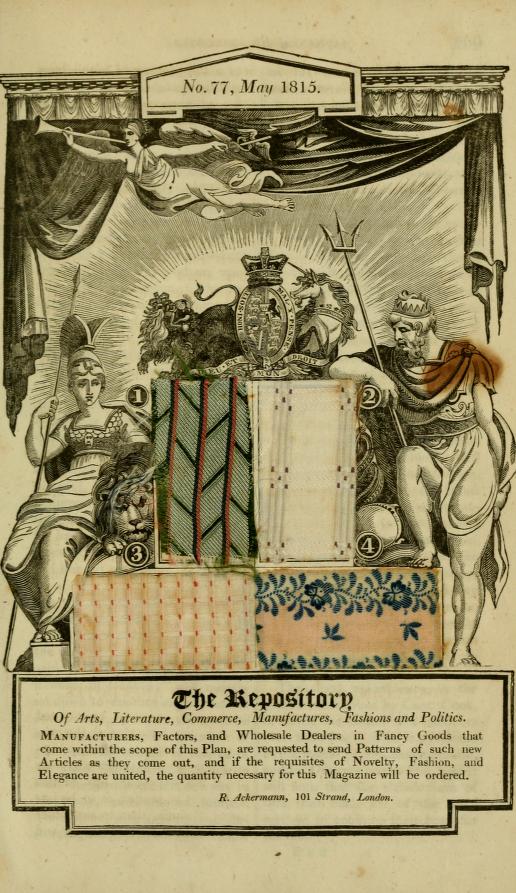
Allegorical Wood-Cut, with Patterns of British Manufactures. May, 1815. Ackermans's Repository of Arts, etc. Volume 13.

Allegorical Wood-Cut, with Patterns of British Manufactures. May, 1815. Ackermans’s Repository of Arts, etc. Volume 13.

It’s a Homer-quality forehead-slapping moment.

Caption, Allegorical Wood-Cut of British Manufactures. Ackermans's Repository of Arts, etc. Volume 13, May, 1815. page 298

Caption, Allegorical Wood-Cut of British Manufactures. Ackermans’s Repository of Arts, etc. Volume 13, May, 1815. page 298

Not only are there extant cotton roller-print Spencers, and wild printed cotton Spencer ensembles in North American collections, there’s print evidence of patterned silks for Spencers. Somehow, until I came across this plate and the description in Ackermann’s, I could not make the leap from cotton to silk.

Despite the existence of this.

My sole defense is that one patterned Spencer is still a zebra among horses.

But additional evidence, in the form of recommendations for spring in Ackermann’s? The zebra’s looking a little more like a horse.

Want more Ackermann’s? You know you do. The links are better sorted here.

Many, many thanks to Mr B for the tip!

Share this:

  • Click to share on Facebook (Opens in new window) Facebook
  • Click to share on Pinterest (Opens in new window) Pinterest
  • Click to email a link to a friend (Opens in new window) Email
  • Click to share on X (Opens in new window) X
Like Loading...

Frivolous Friday: Checkin’ it Out

29 Friday Jan 2016

Posted by kittycalash in Clothing, Frivolous Friday, Making Things

≈ 11 Comments

Tags

19th century clothing, checks, Costume, fashion, fashion plates, Federal style, living history, Making Things

Costume Parisien 1808 Cornette et Robe de Marcelline

Costume Parisien 1808
Cornette et Robe de Marcelline

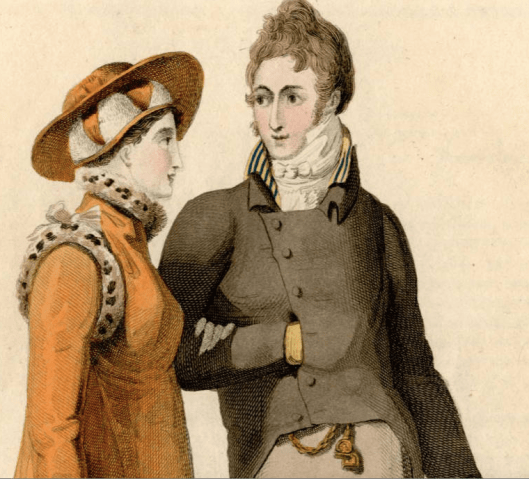
One gets ideas. I often get ideas about checks. In particular, I get ideas about loud checks. The gown in the fashion plate is appealing, when you’re looking for checks, and all the more so when you know how similar it is to an extant garment in your actual location.  The cornette I can do without– that’s the headgear, which looks like she’s crammed a sugar Easter egg on her head– but at least it could hide a short hair cut or the melting pomade of humid summer.

Costume Parisien 1808 Chapeaux et Capotes en Paille Blanche et Rubans

Costume Parisien 1808
Chapeaux et Capotes en Paille Blanche et Rubans

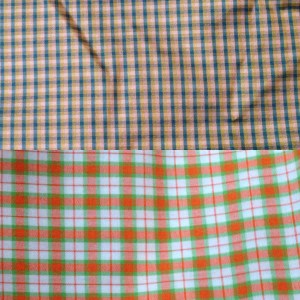
But wait! What check through yonder tastefulness breaks? It is the fashion plate, and  the checked bonnet is my sun. My goodness, that bonnet on the lower left is satisfying. It appeals to me the most because it is by far the most check-heavy bonnet I’ve seen, and making it would not involve plaiting straw, which I know nothing about. It’s a direct trip to obnoxious via silk taffeta, and that’s a trip I’ll buy a ticket for.

Top: check silk taffeta, Artee Fabrics Bottom: check cotton, Mood Fabrics

Top: check silk taffeta, Artee Fabrics
Bottom: check cotton, Mood Fabrics

Actually, as the result of a train ticket last August, I am the proud possessor of some delightfully bright lightweight cotton check in search of a fashion plate. The year I’m targeting (which is not 1808, but 1818) hasn’t yet provided published inspiration, but there are more places to search. In any case, an orange check gown with a blue check bonnet is pretty much crying out to be made. Bring your hanky, in case your eyes water, but make sure it’s check, too.

Share this:

  • Click to share on Facebook (Opens in new window) Facebook
  • Click to share on Pinterest (Opens in new window) Pinterest
  • Click to email a link to a friend (Opens in new window) Email
  • Click to share on X (Opens in new window) X
Like Loading...

Reflecting Fashion

21 Thursday Jan 2016

Posted by kittycalash in Clothing, History, Museums, Research

≈ 1 Comment

Tags

fashion plates, Federal style, frock coats, menswear, miniatures, portraits, tailoring

Whilst serving as the commandant for a research-paper writing prison*, I spent some time perusing the Met’s digital collections, in particular the Costume Institute’s collection of Men’s Fashion Plates, because, you know, stuff.

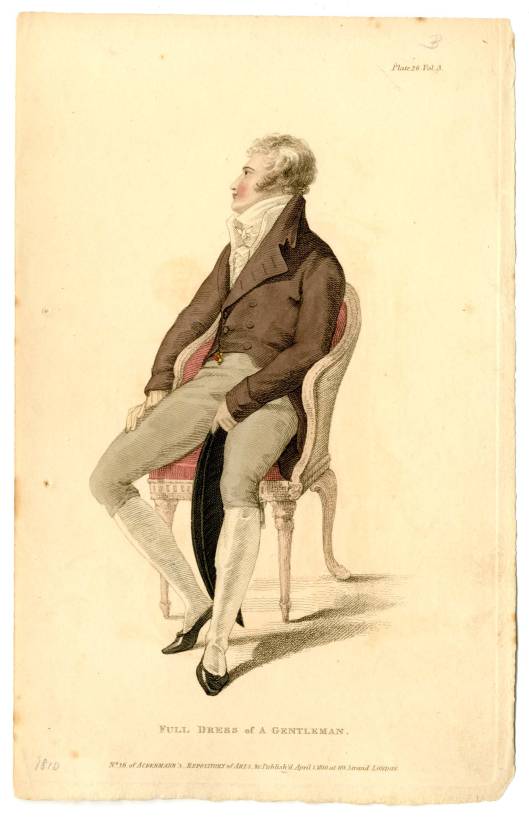
Men's Wear 1790-1829, Plate 002, 1807. Gift of Woodman Thompson Costume Institute Fashion Plates Metropolitan Museum of Art
Men’s Wear 1790-1829, Plate 002, 1807. Gift of Woodman Thompson Costume Institute Fashion Plates Metropolitan Museum of Art
John Myers. Oil on canvas by Thomas Sully, 1814. MFA Boston 45.894 Gift of Maxim Karolik for the M. and M. Karolik Collection of American Paintings, 1815–1865

I stopped at Plate 002, because I knew I’d seen that coat somewhere before. Why, yes: at the MFA in the Art of the Americas Wing, where I recently spent a pleasant afternoon with the Drunk Tailor. After some initial joy at discovering dust on a teapot, we got down to the business of setting off proximity alarms, reading labels, and contemplating  the occasional neck stock.

Mr Myers stopped me, though: what a handsome coat. High shoulder seams, long cuffs, buttoned all the way up. Nifty high-waisted grey trousers, too, and what seems to be a yellow waist coat. The portrait is dated 1814, and the fashion plate 1807.

Detail, 1807 fashion plate

Detail, 1807 fashion plate

Hmmmm…

Men's Wear 1790-1829, Plate 005, 1807. Gift of Woodman Thompson, Metropolitan Museum of Art

Men’s Wear 1790-1829, Plate 005, 1807. Gift of Woodman Thompson, Metropolitan Museum of Art

The brown M-notch collar coat is clearly a thing in 1807. It’s popular in 1802. So popular. 1802 on the left. On the right, 1812.

Portrait of a Gentleman of the Society of the Cincinnati. Miniature by James Peale, American, 1802. Philadelphia Museum of Art, 2000-137-11
Portrait of a Young Man by James Peale, 1812. Philadelphia Museum of Art, 1944-47-1


And our friend Sully paints one in 1814.

After seeing Copley and other early American painters use English prints as references for portraiture, I wondered if Sully was at all influenced by fashion plates, and then to what degree American men and their tailors were influenced by published fashion plates.

Portrait of the Artist. Thomas Sully, 1821. Metropolitan Museum of Art, 94.23.3

Brown coats are clearly classic: Sully’s got one himself in 1821. I’m sure there’s a dissertation out there somewhere on the influence of fashion plates on American men’s  fashion and representation in portraiture–  I can almost remember stumbling across the reference. So that echoes and re-echoes and reflects through time even as I recall not just the the folk wisdom about brown suits, but the significance of well-tailored suit. Maybe from 1802-1821, brown is the new black.


*Ah, teenagers. The Young Mr failed to complete a paper by the due date, so I spent some quality time ensuring he got back on track.

Share this:

  • Click to share on Facebook (Opens in new window) Facebook
  • Click to share on Pinterest (Opens in new window) Pinterest
  • Click to email a link to a friend (Opens in new window) Email
  • Click to share on X (Opens in new window) X
Like Loading...

Gigot or Gigantic?

08 Wednesday Jul 2015

Posted by kittycalash in Clothing, Events, Living History, Making Things, Research

≈ 6 Comments

Tags

10th Massachusetts, 1833, 19th century, 19th century clothing, authenticity, Clothing, common dress, fashion, fashion plates, living history, Making Things, style

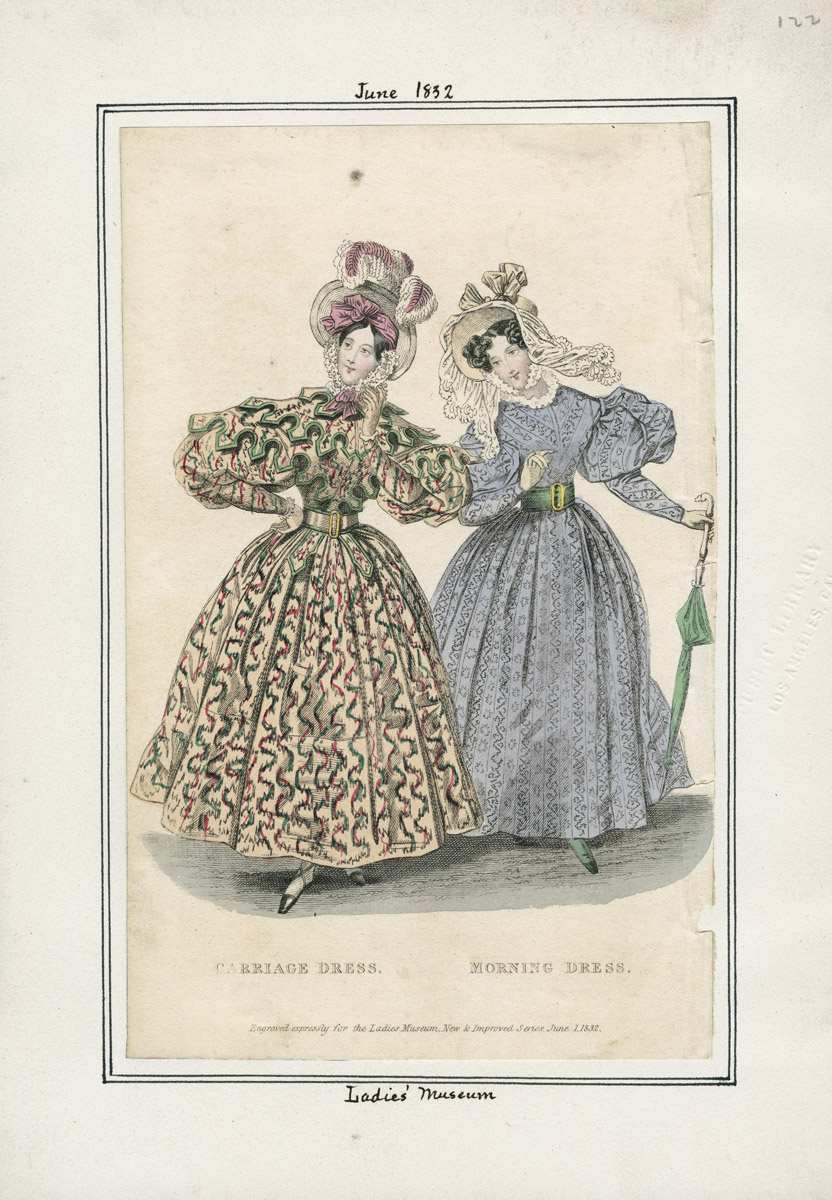
Carriage and Morning Dress, 1832. LAPL Fashion Plate Collection

Carriage and Morning Dress, 1832. LAPL Fashion Plate Collection

So, about that 1833 thing…

No, it’s not that I’m reconsidering. It is merely that as I consider the options, the fashion plates are a bit overwhelming. On the other hand, I am getting really good at recognizing the look of the 1830s in undated portraits. There’s an upside to everything.

Extant garments are fairly plentiful in the Usual Suspects’ Collections; there’s even a Tumblr. There’s a Tumblr for everything.

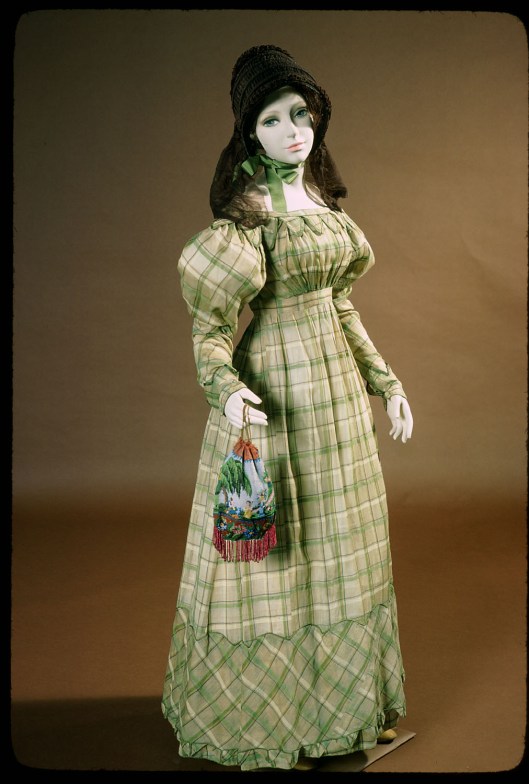
Woman's Green, Tan, Yellow and Blue Striped/Plaid Gown. OSV, 26.33.63

Woman’s Green, Tan, Yellow and Blue Striped/Plaid Gown. OSV, 26.33.63

Fortunately, there are some tamer garments out there, with sleeves less likely to result in flight in a high wind. Bonus: not floral, and not silk. Printed wool seems to have been fairly common, but the weight is just impossible to find. I did some looking in New York, but nothing convinced me with print or price.

This is a milita muster, so there will be time outside. I’m toying with a habit or Amazone (hard to resist a garment with that name) though the most I know about horses is that they have four legs. It’s tailoring that attracts me, not use. Also, wool. Mid-September might warrant wool, even if that’s hard to imagine today. (The downside, of course, is that there’s menswear to be made, too, so a simple dress is surely the best option.)

Share this:

  • Click to share on Facebook (Opens in new window) Facebook
  • Click to share on Pinterest (Opens in new window) Pinterest
  • Click to email a link to a friend (Opens in new window) Email
  • Click to share on X (Opens in new window) X
Like Loading...

Sheer Madness

10 Wednesday Jun 2015

Posted by kittycalash in Clothing, Events, Living History, Making Things, Reenacting

≈ 3 Comments

Tags

19th century clothing, Clothing, Costume, dress, Events, fashion, fashion plates, Federal style, Genesee Country Village, living history, Reenacting, sewing, style

Mercury is retrograde and the schedule is tight, even for me, as I made the plans I’ll put into action at the end of this week: a special event Thursday night at work, followed by mad packing and a drive pretty far into New York.

I did say sheer.

Yes: I am going to Genesee. It’s a long drive from here, so I’m happy to be picking up some friends in Albany (neither of whom live there) for company and some relief behind the wheel. Of course we’re taking our car: it’s the Quartermaster cart.

Since this is one of two occasions when I can portray someone in trade rather than in service (and a better trade than selling fruit on the street), I made a new gown. And a new Spencer. And a new reticule. And cut out a new coat for Mr S, with a newly (fingers crossed!) patterned collar, based on plates in Lapsley and Queen and images texted from a friend.

Yes, I am a little crazy, but it does make life interesting.*
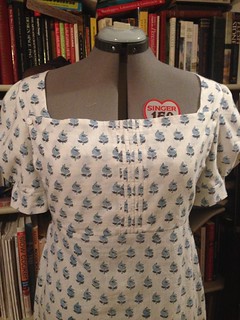
Finished –even hemmed– days before the event!

The gown is made from fairly sheer block-printed Indian cotton found on eBay. The pattern is based on one in Nancy Bradfield’s Costume in Detail with a bib front and tucks in the center back. To help with measurements, I also referred to the bib-front dress in the back of Bradfield’s book, as patterned on the fabulous 19th US site, as well as Janet Arnold.

The first bib-front gown I made ended up a little slanted: your mileage may vary, but I find patterning on opioids is not recommended (I sewed while recovering from hip replacement surgery). This one seems a little better, though the fabric came in for some commentary when I was working on this in a room full of light infantry “men.” We devolved from “chicken on flower” to “Seagull on a bush” in describing this buta-like shape. I only bled a small amount on the tucks, despite texting while sewing.
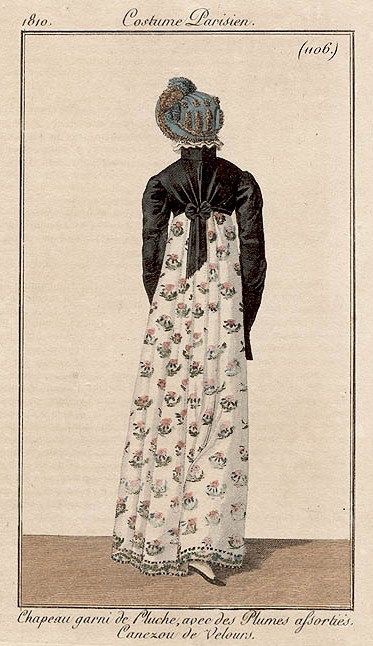
Canezou de Velours, 1810

Inspired by this 1810 fashion plate, I made a black velvet Spencer as well. That’s finished, save for the buttonholes, though there will be no texting while button holing.

Men’s waistcoats often have cotton or linen at the CB neck.

It got pretty matchy-matchy when I did the lining.

You will note that the plate describes a “Canezou de Velours.” Canezou was new to me, and while I don’t trustthe internet too much, here we are with Larousse: Vieux. Corsage de femme en lingerie.

Huh. It seems to be a lightweight-bust length garment for women.

Here’s the OED:

Oxford English Dictionary

canezou canezouHist.

(ˈkanzu)
[Fr., of unknown origin.]
A woman’s blouse-like garment of muslin or cambric. Also attrib.
1827 Lady’s Mag. Sept. 510/2 A canezou spencer of embroidered muslin. Ibid. 511/1 Muslin canezous over high dresses. 1893 G. Hill Hist. Engl. Dress II. 241 A cambric canezou..with sleeves full to the elbow. 1898 Daily News 26 Sept. 6/4 When the Restoration came in 1815,..Fleur-de-lys appeared on everything… The canezou replaced the hideous spencer.


Ah, the hideous Spencer. I rather like them, myself.


*A very long time ago, I had a drawing teacher who said there is never an excuse for being bored. There is always something to do, to see, to observe. That was my first lesson in being present. Perhaps I take this statement a bit too literally.

Share this:

  • Click to share on Facebook (Opens in new window) Facebook
  • Click to share on Pinterest (Opens in new window) Pinterest
  • Click to email a link to a friend (Opens in new window) Email
  • Click to share on X (Opens in new window) X
Like Loading...
← Older posts
Newer posts →

Archives

wordpress statistics

Creative Commons License
Kitty Calash blog by Kirsten Hammerstrom is licensed under a Creative Commons Attribution-NonCommercial-ShareAlike 4.0 International License.

Website Built with WordPress.com.

  • Subscribe Subscribed
    • Kitty Calash
    • Join 621 other subscribers
    • Already have a WordPress.com account? Log in now.
    • Kitty Calash
    • Subscribe Subscribed
    • Sign up
    • Log in
    • Report this content
    • View site in Reader
    • Manage subscriptions
    • Collapse this bar
 

Loading Comments...
 

    %d