• Home
  • Completed Costumes/Impressions
  • Emma and Her Dresses
  • Free Patterns and Instructions

Kitty Calash

~ Confessions of a Known Bonnet-Wearer

Kitty Calash

Tag Archives: Federal style

Frivolous Friday: The Pabodie Project

16 Friday Sep 2016

Posted by kittycalash in Clothing, Events, History, Living History, Making Things, material culture, Pabodie Project

≈ 12 Comments

Tags

19th century clothing, authenticity, fashion, Federal style, interpretation, Jane Pabodie, portraits, Rhode Island, Rhode Island Historical Society

Mrs William (Jane) Pabodie. oil on canvas, 1813. RIHS 1970.60.2

Mrs William (Jane) Pabodie. oil on canvas, 1813. RIHS 1970.60.2

Jane Jewett Pabodie, born around 1771, died 23 March 1846 is buried in Swan Point Cemetery on the Seekonk River in Providence. She was the wife of William Pabodie– which one? Well, it’s hard to tell until I really dig into the genealogy. At the moment I am so besotted with this image that all I can think about is what she’s wearing!

What she’s wearing….about that. I have some work– and some thinking– to do. The cap is slightly confounding. It’s a chance to learn a great deal more about early federal caps, which is good. I don’t understand it, which is unfortunate. The asymmetrical nature of the cap is new to me- or at least I cannot think of another example, so feel free to school me, people. But really: it is asymmetrical! With a ruffle on what is the right side of her head, and a… pinked? Van Dyked? Prairie pointed? band that runs from her left ear around to the back of her right ear? I’m confused. It would make more sense if the cap had slipped, but why would the Pabodies pay for a painting that recorded such a thing?

Honestly, I think the only way to really understand the cap is to make the cap. In muslin first, thankyouverymuch, I’m not that crazy.
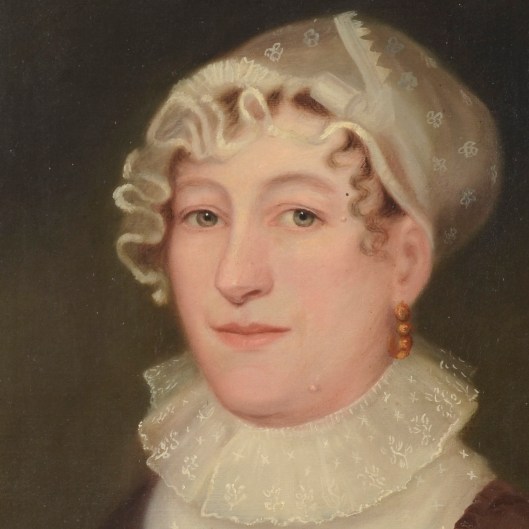
Detail, Mrs William Pabodie. Oil on canvas, 1813. RIHS

Detail, Mrs William Pabodie. Oil on canvas, 1813. RIHS

The chemisette is more straightforward, being made of a sheer figured or embroidered cotton with a slightly gathered collar embellished with floral whitework embroidery. That I think can manage, at least in the basic construction (fabric, well, I’m looking).

Of course, why do I feel the need to manage all of this, with a deadline now less than eight weeks away? For a program, of course– I have only to write the copy for it. The idea (for me, anyway) is to replicate a portrait as closely as I can. Now, Mrs Pabodie and I are not exactly the same age, but I think I can pull this off…the cap, more troubling.

It’s an interesting project for me, not so much from the sewing point of view, but from a conceptual standpoint.

How close can I get? What does exactitude mean?

If I want to represent a character, what’s more important: understanding the clothing, or understanding Jane Pabodie? Constrained as I am by modern materials, unable to match these exactly, how do I navigate choices based on suppositions of what an artist meant to represent? Just my kind of conundrum.
Share this:

  • Share on Facebook (Opens in new window) Facebook
  • Share on Pinterest (Opens in new window) Pinterest
  • Email a link to a friend (Opens in new window) Email
  • Share on X (Opens in new window) X
Like Loading...

Documented Fantasies

08 Monday Aug 2016

Posted by kittycalash in Clothing, Events, History, Living History, Museums, personal, Reenacting, Research

≈ 5 Comments

Tags

19th century, 19th century clothing, art history, authenticity, Events, fashion, Federal style, happenings, interpretation, living history, performance art, Reenacting

It was three years ago on a warm August afternoon in the museum room we’d turned into a photo studio when I quipped, “All my fantasies are documented.” It’s been hard to live down ever since.

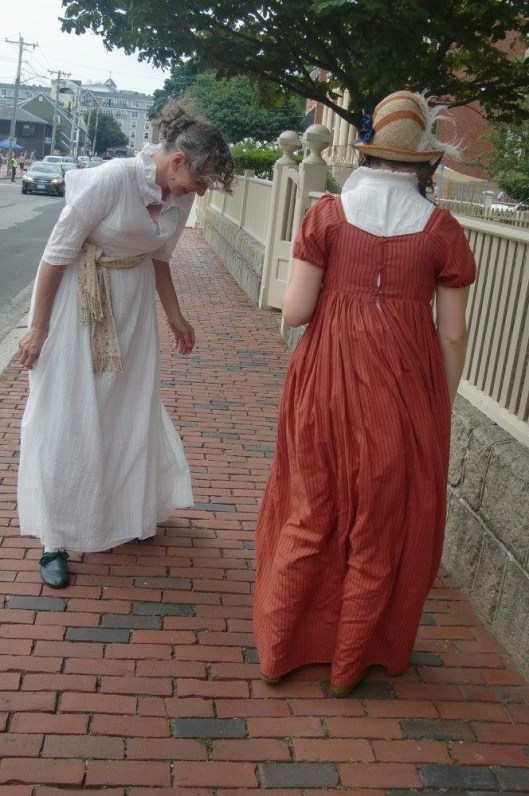
With Mrs B watching Miss B self-perambulate upon the sidewalk.

With Mrs B watching Miss B self-perambulate upon the sidewalk.

Documentation, research: we all do it, everyone who reads this blog does it. What matters is how you use it– or, maybe even more importantly, how well you understand how you are using your research. This past weekend was the Salem Maritime Festival, and round number three for me in the West India Goods Store (WIGS, which sounds far more political than it is). The year was 1804, and as you may recall, that required a new dress.

Reader, I wore it. And it survived!

Yes, it is made from an IKEA curtain. The pattern is my own, derived from examples in Janet Arnold, at Genesee, and the KCI. Once again, I discovered the power of upper body strength and leverage. It’s not that my stays are too big necessarily. The busk is too long, that I will grant you. But I think the shoulder straps are as well, and the shift– that slattern! She was rolling a la Renaissance Faire, which is completely unacceptable, of course, as she slid down my right shoulder by the end of the day when the shop had been unpacked into the conveyance.

So let us focus on the non-slattern part of the day, when a mercantile enterprise briefly overtook the WIGS.

Behind the Counter
Behind the Counter
DSCN4425

There was some custom, though numerous debts were recorded in the ledger.  (Somehow, there are no images of Mr K sweating over the figures in the book, though I recall them clearly.)

IMG_7634 (1)

The shop was hot, but we attempted to stay fed and hydrated, as we discussed the various kinds of goods imported to places like Salem and Providence in 1804. Politics were rather difficult to discuss, as Mr K has a marked antipathy for Mr Jefferson that caused a mild agitation; expanding the country does seem a bold and perhaps unconstitutional move, given the deal Mr Jefferson has struck with Bonaparte, but perhaps this is for the best. The Indians will surely benefit from Christianity and education.*

It’s engaging in the moment, and we’ve done our research. But it’s a fantasy nonetheless, a kind of happening grounded in primary sources and material culture. I’m OK with that– I understand what I am doing– but I wonder sometimes if the people I’m watching on social media understand what they are doing with the fantasies they portray.


* To be SUPER clear, I’m staying in character here. I worked in Missouri and I have enough understanding of “manifest destiny” to disagree with this point of view.

Share this:

  • Share on Facebook (Opens in new window) Facebook
  • Share on Pinterest (Opens in new window) Pinterest
  • Email a link to a friend (Opens in new window) Email
  • Share on X (Opens in new window) X
Like Loading...

Friday’s Fright: A Dress in White

05 Friday Aug 2016

Posted by kittycalash in Clothing, Events, History, Living History, Research, Uncategorized

≈ 1 Comment

Tags

19th century clothing, art history, Costume, Events, fashion, Federal style, living history, Research, sewing

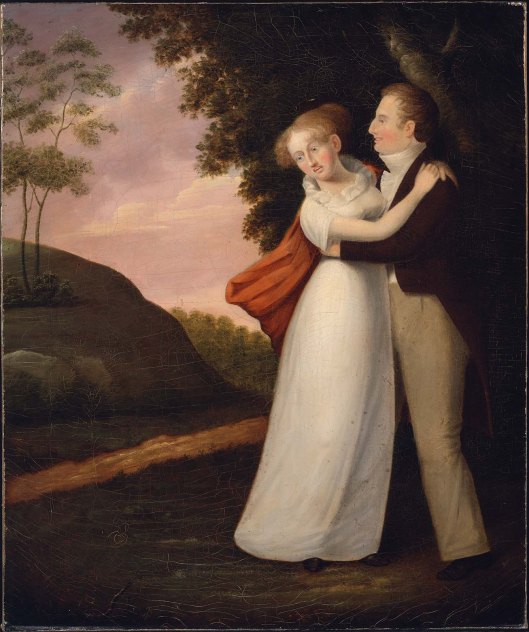
The Frightened Girl, oil on canvas by Cephas Thompson ca. 1810. MFA Boston, 1986.397

The Frightened Girl, oil on canvas by Cephas Thompson ca. 1810. MFA Boston, 1986.397

Two paths crossed for me this week, both in the early Federal era. Cephas Thompson, a self-taught New England painter, recently became very interesting to me. Although he grew up in Massachusetts, Thompson painted extensively in Virginia, but also in Providence, so of course the story resonated with me. But even more than the story, I loved the images. What a show the portraits would make– and he seems to have painted miniatures as well– so when I met with a local preservationist who turned out to be a fellow art school fugitive, wheels began to turn.

“What clothes!” my new friend said.
“I can get you a room full of people in those clothes,” I replied. And what fun would that be, a gallery opening where the people in the portraits appear to have come to life? Beats the pants off mere mannequins, but keep your Cossacks on: this one’s gonna take a while. In the meantime, what about those clothes?

Salem Register, July 14, 1803.

Salem Register, July 14, 1803.

Saturday marks the third time I’ve been part of the Salem Maritime Festival, and once again the West India Goods Store will be the base of operations for a mercantile enterprise. Millinery has its charms, but this year, the park historian shared fascinating notes on “She Merchants” of Salem, and the Hathorne sisters really intrigued me. Drunk Tailor dug into online newspapers (harder than ever to access remotely) and found an 1803 issue of the Salem Register

That’s an incredibly helpful list of goods to sell (and to pack from the Strategic Fabric Reserve), but a new year means a new dress, of course, and for reasons still not entirely clear to me, this seemed like exactly the right time to wear white. That’s sort of where Cephas Thompson comes back into play: white dresses.

Mrs. Cephas Thompson (Olivia Leonard). Oil on canvas by Cephas Thompson, 1810-1820. MMA, 1985.22

Mrs. Cephas Thompson (Olivia Leonard). Oil on canvas by Cephas Thompson, 1810-1820. MMA, 1985.22

There’s a pile of white cotton and white linen on my table, ready to be packed up this evening: with the dress on for a fitting, I felt like a bowl of whipped cream, the red silk Spencer and scarf the cherry on top. Happily, white and red are documentable to New England, though I would be mortified to be as frighted of a garter snake as the girl in Thompson’s painting. Strawberries and coffee are entirely different, and I shall probably require a bib for Saturday, lest my whipped cream be spoilt.

Share this:

  • Share on Facebook (Opens in new window) Facebook
  • Share on Pinterest (Opens in new window) Pinterest
  • Email a link to a friend (Opens in new window) Email
  • Share on X (Opens in new window) X
Like Loading...

Privacy and Proximity

23 Thursday Jun 2016

Posted by kittycalash in Events, History, Living History, personal

≈ 3 Comments

Tags

19th century, authenticity, common people, Federal style, Genessee Country Village Museum, interpretation, living history

DSC_0412

Feeling the Wyeth at Kiefer House

It has been a long time since I read Bowling Alone, and longer still since I read A Pattern Language or Jane Jacobs, but all of those came to mind this past weekend.

I don’t mythologize or romanticize the villages of the past: we all know how The Crucible turns out, but I thought about privacy and proximity, and I thought about scale. Let’s take privacy first.

In this century, it’s difficult to experience the past as anything more than a series of simulacra which we piece together in a crazy quilt of understanding, but past notions of privacy are far different from our own.

Bedroom

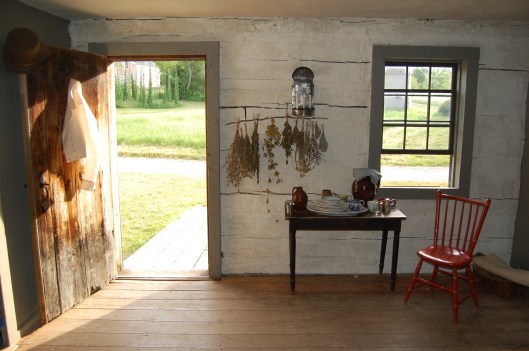
Early one morning, as I lay in a creaking rope bed, I considered how unfamiliar most of us are with the noises of other humans. The wall of our bedroom just barely fit against the exterior wall, and moonlight on whitewash showed the spaces between planking and the plaster, and we slept with the bedroom door open to take best advantage of the cool evening cross breeze.

As I lay awake, my companion happily asleep, I pondered the true extent of my laziness. How much clothing did I really need to wear to go up to the public facility? How loud would relieving myself in the chamber pot be? And what would the reaction be? (I have been on the side of someone else’s choice not to use a chamber pot, and said, “I wouldn’t care,” but one never knows.) And though I elected to put on more than my shift and walk to the public convenience, I began to wonder: what did the people in the past tolerate, ignore, or politely decline to mention?

What did living together feel like, when people shared smaller spaces? When the boundary between private and public, bedroom and parlor, was pierced with holes?

Share this:

  • Share on Facebook (Opens in new window) Facebook
  • Share on Pinterest (Opens in new window) Pinterest
  • Email a link to a friend (Opens in new window) Email
  • Share on X (Opens in new window) X
Like Loading...

My Grandfather’s Trunk

11 Saturday Jun 2016

Posted by kittycalash in Events, History, Living History, Reenacting

≈ 2 Comments

Tags

1814, 19th century, 19th century clothing, authenticity, fashion, Federal style, Genessee Country Village Museum, interpretation, sketching

Some objects you can't shake. And then you buy them.

Some objects you can’t shake. So you buy them.

When I was little, one of the games my mother and I played was “I packed my grandfather’s trunk.” You start with that line, and take turns adding an item in alphabetical order. The trick is, you have to repeat the whole string as you go along, so that by the time you’re packing a zebra, a zither, or zwieback, you’ve got to remember the other 25 things you and your companions have packed. It’s a good game for waiting rooms when you can’t run around, and fun for people who love words. How many nouns that start with “y” can you think of?

After lining the bottom with paper, I packed the linens.

After lining the bottom with paper, I packed the linens.

In less than a week, I’ll be packing someone else’s greatx-grandfather’s trunk for a trip westward into the (relative) wilds of New York State to join a Sketching Party. Despite two intense weeks, I’ve persevered on the orange check gown and made significant progress on the Thriller Spencer and finished the second sheet. This is a trip to a different class altogether, one of my two annual forays into the mercantile class of the early Federal period.

It’s quite the thing, packing your alter ego’s equipage for another century, and as I’ve enjoyed a longer commute recently, I’ve pondered the ways in which we stereotype certain kinds of living history practitioners. Progressives don’t always travel light: they travel right, and in this case, it means a quantity of baggage to create the proper simulacrum of an 1814 excursion.

DSC_0401

It’s a quantity of stuff, isn’t it?

While I decry the use of film and television as sources for historical costuming, I do appreciate them for inspiration, and it is remarkably easy to get someone else hooked on a good adaptation like the BBC’s 2009 Emma. The depiction of the picnic on Box Hill is particularly good (i.e. excruciating) and the pile of materials required for appropriate comfort is overwhelming to anyone who prefers to travel lightly. Never before have I considered a turkey carpet a possible accessory to an excursion, but when one intends to ape one’s betters and bring culture to the frontier, anything is possible.

Share this:

  • Share on Facebook (Opens in new window) Facebook
  • Share on Pinterest (Opens in new window) Pinterest
  • Email a link to a friend (Opens in new window) Email
  • Share on X (Opens in new window) X
Like Loading...
← Older posts
Newer posts →

Archives

wordpress statistics

Creative Commons License
Kitty Calash blog by Kirsten Hammerstrom is licensed under a Creative Commons Attribution-NonCommercial-ShareAlike 4.0 International License.

Website Built with WordPress.com.

  • Subscribe Subscribed
    • Kitty Calash
    • Join 621 other subscribers
    • Already have a WordPress.com account? Log in now.
    • Kitty Calash
    • Subscribe Subscribed
    • Sign up
    • Log in
    • Report this content
    • View site in Reader
    • Manage subscriptions
    • Collapse this bar
 

Loading Comments...
 

    %d