• Home
  • Completed Costumes/Impressions
  • Emma and Her Dresses
  • Free Patterns and Instructions

Kitty Calash

~ Confessions of a Known Bonnet-Wearer

Kitty Calash

Tag Archives: Federal style

Sheer Madness

10 Wednesday Jun 2015

Posted by kittycalash in Clothing, Events, Living History, Making Things, Reenacting

≈ 3 Comments

Tags

19th century clothing, Clothing, Costume, dress, Events, fashion, fashion plates, Federal style, Genesee Country Village, living history, Reenacting, sewing, style

Mercury is retrograde and the schedule is tight, even for me, as I made the plans I’ll put into action at the end of this week: a special event Thursday night at work, followed by mad packing and a drive pretty far into New York.

I did say sheer.

Yes: I am going to Genesee. It’s a long drive from here, so I’m happy to be picking up some friends in Albany (neither of whom live there) for company and some relief behind the wheel. Of course we’re taking our car: it’s the Quartermaster cart.

Since this is one of two occasions when I can portray someone in trade rather than in service (and a better trade than selling fruit on the street), I made a new gown. And a new Spencer. And a new reticule. And cut out a new coat for Mr S, with a newly (fingers crossed!) patterned collar, based on plates in Lapsley and Queen and images texted from a friend.

Yes, I am a little crazy, but it does make life interesting.*

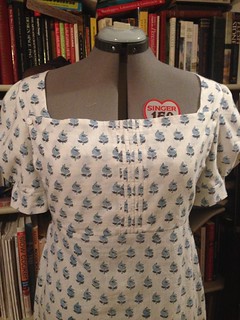
Finished –even hemmed– days before the event!

The gown is made from fairly sheer block-printed Indian cotton found on eBay. The pattern is based on one in Nancy Bradfield’s Costume in Detail with a bib front and tucks in the center back. To help with measurements, I also referred to the bib-front dress in the back of Bradfield’s book, as patterned on the fabulous 19th US site, as well as Janet Arnold.

The first bib-front gown I made ended up a little slanted: your mileage may vary, but I find patterning on opioids is not recommended (I sewed while recovering from hip replacement surgery). This one seems a little better, though the fabric came in for some commentary when I was working on this in a room full of light infantry “men.” We devolved from “chicken on flower” to “Seagull on a bush” in describing this buta-like shape. I only bled a small amount on the tucks, despite texting while sewing.

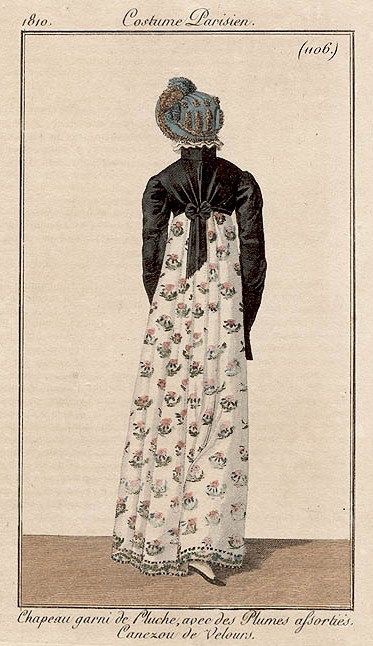
Canezou de Velours, 1810

Inspired by this 1810 fashion plate, I made a black velvet Spencer as well. That’s finished, save for the buttonholes, though there will be no texting while button holing.

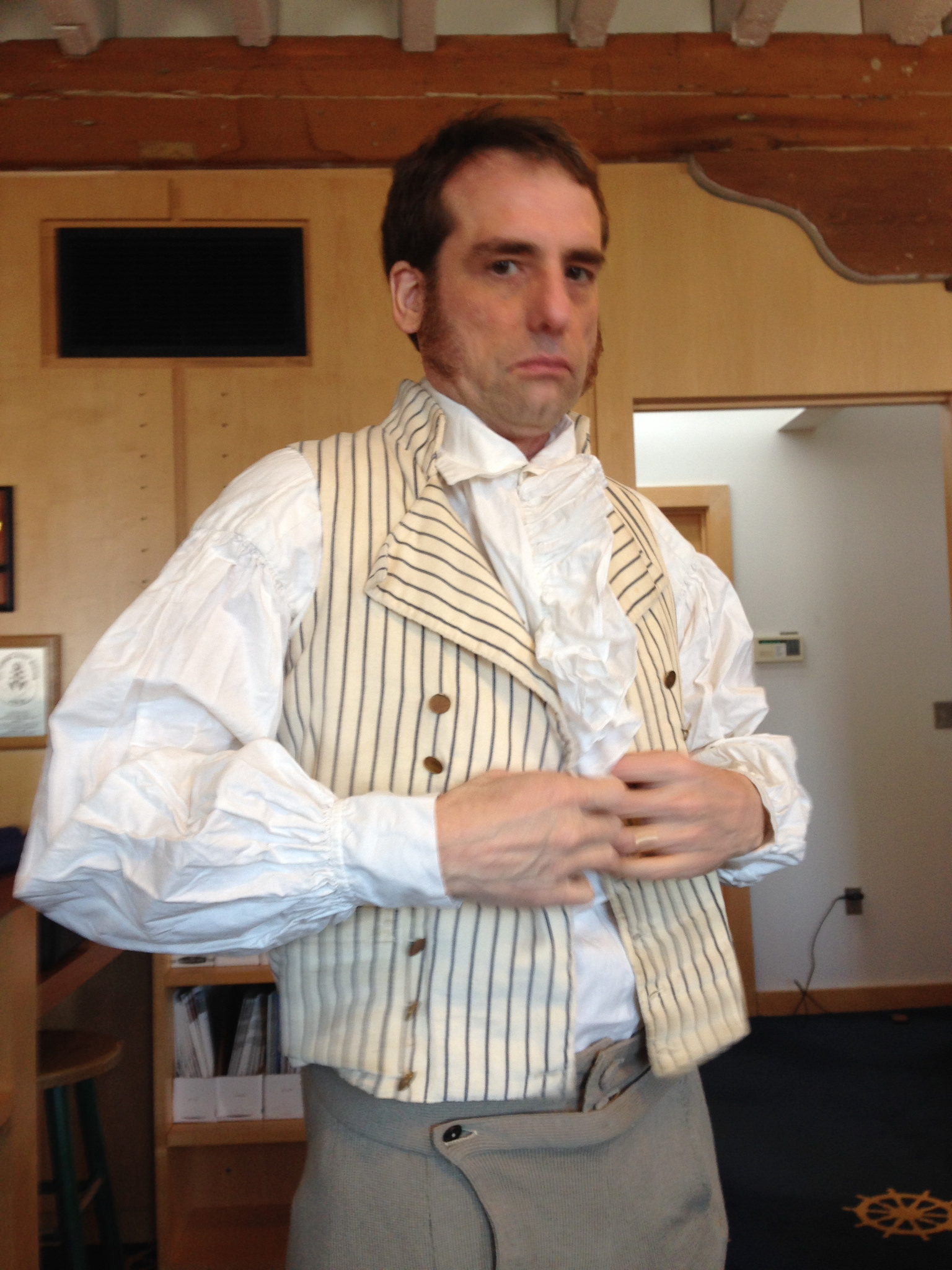
Men’s waistcoats often have cotton or linen at the CB neck.

It got pretty matchy-matchy when I did the lining.

You will note that the plate describes a “Canezou de Velours.” Canezou was new to me, and while I don’t trustthe internet too much, here we are with Larousse: Vieux. Corsage de femme en lingerie.

Huh. It seems to be a lightweight-bust length garment for women.

Here’s the OED:

Oxford English Dictionary

canezou canezouHist.

(ˈkanzu)
[Fr., of unknown origin.]
A woman’s blouse-like garment of muslin or cambric. Also attrib.
1827 Lady’s Mag. Sept. 510/2 A canezou spencer of embroidered muslin. Ibid. 511/1 Muslin canezous over high dresses. 1893 G. Hill Hist. Engl. Dress II. 241 A cambric canezou..with sleeves full to the elbow. 1898 Daily News 26 Sept. 6/4 When the Restoration came in 1815,..Fleur-de-lys appeared on everything… The canezou replaced the hideous spencer.


Ah, the hideous Spencer. I rather like them, myself.


*A very long time ago, I had a drawing teacher who said there is never an excuse for being bored. There is always something to do, to see, to observe. That was my first lesson in being present. Perhaps I take this statement a bit too literally.

Share this:

  • Share on Facebook (Opens in new window) Facebook
  • Share on Pinterest (Opens in new window) Pinterest
  • Email a link to a friend (Opens in new window) Email
  • Share on X (Opens in new window) X
Like Loading...

Some Velvet Morning

03 Wednesday Jun 2015

Posted by kittycalash in Clothing, Living History, Making Things, Reenacting

≈ 4 Comments

Tags

19th century clothing, Clothing, Costume, fashion, Federal style, Research, sewing, style

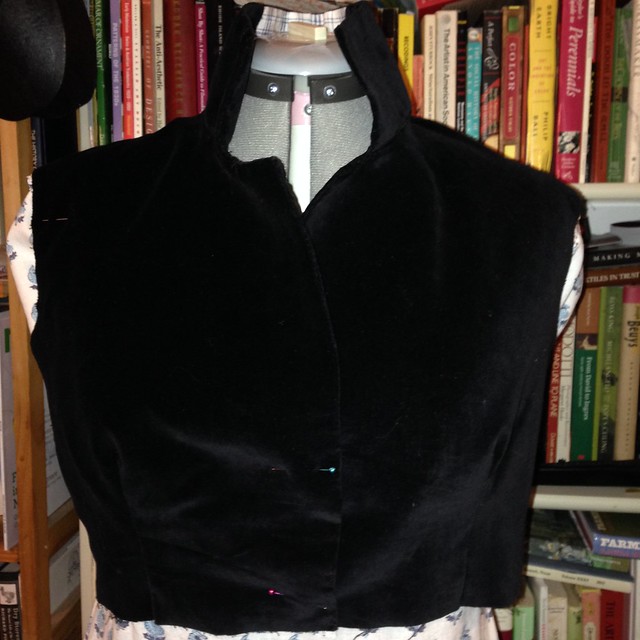
Sewing velvet is a strange experience. I’m working with a cotton velvet from a remnant table; it has a nice hand, but still crumbles and covers the table with fabric soot when I cut it. It’s not easy sewing black fabric with black thread, even in strong morning light, and “Some Velvet Morning” is an unhelpful thing to have stuck in your mind (especially the Lydia Lunch rendition).

With just one yard of 44″ wide stuff, cutting a Spencer took a little doing and some minor piecing. I borrowed techniques from some waistcoats I’ve seen recently, and pieced in linen at the back collar lining. That seems to be pretty common, and makes sense from a wear and hair perspective.

I patterned this on Monday morning before work, basing the pattern shapes on an 1810 fashion plate and an original at the MFA Boston. The MFA’s Spencer is particularly satisfying because of its connection to Lexington, Massachusetts. A New England-made Spencer is a happy find.

Share this:

  • Share on Facebook (Opens in new window) Facebook
  • Share on Pinterest (Opens in new window) Pinterest
  • Email a link to a friend (Opens in new window) Email
  • Share on X (Opens in new window) X
Like Loading...

Waistcoat Wanting? Workshop!

20 Monday Apr 2015

Posted by kittycalash in Clothing, History Space, Living History, Making Things, Museums, Reenacting

≈ 2 Comments

Tags

1790s, 1797, Events, Federal New England Fashion, Federal style, George Washington, Hermione, History Space, menswear, sewing, style, waistcoat, waistcoats

Gentlemen of Rhode Island

Gentlemen of Rhode Island

I managed, with sore fingers and considerable snake-eyed concentration, to get breeches and coats finished enough to send these two off to Battle Road better dressed than ever before. I’m pleased indeed with how the blue suit turned out, and planned to make a blue wool waistcoat to complete the set. Except…the Young Mr prefers some contrast in his clothing (a change from his prior preference for complete camouflage) and now wishes for white. I ask you.

Mr S is need of a new waistcoat himself, and he’s registered for a workshop with Henry Cooke to make a new waistcoat for himself. He was awfully taken with Mr B’s clothes two Saturdays ago, when he dressed as George Claghorn, the Naval contractor who supervised the building of the USS Constitution

Plush. No, really, it's made of plush *and* it's fancy, at least for us.

Plush. No, really, it’s made of plush.

.

L’Hermione is coming to Boston and Newport in July, and then we have An Afternoon in 1790 planned, with What Cheer Day not far behind, so there’s plenty of need for new waistcoats in a variety of styles– 1780, 1780, 1800 each have their variations.

Why not join us May 2nd and 3rd in Providence, and make your own fabulous waistcoat? There’s still a space or two left! Register here.

Share this:

  • Share on Facebook (Opens in new window) Facebook
  • Share on Pinterest (Opens in new window) Pinterest
  • Email a link to a friend (Opens in new window) Email
  • Share on X (Opens in new window) X
Like Loading...

Smock it to Me

18 Wednesday Feb 2015

Posted by kittycalash in Clothing, History, Making Things, Museums, Reenacting, Research

≈ 2 Comments

Tags

19th century clothing, anna maria von Phul, authenticity, Clothing, Colonial Williamsburg, common dress, common people, Costume, fashion, Federal New England Fashion, Federal style, Missouri History Museum, New England, style, watercolors

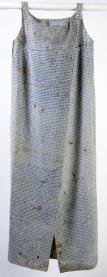
Smock, Checked cotton, Pocumtuck Valley Memorial Association. #2000.01.869.

Smock, Checked cotton, PVMA. #2000.01.869.

Edited to correct numerous typos and to add a bad sketch of the OSV apron. Don’t try to do research while conducting a small but energetic boy through a musket exhibit.

Two aprons, many questions, all of them excellent.

It’s really tough when an extant garment lacks provenance or even faux-venance, as in the “Revolutionary War” garments that turn out to be later. So, where do we look to figure things out when we a) like a garment a lot and don’t know if it’s right or b) are embarking on something a little new? And yes, in this case, we are talking bibbed aprons in the first quarter of the nineteenth century, in Rhode Island and in the Missouri Territory.

We start with questions:

1. What documentary sources can I find?
2. Is the form plausible for time period/area?
3. What is the typical fabric for the time period/area?
4. Is the item appropriate for my character/persona/impression?

Apron, checked with high waist, 1800-1820. Plain weave linen, probably Southeastern US. Colonial Williamsburg 1995-53

Apron, checked with high waist, 1800-1820. Plain weave linen, probably Southeastern US. Colonial Williamsburg 1995-53

What documentary sources do we have?
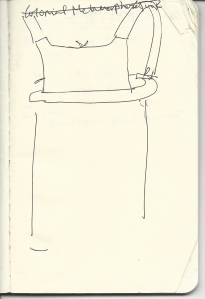
OSV's apron: I do my best work on the fly.

OSV’s apron: I do my best work on the fly.

We have some extant garments, two with images.

1. Extant apron 26.39.4, Old Sturbridge Village
2. Extant smock ca. 1800, Pocumtuck Valley Memorial Association 2000.01.869
3. Extant apron 18100-1820, 1995-33, Colonial Williamsburg (unstable links, search for accession number)
4. Apron 2005.24.4 at Historic New England has an intriguing description: A reddish brown linen apron with blue and white plaid. The apron is smock-like, with two holes for the arms and ties that extend from under the arms to the back. The bottom has a double hem. The neckline can be tightened or loosened with a blue and white string. What does that look like? Could it look like the Stonington plaid? It’s certainly a plausible New England weave 1810-1820.
5. Apron 1989.3, also at Historic New England, with a description similar to the CW high waisted apron:Cream & blue plaid linen; tucked at waist; no waistband; long cotton tape ties. (The tucked waist is similar to CW’s)

We have some imagery from the United States.

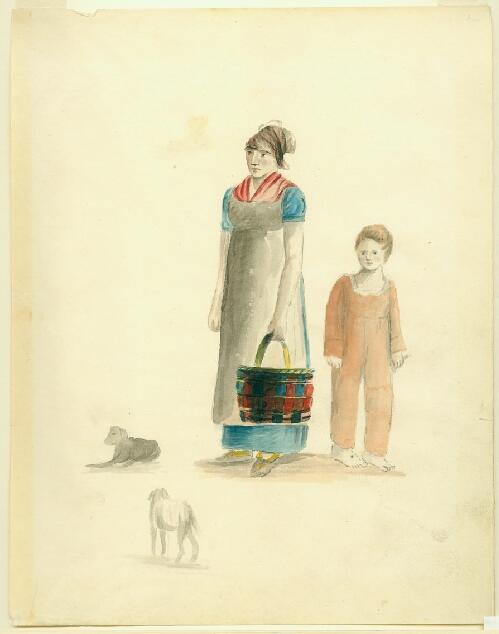
1. “Creole woman and child,” watercolor by Anna Maria von Phul, 1953.158.37, Missouri Historical Society

What else is out there? MHS’s database has an Apache error today, so not sure what aprons  they have, though they’re exactly where we need to look for one instance. I’ve looked and failed to find aprons of this description in the following catalogs: Historic New Orleans, Chicago Historical Society, State Historical Society of Wisconsin, Connecticut Historical Society, the Met, MFA Boston, Maine Historical Society, New Hampshire Historical Society, Ohio Historical Society, Newport Historical Society and Little Compton (RI) Historical Society. I’m now really tired of interacting with Past Perfect software.

Is this form plausible?

We have 5 objects and one image, all found in a cursory afternoon. Me, I’m still liking this form for the first quarter of the nineteenth century in the United States. I think the form varies somewhat, as can be seen in the descriptions; the OSV apron is the outlier, with the other 4 extant garments seeming more smock-like.

From RIHS MSS 72, Preserved Pearce papers,  Tailor's and Tavern account books, 1778-1781.

From RIHS MSS 72, Preserved Pearce papers, Tailor’s and Tavern account books, 1778-1781.

Fabric type?

Neither the OSV apron nor the PVMA smock have much (any) provenance, but the fabric is very typical of New England from the Connecticut River to the coast; it appears in inventories from 1777, on home- bound volumes, extant aprons in Deerfield and and in sample books from 1815.

Blue and white check: I am comfortable saying that those two aprons are 1800-1820 New England based on form and fabric. I am delighted to have found it in the apron at Colonial Williamsburg, which is thought to be from the Southeastern United States. I think that expand the range down the eastern seaboard. With the evidence of the extant garments and fabrics typical in New England, I am still OK with this form of apron, even if my rendition of the OSV apron is rather poor, thank you for noticing.

But what about Missouri? What should you wear out there, on the banks of the Mississippi?

Creole woman and boy. Acc. # 1953.158.37. Watercolor and pencil on paper by Anna Maria von Phul, 1818. Missouri History Museum Collections. Von Phul 37

Creole woman and boy. Acc. # 1953.158.37. Watercolor and pencil on paper by Anna Maria von Phul, 1818. Missouri History Museum Collections. Von Phul 37

Enter Anna Maria Von Phul. She is a little sketchy on some details– these are watercolors, after all–but I think she would have made the apron blue if it was made of blue and white check. She has rendered some stripes (?) in the head scarf, so she does hint at some detail.

Because I know AMVP, I believe that she is documenting fashions pretty typical of the time and place. The ladies she portrays in St. Louis in 1818 are fashionably dressed and not behind the times for the year, even if we cannot see every detail of dress.

If I were to make the cognitive leap that women across what is now the eastern half-or-so of the United States wore bibbed-style smocks or aprons between 1810-1820, and made them up in the most common fabric of their area (cue blue and white checks for New England), I might step back from that link in Wm Booth’s catalog. If I were to copy this image’s apron, I think I would make it in plain, unbleached linen, based on how I read this color and shading.

Ideally, you would find bracketing aprons– that is, some a little earlier and some a little later– in a “typical” fabric. I didn’t find those animals in the Western Reserve or Louisiana Purchase Territory collections available online, but that only means I didn’t dig in hard enough.

I don’t think these utilitarian garments will turn up in shop records, and I don’t think we are likely to find detailed probate inventory descriptions– mostly it says “apron,” which is too general for our purposes. We won’t find runaway ads: it’s too late for those, and a little early for newspapers in the Territories, though it wouldn’t hurt to search online.

I think our best alternate documentary sources in this case will be in diaries (again, we may not get the specificity we want; Sylvia Lewis only makes Spencers differentiated by color, so we are ignorant of collar shape, trims, number of buttons, closures, etc.) and in watercolors and drawings, often amateur, of everyday life.  After all, you can never have too many sources.

Is it appropriate?

Well…the evidence on the PVMA smock is of some use, though stains can be acquired in storage, too. The CW smock-apron is less used. I think this form in a checked or plain linen fabric would be best suited for everyday and working wear, cleaning, cooking, gardening, but not for serving at table (in a house that supported that), and not for dress or best, when white would have been what was wanted.

Share this:

  • Share on Facebook (Opens in new window) Facebook
  • Share on Pinterest (Opens in new window) Pinterest
  • Email a link to a friend (Opens in new window) Email
  • Share on X (Opens in new window) X
Like Loading...

New England Spencers

07 Saturday Feb 2015

Posted by kittycalash in Book Review, Clothing, History, Making Things, Museums, Research, Snark

≈ 7 Comments

Tags

19th century clothing, cataloging, common dress, common people, Dublin Seminar, Federal New England Fashion, Federal style, New England, Regency, Research, Spencer, Spencers, Sylvia Lewis

You may recall how tortured I was (sort of) about making a Spencer for What Cheer Day, concerned that Spencers could not be documented to Rhode Island, let alone New England. I had the same worry about the Not-Quite-Good-Enough Coat.

JDK_8210_1

Things will come to those who wait, and what came this week was the long-awaited Proceedings of the Dublin Seminar for 2010, Dressing New England. In it I found an article by Alden O’Brien, Federal New England Fashion in the Diary of Sylvia Lewis.

Sylvia Lewis [Tyler], Diary (1801-1831), MSS 2899 in the Americana Collection of the NSDAR provides the basis for O’Brien’s article and my joy. It begins routinely enough with my favorite stuff– spinning!– and carries on to knitting: stockings, mittens, gloves, a hat or two, and even “comforters,” or scarves. Shag, or thrummed, knitting is mentioned, so at least those of us interpreting the world of 1801 and later can be war.

The real excitement comes on the third page: in the winter of 1803-1804, Sylvia Lewis cuts and sews a greatcoat. Then, in 1806, she makes a green Spencer, and in 1808, a black one.

Spencer ca. 1800 French. silk. Purchase, Irene Lewisohn Trust Gift, 1991 1991.239.2

Spencer ca. 1800
French. silk. Purchase, Irene Lewisohn Trust Gift, 1991
1991.239.2

1806 is still later than I wore my Spencer. They’re shown in fashion plates of the 1790s, and here’s a pattern, too: so they’re clearly worn in Europe earlier than 1806. The similarity between the French silk spencer at the Met and fashion plates gives me confidence that they are being made and worn in the 1790s and early years of the 19th century; Spencers are also mentioned in tailoring manuals of this period.

1797, with a similar shape to the Met's French silk spencer.

1797, with a similar shape to the Met’s French silk spencer.

They’re placed in New England with written documentation, but how early are they here? And what did they look like? I know of one in a private collection which I am slavering to see, based on the description of the wool. The MFA has a few that seem to be local to Lexington, and there is one in Maine with a catalog record that shines with passive aggressive crankiness, and delights when compared to another in the same catalog. And no, I’m pretty confident that gentlemen did not wear spencers, or tailed spencers, at any time.

"wearing a spencer"
“wearing a spencer”
"she *says* its a spencer"
“she *says* its a spencer”

But there’s really good stuff in Sylvia Lewis’s diary for anyone who wants to know more about clothing production, use, and costs in early Federal New England. Even if your Library doesn’t have it, your Librarian can get a copy of the article for you through ILL or you can buy the entire proceedings here.

Share this:

  • Share on Facebook (Opens in new window) Facebook
  • Share on Pinterest (Opens in new window) Pinterest
  • Email a link to a friend (Opens in new window) Email
  • Share on X (Opens in new window) X
Like Loading...
← Older posts
Newer posts →

Archives

wordpress statistics

Creative Commons License
Kitty Calash blog by Kirsten Hammerstrom is licensed under a Creative Commons Attribution-NonCommercial-ShareAlike 4.0 International License.

Website Built with WordPress.com.

  • Subscribe Subscribed
    • Kitty Calash
    • Join 621 other subscribers
    • Already have a WordPress.com account? Log in now.
    • Kitty Calash
    • Subscribe Subscribed
    • Sign up
    • Log in
    • Report this content
    • View site in Reader
    • Manage subscriptions
    • Collapse this bar
 

Loading Comments...
 

    %d