• Home
  • Completed Costumes/Impressions
  • Emma and Her Dresses
  • Free Patterns and Instructions

Kitty Calash

~ Confessions of a Known Bonnet-Wearer

Kitty Calash

Tag Archives: history

Good Help is Hard to Find

06 Sunday Oct 2013

Posted by kittycalash in Events, Living History, Museums, Thanks

≈ 8 Comments

Tags

18th century, history, John Brown House Museum, living history, Providence, Rhode Island, Rhode Island Historical Society, What Cheer Day

Esther helps Mrs Smith with her bonnet

Esther helps Mrs Smith with her bonnet

Esther Hudson here has a terrible fascination for knittin, and an abundant fascination with sheep.I fear sometimes for her sanity, as she spends much of the evening sketchin cats on her slate and showing em to me. Cats, sheep, and knittin are much of her conversation and I wonder if she will ever be settled in a home of her own. I durst not send her away, as her father is at sea, and knowing what might befall her, given her simple ways, I think it best to keep her close. She is fond, as you can see, of dressin, but refuses utterly to quarter a fowle. She will beat a fine pound cake, but the coarser tasks of the kitchen she finds distasteful, preferrin to dress the ladies’ hair. Of her future, I do sometimes despair.

Mrs Smith and Miss Smith

Mrs Smith and Miss Smith

My cousin, Miss Eliza Smith, has donned her new dress to come up to town from her beloved Newport to see about a position. The family with whom she has found employment these many years has suffert in that city’s decline since the late war, and she seeks a new future in Providence. She writes a fine letter, and with excellent references, Miss Smith would be well suited to manage a household for Mrs Brown’s youngest daughter, the recently married Mrs Mason. Miss Smith seems also to steady Esther, whose conversation grows more sensible when she is not with me. Perhaps after speaking with Mrs Mason, Esther, Eliza and I can slip away to enjoy some of the newly pickt apples she has brought up from Rhode Island.
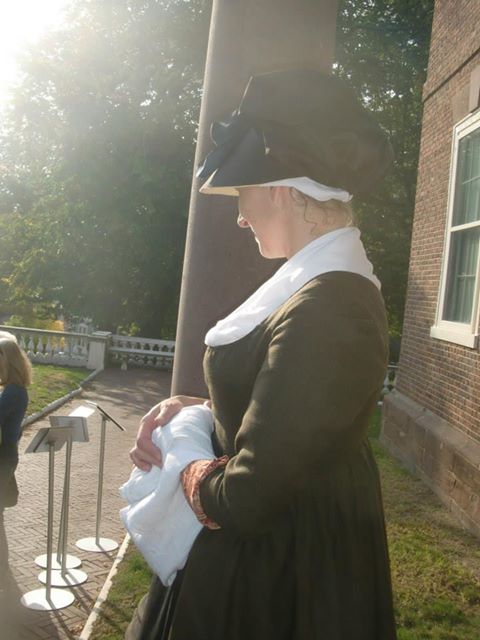
Mrs Smith, ready for some ale

Mrs Smith at day’s end

At the end of a long day filled with visitors– every stage has stopt at our house, some mistaking it, I think, for that questionable establishment operated by ‘Mrs’ Mary Bowen on South Main Street–I was ready to remove my soild apron (thankfully Esther has a spare) and venture down the hill to seek refreshment with my frinds. I may chanst to hear some news of the Ann & Hope, bound for Canton, and on which my son is a sailor. Or perhaps, before the light fails, I may read a bit of Mr Defoe’s most moral tale, Moll Flanders, and think in gratitude that my late husband’s family has seen fit to give me employ. I cant read at home, for if Mrs Brown catchs me readin that book agin, I will surely be trouble.

(Top photo thanks to the Providence Journal; bottom two thanks to Sharon Ann Burnston, our Mrs Brown)

Share this:

  • Share on Facebook (Opens in new window) Facebook
  • Share on Pinterest (Opens in new window) Pinterest
  • Email a link to a friend (Opens in new window) Email
  • Share on X (Opens in new window) X
Like Loading...

Places!

04 Friday Oct 2013

Posted by kittycalash in Events, Living History, Museums

≈ Comments Off on Places!

Tags

18th century, history, John Brown House Museum, living history, Rhode Island Historical Society, What Cheer Day

places_pleaseI don’t think we can be very much more ready. It’s a bit of madness, really, when the actors are also the stage managers, press agents, prop masters, and set designers, but that’s how these things work. (The local paper says we’re presenting a play; it’s somewhere between a reenactment in the larger, looser sense and improv theatre, but never mind.) I have only myself to blame, and Mister Mason and his interest in Sleep No More, for all this. Aware of Mister Mason’s interest, I should have realized what might happen when I said,  “Can’t we just occupy the house for a day?” with all the fluidity of the Occupy movement in mind.

My compatriots, I apologize.

Share this:

  • Share on Facebook (Opens in new window) Facebook
  • Share on Pinterest (Opens in new window) Pinterest
  • Email a link to a friend (Opens in new window) Email
  • Share on X (Opens in new window) X
Like Loading...

Animal Apples

08 Sunday Sep 2013

Posted by kittycalash in Food, History

≈ 2 Comments

Tags

apples, food, history, Rhode Island

apple-tree-056fb57ed927bf3668ef04e5b9850e99363b87fe-s6-c30The neighborhood where we live is part of the old rural past of our college town: it’s up the hill from the oldest settlement area, and slopes downhill to a plateau that runs out towards the other river, where the land drops precipitously. The house we live in was built in the 1920s, about the time of the junior high school and the stadium below us. The streets are named for the people who settled and farmed here, and two of the early houses remain, one frame and one stone.

Even into the 1940s, there was a dairy farm in this area, and a milk wagon; paintings from the first quarter of the twentieth century show an orchard named for one of the settlers, and there’s possible physical evidence of an earlier existence: apple trees in the verge around the corner from us.

I don’t know if these are new trees or old, though apple trees can live a long time. Well established and productive, the apples look like Paula Reds, but then again, so do Devonshire Quarrendens. (Paulas are a 1968 apple introduction, based on McIntosh apples.) What I do know is that they’re early season and good for eating, though we don’t like to pick too many: it feels like stealing, though no one ever seems to picks them. Mr S finally heard why: they’re Animal Apples.

1-squirrel-apple

A man and his son were on bikes at the corner under the tree; the man told his son the apples were not for eating: “Those aren’t for people. Those are animal apples.”

Those apples are delicious, and if it didn’t feel like stealing, I’d go up there with a basket. So many go to waste, and I suppose it’s because people have this “animal apple” idea.

There’s good foraging in the city, if you look, blackberries and raspberries in scrub ground, the apple trees, and the lettuce I let go to seed that flourished in the cracks of the walk down the side of our house. The idea that apples on a city tree aren’t for people  is sad. I ate mulberries off the tree in our yard in Chicago, where we grew rhubarb in the yard that fronted a busy street.

I don’t know what I find most disturbing about Animal Apples: the possibility that we’re so far removed from food that people can’t tell the difference between eating apples and ornamental apples, or that we’re so far from where our food originates that we fear anything that’s not assembled, processed, or obviously tamed and presented for our consumption.

Share this:

  • Share on Facebook (Opens in new window) Facebook
  • Share on Pinterest (Opens in new window) Pinterest
  • Email a link to a friend (Opens in new window) Email
  • Share on X (Opens in new window) X
Like Loading...

‘Visual Arts Crush’

21 Wednesday Aug 2013

Posted by kittycalash in Art Rant, Museums, Research

≈ Comments Off on ‘Visual Arts Crush’

Tags

art, art history, Art Institute of Chicago, historic interiors, history, miniature rooms, miniatures, Museums

I’ve been following the Times’ “Arts Crush” series, and one of the best, and best-written, in the series has been Holland Cotter’s piece on poetry and the MFA. Cotter’s writing is always elegant and accessible, with an amazing ability to render high concepts simply. (I wish he’d taught my graduate seminars in art theory…) The series inspired me to think about my first visual arts crush, and how it still resonates today.

I grew up on the North Side of Chicago, in the actual city, not Ferris-Bueller-land. By the time I was in high school, I had a pretty free-range existence thanks to the Chicago Transit Authority, and rode the bus anywhere and everywhere, even up to the southern edge of Bueller-land, also known as Evanston.

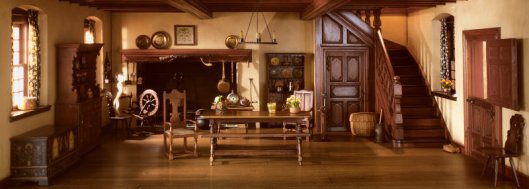
Mrs. James Ward Thorne American, 1882-1966 A17: Pennsylvania Kitchen, 1752, c. 1940. Art Institute of Chicago

Mrs. James Ward Thorne
American, 1882-1966
A17: Pennsylvania Kitchen, 1752, c. 1940. Art Institute of Chicago

Thanks to the CTA, and to the car my family drove only on weekends, and plenty of field trips in school, we visited most of the museums in the city: the Museum of Science and Industry, the Shedd Aquarium, the Chicago Historical Society, the Field Museum and the Art Institute of Chicago. That’s where I found my very first crush.

Mrs. James Ward Thorne American, 1882-1966 A3: Massachusetts Dining Room, 1720, c. 1940. Art Institute of Chicago.

Mrs. James Ward Thorne
American, 1882-1966
A3: Massachusetts Dining Room, 1720, c. 1940. Art Institute of Chicago.

There’s a lot to love in the AIC, from classic Impressionists to post-war Abstract Expressionists, but when I was in grade school, what really made an impression on me were the Thorne Rooms. The Thorne miniature rooms are meant to be the most accurate 1/12 scale representations of historical interiors. It will not surprise you that I pressed my 10-year-old nose against the glass of the early Pennsylvania rooms, or the high-style Rhode Island rooms, wishing desperately that I could shrink and slip through that solid membrane and inhabit the world the rooms depicted.

Mrs. James Ward Thorne American, 1882-1966 A11: Rhode Island Parlor, c. 1820, c. 1940. Art Institute of Chicago

Mrs. James Ward Thorne
American, 1882-1966
A11: Rhode Island Parlor, c. 1820, c. 1940. Art Institute of Chicago

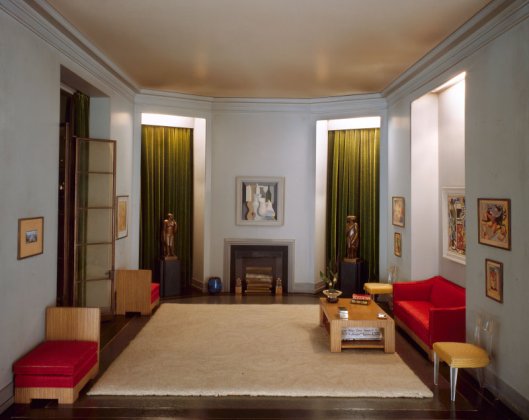
My mother and I would play a game: Which is your favorite room? Which one would you like to live in? And even if the rooms filled with tiny ball-and-claw feet were my favorite, or the chestnut-panelled keeping rooms, the one I wanted to live in (because somewhere there would be a telephone and a radio, and behind the tiny door, a well-appointed bathroom) was the Art Deco apartment. We were fairly certain this was a room you never saw in “Bringing Up Baby,” maybe the room on the other side of the bathroom where the leopard was kept.

Mrs. James Ward Thorne American, 1882-1966 A37: California Hallway, c. 1940, c. 1940. Art Institute of Chicago.

Mrs. James Ward Thorne
American, 1882-1966
A37: California Hallway, c. 1940, c. 1940. Art Institute of Chicago.

Accuracy and anarchy: those contradictory impulses have guided most of my life, from the work I made as an artist, to the work I do now. Getting details right, from citations to what’s on a table for a 1799 tea, matters; but once that’s set in motion, life takes over, the metaphorical leopard is loose, and we’re off to see what life was really like in all its emotive glory in 1799.

Mrs. James Ward Thorne American, 1882-1966 E-15: English Drawing Room of the Modern Period, 1930s, c. 1937. Art Institute of Chicago.

Mrs. James Ward Thorne
American, 1882-1966
E-15: English Drawing Room of the Modern Period, 1930s, c. 1937. Art Institute of Chicago.

And it all started in the basement of the Art Institute of Chicago, imagining what it would be like to live in each of the tiny worlds that ring the walls of the Thorne Rooms gallery.

Share this:

  • Share on Facebook (Opens in new window) Facebook
  • Share on Pinterest (Opens in new window) Pinterest
  • Email a link to a friend (Opens in new window) Email
  • Share on X (Opens in new window) X
Like Loading...

Hunting Frocks, Again

11 Sunday Aug 2013

Posted by kittycalash in Clothing, Living History, Reenacting, Research

≈ Comments Off on Hunting Frocks, Again

Tags

10th Massachusetts, 18th century clothes, 2nd Rhode Island, common soldier, history, hunting frock, Making Things, menswear, Research, resources, Revolutionary War, uniforms

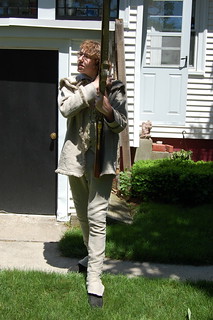
They’re not Mr S’s favorite thing, and I can understand why. Hunting frocks lack pizzazz, buttons, tape, lace, lapels, skirts and all the things that make him so fond of the Ugly Dog Coat worn by the 10th Massachusetts in 1782. (I think these are the coats captured from British supply ships and dyed at Newburgh and West Point in tanner’s vats.) But what he has right now is a hunting frock.

Here’s the kid in his new hunting frock, and a hand colored copper engraving by Johann Martin Will from 1776.

You gotta hold your tongue just right when you drill.

Americaner Soldat, Johann Martin Will. Ann S. K. Brown Collection, Brown University.

Americaner Soldat, Johann Martin Will. Ann S. K. Brown Collection, Brown University.

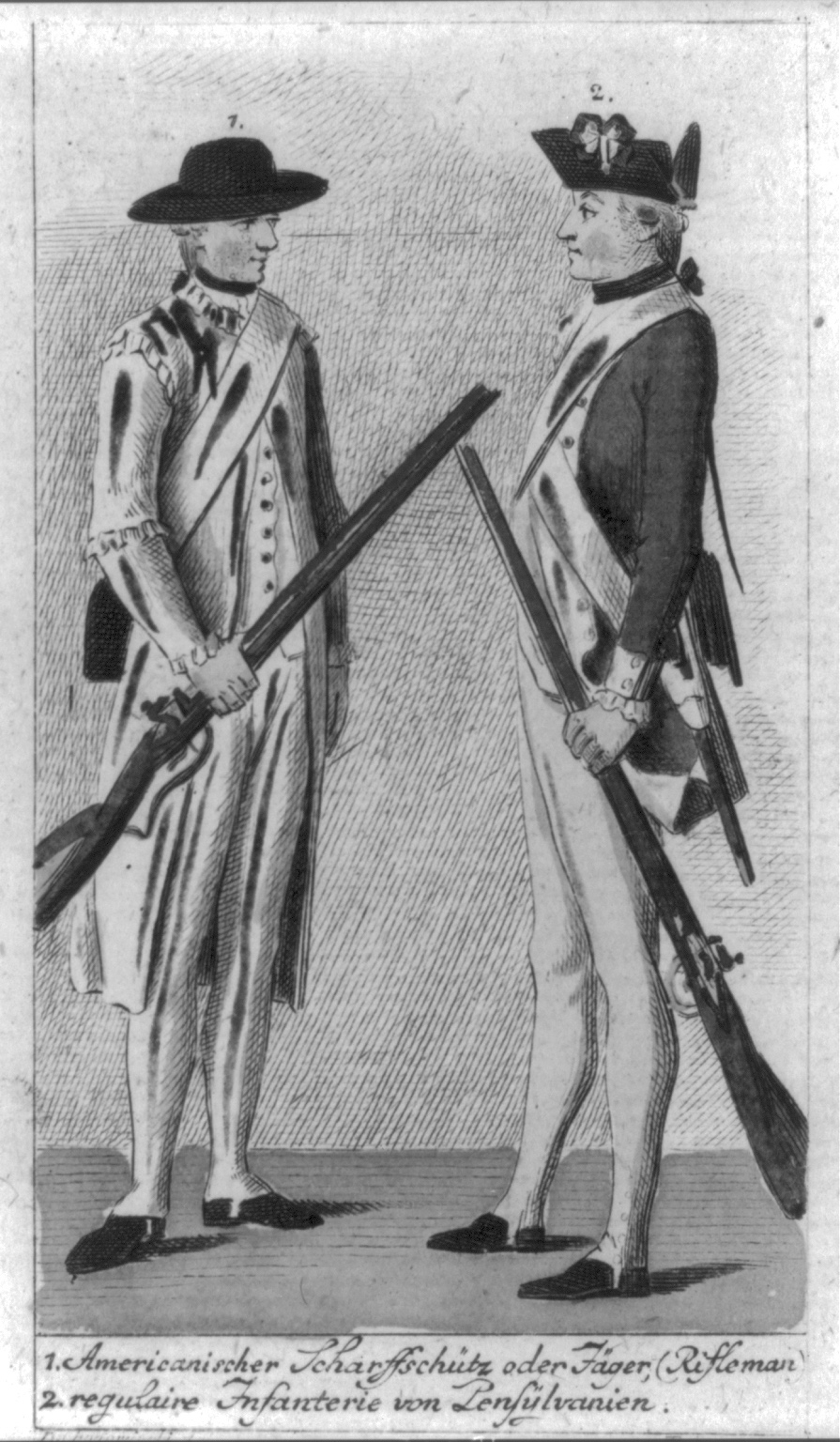
And then there are the colored and plain engravings, “1. Americanischer scharffschütz oder Jäger (rifleman) 2. regulaire infanterie von Pensylvanien,” engraved by Berger after Chodowiecki.

 Library of Congress

Library of Congress

Berger after Chodowiecki, Ann S. K. Brown Military Collection, Brown University

Ann S. K. Brown Collection

I started thinking about these again because not only am I reading Hurst’s thesis, but I’m fresh from helping the guys get dressed and arrange their capes and straps. I have been doing that as long as Mr S has been wearing historic clothing.

Early days of draping

Early days of draping


Drapey capes

The hunting frock drifts if it does not have some kind of fastening at the neck. The two halves migrate in opposite directions, and while belts help, the light infantry bayonet shoulder belt does not contain the hunting frock as well as one might like. So the thing to do, I think, is to attach a loop and button at the neck to hold the garment in place. From the period engravings, I think that’s acceptable. The garments all look as if they are closed at the neck. From the evidence in the field, and from the images, I plan to make loops and attach buttons, and hope that will limit some tendency to wander.

The image of the two soldiers together suggests another wrinkle in the hunting frock quandary, since the left hand soldier’s out garment looks like a long pocket-less coat with applied fringe and only a very small cape at the neck. Thank goodness that soldier is a rifleman, and thus outside the realm of immediate relevance. (And on a side note, I know a gentleman who very much resembles the Pennsylvania infantry man: identical calves, and even a similar face.)

Share this:

  • Share on Facebook (Opens in new window) Facebook
  • Share on Pinterest (Opens in new window) Pinterest
  • Email a link to a friend (Opens in new window) Email
  • Share on X (Opens in new window) X
Like Loading...
← Older posts
Newer posts →

Archives

wordpress statistics

Creative Commons License
Kitty Calash blog by Kirsten Hammerstrom is licensed under a Creative Commons Attribution-NonCommercial-ShareAlike 4.0 International License.

Website Built with WordPress.com.

  • Subscribe Subscribed
    • Kitty Calash
    • Join 621 other subscribers
    • Already have a WordPress.com account? Log in now.
    • Kitty Calash
    • Subscribe Subscribed
    • Sign up
    • Log in
    • Report this content
    • View site in Reader
    • Manage subscriptions
    • Collapse this bar
 

Loading Comments...
 

    %d