• Home
  • Completed Costumes/Impressions
  • Emma and Her Dresses
  • Free Patterns and Instructions

Kitty Calash

~ Confessions of a Known Bonnet-Wearer

Kitty Calash

Tag Archives: history

A Day in Time

08 Thursday Oct 2015

Posted by kittycalash in Uncategorized

≈ 5 Comments

Tags

authenticity, common people, common soldier, history, interpretation, living history, Reenacting

You know what’s wrong with most reenactments and living history events?

They’re not actual days. They’re fragments of many days jammed together like a fractured mosaic.

It’s tough and tiring to imagine and script and play out a whole day—all the simultaneous pieces—but if living history or reenacting events were run as A Day In Time, there would more likely be:

• Roles for More [kinds of] People
• Contextualization of Events
• Boring Bits like Paper Work
• No Time for Spinning
• Moar Drilling
• Rations & Messes, Actually
• Moar Drilling
• Courts Martial
• Small Acts of Drama Amid the Quotidian

Of course, y’all would have to work together…but imagine the power if an entire event ran the way a military camp should be, would have been, run. Orderly books provide plenty of ideas, entire days of stuff to do and get in trouble for.

Stop splitting, start lumping, and these events will, at last, become truly engaging on both sides of the rope line.

Share this:

  • Click to share on Facebook (Opens in new window) Facebook
  • Click to share on Pinterest (Opens in new window) Pinterest
  • Click to email a link to a friend (Opens in new window) Email
  • Click to share on X (Opens in new window) X
Like Loading...

Men, Women, and Work

07 Wednesday Oct 2015

Posted by kittycalash in Uncategorized

≈ 8 Comments

Tags

authenticity, common people, Events, history, interpretation, Reenacting, women's history, women's work

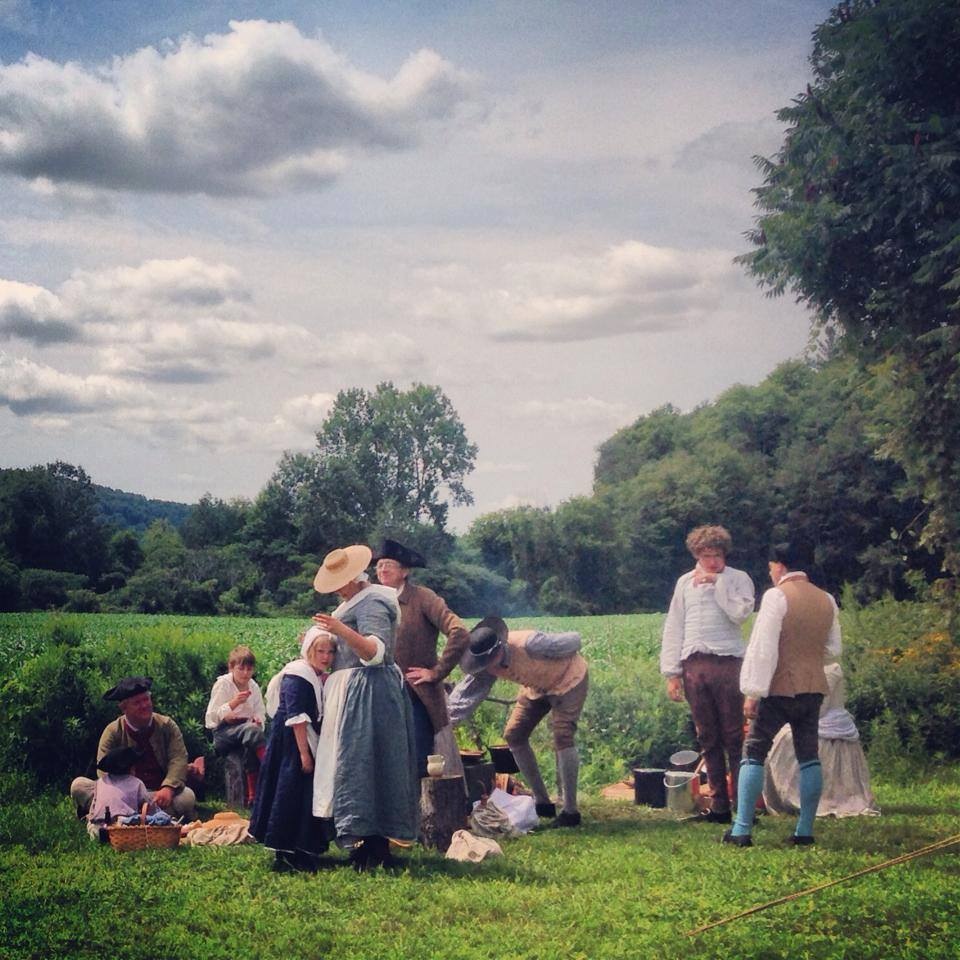
After a late afternoon meeting that left me raw from the way men speak over, interrupt, and dismiss women, I began to think again about a conversation I’d had with a friend at lunch about women’s roles at living history events, primarily military, but also militia, so let’s call them Gun Shows.

14999323655_5d9dcf2259_o

What do women do at the Gun Shows? They cook, for one thing, tied to camp fires. That’s at least a little better than the spinning that can happen, but it’s still not always right. I think a lot about how we’re not truly representing the ways that armies moved, slept, provisioned themselves, and how that affects the roles that women, children, and the (forgive me ) Invalid Corps might play. Yes, there are options: laundry, petty sutlering. There are women doing those things and doing them well, which is fantastic. When I think about how I might complement that, I end up thinking about women even naughtier than Bridget– and I think Bridget must have been very naughty indeed.

Even when you move away from military events, let us say to militia events, similar segregation occurs: women cook and wash dishes, men fire weapons. It just makes me tired, this notion of women forever being pendant to a gun, dependent on housework. It leaves me wondering what else I can do.

Perhaps more Gaskell than Austen, here

Perhaps more Gaskell than Austen, here

That’s easier in a civilian context. Women ran boarding houses, had small shops, ran needlework and boarding schools, worked as seamstresses, soap makers, tailoresses, milliners, mantua makers, painters and silhouette cutters. None of those things belong in a camp, and I begin to think that unless I can figure out a feminist interpretation of women’s lives of drudgery, I will have to give up the Gun Shows completely. And yes, for those of you who know me, that will be a natural transition, won’t it?

Share this:

  • Click to share on Facebook (Opens in new window) Facebook
  • Click to share on Pinterest (Opens in new window) Pinterest
  • Click to email a link to a friend (Opens in new window) Email
  • Click to share on X (Opens in new window) X
Like Loading...

Smell Ya Later

16 Tuesday Jun 2015

Posted by kittycalash in Clothing, Fail, History, Laundry, Living History, Reenacting, Research

≈ 9 Comments

Tags

19th century, 19th century clothing, authenticity, clothes, Clothing, common people, historical clothing, historical myths, historical reenactors, history, interpretation, laundry, smell

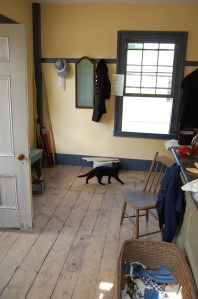
Wool on hooks, cat on prowl

Wool on hooks, cat on prowl

One of the most common questions you get when you’re wearing historical clothing is the undying, “Aren’t you hot in those clothes?”

A heavily perspiring visitor wearing practically nothing usually asks this question, and the standard reply is a variation of “Aren’t you hot? In really warm weather, everyone is hot. But natural fibre clothing wicks the moisture from the skin and helps to keep you cool.” My internal response (vocalized only once) is, “Why yes, I am—and thank you for noticing. I work hard for this look.”

The “aren’t you hot” question is often followed by, “Wow, and they didn’t bathe, so everyone really smelled.” You try not to think of that Monty Python sketch about Britain’s deadliest joke program in WWII and move the conversation on to weekly laundering of body linen, multiple shifts, shirts, and under-drawers, and the general hygienic practices of the past.

What struck me after a sticky weekend is how much I noticed the smell of modern people.

two tailors and a tailoress

two tailors and a tailoress

My traveling companions and I bathed on Friday morning, drove for 7+ hours in muggy weather, slept in our clothes, wore wool, cotton and linen in rain and thick humidity, sweated in the tailor’s shop, slept in our clothes again, and spent another warm, close, day in muggy weather, including grave digging and pall bearing. But as feral as my shift may have been on Sunday night, I never smelled us.

Mr H reported that his wool trousers were really stinky in the rain, and I think his white Spencer was well-seasoned even before this weekend, but I didn’t notice anything. Mr S’s soaking greatcoat was whiffy only at extremely close range.

What I did smell were modern perfumes, deodorants, and hair products. Those linger around their wearers and trail behind them, sometimes eye-watering in their intensity. I encountered lingering perfume in a bathroom at the museum, and we were overwhelmed by cologne at diner Monday morning: wow, people must really smell now, of petrochemicals.

more wool

more wool

This is not to say that homeless people and sulky teenagers don’t smell of unwashed bodies and clothes, but people in the past may not have smelled quite as badly as we think. They washed, if not bathed (bathing being full immersion washing) and by changing body linen and airing their clothes, they kept reasonably clean.

There was plenty to whiff in the past: wastes of all kinds, stagnant bodies of water used as dumps, rotting foods and corpses. But I’m not convinced that we haven’t simply exchanged one set of smells for another of different origin and intensity.

Share this:

  • Click to share on Facebook (Opens in new window) Facebook
  • Click to share on Pinterest (Opens in new window) Pinterest
  • Click to email a link to a friend (Opens in new window) Email
  • Click to share on X (Opens in new window) X
Like Loading...

By Jupiter!

24 Friday Apr 2015

Posted by kittycalash in History

≈ 1 Comment

Tags

astronomy, history, Ladd Observatory, personal, Providence, Rhode Island history

Ladd Observatory, 1898, back of the transit room.

Ladd Observatory, 1898, back of the transit room. Brown University image

On Tuesday, after a long hiatus, the local observatory was, at last, able to open to the public. Between the Snow on Monday theme of this winter, and the tendency to clouds and rain in what New England calls Spring, Ladd had been closed, and sending plaintive and apologetic emails, for weeks.

We walked up shortly after the 8:00 PM opening to find long lines, and a crowd as large or larger than the Halloween open house nights, when the staff and students turned the Observatory into a haunted house, neighborhood naughties swiped too much candy, and the roof deck was open for star gazing. Being Tiny Town, the Young Mr’s middle school art teacher was in line ahead of us with her young son and wife. To his credit, he did acknowledge her.

The telescope used by Benjamin West to observe the Transit of Venus, 1769

The telescope used by Benjamin West to observe the Transit of Venus, 1769. Brown University image.

There’s a long history of astronomical observation here, with a street named Transit for the 1769 Transit of Venus, observed by Benjamin West and other local notables.

We were happy to join the queue to look through the much larger telescope to see Jupiter, easily visible now.

It is really is a “wow!” moment, cooler even than the packages that make it here from India and astonish me. All that distance, light. How truly awesome the view through a telescope must have been in the 18th century, when we, collectively, knew less about the world and universe. How awesome it is now, to be able to see a world so far away, and to wonder what it is like.

Share this:

  • Click to share on Facebook (Opens in new window) Facebook
  • Click to share on Pinterest (Opens in new window) Pinterest
  • Click to email a link to a friend (Opens in new window) Email
  • Click to share on X (Opens in new window) X
Like Loading...

Feeling Materialistic

27 Friday Mar 2015

Posted by kittycalash in History Space, Living History, personal

≈ Comments Off on Feeling Materialistic

Tags

collections, history, History Space, interpretation, living history, material culture, Museums, objects

Chinese Export Porcelain bowl for the American market, 1790-1810. RIHS collection

Chinese Export Porcelain bowl for the American market, 1790-1810. RIHS collection

I went to Newport yesterday for a History Space program on material culture. I don’t know why I  was nervous, really, because I love stuff. I try not to accumulate too much stuff in my own life, and to be a careful curator, but really: beautiful objects make me really happy, and I love talking about “the thingness of things.”

Living history is fun for me for a lot of reasons, some esoteric and personal. I spent a lot of time in school thinking about images of America, and what they meant (it was the age of semiotics and Derrida) so creating living history personae and clothes and based on images and research is a way of making art of history, or else dressing up in funny clothes and enjoying loud noises.

Historical research is most fun when it asks questions– the journey is as good as the destination–and there are good questions to ask the things you carry with you or use in living history. (They’re probably good to ask if you’re in a mood to downsize at home, too.)

  • What is it?
  • When was it made?
  • Who made it?
  • What is it made of? Where did the materials come from?
  • Where did you get it? When did you get it?
  • How does it work, what does it do?
  • What does it mean to you?

If you can answer those questions, you’ll be a lot closer to knowing the why of what you have.

It’s the stories we tell about our objects that give them meaning: sometimes it’s who made or used a thing, sometimes the story has a meaning that you can’t tell from the object itself.

Think of this: I crossed the Pell bridge last night to come home, the road climbing into a storm cloud, the car lashed with rain and wind on a road surface daguerrotype-reflective and hard to read. The buffeting gusts on the car reminded me of the carpenter who didn’t like crossing the bridge to work in Portsmouth. Still, he told a story about crossing the bridge in storm on a motorcycle, with a girl riding behind him. The wind would rise, you’d both get scared, and she’d squeeze closer. He shivered inside his t-shirt as he told the story, with a tiny smile, and you knew he’d gone to Newport in that weather, on that bike, with that girl, on purpose.

You’d never get that story just from a jacket, a helmet, or a bike, but somewhere, there’s a object tied to that story.

Share this:

  • Click to share on Facebook (Opens in new window) Facebook
  • Click to share on Pinterest (Opens in new window) Pinterest
  • Click to email a link to a friend (Opens in new window) Email
  • Click to share on X (Opens in new window) X
Like Loading...
← Older posts
Newer posts →

Archives

wordpress statistics

Creative Commons License
Kitty Calash blog by Kirsten Hammerstrom is licensed under a Creative Commons Attribution-NonCommercial-ShareAlike 4.0 International License.

Website Built with WordPress.com.

  • Subscribe Subscribed
    • Kitty Calash
    • Join 621 other subscribers
    • Already have a WordPress.com account? Log in now.
    • Kitty Calash
    • Subscribe Subscribed
    • Sign up
    • Log in
    • Report this content
    • View site in Reader
    • Manage subscriptions
    • Collapse this bar
 

Loading Comments...
 

    %d