• Home
  • Completed Costumes/Impressions
  • Emma and Her Dresses
  • Free Patterns and Instructions

Kitty Calash

~ Confessions of a Known Bonnet-Wearer

Kitty Calash

Tag Archives: living history

A Cloak for the Cold

04 Saturday Jan 2014

Posted by kittycalash in Clothing, Living History, Making Things

≈ 4 Comments

Tags

18th century clothes, 18th century clothing, cloak, common dress, fashion, living history, Rhode Island, sewing, short cloak, style, winter, wool

January 11

January 11, 1777. Providence Gazette

We’ve had a bit of snow and cold, which kept me at home (when there’s a parking ban, most businesses have to close, as most parking is on the street here). We have plans in another century this evening, so I thought a second cloak would be in order. The first cloak I made was based on one in the collection at work as well as on a Rhode Island runaway advertisement.
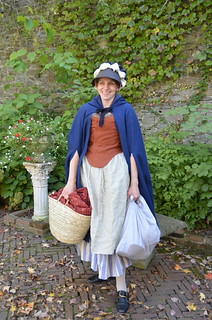
Long blue cloak, in 2012

Although I’m not displeased with the cloak, the length can be annoying and I knew that the blue cloak for a runaway was not what I wanted to wear with the sacque. So I sacrificed some yardage from the Strategic Fabric Reserve, read up on cloaks, and got out my scissors. A cloak is a fairly simple thing to make, so I don’t know why it took all day, beyond getting distracted, making dinner, shoveling, re-learning high school geometry, and trying to do a very careful job.

Hood, with lining, pinned to the body of the cloak

Because I’m tall and have long arms, I made the new cloak a little longer than I would have for a true short cloak: it is easier to trim than to add, though this is pieced on the fronts and on the hood and on the hood lining.
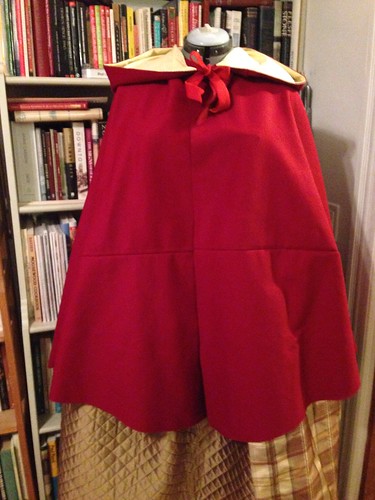
Pieced across the front.

The front piecing is more noticeable than I really like, but that’s how this came out and how cloaks often work out. I won’t really care, as long as I am warm and able to move my arms. When it’s really cold, as it is today, I can wear both red and the blue cloaks with a wool gown and petticoats and wool kerchief. Or perhaps I should just wear a sheep.
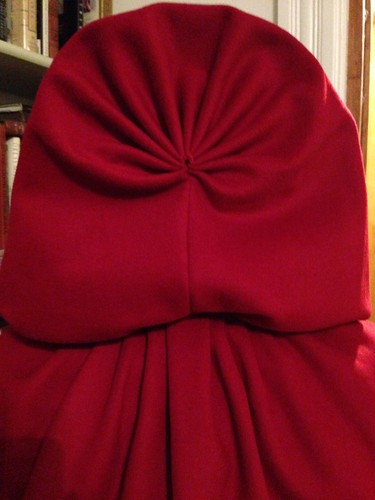
Back pleats. By a third cloak, I might get them really right.

I found the trick to getting the pleats/gathers on the hood to flip correctly was to work from the outside, or right side, once the back seam had been sewn up partway. It took three tries to figure that out, but somehow working the pleats/gathers from the right side worked. I did backstitch the pleats/gathers on the inside to hold them in place.

Inside the hood. with lining in place.

In all, this took less than a yard of yellow silk Persian, about half a yard of red wool twill tape, and two yards of crimson broadcloth, all from Wm Booth, and all but the Persian purchased as remnants. There’s a fair amount of broadcloth left, so a yard and a half with aggressive piecing might work, especially if you want a shorter cloak, and are not as tall as I am.

Share this:

  • Share on Facebook (Opens in new window) Facebook
  • Share on Pinterest (Opens in new window) Pinterest
  • Email a link to a friend (Opens in new window) Email
  • Share on X (Opens in new window) X
Like Loading...

The Checkered Past

26 Tuesday Nov 2013

Posted by kittycalash in Clothing, History, Research

≈ 3 Comments

Tags

18th century clothes, authenticity, Clothing, common dress, common people, common soldier, Costume, dress, exhibits, fashion, living history, Research, resources, Rhode Island

Coat, 1790s American CB: 38 in. Gift of The New York Historical Society, 1979.346.42. MMA
Textile Sample Book, 1771. British Rogers Fund, 156.4 T31, MMA

Some gentlemen I know should consider what they might want to do to avoid (or alternately, encourage) having this coat made for them. It’s really a lovely thing, found as the best things are, while looking for something else.

It reminded me, too, of the textile sample book at the Met, currently on display in the Interwoven Globe exhibition. (No, I haven’t seen it; I’m going to try, but…).

Wm Booth has a new linen coming in the winter, and as the men in my house have outgrown or outworn their shirts, I am thinking of making new check shirts. I did finish a white shirt at Fort Lee, which will go to the Young Mr (his small clothes being now his too-small clothes). I will have to make Mr S a white shirt for best wear, but they could each use a second working shirt. At least with checks you get “cut here” and “sew here” lines.

Last week, I found a weavers’ book in the Arkwright Company Records (Box 1, Folder 1, 1815). It’s a slim, blue paper-covered volume with small samplers glued in to the pages, and full of checks and stripes. Blue and white, red and blue, checks and stripes were prevalent in the late 18th and early 19th centuries. The more I look at extant garments, sample books, and ads, the more I think the streets must have been a vibrant, if grimy, visual riot.

Share this:

  • Share on Facebook (Opens in new window) Facebook
  • Share on Pinterest (Opens in new window) Pinterest
  • Email a link to a friend (Opens in new window) Email
  • Share on X (Opens in new window) X
Like Loading...

Headed for the Hudson

22 Friday Nov 2013

Posted by kittycalash in Events, Reenacting

≈ Comments Off on Headed for the Hudson

Tags

10th Massachusetts, 2nd Rhode Island, authenticity, Brigade of the American Revolution, common soldier, Fort Lee, living history, Reenacting, Revolutionary War

Fort Lee: It’s a mixed bag.

Fort Lee is a mixed bag: the site is very urban, authenticity levels vary, the activities sometimes get off schedule, and I don’t think anyone knows for certain what goes into the stew pot. Still, it’s an easy there-and-back dash, and all of us are going now that Sunday’s swim meet is cancelled.

After all, the Young Mr has an agenda. After being told at the Fort that “they didn’t have grapeshot then,” we found a reference in the Jeremiah Greenman diary to grapeshot being fired on the Continental troops at Fort Mifflin in 1777. He’s fastened on this and looks forward to moving that conversation forward…

And I’m just happy to have a day outside to look forward to. It’s a little dull without a fire and tent, but the event has its quirky charms, and I can always bring a book or work on shirts.

Share this:

  • Share on Facebook (Opens in new window) Facebook
  • Share on Pinterest (Opens in new window) Pinterest
  • Email a link to a friend (Opens in new window) Email
  • Share on X (Opens in new window) X
Like Loading...

To (Ft) Lee or Not to (Ft) Lee?

19 Tuesday Nov 2013

Posted by kittycalash in Events, Living History

≈ Comments Off on To (Ft) Lee or Not to (Ft) Lee?

Tags

10th Massachusetts, 18th century clothes, Brigade of the American Revolution, Events, Fort Lee, living history, Revolutionary War, weather, wool

A Market Girl with a Mallard Duck, pastel by John Russell, 1787. (Sold by Christie's)

A Market Girl with a Mallard Duck, pastel by John Russell, 1787. (Sold by Christie’s)

I like Fort Lee: after all, I like big guns, and Fort Lee has a 32 pound gun.

It’s always cold, though, and I could use a day sewing various projects or vacuuming. But it’s also the last event of the season. Of course, in the slack time, I always stand on the NJ shore wondering how feasible it would be to run over to Manhattan for trim, fabric, or a trip to a museum. In kit. Because…. why not?

But Mr S wants me to come, so I’ve stirred myself to cutting and pressing and starting to hem a wool kerchief. This is made from some crossed-barred wool found in Somerville on the shopping expedition with Sew 18th Century.

She kindly sent me the image above, which is a good thing because I get distracted and think, “you know, that image with the duck and the girl and the bonnet,” which will give you 71,000,000 results in Google, but fortunately includes this one.

Three hems: I should be done by now.

It’s an easy project, but sometimes those are the hardest because you’re not learning anything. That, of course, is what Netflix is for: ghastly murders or sophisticated dramas keep you going on repetitive hems.  (I do my best backstitching to BBC crime dramas– go figure.)

So, a November Saturday up on the Palisades means wool, in fact, requires wool, and for the first time I think I have enough wool to stay reasonably comfortable. That’s a cloak, kerchief, gown and two wool petticoats, plus wool stockings and, if they fit, sheepskin insoles for my shoes. We have a wool shift at work, but at about 50 years later than the Fall of Fort Lee, it provides no justification for a wool flannel shift. Still, a wool shift is a tempting thought, and suddenly that kerchief hem gets more interesting, as I start to think about where to look for documentation of wool or flannel shifts.

Share this:

  • Share on Facebook (Opens in new window) Facebook
  • Share on Pinterest (Opens in new window) Pinterest
  • Email a link to a friend (Opens in new window) Email
  • Share on X (Opens in new window) X
Like Loading...

How many men and a tub?

16 Saturday Nov 2013

Posted by kittycalash in Laundry, Living History, Research

≈ Comments Off on How many men and a tub?

Tags

10th Massachusetts, 18th century, 18th century clothes, authenticity, common people, common soldier, laundry, living history, washing

The Laundry
Louis-Adolphe Humbert de Molard (French, Paris 1800–1874)
1840s, Salted paper print Credit Line: Gilman Collection, Purchase, Ann Tenenbaum and Thomas H. Lee Gift, 2005
2005.100.1241

How many men does it take to know what kind of wood a laundry tub should be made of?
For now, one woman. Yes, I’ve got a new obsession.

It started innocently enough with an exchange about future laundry tubs and an existing tub described as large, made of pine, and badly shrunken. Somehow I found myself burning to know, What is the appropriate wood for a laundry tub made in southeastern New England between 1775 and 1785?

Luckily I work in the kind of place where you might find an answer to that kind of question. In the Miscellaneous Manuscripts Collection, I found George Dods Cooper Accounts (MSS 9001-D Box 4). Mr Dod worked as a cooper in Providence between about 1790 and 1820, so he’s later than I need for this specific application, but I’m not sure the form changes radically before 1850, so Mr Dods seemed like a good place to begin.

While I did not find the hoped-for a receipt for purchases of specific kinds of wood, I did find that Dods was coopering with both iron and wooden hoops, and that he was making barrels, tubs and buckets of unspecified kinds of wood as well as cedar tubs.

1813 Mr Holroid
Nov 19
Sating 4 iron hoops on a Poudering Tub 0=6 0
Sating 6 Wooden Do- on another – Do- 0=3 0

1810
Oct 3 Satting 3 hoops on a large cedar tub 1 firking hoop 0=1-6

1813
July 6 Sating 2 hoops on a Cedar tub 0=1-0

–George Dods Papers, MSS 9001-D Box 4, Folder 2, RIHS Library.

Poudering or powdering tubs were used for salting meat; satting is how Mr Dods spelled setting, and the firking is a firkin. His spelling was idiosyncratic but consistent.

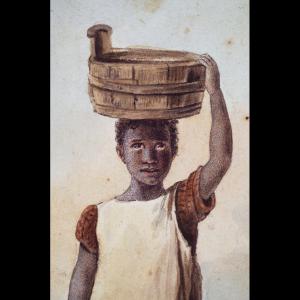
Enslaved Girl 1830 Origin: America, Virginia, Arlington County Primary Support: 6 x 4 1/8in. (15.2 x 10.5cm) Watercolor, pencil, and ink on wove paper Museum Purchase Acc. No. 2007-34,1

Enslaved Girl, 1830
America, Virginia, Arlington County
Watercolor, pencil, and ink on wove paper
Museum Purchase Acc. No. 2007-34,1

So, 1813: a cedar tub. But was it for laundry? I found well buckets and house buckets, ‘poudering’ tubs and pounding barrels, barrels for meat and rum and ‘flower,’ cedar tubs and a ‘tub for Cora,’ but no tub specifically described as a laundry, washing or dish tub.

Searching local library and special collections databases using the appropriate Library of Congress subject terms proved fruitless as well, though eventually I ended up at Williamsburg, where I found an 1830 watercolor drawing of an enslaved girl with a tub on her head. (They call it a tub; you and I might call it a piggin.) This at least confirmed the persistence of the tub style seen in the 1785 British Encampment drawing. I suppose that’s something.

Domestic Engineering and the Journal of Mechanical Contracting, Vol. LX No. 6, page 160. 1912

But still, questions persisted: first, what wood would be right, and secondly, what size should the tub be? There was the thought that pine might not be right, since reputable coopers are making tubs from oak and cedar. Finally did what most of us do when frustrated now: I did a very simple Google search and ended up at Google Books with Domestic Engineering and the Journal of Mechanical Contracting, Volume 60. 

This journal helpfully informed me that Wooden tubs are made out of 1- 1/4 inch white pine grained or dovetailed together at the ends and held together by means of iron rods and went on to explain that Great latitude was generally allowed in the making of wooden tubs as they were usually made on the premises by the carpenter who had no standards to follow. No standards! Doesn’t that explain a lot.

Fully loaded for Saratoga

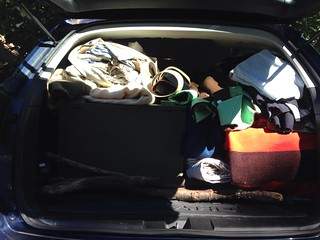
Do I have any clearer direction? Well, clear as mud, maybe. It appears that one could have a tub of unspecified wood, hooped with wood or metal, in which one could do laundry. Or one could follow Domestic Engineering, and consider the current pine tub acceptable, if perhaps in need of mending. (I have not seen it, so I do not know.) I suppose the question is really whether or not all of this business will fit into the supply wagon known as our Subaru.

Share this:

  • Share on Facebook (Opens in new window) Facebook
  • Share on Pinterest (Opens in new window) Pinterest
  • Email a link to a friend (Opens in new window) Email
  • Share on X (Opens in new window) X
Like Loading...
← Older posts
Newer posts →

Archives

wordpress statistics

Creative Commons License
Kitty Calash blog by Kirsten Hammerstrom is licensed under a Creative Commons Attribution-NonCommercial-ShareAlike 4.0 International License.

Website Built with WordPress.com.

  • Subscribe Subscribed
    • Kitty Calash
    • Join 621 other subscribers
    • Already have a WordPress.com account? Log in now.
    • Kitty Calash
    • Subscribe Subscribed
    • Sign up
    • Log in
    • Report this content
    • View site in Reader
    • Manage subscriptions
    • Collapse this bar
 

Loading Comments...
 

    %d