• Home
  • Completed Costumes/Impressions
  • Emma and Her Dresses
  • Free Patterns and Instructions

Kitty Calash

~ Confessions of a Known Bonnet-Wearer

Kitty Calash

Tag Archives: menswear

(Not) Spencer Closure

14 Thursday Nov 2013

Posted by kittycalash in Clothing, Making Things, Research

≈ 2 Comments

Tags

18th century clothes, authenticity, Costume, fashion, LACMA, menswear, Metropolitan Museum of Art, museum collections, Research, sewing

Jacob Issacs by Ralph Earl, 1788. Dayton Art Institute

No, I still haven’t written to the museum in Sweden– I had fabric shopping to do. Well, not had to, but when someone offers to take you to a new den of iniquity crack house fabric store you haven’t seen before, you go.

Reader, I scored. Mr S will have a new fabulous and toasty waistcoat thanks to a 5/8 of a yard remnant of the coziest Italian double faced wool I have ever petted. It should be a kitten! Mr Isaacs here has a lovely black waistcoat and while I cannot achieve that fabulousness without a new pattern (sigh) and I think that waistcoat is silk, you get the general green-and-black idea. Mr S totally has that hat.

Coat, French, 1790s. MMA 1999.105.2

But in thinking about the Spencer issue (and yes, I scored some on-sale broadcloth so I can make another one on the way to cutting into that K&P wool), I asked Mr Cooke about clasps, since the Spencers I’m interested in are so very clearly grounded in menswear generally, and uniforms particularly. The answer was what I’d expected: buttons and buttonholes or braid loops on dragoons’ and hussars’ coats, hooks and eyes sandwiched between shell and lining on center-front closing uniform coats.

So I went back to look at menswear, because somewhere the phrase “miniature frock coat” rattled in my head, and I knew I wanted to re-draft the pattern for the front anyway, to get closer to the high stand and fall collar of the Swedish original.

The other collection that’s extremely useful is the LACMA collection, because they have patterns up on their website.

Man's Banyan Textile: China; robe: the Netherlands, Textile: 1700–50; robe: 1750–60 (M.2007.211.797)

Man’s Banyan
Textile: 1700–50; robe: 1750–60 (M.2007.211.797)

I’ve already started to crib a new two-part sleeve pattern from a frock coat pattern, so now I think the next step to getting the look I want is to crib from the LACMA banyan pattern. It’s earlier than the Spencer by some 30 years or more, but the neckline looks like a better place to start.

And, bonus, along the way I’ll learn more about menswear to the ultimate benefit of those guys I sew for.

Share this:

  • Share on Facebook (Opens in new window) Facebook
  • Share on Pinterest (Opens in new window) Pinterest
  • Email a link to a friend (Opens in new window) Email
  • Share on X (Opens in new window) X
Like Loading...

Documenting Mr S

16 Friday Aug 2013

Posted by kittycalash in Clothing, Events, Research

≈ 7 Comments

Tags

18th century, 18th century clothes, authenticity, Clothing, common dress, common people, Costume, Events, fashion, living history, menswear, Reenacting, Research, sewing

The guys are usually easy: they wear what the sergeant tells ’em to wear, and they like it, because that’s what soldiers do.

Mr S in Cambridge

Sergeant’s not a sergeant in quite the same way in 1774-1775: he’s a militia sergeant, and while we can still get up to tricks that get us yelled at, the clothing we wear is more personal. Mr S’s clothes seemed, at first, to be completely undocumentable.

Really? Yes, I have been known to have some anxiety issues over small matters. So I calmed down, re-read the standards, and looked again.

The shirt is checked linen, see here for details. The stockings, which will be replaced by hand-knit blue stockings, are also documented to Rhode Island.  But wait! That’s 1777, can it count for 1775? How long do stockings last, anyway?

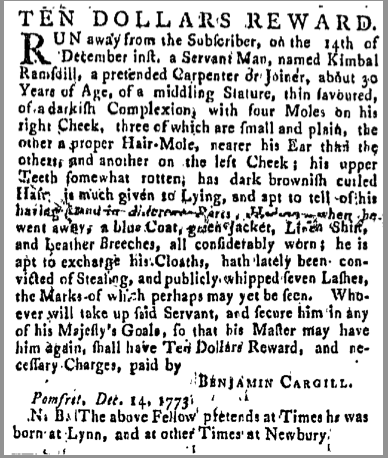
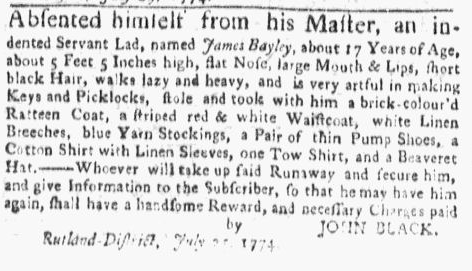
I’ll own up to having been described as “literal and precise,” and I’m taking that comment to heart. Reader: literal is where one gets into trouble when one is precise. Literal interpretations can lead you, almost hubristically, into creating replicas of runaway ads  or extant garments that don’t reflect who you are, or what time you are portraying, not really.

bluestockings_whitebreeches

Boston Post Boy, 7/25/1774

But not to worry, I dug up the blue stockings. This is from the Boston Post Boy, July 25, 1774. “White Linen Breeches, blue yarn stockings.” This is not too bad: Mr S has got his basic extremities covered now. It’s hard not to be distracted by the Cotton Shirt with Linen Sleeves, which reminds me of women’s shifts with finer sleeves, or sleeves to pin on.

browncamblet Waistcoat 7-4-1772 providence

Providence Gazette, 7/4/1772.

Keeping focused, let’s get Mr S more fully dressed, more proper, and warmer, since this is late August. You can’t see his waistcoat under the green jacket, but here you can. I know this broadcloth fabric, and its color, are from the acceptable palette for the last quarter of the 18th century, but can I find one in Providence or Massachusetts? Just about. The waistcoat described in this ad is camblet. There’s no goat or camel in Mr S’s camel-colored waistcoat, but I think we’ll call it found and be grateful that Mr S has not taken any action despite the numerous photos I have posted of him in various “poofy shirts” and “funny outfits,” as some of my friends describe them.

What’s left? There’s John Appleton’s ad in the Essex Gazette of May 17, 1774 for “blue, green and cloth colored bandannoes,” which pretty much takes care of the neck cloth; we’ve a brownish one, and a blue one; the Young Mr likes the orangey one, but I think we have those documented.

1774_greenJacket

Essex Gazette, 12/6/1774

1774_Prov_greenJacket

Providence Gazette, 1/29/1774

The green jacket, that’s what’s left. In the Essex Gazette of December 6, 1774, we find a “green jacket, light breeches, and yard Stockings,” much like what Mr S is wearing.  Nice! Multiple sources of documentation for items are always welcome chez Calash.

And, knowing that, you will not be surprised that I have found another jacket, closer to home. In the Providence Gazette of January 29, 1774, the man with the “proper hair mole” runs away in a green jacket. He’s also got leather breeches, and they’re on my wish list, though other things must come first, given their expense–things like tires, and allergy drops for the Young Mr.

Share this:

  • Share on Facebook (Opens in new window) Facebook
  • Share on Pinterest (Opens in new window) Pinterest
  • Email a link to a friend (Opens in new window) Email
  • Share on X (Opens in new window) X
Like Loading...

Hunting Frocks, Again

11 Sunday Aug 2013

Posted by kittycalash in Clothing, Living History, Reenacting, Research

≈ Comments Off on Hunting Frocks, Again

Tags

10th Massachusetts, 18th century clothes, 2nd Rhode Island, common soldier, history, hunting frock, Making Things, menswear, Research, resources, Revolutionary War, uniforms

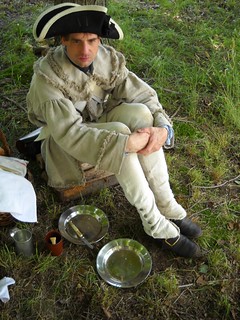
They’re not Mr S’s favorite thing, and I can understand why. Hunting frocks lack pizzazz, buttons, tape, lace, lapels, skirts and all the things that make him so fond of the Ugly Dog Coat worn by the 10th Massachusetts in 1782. (I think these are the coats captured from British supply ships and dyed at Newburgh and West Point in tanner’s vats.) But what he has right now is a hunting frock.

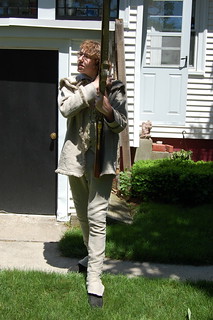
Here’s the kid in his new hunting frock, and a hand colored copper engraving by Johann Martin Will from 1776.

You gotta hold your tongue just right when you drill.

Americaner Soldat, Johann Martin Will. Ann S. K. Brown Collection, Brown University.

Americaner Soldat, Johann Martin Will. Ann S. K. Brown Collection, Brown University.

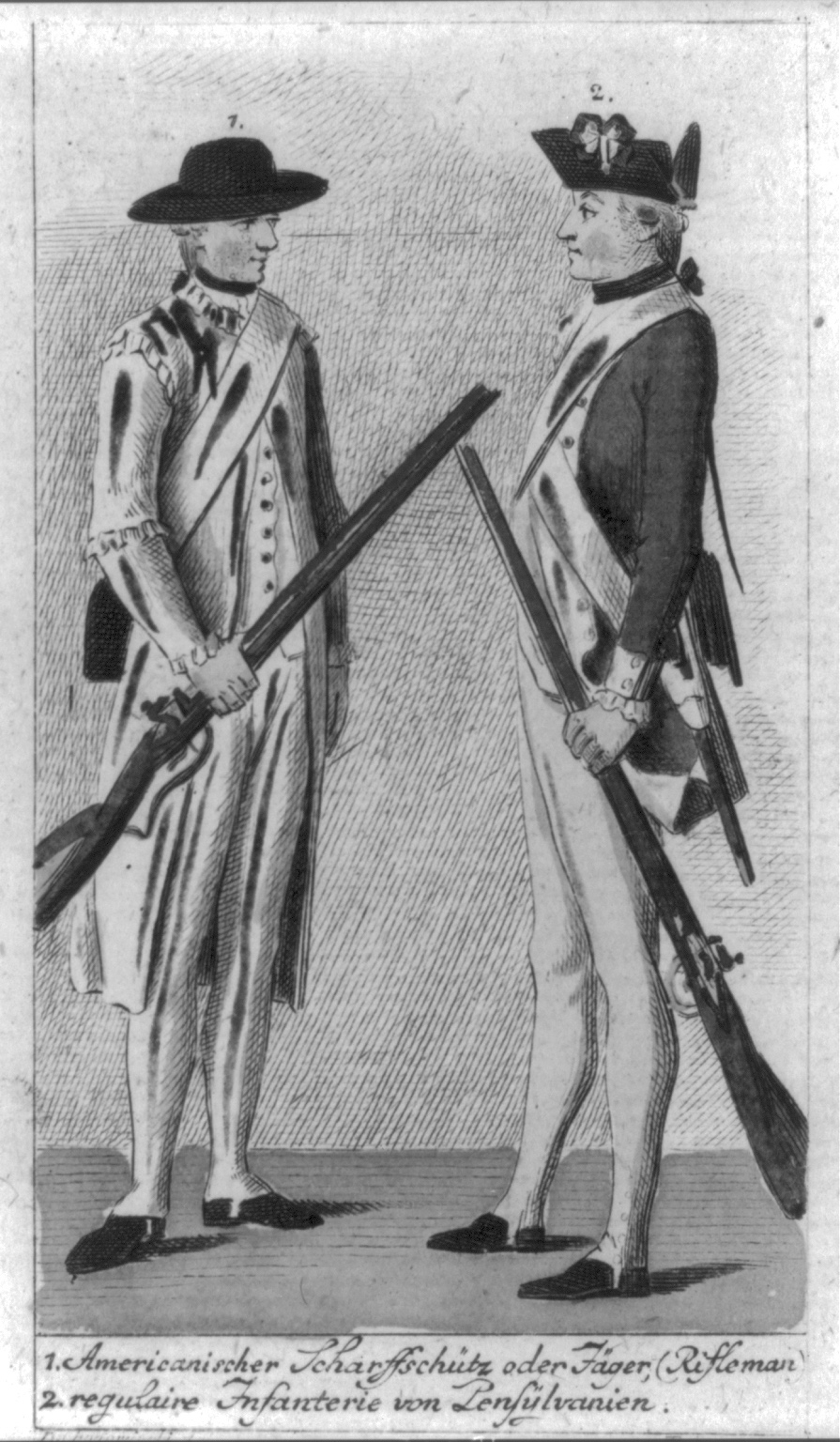
And then there are the colored and plain engravings, “1. Americanischer scharffschütz oder Jäger (rifleman) 2. regulaire infanterie von Pensylvanien,” engraved by Berger after Chodowiecki.

 Library of Congress

Library of Congress

Berger after Chodowiecki, Ann S. K. Brown Military Collection, Brown University

Ann S. K. Brown Collection

I started thinking about these again because not only am I reading Hurst’s thesis, but I’m fresh from helping the guys get dressed and arrange their capes and straps. I have been doing that as long as Mr S has been wearing historic clothing.

Early days of draping

Early days of draping


Drapey capes

The hunting frock drifts if it does not have some kind of fastening at the neck. The two halves migrate in opposite directions, and while belts help, the light infantry bayonet shoulder belt does not contain the hunting frock as well as one might like. So the thing to do, I think, is to attach a loop and button at the neck to hold the garment in place. From the period engravings, I think that’s acceptable. The garments all look as if they are closed at the neck. From the evidence in the field, and from the images, I plan to make loops and attach buttons, and hope that will limit some tendency to wander.

The image of the two soldiers together suggests another wrinkle in the hunting frock quandary, since the left hand soldier’s out garment looks like a long pocket-less coat with applied fringe and only a very small cape at the neck. Thank goodness that soldier is a rifleman, and thus outside the realm of immediate relevance. (And on a side note, I know a gentleman who very much resembles the Pennsylvania infantry man: identical calves, and even a similar face.)

Share this:

  • Share on Facebook (Opens in new window) Facebook
  • Share on Pinterest (Opens in new window) Pinterest
  • Email a link to a friend (Opens in new window) Email
  • Share on X (Opens in new window) X
Like Loading...

Authenticity: Sources II, or, Stripes!

10 Saturday Aug 2013

Posted by kittycalash in Clothing, History, Living History, Reenacting, Research

≈ 7 Comments

Tags

18th century clothes, 2nd Rhode Island, authenticity, Clothing, common dress, common soldier, Costume, fashion, menswear, Museums, Revolutionary War, Rhode Island, uniforms

In any decade, I love stripes.

Stripes. I love them, really, I do. Gowns, petticoats, cats. Why do I want to use them so much?

For the guys, because I can document what they’re wearing, at least based on their current state of residence and their current nominal “home” unit with the BAR.

Here’s why:

1777 Oct 22
An inventory of Searjeant George Babcock’s
Wearing Apparil who was Killed at fort Mercer
Octor 22d 1777 Belonging to Capt Thos Arnold’s Comp’y in Colo Green’s Regemt

Two Check Linen Shirts
one Pair of Striped Linen overalls
one Striped Cotton & linen Jacket without Sleeves
one flannel Jacket without Sleeves
one home spun Woolen Jacket without sleeves
one Linen & Worsted cotee
one Kersey outside Jacket Lined with flannel
one beaver Hat & one Pair of shoes
one Pair of blue worsted stockings
one pair of thread ditto
one pair of blue yarn Stockings
one Linnen Handkerchief
one knapsack

(Clothing inventory, Capt Thos. Arnold, Col. Christopher Greene, Rhode Island Regiment
RIHS MSS 673 SG 2, S1, SSA Box 1 Folder 13)

From RIHS MSS 72, Preserved Pearce papers,  Tailor's and Tavern account books, 1778-1781.

From RIHS MSS 72, Preserved Pearce papers, Tailor’s and Tavern account books, 1778-1781.

This inventory has formed the basis for many of the clothing choices I’ve made for Mr S and the Young Mr from their check linen shirts to their blue stockings. I was criticized for the size of the checks of their linen shirts (too small! I heard), but feel vindicated time and again by the extant garments I’ve found (aprons, mostly) in this period. The checks are small.

The best piece of evidence I found was serendipitous: whilst going through tailor’s books Thursday, looking for stays, I found a scrap of blue and white checked linen used as a binding. The biggest lesson from that scrap is that I need a deeper, more indigo-rich blue and white to begin with.

The “Striped Linen overalls” in the inventory are definitely on the list of things I’d love to make, along with the “Striped Cotton & linen Jacket without Sleeves.”

One of my favorite garments of all time. Boy's frock, ca. 1760-1770. RIHS 1959.6.1

One of my favorite garments of all time. Boy’s frock, ca. 1760-1770. RIHS 1959.6.1

There are extant Rhode Island garments from made of blue striped linen, documented to the period we interpret, and another one, recently acquired (coming soon to a database near you!) from which a pattern has been taken.

After a while, though, blue stockings and checked linen shirts seem…ordinary. Common. You might start to wonder if they’re just another re-enactorism, they’re so ubiquitous.

It’s worth checking again to see that these are, in fact, common garments, probably as prevalent then as they are now.

Share this:

  • Share on Facebook (Opens in new window) Facebook
  • Share on Pinterest (Opens in new window) Pinterest
  • Email a link to a friend (Opens in new window) Email
  • Share on X (Opens in new window) X
Like Loading...

Sewing for Zombies

13 Saturday Jul 2013

Posted by kittycalash in Clothing, Events, Making Things, Museums

≈ 4 Comments

Tags

18th century clothes, common dress, fashion, menswear, museum collections, Reenacting, Revolutionary War

Death by Fitting

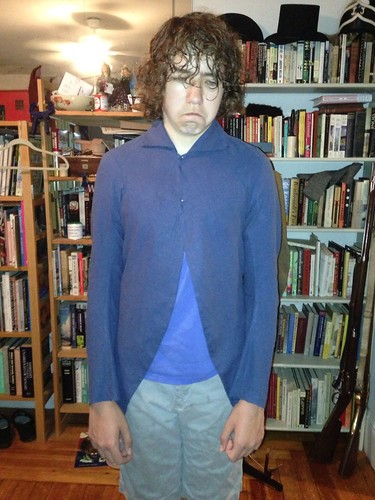
He doesn’t always look this horrible, but when the Young Mr sets out to look like death, he does it very well. Dressing 18th Century style comes at the price of fittings, and while we like to cut a fine enough figure at an event, we want no part whatsoever of the process. Even the promise of playing with a dog won’t get us to a fitting. And he dearly wants a dog…so you know fittings are a trial.

Cutting Out on Sunday

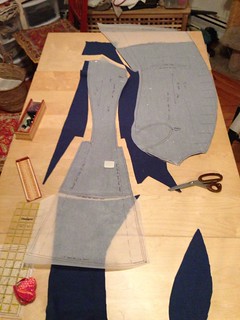
The pattern is by Henry Cooke, based on both a Rhode Island original in a private collection and a jacket in the collection of the Connecticut Historical Society. It is solidly 1770s-1780s, unlined, and both originals made up in brown linen. (From the pattern notes and what I know of the CHS jacket, accession number 1981.110.0; their catalog links are unstable, search for 1981.110.0.)

It goes together well; I started without directions, but as I am more idiot than savant, I got myself confused. I did have to alter the sleeve for the Young Mr, as he has long, thin arms. The rest of the pattern seemed to fit him pretty well, all in all, but a few untoward things happened between measuring, mock-up, basting and fitting. Still, it can be worn, with improvements made next week after he wears it in Cambridge this Sunday. 

Share this:

  • Share on Facebook (Opens in new window) Facebook
  • Share on Pinterest (Opens in new window) Pinterest
  • Email a link to a friend (Opens in new window) Email
  • Share on X (Opens in new window) X
Like Loading...
← Older posts
Newer posts →

Archives

wordpress statistics

Creative Commons License
Kitty Calash blog by Kirsten Hammerstrom is licensed under a Creative Commons Attribution-NonCommercial-ShareAlike 4.0 International License.

Website Built with WordPress.com.

  • Subscribe Subscribed
    • Kitty Calash
    • Join 621 other subscribers
    • Already have a WordPress.com account? Log in now.
    • Kitty Calash
    • Subscribe Subscribed
    • Sign up
    • Log in
    • Report this content
    • View site in Reader
    • Manage subscriptions
    • Collapse this bar
 

Loading Comments...
 

    %d