• Home
  • Completed Costumes/Impressions
  • Emma and Her Dresses
  • Free Patterns and Instructions

Kitty Calash

~ Confessions of a Known Bonnet-Wearer

Kitty Calash

Tag Archives: millinery

Making Plans….

26 Monday Aug 2019

Posted by kittycalash in Living History, Making Things, material culture, Museums, personal, Reenacting

≈ 1 Comment

Tags

historic house museums, kickstarter, living history, milliner, millinery, millinery shop, Van Cortlandt House Museum

I have set my sights on being at Van Cortlandt House Museum’s Second Annual History and Culture Fair on Saturday, September 21. This is a bit of a stretch: It’s farther than Philadelphia, where I’m scheduled to be the following weekend at the Museum of the American Revolution– and I want tweak that impression and its material culture a bit, too. Still: setting up a ca. 1777-1780 milliner and mantua maker or merchant display has been on my to-do wish list for years, and I’m pretty sure I can pull this off as long as I modify/upgrade items already in my closet.

There are enough images to provide good inspiration and ways to start accessorizing.

Several prints  from the British Museum provide guidance.

It’s clear– as I knew already– that my accessory game requires major upping. But this is solvable! It’s not ideal, being in a situation where I can’t buy new fabric, and I don’t have the time to make up the fabric I do already have in the garment styles I need. This is no time to start a new patterning project!

So this means making accessories to upgrade a gown and petticoat already on hand and known to fit (though they should be fit-tested once again before committing!).

Which dress? Why, Nancy Dawson, of course. She’s the brightest and most stylish gown I have. Thankfully, I have upgraded my cap collection, and could even– probably– manage a new cap in the time allotted.

So what do I need? A well-decorated, possibly floofier cap, a LBB (™) of the kind worn in “The Rival Milleners”, a breast knot or bow, a new fine silk or cotton apron, and some kind of sleeve treatment.

The maid in the back of “A Morning Visit,” carrying in the tea tray, demonstrates the more understated upgrades I think I will be able to manage in the time I have. In a year, a trimmed silk gown can happen. In a month, it cannot.

The main upgrade I’d like to make is to add a red silk quilted petticoat, since they appear in so many prints with cotton print gowns, including a print of Nancy Dawson herself.

Miss Nancy Dawson, aquatint print. Victoria and Albert Museum. E.4968-1968

I almost assuredly have red silk in my stash: the question is, can I find it, back it, and quilt it in time? Probably not. So there are choices to be made, like the sensible one of simply upgrading sleeve finish and apron and adding bow knots.

Those are just the upgrades I hope to make to my personal kit! I need a dome top trunk (underway; I need the one I have for Elizabeth Weed), and there are inventory items to make that have been on the list for a while.

All of this has to get done while I’m splitting my 55-60 hour weeks between commissions and a retail gig (which I am trying to streamline!).

Once again, I start down the path of madness. Won’t you join me? I think it’ll be a blast!

Share this:

  • Click to share on Facebook (Opens in new window) Facebook
  • Click to share on Pinterest (Opens in new window) Pinterest
  • Click to email a link to a friend (Opens in new window) Email
  • Click to share on X (Opens in new window) X
Like Loading...

A Little Black Bonnet

02 Tuesday Jul 2019

Posted by kittycalash in Clothing, Living History, Making Things

≈ 1 Comment

Tags

18th century, 18th century clothing, authenticity, bonnet, common dress, helmets, milliner, millinery


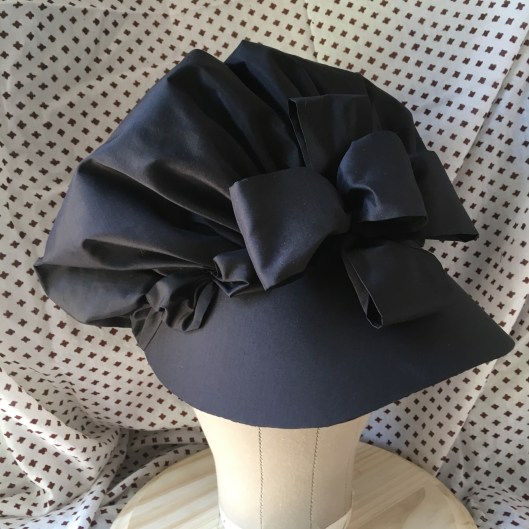
Practically everyone needs one, and like the Little Black Dress, the little black bonnet flatters practically everyone, too. In finishing up some inventory projects, I went back to basics and made up a black silk taffeta bonnet with trimming inspired by “The Rival Milleners.”

The Rival Milleners.

Really, it’s a look that’s hard to resist, the black bonnet with poufs and bows. I’ve always loved my black bonnets, but now I might need to trim another one up for myself– if I can only make the time. Up on Etsy if you want one for yourself (along with some other colors, too).

Share this:

  • Click to share on Facebook (Opens in new window) Facebook
  • Click to share on Pinterest (Opens in new window) Pinterest
  • Click to email a link to a friend (Opens in new window) Email
  • Click to share on X (Opens in new window) X
Like Loading...

A Bonnet, Universally Acknowledged

11 Monday Feb 2019

Posted by kittycalash in Clothing, History, Living History, material culture, Reenacting, Research

≈ 2 Comments

Tags

1770s, 18th century clothes, American Revolution, authenticity, bonnets, Boston, living history, millinery, Research

Print made by James Caldwall, 1739–1819, British, A Ladies Maid Purchasing a Leek, 1772, Yale Center for British Art, Paul Mellon Collection

“It is a truth universally acknowledged that if a bonnet existed in the 1770s, it was black taffeta” has long been the rule reenactors have followed, particularly those wanting to adhere to the strictest standards of well-researched impressions based on primary source documents and period material culture. Truth examined is more subtle, showing that bonnet colours, materials, and shapes varied from decade to decade—and year to year—and that these factors seem to have varied by region. What worked in Boston would not be comfortable in the Carolinas, and people adjusted accordingly.

I was asked recently about Boston-area bonnets in the first half of the 1770s. My impression of this decade is that it is one in which there is a stylistic change in women’s headwear, as the “sunshade”* and “Bath” bonnet terms fade from use, giving way to plain “bonnet” or “chip” bonnets. These appear to have been made from “bonnet paper,” seen in both blue and white** in newspaper ads, though prints and paintings show brims in both boned and paper forms.
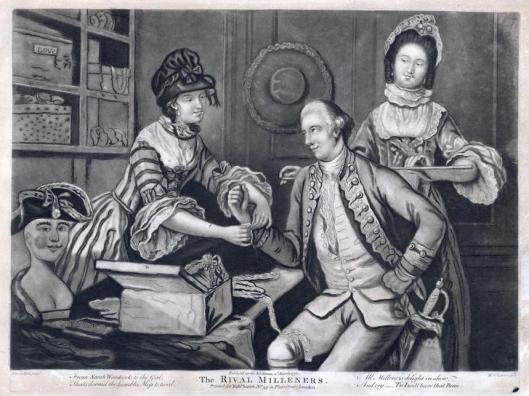
The Rival Milleners. Mezzotint after John Collet, 1772. Colonial Williamsburg Foundation, 1955-125

Brim shape and bonnet material— fabric and colour–  vary by period (and region). So let’s look at Boston in the first years of the 1770s. One tricky bit is that there are fewer indentured servants and enslaved people in Boston than elsewhere in the American Colonies in this period, so runaway ads are scarce, giving us fewer clues than we get in Pennsylvania and points south. Still, there are plenty of ads to help guide us.

As early as 1769, we see color variations, with the mention of “black, blue, green, white, and crimson bonnets” in Caleb Blanchard’s store. The year before, Joshua Gardner and Company advertised “black, pink, blue & crimson sattin hats and bonnets.” That means that on the streets of Boston and environs, by 1775, you’d see half-worn black, blue, green, white, crimson and pink satin bonnets.

The best statistics around for bonnets are currently tabulated for Pennsylvania, and definitely show the preponderance of bonnets are black (52 of 75 tabulated, or 69%). So don’t give up on black silk bonnets! They are the most common color. If we extrapolate these statistics, for a Pennsylvania event in the 1770s, of every 10 bonnets, seven should be black, one should be white, one should be green, and one should be blue. In larger groups, we’d also see red and brown bonnets, but again, just one in 20 or 30.

The Boston Gazette, April 4, 1774. Benjamin Franklin’s sister advertises “Sattins of the newest Fashion… for Bonnets.”

“A few sarsnet taffety bonnets,” in the Boston Evening Post, September 28, 1772.

For Massachusetts, statistics are more difficult to compile, given the dearth of runaway ads and the fact that I haven’t yet dived into inventory and probate records. Merchants’ ads give us some clues as to materials, and one thing I find is that “sattin” shows up, as well as “sarsnet taffety” or pelong. Sarsnet or sarcenet was a “think transparent silk of plain weave,” according to Textiles in America. Thicker than Persian, sarcenet was woven both plain and twill, and could be plain or changeable. Pelong is a kind of silk satin, again according to Textiles in America, and in The Dictionary of Fashion History, described as a kind of “thin silk satin,” but I have also seen it described as a ribbed silk. Joshua Blanchard advertised “Pelong sattins of all colours” in 1768. Where does that leave us with materials? Probably with the need for more bonnets to be made of silk satin than of silk taffeta, though the proportions are difficult to calculate yet.

Miss Theophila Palmer (1757-1848), oil on canvas, attributed to Sir Joshua Reynolds ca 1770.

What about shape? For those dressing a la mode, we are past the deep-brimmed, small-cauled “lampshade” of the 1760s, and into a smaller, tighter bonnet with a larger caul and more trimming. In the portrait of Miss Palmer, we see how the brim stands away from the face, and the caul or crown poufs up. “A Lady’s Maid Purchasing a Leek” and “The Rival Milleners” (aee above) both depict women in similarly tight-brimmed and round-crowned bonnets trimmed with bows. These are shapes that I am confident appeared almost universally (with variations) in the American colonies in the first years of the 1770s. Now, there are different shapes to be sure, but these seem to predominate. I do think we need to see more brims that wrap around the head, as seen in the 1774 mezzotint of George Whitefield (Anglo-America’s most popular preacher) and his followers.
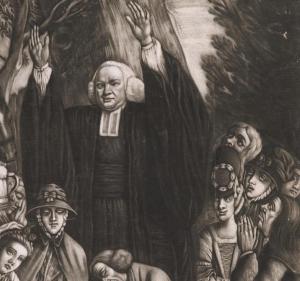
Detail, A Call to the Converted. Publish’d April 15, 1774, by W. Humphry . Lewis Walpole Library, 774.04.15.01+

So what’s the take away, if we are looking specifically at Boston and environs in the first half of the 1770s?

  1. Most bonnets (70%) were black, but a few white, green, crimson, and blue were seen.
  2. Most bonnets were made of silk satin, with others of taffeta or sarsnet (sometimes twilled silk).
  3. Most bonnets would have a shorter, higher brim that curves across the face just above eye level, with a high, rounded crown/caul and bow trims.
  4. Bonnet brims would vary between bonnet (paste) board and boned

Each place has a local style– which, if you think about it, is still true today. When I stand on the Metro platform in the red wool coat I bought in Providence, these folks know I’m not from here. The way we dress for the past should reflect the place and the time we are representing as best we can. And that means we need accessories to match those times and places, as well as clothes.

And yes, full disclosure, I sell researched bonnets on Etsy. If you want a bonnet for a particular time and place, that’s what I make.

* Known on this blog as “lampshade”
** Nope, don’t know what that means yet, haven’t looked into it

Share this:

  • Click to share on Facebook (Opens in new window) Facebook
  • Click to share on Pinterest (Opens in new window) Pinterest
  • Click to email a link to a friend (Opens in new window) Email
  • Click to share on X (Opens in new window) X
Like Loading...

The Colour of Things to Come

28 Monday Jan 2019

Posted by kittycalash in Clothing, History, Living History, material culture, Reenacting, Research

≈ 5 Comments

Tags

18th century clothing, bonnets, Costume, fashion, French and Indian War, millinery, Research, Revolutionary War

I have a thing for hats– well, for bonnets, really. I know I made stays and a shift before I made anything else for the 18th century, but I might have made a bonnet before I made a proper gown. It’s a condition I inherited from my grandmother, and a great aunt who was a milliner, so there’s little to be done about it– except to dive in deeper.

Miss Theophila Palmer (1757-1848), oil on canvas, attributed to Sir Joshua Reynolds ca 1770. Pretty sure that’s a white “whalebone” or “skeleton” bonnet.

As people do more research and generously share it with me, I’ve come to realize that I need to synthesize what we are seeing. It’s a tricky thing, what with that single (known) extant bonnet at Colonial Williamsburg and only prints and images to go on. What I’ve done to compile a stack of references from newspaper ads (primarily Mid-Atlantic and New England colonies at the moment) and interfiled them with images. This has given me a much better sense of  the change in shapes and construction over time, as well as the range of colours– yes, colours, available and popular.

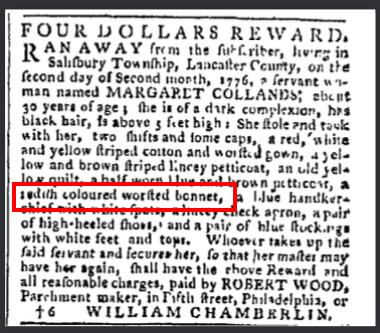
It’s not just that wool bonnets are a thing– there’s the ““a reddish coloured worsted bonnet” in the April 8, 1776 Pennsylvania Packet an ad for runaway Margaret Collands, and the “black durant” recommended in Instructions for Cutting Out Apparel for the Poor– but close reading shows that the colors are more varied than we’ve accept lately, but they vary by region and time period.

The Misses Waldegrave. Are blue bonnets *only* for children? Maybe.

There’s been a rule that “all bonnets are black silk,” which is too broad a statement. Most bonnets are black, that’s true. But in 1768, in Boston, a place where folks would have you think that black is the only colour bonnet you can ever have, you can have “Black, pink, blue and crimson sattin hatts and bonnets” (Joshua Gardner and Com. ad, Boston News-Letter, November 24, 1768).

Heck, if you shopped at Caleb Blanchard, you could have a green bonnet, too! Blanchard advertised “black, blue, green, white and crimson Sattin bonnets” in the Boston Gazette on December 18, 1769.

screen shot 2019-01-26 at 6.56.33 am
screen shot 2019-01-26 at 6.56.22 am
What does this mean? My SWAG is that roughly 60-70% of bonnets should be black. After that, blue, white, red and green would make up the balance. In Philadelphia, green bonnets– and green flowered bonnets– last longer in the ads. Philadelphia is also where I see more white bonnets, a brown silk bonnet, a diaper bonnet, a “queen’s grey” bonnet, and, in Trenton, a “lye coloured” bonnet. In Rhode Island, there’s a blue stuff bonnet. So yes, bonnets should mostly be black. But they can also be other colours.

Share this:

  • Click to share on Facebook (Opens in new window) Facebook
  • Click to share on Pinterest (Opens in new window) Pinterest
  • Click to email a link to a friend (Opens in new window) Email
  • Click to share on X (Opens in new window) X
Like Loading...

Hoods and Caps and Bonnets, oh my!

07 Monday Jan 2019

Posted by kittycalash in Living History, Making Things, material culture, Research

≈ 1 Comment

Tags

18th century clothing, common dress, Etsy, hoods, millinery, winter

Griselda Countess Stanhope. Mezzotint engraving by James McArdell after Allen Ramsay. British Museum, ca 1760

Let’s take a closer look at Griselda, Countess Stanhope. She wears a hood over a fine white cap, as well as a hooded cloak. Around her neck, she wears a fur tippet, and her hands are snuggled into a muff. While most of the “common” women in the colonies wouldn’t rise to the Countess’s ermine tippet, they did have hoods.

Thomas Howe Ridgate’s inventory taken 19 June 1790 in Charles County Maryland includes “3 velvet and silk hoods,” while Mrs. Elizabeth Lawson’s inventory, taken 3 May 1766 in Prince Georges County Maryland includes one velvet hood and one “Allamod” hood. (She also has “1 old Striped Bonnet,” as well as 2 Womens New Capes, and 1 Womans Life everlasting Petticoat, which bears further investigation.)

Hoods appear fairly regularly in prints, worn over caps (as in Countess Stanhope), under hats, and even under bonnets, as in this print from the Victoria & Albert Museum.

January, engraving, ca. 1780. E.3520-1953. Victoria & Albert Museum

img_6676
img_6678

The mantelet hood worn over the bonnet, hood, and cap layers.

In the images above, I’m wearing a white cap, black silk hood, and black “stuff” bonnet, with a black silk mantlet over a silk neck-handkerchief. The hood needs some tweaking, size-wise, but the layers definitely recreate what we see in the print of “January.” The bonnet has an adjustable caul, so will easily fit over hair, cap, and hood; the hood has a drawstring closure at the neck that helps keep out the wind. Taken altogether, these layers are definitely insulating! Looking like an 18th century engraving is almost a bonus– but when you wear what they wore, you look like they did.

Share this:

  • Click to share on Facebook (Opens in new window) Facebook
  • Click to share on Pinterest (Opens in new window) Pinterest
  • Click to email a link to a friend (Opens in new window) Email
  • Click to share on X (Opens in new window) X
Like Loading...
← Older posts
Newer posts →

Archives

wordpress statistics

Creative Commons License
Kitty Calash blog by Kirsten Hammerstrom is licensed under a Creative Commons Attribution-NonCommercial-ShareAlike 4.0 International License.

Website Built with WordPress.com.

  • Subscribe Subscribed
    • Kitty Calash
    • Join 621 other subscribers
    • Already have a WordPress.com account? Log in now.
    • Kitty Calash
    • Subscribe Subscribed
    • Sign up
    • Log in
    • Report this content
    • View site in Reader
    • Manage subscriptions
    • Collapse this bar
 

Loading Comments...
 

    %d