• Home
  • Completed Costumes/Impressions
  • Emma and Her Dresses
  • Free Patterns and Instructions

Kitty Calash

~ Confessions of a Known Bonnet-Wearer

Kitty Calash

Tag Archives: Research

Auction Season: The Holiday Sales

07 Friday Dec 2018

Posted by kittycalash in material culture, Research

≈ Comments Off on Auction Season: The Holiday Sales

Tags

auctions, material culture, Research, sales, toys

Screen Shot 2018-12-05 at 6.34.13 AM

Lot 1159 Antique Gold, Carbuncle Garnet, and Diamond Bracelet. Yes, those are rose-cut diamond flies.

First come the jewelry sales, the big guns like Sotheby’s leading the way with sales as crazy as Marie Antoinette’s jewelry (Royal Jewels from the Bourbon Family of Parma, technically, though it sounds more like a delicious lunch than a sale), but the smaller houses play, too. Skinner’s sale closed December 5, Freeman’s earlier, but later than Sotheby’s. These are not sales I bid in, but they are places to see things you’d might not otherwise see. Garnet bracelets with rose-cut diamond flies? Not something I see gracing the wrists of my fellow Metro riders or grocery shoppers.

Screen Shot 2018-12-05 at 6.41.39 AM

Lot 7, Contemporary painted tin hat trade sign, 20th Century. 7″ x 13.25″

Once the serious stuff has sold, the fun begins: the toys! Pook and Pook’s two-day toy sale begins December 7th, and you might call it whimsies and toys, since it begins with shop signs. Who doesn’t want an enormous tin hat? What’s the point, you ask? Why look, if you don’t collect? Because you can collect– information, screen caps of reference images, ideas for things to make, and a visual reference library to fill in the blanks of what you read. The steam engine that breaks in The Railway Children seemed crazy to me as a child, and I assumed it was just a model of a steam locomotive. But no: there were steam toys and accessories, from lighthouses in moats with Indians in sailboats to working looms to….steam locomotives.

Screen Shot 2018-12-05 at 6.52.23 AM

Day Two, Lot 521, Large Bassett Lowke live steam train locomotive and tender, 3 1/2″ gauge, engine – 13 1/2″ l.

The darling thing even looks like Percy, filling in the gaps of the origins of Thomas the Tank Engine, Edwardian children’s stories, and the wonders of the steam age (which you can replicate, if you choose). Hard to believe, in our age of safety, that steam engines might be de rigueur in the parlors of well-to-do Victorian and Edwardian families. (Perhaps your childhood was not as full of E. Nesbitt, Kenneth Grahame, and Arthur Ransome as mine, but if your mother’s primary caregiver was born in late 19th-century Great Britain, you might grow up with an attachment disorder and a taste for fabulist literature of the early 20th century.)

Day One, Lot 230,
German dressmaker and milliners shop room box.

And then there are the dioramas or room boxes, many, if not most, German. These early 20th-century displays give us a sense of the kinds of craft or hobby activities people enjoyed, front-facing dioramas. I think you either “get” them, or you don’t; not everyone wants a miniature world to control or fantasize about, but from the perspective of someone trying to understand what the past looked like, these can provide a three-dimensional view of what are usually only black and white images. Are they perfectly correct? No. But they do give us a sense of the kind of visual stimulation people encountered and enjoyed shopping and playing.

Day One, Lot 220, Papier-mâché milliner’s model doll.

There are dolls, always divisive (they’re creepy or cute, few folks fall in between) and they have they own usefulness. None in this Pook sale tell us much about early toys, but there are a couple of early 19th century examples to remind us of what children played with in the past, and how new fashions were disseminated. In the case of the milliner’s model doll at left, we get a good sense of the Apollo’s knot hairstyle, and a pair of red slippers I would love to have. The back view is equally useful, for it is only with three-dimensional objects (dolls or sculpture) that we can get a complete sense of a hairstyle or costume. With enough looking, you can extrapolate, but there’s nothing like being able to see the past in the round. That’s even better than the telephone-book-thick catalogs from Sears and J.C. Penney that arrived before the holidays in decades past.

Share this:

  • Click to share on Facebook (Opens in new window) Facebook
  • Click to share on Pinterest (Opens in new window) Pinterest
  • Click to email a link to a friend (Opens in new window) Email
  • Click to share on X (Opens in new window) X
Like Loading...

Where You Come From

24 Sunday Dec 2017

Posted by kittycalash in History, personal

≈ 1 Comment

Tags

blurry photos, family, family portrait, personal, photography, Research

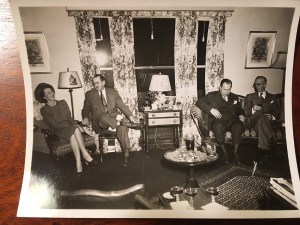
A selection from the box, mostly documenting the first two decades of my mother’s life

Mumblety-odd years ago, my first museum job was in a photograph and print collection, working as a photo researcher both finding and processing collections. There was a voyeuristic quality to the work, sometimes when going through a photographer’s more personal images, but especially when working on a family collection.

As I continued to work in the field, I started meeting with donors, and learned to talk them into giving their collections to the museum. It was easy enough to talk to them about making their memories tangible, creating and preserving a legacy of their lives so that others could understand the past and the contribution they, in particular, had made. How they typified an important part of a state or region’s history.

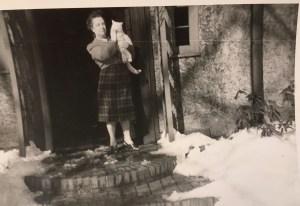
Susie the Cat makes many appearances

Sporadically, I organized my own photos and ask my mother for images of our family. I certainly took plenty of photos of my own son, but as time went on– and whether this is due to smartphones or trying to live in the moment, or not wanting to break the magical spell of an experience– I stopped taking pictures. I could still talk people into donations, and still enjoyed going through their family albums, but recording my own life didn’t make much sense to me, and I began to consider pitching images and letters and postcards, especially as I packed to move south. Keeping photographs for myself didn’t make sense.

Federal furniture: always central in my family

Sitting in bed on Friday night, Drunk Tailor and I looked through a box of snapshots my mother keeps in a fabric-covered box. He said, “Photographs are what you use to show people what you used to look like,” and to a degree that’s true. They are also proof that you had a life before this moment (think Blade Runner) and proof– perhaps– that you are who you think you are (think Blade Runner 2049). But even more like the Blade Runner movies, photographs of your past, or your family’s past, tell you where you come from, and where you might belong. Love them or leave them, you fit in somewhere in a larger story of people, and that shapes your identity, what you do, who you love, and how you live.

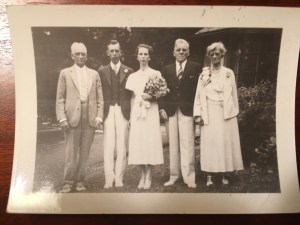
1936: My grandmother’s wedding.

As every year ends, I look back with some sadness at things I wish I had done differently, people I wish I had not hurt, people I wish I’d hugged more. The box of snapshots reminds me that I’m all too common, all too normal. Everyone has those pangs of nostalgia, the words they wish they’d said, the loss they feel as they lose the people they love.

Saint Lucia Day ca 1947

And that’s the point, I suppose: love one another. Be excellent to each other. Take the photos, label them (in pencil, on the back, listen to your archivist), and look at them when you can’t remember who you are, where you came from, or why you matter.

Share this:

  • Click to share on Facebook (Opens in new window) Facebook
  • Click to share on Pinterest (Opens in new window) Pinterest
  • Click to email a link to a friend (Opens in new window) Email
  • Click to share on X (Opens in new window) X
Like Loading...

Gathering Thoughts

25 Saturday Nov 2017

Posted by kittycalash in Clothing, Living History, Making Things, Research

≈ 1 Comment

Tags

apron, classes, Paul Sandby, Research, sewing, sewing project

Someone must watch the baggage.

You only live once, as they say, so you might as well enjoy yourself, and have a nice apron while you’re at it.

At last I have finished the one I made to serve as a demonstration model for the apron class I taught for Crossroads of the American Revolution. Plain, unbleached linen (osnaburg), it will be a good, serviceable garment well suited to getting dirty through use. There’s a lot to be said for filth, and my first-ever apron has acquired a fine patina of stains and wear.

Paul Sandby RA, 1731–1809, British, London Cries: A Girl with a Basket on Her Head ("Lights for the Cats, Liver for the Dogs"), ca. 1759, Watercolor, pen and brown ink, and graphite on medium, cream, slightly textured laid paper, Yale Center for British Art, Paul Mellon Collection
Paul Sandby RA, 1731–1809, British, London Cries: A Girl with a Basket on Her Head (“Lights for the Cats, Liver for the Dogs”), ca. 1759, Watercolor, pen and brown ink, and graphite on medium, cream, slightly textured laid paper, Yale Center for British Art, Paul Mellon Collection
Paul Sandby RA, 1731–1809, British, London Cries: "Do You Want any Spoons...", ca. 1759, Watercolor, pen and brown ink and graphite on medium, cream, slightly textured laid paper, Yale Center for British Art, Paul Mellon Collection
Paul Sandby RA, 1731–1809, British, London Cries: “Do You Want any Spoons…”, ca. 1759, Watercolor, pen and brown ink and graphite on medium, cream, slightly textured laid paper, Yale Center for British Art, Paul Mellon Collection

So why make a new one, aside from needing a teaching aid? Especially when you already HAVE a checked apron that’s looking used, and you have others in your wardrobe: why? One reason was the sheer cussedness of making the plainest, dullest, least-pretty item as finely and carefully as I could. Another was that the more I looked for apron data and examples, the more I noticed plain linen aprons. Yes: the preponderance of aprons are check, but looking at Sandby again made me realize that plain was documented, and under-represented in living history.

Sandby shows working women in checked and in blue aprons, but he also seems to depict women in plain, unbleached linen aprons, particularly the women in the street scenes. All the more reason to make up a plain apron, when your preference is portraying the urban underclass.

DSC_0811
DSC_0824

It’s also a good chance to hone one’s skills and keep in practice when you’re avoiding sewing the things that need sewing, like new shifts. And a basic project is meditative in a way that a new pattern is not: making stitches small and even is to sewing what scales are to piano playing or singing.

The first supervised apron I ever made is described here, and I’m pleased that my skills have improved since.

DSC_0825
DSC_0826

Stroke gathers are worth practicing, since they’re used on shifts and shirts as well as aprons; I’ve even used them on early 19th century garments to evenly distribute fine cotton lawn across the back of a gown. Sharon Burnston explains them here. I don’t know that there’s any one “trick” to them aside from patience and even stitches, but that “trick” will take you far in assembling pretty much every hand-made garment.

Share this:

  • Click to share on Facebook (Opens in new window) Facebook
  • Click to share on Pinterest (Opens in new window) Pinterest
  • Click to email a link to a friend (Opens in new window) Email
  • Click to share on X (Opens in new window) X
Like Loading...

We Have Data

26 Thursday Oct 2017

Posted by kittycalash in Living History, Making Things, Philosophy, Reenacting, Research

≈ 1 Comment

Tags

authenticity, interpretation, Reenacting, Research, survey

My assistant misunderstood the exercise, and is disappointed that we will not be turning the government over to him.

Data Cat says it’s clear: Cats Rule.

What is clear is that 501 people from around the world (really: people responded from the US, Canada, Australia, Europe, Great Britain) were interested enough to see what we could find out by asking questions about what, how, and why we make and wear these funny clothes. I’m immensely grateful that Google tools are easy to use, as I can present Graphs Without Tears:

Here’s how that breaks down:
Strongly disagree: 1.8%
Disagree: 0.6 %
Neutral: 3%
Agree: 30.9%
Strongly agree: 63.7%

That is, 94.6% of respondents agree that they try to make the most period-correct clothing they can. The “strongly disagree” folks (9 of them) are interesting to me, because it’s a position that’s foreign to me. (This is why recording your email was an option, so I could clarify the data.)

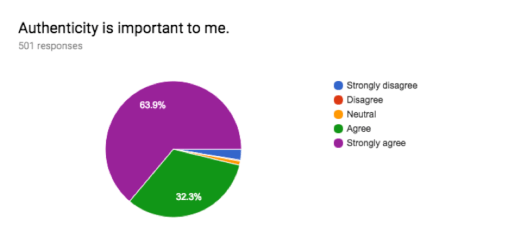
Next, let’s look at Authenticity:

Here’s how that breaks down:
Strongly disagree: 2.6%
Disagree:.2 %
Neutral:1%
Agree:32.3%
Strongly agree:63.9%

And on the use of Primary Sources:

Yes: 94.4%
No: 5.6 %

When I dug into what sources people use, and consider “primary sources,” I realized I have more questions to ask, and there are some folks who could use some research help. Not handed to them on a plate or in a slideshow, but in terms of process, and in recognizing primary versus secondary sources, and how they can be used together for maximum understanding.

Then I asked, Why is documentation important to you? 

Those responses will also inform another round of questions. Many were very revealing of thought processes and approaches; some made me a little sad. A couple of people said, essentially, I don’t want other reenactors to laugh at me.  I think we can do better than that, right? Let’s try empathy on for size, and be as helpful as we can in guiding people to an understanding of what they want to do, and how best to go about it.

Because the answers varied in length, I started reading them to discern the essence of the response, and I came up with five categories; the sixth slice represents the answers left blank.

Accuracy: 73.4%
Immersion: 11.6%
Learning: 6.1%
Respect (of ancestors, history): 4.0%
Personal (fun; satisfaction): 0.5%
No answer: 4.5%

Accuracy is the main reason documentation matters to people, and they gave good answers for why accuracy mattered.

I want to have the resource itself, rather than someone else’s interpretation of it. If everyone bases their impression off of somebody else, rather than going to the source first, it becomes a game of telephone.

It’s like medical documentation. If it’s not written down, it didn’t happen. There’s enough open source imagery and documents on the internet, let alone physical ones or surviving garments, that there really is no excuse for wild supposition.

Because everything else is unsubstantiated conjecture or hearsay and feels inauthentic to me and to those around me.

Because I use my impression to communicate about history, and history is grounded in factual, accurate information.

Documentation is the truth behind the fiction of a living history impression.

Immersion had interesting answers, too:

I want to accurately portray my impression for the public. As an added bonus, wearing the correct clothing and using period correct items, helps me connect with the people I portray on a personal level.

Because the point of living history (to me) is to recreate the past enough to learn from the visceral experience of *living* it, so it needs to be pretty accurate! Documentation is how I can know if what I’m doing is accurate (or close to accurate).

It tells us a lot about the larger picture of what was going on: trade, manufacturing, diplomacy, economics

Learning:
Because if we’re teaching people history, teaching them something that’s wrong is a disservice and an embarrassment on our part. We have the ability to learn what’s correct.

Researching and documenting my impression is why I am proud to put on my clothes. I enjoy the challenge and detective work that comes before I ever cut into any fabric.

Respect:
We owe it to our ancestors to tell their stories as accurately as possible.

For the class of person I represent, documentation can be very difficult to get at. Some documentation indicates that the garment(s) in question possibly existed, 3 pieces of documentation is ideal, but 2 will sometimes do, depending on my instincts about something. I have regretted only going for two in the past because my intention is generally to represent something very common. Documentation is important because it shows respect for the historical people I am trying to represent, it shows respect for my own work and time and it shows respect to the hobby (which, in historical circles, is often far more important than people give it credit for).

There’s a lot to think about in considering what you all think about, and I am really grateful for your help! As I look at the answers over the next days/weeks, I’ll let you know what else I see, and once I figure out how to ask the next round, there will be more questions! Thanks again! (And if you didn’t get to participate this time, no worries: you can join in next time; the easiest way is to follow the Kitty Calash FB page, but I’ll also post a link here.)

Taking the Census. oil on canvas, 1854. Francis William Edmonds. Gift of Diane, Daniel, and Mathew Wolf, in honor of John K. Howat and Lewis I. Sharp, 2006 2006.457 Metropolitan Museum of Art.

Share this:

  • Click to share on Facebook (Opens in new window) Facebook
  • Click to share on Pinterest (Opens in new window) Pinterest
  • Click to email a link to a friend (Opens in new window) Email
  • Click to share on X (Opens in new window) X
Like Loading...

Reap what you Sew

12 Tuesday Sep 2017

Posted by kittycalash in Clothing, History, Living History, Making Things, material culture, Reenacting

≈ 1 Comment

Tags

bonnets, George Stubbs, living history, Making Things, museum collections, Research

Too big!

Lampshade: She’s been the Holy Grail of bonnet making.

There were several failures in the winter of 2016, and some revisiting of the Whale-Safe Bonnet as I tried to figure out the brim and the caul. My first efforts made a caul that was waaaaay too small. That’s not necessarily a bad thing, as I’ve made plenty of too-big bonnets. (Too small did not make the move from RI to VA, but trust me: too small a caul was far too small.)

Reapers 1785 George Stubbs 1724-1806 Purchased with assistance from the Friends of the Tate Gallery, the Art Fund, the Pilgrim Trust and subscribers 1977 http://www.tate.org.uk/art/work/T02257
Haymakers 1785 George Stubbs 1724-1806 Purchased with assistance from the Friends of the Tate Gallery, the Art Fund, the Pilgrim Trust and subscribers 1977 http://www.tate.org.uk/art/work/T02256

This morning, I took another look at George Stubbs’ paintings of working women. I know the lampshade-like bonnet is pre-1770, but where are we at the end of the Revolutionary War period? Well, BIG was in, obviously. (We can have a healthy debate about the likelihood of these gowned women depicting actual working women, but for now, let’s stick to bonnet brim shapes.)  They’re a little cone-like, aren’t they? With generous (yuuuge) cauls, though.

IMG_1921
IMG_1922

Now, I have gone about this all a bit backwards, which is to admit that I picked up the shellacked brim of yesteryear that did make the move down to VA, and decided to make it up as a bonnet yesterday. The brim is easy– trace and cut with a seam allowance– but the caul? I winged it, using a selvage edge for the inside of the back drawstring (I like my headwear to be adjustable and pack flat) and economized on fabric to leave plenty of taffeta left over. So there’s nothing particularly well-researched about this, except for all the years of looking and thinking and drawing and making that came before the moment I threw this all together yesterday afternoon watching North by Northwest and drinking a Manhattan.*

Part I like best?
Part I like best?
The way it hides my face!

Making this up raises more questions: how individually fitted were bonnets to wearers? Did caul and brim size vary depending on wearer? What’s the class line below which a woman doesn’t have a bonnet, but only a hat? How quickly did styles change? The sort-of-conical black bonnet is seen on “older” women in paintings well past the height of the style. But as I’ve asked before, what do we really understand about the portrayal of age in art? Are we really reading the symbols correctly? How well do we grasp the semiotics of the 18th century? All of those questions are present when we try to replicate the past using only visual sources. Yes, there is an extant 18th century black silk bonnet at Colonial Williamsburg, and we can use that in conjunction with images to make the things we wear. But pondering all of these questions makes me think it’s time for another troll through collections in Great Britain, just in case new cataloging has put old bonnets online.

*See my other blog, TipsyMilliner, for more.

Share this:

  • Click to share on Facebook (Opens in new window) Facebook
  • Click to share on Pinterest (Opens in new window) Pinterest
  • Click to email a link to a friend (Opens in new window) Email
  • Click to share on X (Opens in new window) X
Like Loading...
← Older posts
Newer posts →

Archives

wordpress statistics

Creative Commons License
Kitty Calash blog by Kirsten Hammerstrom is licensed under a Creative Commons Attribution-NonCommercial-ShareAlike 4.0 International License.

Website Built with WordPress.com.

  • Subscribe Subscribed
    • Kitty Calash
    • Join 621 other subscribers
    • Already have a WordPress.com account? Log in now.
    • Kitty Calash
    • Subscribe Subscribed
    • Sign up
    • Log in
    • Report this content
    • View site in Reader
    • Manage subscriptions
    • Collapse this bar
 

Loading Comments...
 

    %d