• Home
  • Completed Costumes/Impressions
  • Emma and Her Dresses
  • Free Patterns and Instructions

Kitty Calash

~ Confessions of a Known Bonnet-Wearer

Kitty Calash

Tag Archives: Research

A Tisket, A Tasket: What Basket?

17 Saturday Sep 2016

Posted by kittycalash in History, Living History, material culture, Reenacting

≈ Comments Off on A Tisket, A Tasket: What Basket?

Tags

18th century, authenticity, baskets, common people, interpretation, living history, Research, shopping

Nancy had a great question: What did middle class ladies use to carry their shopping?

But here’s the thing: they didn’t carry the shopping, because they didn’t do the shopping– not the big shopping, anyway.

La Pourvoyeuse, oil on canvas by Jean-Simeon Chardin, 1739. Louvre Museum.

La Pourvoyeuse, oil on canvas by Jean-Simeon Chardin, 1739. Louvre Museum.

La Pourvoyeuse by Chardin shows a woman returning from market in 1739. No basket. A bundle or bag with a fowl in it, head down. Unwrapped loaves of bread. But clearly a servant.

From waste books, it’s pretty clear that people are sending their “boys” and “girls” (servants or slaves) to fetch liquor. That will come home in bottles, like the ones at the feet of La Pourvoyeuse. And I think it comes home just in their hands, but perhaps- and more likely not– in a basket. A floppy basket, usually for floppy birds.
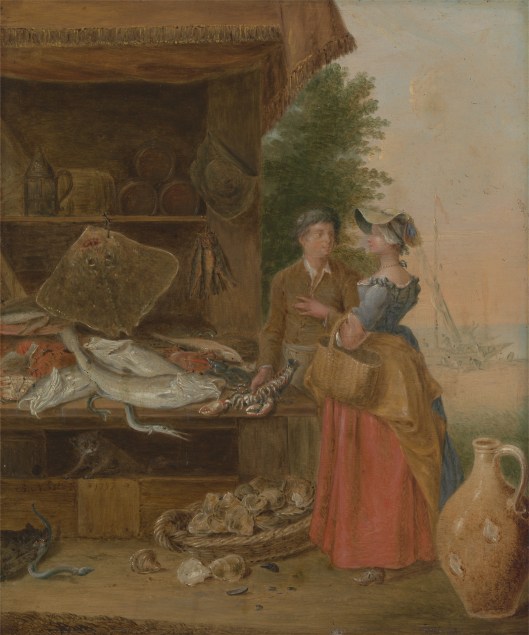
Balthazar Nebot, active 1730–1762, Spanish, active in Britain (from 1729), Fishmonger's stall, 1737, Oil on copper, Yale Center for British Art, Paul Mellon Collection

Balthazar Nebot, active 1730–1762, Spanish, active in Britain (from 1729), Fishmonger’s stall, 1737, Oil on copper, Yale Center for British Art, Paul Mellon Collection

Baskets have come up before. So this is part of a larger argument. Mostly, we see servants marketing. Middle class ladies certainly shop– what is the class level of this woman (above)?— but so many things can be delivered, or are peddled door-to-door, and servants are so common, that I think we don’t yet fully understand shopping in the 18th century.

After the meteoric rise of consumerism, after department stores, yes: shopping is more like what we do. But in the pre-ice box and pre-packaged era, meat cannot be bought and frozen, and milk will not last all that long. Things were brought home one at a time, or a few at a time, many times a week. And middle class ladies bought small things– ribbons, almanacks, shoes– and bring them home in their pockets, just in their hands, or, I would guess, wrapped in a bundle of paper (a pair of shoes) or in a band box (a bonnet) if the things are not delivered.

A long winded way to say, I don’t know: but I’m pretty sure middle class ladies sent their servants out frequently so the ladies didn’t carry baskets and the servants used bags, aprons, and their hands.
Share this:

  • Share on Facebook (Opens in new window) Facebook
  • Share on Pinterest (Opens in new window) Pinterest
  • Email a link to a friend (Opens in new window) Email
  • Share on X (Opens in new window) X
Like Loading...

Hell is a Hand Basket

15 Thursday Sep 2016

Posted by kittycalash in Art Rant, Clothing, Fail, History, material culture, Research

≈ 5 Comments

Tags

18th century, 18th century clothes, art history, authenticity, baskets, Costume, dress, fashion, interpretation, John Copley, john smibert, Joseph Blackburn, portraits, Research

Gentle Reader: Remember the post on semiotics? We need to go back to that once more.

Just what are we looking at here?
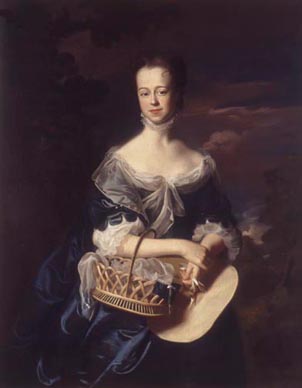
copley_john-singleton-mrs-daniel-rogers-middleton-collection

John Singleton Copley.
Portrait of Mrs. Daniel Rogers (Elizabeth Gorham Rogers), 1762
50 X 40, oil on canvas.
Middleton Collection, Wake Forest University
HC1991.1.1

Hmm…. 1762. Does that dress look like 1762 to you? Or does it resemble a 17th century garment? Check out those sleeves: scallops. The shift sleeves: super full. The line of the gown at the neck: a shallow scoop. The front of the bodice: closed.

Are those the hallmarks of a typical 1762 gown in New England, England, or France? You are correct, sir: They are not.

What’s happening here? What is Copley doing, and why?

He’s making his subject look good, reflecting her wealth and status. He’s flattering her by painting her in a faux-17th century gown, a “Vandyke costume, a popular artistic convention in England related to the vogue for fancy dress and masquerade.”* 1762 seems a trifle late for this convention, but in 1757, James McArdell produces a mezzotint of Thomas Hudson’s portrait of the Duchess of Ancaster. Henry Pelham wrote to Copley in 1776 that he had purchased one of those mezzotints, suggesting their use as references for Colonial American painters. Reynolda House has a nice explication of this style of dress in the Thëus portrait they own of Mrs. Thomas Lynch, shown below.

Mrs. Thomas Lynch, oil on canvas by Jeremiah Thëus, 1755. Reynolda House, 1972.2.1

Mrs. Thomas Lynch, oil on canvas by Jeremiah Thëus, 1755. Reynolda House, 1972.2.1

There was also a convention of portraying women in “timeless draperies,” following the school of Peter Lely and Godfrey Kneller, both late 17th-century English painters who produced portraits with generalized costumes.

Lady Mary Berkely, wife of Thomas Chambers. oil on canvas by Sir Godfrey Kneller, ca. 1700. Metropolitan Museum of Art, 96.30.6

Lady Mary Berkely, wife of Thomas Chambers. oil on canvas by Sir Godfrey Kneller, ca. 1700. Metropolitan Museum of Art, 96.30.6

This portrait by Kneller (born in Germany, he worked in England) explains a lot, doesn’t it? And this timeless convention persists for some time, and the stylization of the facial features and hair is copied by English and colonial American painters. John Smibert, long familiar to many of you, was a leading practitioner of this style of portrait, and his work would have been well known to Copley and his sitters.

Mrs Samuel Browne by Smibert, RIHS 1891.2.2

Mrs Samuel Browne by Smibert, RIHS 1891.2.2

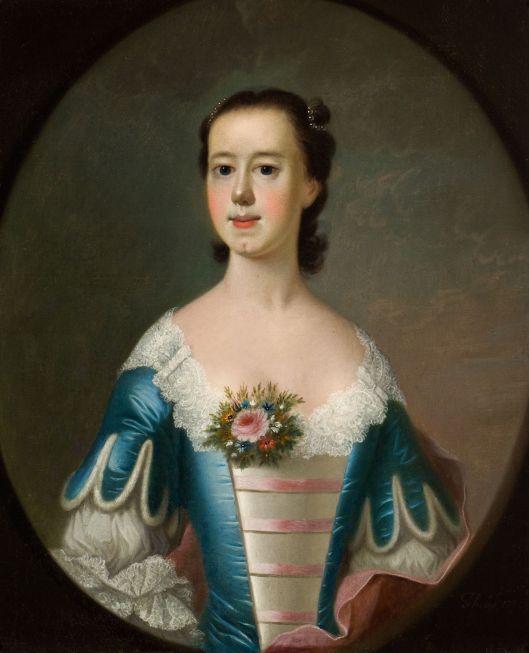
Blackburn’s portrait of Mary Sylvester adopts two conventions at once, in a way: she’s in timeless-style drapery and fancy dress as a shepherdess. Let’s remember, too, that there’s symbolism in the shepherdess imagery, referencing pastoral innocence and Mary Sylvester’s unmarried, presumably virginal, status. Don’t believe me? Read the catalog entry, written (at the very least) under the supervision of actual, degree-toting art historians.

Mary Sylvester, oil on canvas by Joseph Blackburn, 1754. Metropolitan Museum of Art, 16.68.2

Mary Sylvester, oil on canvas by Joseph Blackburn, 1754. Metropolitan Museum of Art, 16.68.2

Where does that leave us with Mrs. Rogers? She’s portrayed in what is essentially fancy dress, holding her straw hat in her left hand (much as Mary Sylvester is) with a basket over her right forearm. You will note the open work of the basket, the delicate arches and the fineness of the base. What’s in it? Something gauzy, as light as the drape around her shoulders, with a square of dark blue silk and a fine white silk ribbon. Honestly I am not entirely certain — the resolution of the image is dreadful.

But what’s NOT in the basket? A redware or pewter mug, sewing, keys, bottle, food, candy, toys, or, really, anything of a very concrete or practical nature.

Is this image a justification for carrying a [nearly empty ] basket on the streets of Boston? Of course it is–as long as you justify walking the streets of Boston in imaginary or fancy dress.

*p.106, Ribeiro, Aileen. “‘The Whole Art of Dress’: Costume in the Work of John Singleton Copley.” John Singleton Copley in America, Metropolitan Museum of Art, 1995.

Share this:

  • Share on Facebook (Opens in new window) Facebook
  • Share on Pinterest (Opens in new window) Pinterest
  • Email a link to a friend (Opens in new window) Email
  • Share on X (Opens in new window) X
Like Loading...

Friday’s Fright: A Dress in White

05 Friday Aug 2016

Posted by kittycalash in Clothing, Events, History, Living History, Research, Uncategorized

≈ 1 Comment

Tags

19th century clothing, art history, Costume, Events, fashion, Federal style, living history, Research, sewing

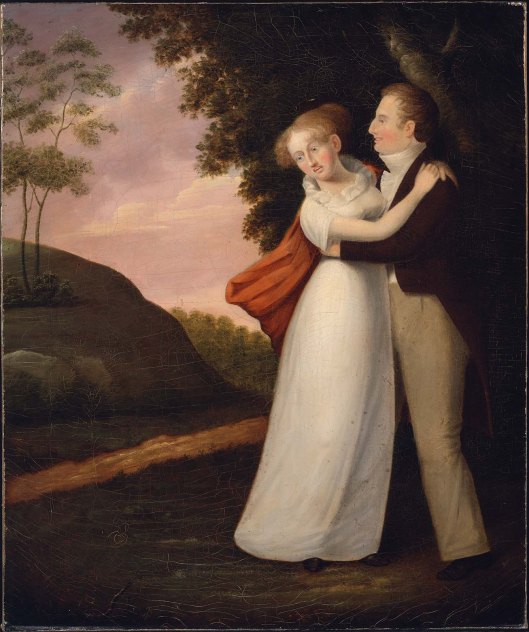
The Frightened Girl, oil on canvas by Cephas Thompson ca. 1810. MFA Boston, 1986.397

The Frightened Girl, oil on canvas by Cephas Thompson ca. 1810. MFA Boston, 1986.397

Two paths crossed for me this week, both in the early Federal era. Cephas Thompson, a self-taught New England painter, recently became very interesting to me. Although he grew up in Massachusetts, Thompson painted extensively in Virginia, but also in Providence, so of course the story resonated with me. But even more than the story, I loved the images. What a show the portraits would make– and he seems to have painted miniatures as well– so when I met with a local preservationist who turned out to be a fellow art school fugitive, wheels began to turn.

“What clothes!” my new friend said.
“I can get you a room full of people in those clothes,” I replied. And what fun would that be, a gallery opening where the people in the portraits appear to have come to life? Beats the pants off mere mannequins, but keep your Cossacks on: this one’s gonna take a while. In the meantime, what about those clothes?

Salem Register, July 14, 1803.

Salem Register, July 14, 1803.

Saturday marks the third time I’ve been part of the Salem Maritime Festival, and once again the West India Goods Store will be the base of operations for a mercantile enterprise. Millinery has its charms, but this year, the park historian shared fascinating notes on “She Merchants” of Salem, and the Hathorne sisters really intrigued me. Drunk Tailor dug into online newspapers (harder than ever to access remotely) and found an 1803 issue of the Salem Register

That’s an incredibly helpful list of goods to sell (and to pack from the Strategic Fabric Reserve), but a new year means a new dress, of course, and for reasons still not entirely clear to me, this seemed like exactly the right time to wear white. That’s sort of where Cephas Thompson comes back into play: white dresses.

Mrs. Cephas Thompson (Olivia Leonard). Oil on canvas by Cephas Thompson, 1810-1820. MMA, 1985.22

Mrs. Cephas Thompson (Olivia Leonard). Oil on canvas by Cephas Thompson, 1810-1820. MMA, 1985.22

There’s a pile of white cotton and white linen on my table, ready to be packed up this evening: with the dress on for a fitting, I felt like a bowl of whipped cream, the red silk Spencer and scarf the cherry on top. Happily, white and red are documentable to New England, though I would be mortified to be as frighted of a garter snake as the girl in Thompson’s painting. Strawberries and coffee are entirely different, and I shall probably require a bib for Saturday, lest my whipped cream be spoilt.

Share this:

  • Share on Facebook (Opens in new window) Facebook
  • Share on Pinterest (Opens in new window) Pinterest
  • Email a link to a friend (Opens in new window) Email
  • Share on X (Opens in new window) X
Like Loading...

Free-for-All Friday

24 Friday Jun 2016

Posted by kittycalash in Events, History, Living History, Reenacting, Research

≈ Comments Off on Free-for-All Friday

Tags

18th century, authenticity, common people, interpretation, living history, Monmouth NJ, New Jersey, Quakers, Research, Revolutionary War

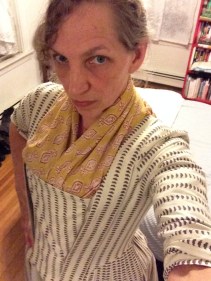
Well, at least I can dress myself.

Well, at least I can dress myself.

Most sadly, my obnoxious yellow gown will not be finished for this coming weekend, so I will not be flaunting my goods in such flashy clothing. Instead, I will be dressed like a giant version of the darling Miss B, whom I fear does wear the Space Invaders print better than I.

The real point, of course, is the action expected for Saturday, June 25, at the Craig House. The press release is fairly general about how we’ll be representin’ New Jersey’s 18th century civil war, and no one has leaped up to portray Little Anthony the [Quaker] Insurrectionist, but here’s the scene:

Craig House is empty the day of the battle. John Craig is with the Continental Army, leaving Ann Craig to flee with chattel, child, and two slaves in two wagons. This leaves the house and remaining property vulnerable to occupation and depredation.

An armed member of the Association for Retaliation is snooping around the Craig house and catches Loyalist and Quaker refugees who are squatting/hiding, as well as a “London” trader. He can’t let them go, and he is afraid to move them for fear of the British by day and the Tories by night. The Retaliator is joined by a local farmer who has stopped by to check on Mrs Craig’s safety in the surrounding commotion of the troops moving towards the coming battle. 

“Disaffected” smugglers use the chaos of the war in New Jersey to continue trading with the British and Loyalists. The “London trade” feeds the taste for tea, fabrics, rum, lemons, and sugar that even the Revolutionaries cannot shake.

Quakers are viewed with suspicion and animosity for their pacifist, anti-slavery views, which gives the impression that they are Loyalists. Harassed in Philadelphia by various committees requisitioning blankets and other goods; by 1778, the Quakers’ abolitionist views make them vastly unpopular in Monmouth County.

These characters in search of a plot will encounter each other at Craig House and, with some history improv, portray the tension and conflict between New Jersey residents in the Revolutionary period. Want to come out? Craig House is here, and a visitors’ guide is here.

Share this:

  • Share on Facebook (Opens in new window) Facebook
  • Share on Pinterest (Opens in new window) Pinterest
  • Email a link to a friend (Opens in new window) Email
  • Share on X (Opens in new window) X
Like Loading...

A Request from the Academie

18 Wednesday May 2016

Posted by kittycalash in Events, Living History, Reenacting, Research

≈ Comments Off on A Request from the Academie

Tags

18th century, authenticity, living history, Research, resources, Revolutionary War

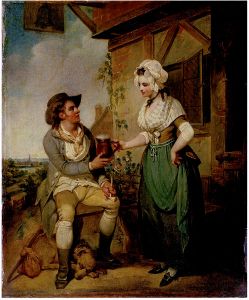
At the Inn Door, oil on canvas by Henry Singleton, ca. 1780, V&A Museum 1834-1900

At the Inn Door, oil on canvas by Henry Singleton, ca. 1780, V&A Museum 1834-1900

Gentle Readers, Living History Enthusiasts, and Rev War Junkies: Your assistance is requested. Mrs. Boice’s Historie Academie is looking for your input for future hands-on learning weekends.

There are some interesting topics in the list– brewing? I certainly enjoy the results of brewing. Dairying? I like cows and love the local dairy farm. Language and speech patterns? I could certainly do better. Professions? Hmmm….I’ve considered several. Much to love in this list, and I’m looking forward to learning more.

Go forth, and register your opinion.

Share this:

  • Share on Facebook (Opens in new window) Facebook
  • Share on Pinterest (Opens in new window) Pinterest
  • Email a link to a friend (Opens in new window) Email
  • Share on X (Opens in new window) X
Like Loading...
← Older posts
Newer posts →

Archives

wordpress statistics

Creative Commons License
Kitty Calash blog by Kirsten Hammerstrom is licensed under a Creative Commons Attribution-NonCommercial-ShareAlike 4.0 International License.

Website Built with WordPress.com.

  • Subscribe Subscribed
    • Kitty Calash
    • Join 621 other subscribers
    • Already have a WordPress.com account? Log in now.
    • Kitty Calash
    • Subscribe Subscribed
    • Sign up
    • Log in
    • Report this content
    • View site in Reader
    • Manage subscriptions
    • Collapse this bar
 

Loading Comments...
 

    %d