• Home
  • Completed Costumes/Impressions
  • Emma and Her Dresses
  • Free Patterns and Instructions

Kitty Calash

~ Confessions of a Known Bonnet-Wearer

Kitty Calash

Tag Archives: resources

Frivolous Friday

28 Friday Mar 2014

Posted by kittycalash in Museums, Research

≈ Comments Off on Frivolous Friday

Tags

Metropolitan Museum of Art, Museums, resources

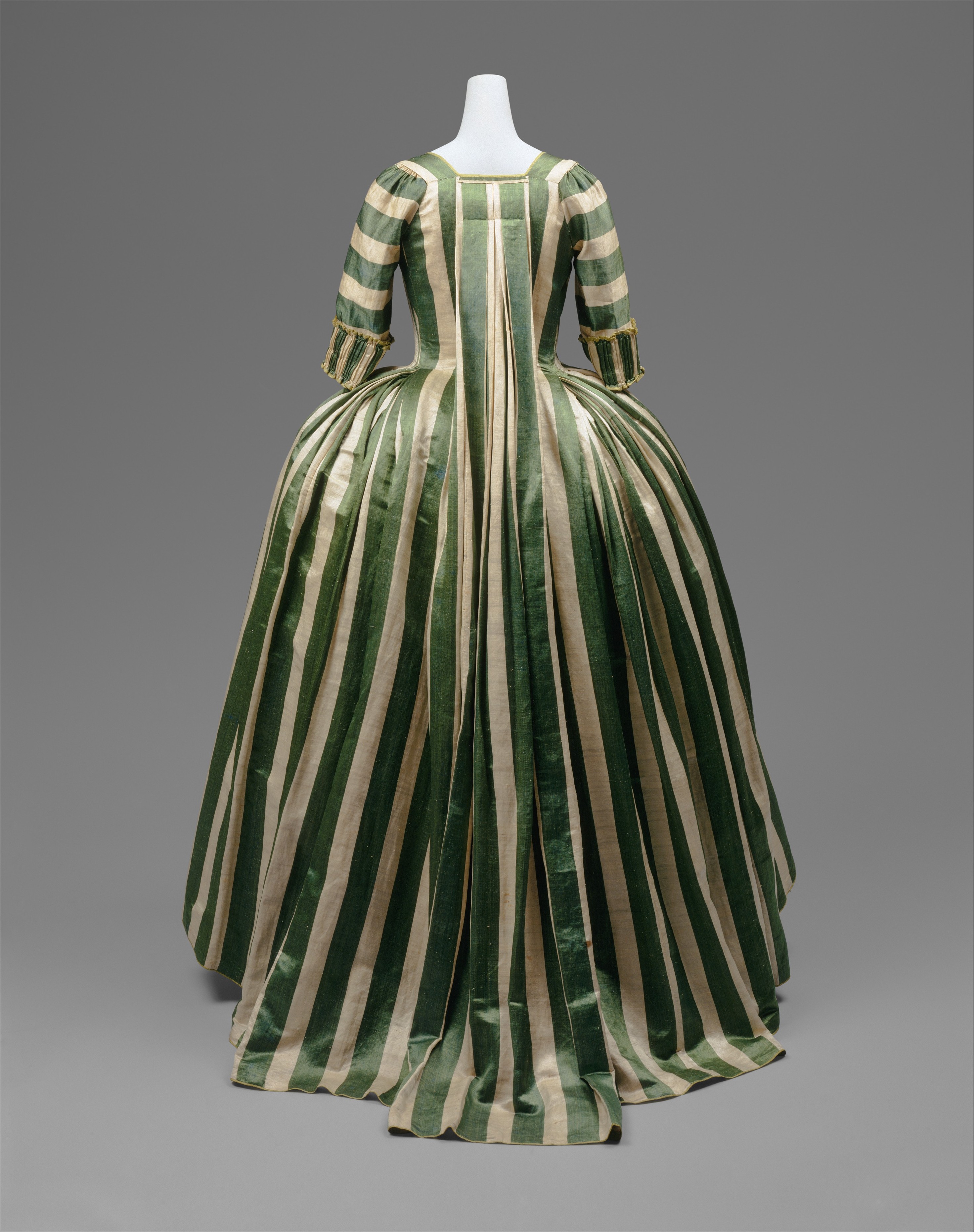
Robe à la Française 1778–85  French linen, silk  Purchase, Irene Lewisohn Bequest, 1965 MMA C.I.65.13.2a–c

Robe à la Française
1778–85
French linen, silk
Purchase, Irene Lewisohn Bequest, 1965 MMA C.I.65.13.2a–c

Yes, I give up. It has been a long week, I am tired of winter and tired of snow and packing books and carpets torn up and tired of bad communication. Fresh content? I am fresh out.

I spent Thursday beating my head against research into the Brown family textile collection, and Providence textiles in general, for a program I seem to part of next Saturday. I hope I’m prepared, but along the way to getting ready, I spent some time in many museum databases beyond our own.

The Met, as always, rocks the party and brings their largesse to us all with their online publications.

Get thee to their website, content-hungry pilgrim, and enjoy the downloadable fun. (Some of you already know this, but I keep losing the right link, so here it is again.)

Share this:

  • Share on Facebook (Opens in new window) Facebook
  • Share on Pinterest (Opens in new window) Pinterest
  • Email a link to a friend (Opens in new window) Email
  • Share on X (Opens in new window) X
Like Loading...

Once Upon A Time…

14 Friday Mar 2014

Posted by kittycalash in Clothing, History, Living History, personal, Philosophy, Reenacting

≈ 2 Comments

Tags

18th century clothes, 18th century clothing, Betsy Ross, Child Guidance Educational Activity, Costume, Costumes, dress, Educational Activity, fashion, interpretation, living history, paper dolls, Reenacting, resources

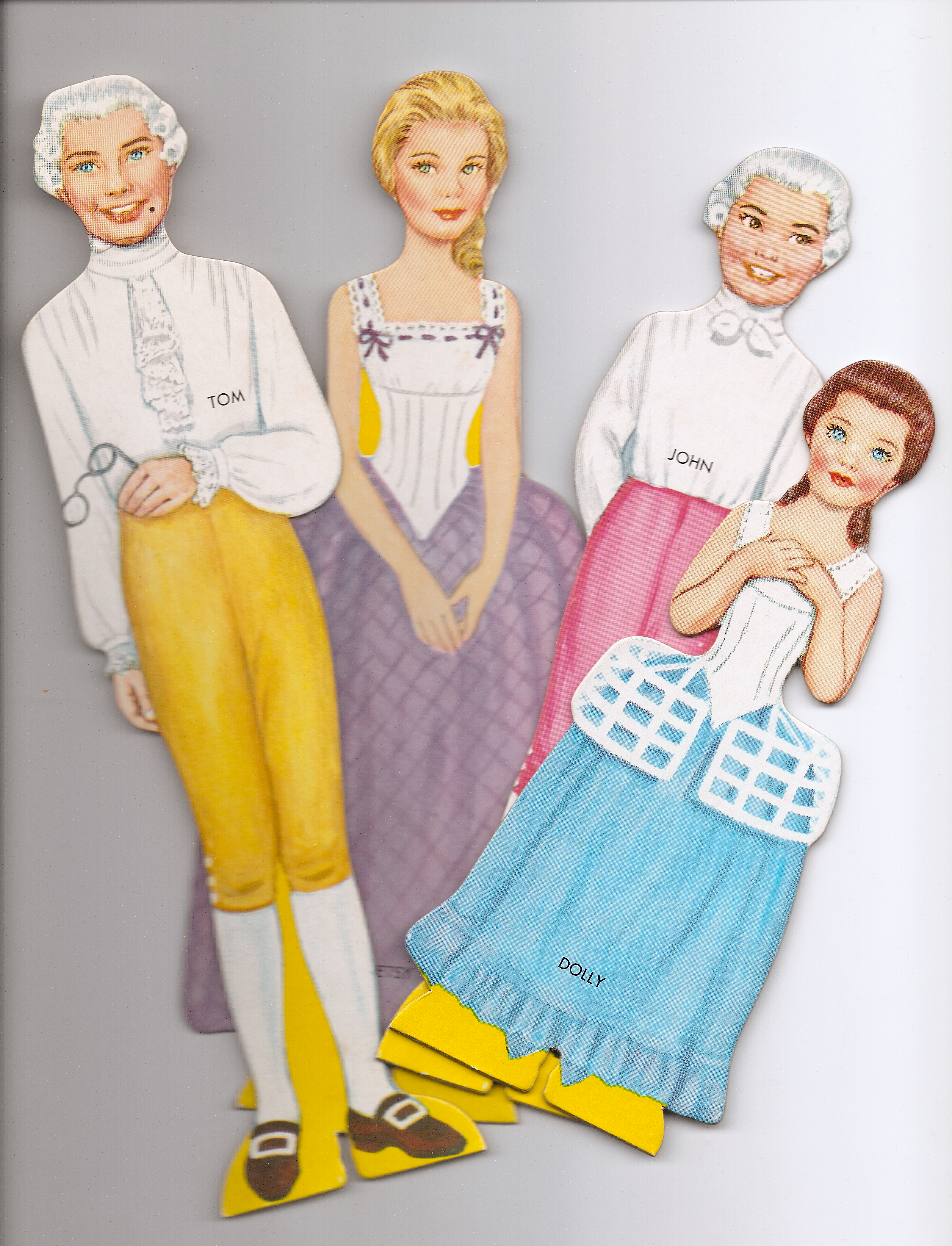
Betsy Ross and friends: A Child Guidance Educational Activity

Betsy Ross and friends: A Child Guidance Educational Activity

This is the third set of these paper dolls (Educational Activity) I have owned. The very first set was given to me by my mother, Lo, at the Dawn of Time, in the Dark Ages known as the 1970s.

I wore them out.

A new set was purchased, probably once again at Marshall Field’s, possibly in the book department. They now reside in an attic outside Philadelphia (how appropriate).

From this Educational Activity flowed many more home-designed outfits and home-made paper dolls of historical and literary origins, which have led to this moment, when I make myself and my family into historical characters, make us outfits, and set us in motion with friends and colleagues in scenes of historical play-acting, by which I mean Educational Activity.

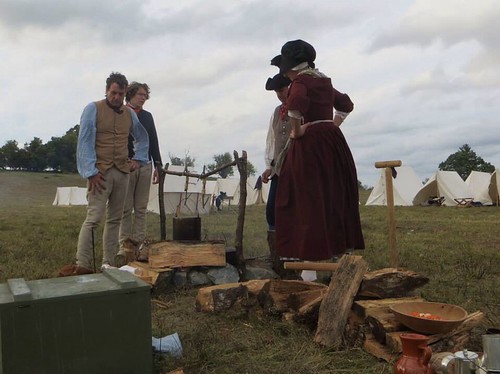
Cooking at Saratoga: very Educational. Photo courtesy D Molly Ross.

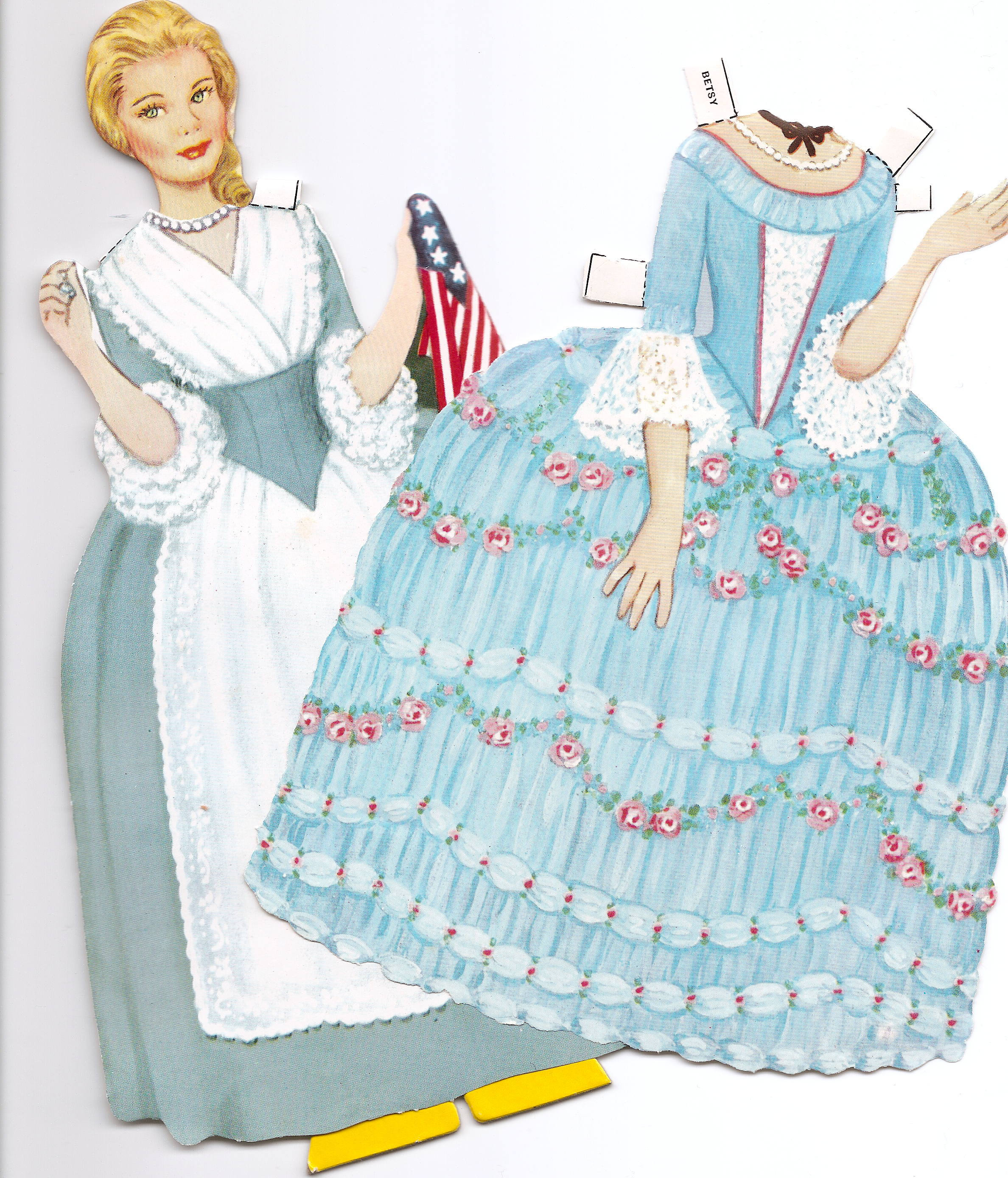
I like to think that the clothing we wear is more correct than the “Authentic Costumes” advertised on Betsy Ross’s box, but there is always more to learn. I am in no way denigrating Betsy Ross, or paper dolls, or suggesting that I see my family, friends and colleagues as paper dolls. But I do know that as long as I have been playing, I’ve been playing history and reading history, and drawing history, and using books and paintings and yes, even paper dolls, to figure out the world present and past.

If January Jones played Betsy Ross...

If January Jones played Betsy Ross…

Even though I always thought I wanted Betsy’s birthday cake gown, the one I really liked was the work gown. The “construction” of her garments confused me even as child: how the heck does that kerchief work? And the bodice front? Never mind, have a slice of dress, I mean cake. (Field’s had a cafeteria that served slices of pink-iced layer cake that I somehow conflated with the paper dolls, thanks to the shopping trips my mother and I made.)

Memory and fact, impression and citation: when we reenact the past as an Educational Activity, we should remember that some will walk away enlightened, and others will walk away thinking about birthday cake. Our job, beyond getting the facts right, is to engage our visitors, to interest them, and to excite their imaginations. What they do from there is up to them, but we will know that we have done our best to present them with a scene that can take them one step closer to being there.

Share this:

  • Share on Facebook (Opens in new window) Facebook
  • Share on Pinterest (Opens in new window) Pinterest
  • Email a link to a friend (Opens in new window) Email
  • Share on X (Opens in new window) X
Like Loading...

Order!

10 Monday Mar 2014

Posted by kittycalash in History, Living History, Research

≈ 2 Comments

Tags

10th Massachusetts, authenticity, Captain Stephen Abbott, common soldier, living history, orderly books, primary sources, Research, resources, Revolutionary War

Francis Wheatley, 1747-1801, British, Soldier with Country Women Selling Ribbons, near a Military Camp, 1788, Oil on canvas, Yale Center for British Art, Paul Mellon Collection

Francis Wheatley, 1747-1801, British, Soldier with Country Women Selling Ribbons, near a Military Camp, 1788, Oil on canvas, Yale Center for British Art, Paul Mellon Collection

You know you’re taking something seriously when you’re willing to pay for the privilege of reading a primary source. The microfilm I ordered from the Phillips Library arrived a week or so ago and I managed to snatch an hour or so between meetings to read and print some of the most interesting pages. I get a week or so more before the reader at work goes to storage, and then I’ll have to go haunt another library.

This is the kind of stuff I will happily read at bedtime, though it should also be noted that I will read regimental record books at bedtime, or runaway ads, so we may not share tastes in literature.

I was willing to pay for the film because I wanted to read the books in full to get a better sense of the context in which Bridget Connor was operating. (Delightedly, I realized last night as I fell asleep, of course there’s no death record for her in Massachusetts. She was expelled from camp at Newburgh, so why would she walk all the way back to Massachusetts? Why not set up a new life in New York? A whole new place to look for her!)

Beyond Bridget, there’s a wealth of detail in the Stephen Abbott Orderly Books.

Thomas Sandby, 1721-1798, British, Encampment at Maestricht, 1747, Pen in black ink, over graphite with gray wash on medium, moderately textured, beige, laid paper, Yale Center for British Art, Paul Mellon Collection

Thomas Sandby, 1721-1798, British, Encampment at Maestricht, 1747, Pen in black ink, over graphite with gray wash on medium, moderately textured, beige, laid paper, Yale Center for British Art, Paul Mellon Collection

“Regl Orders 5th June 1782
the Regiment will make Every preparation
to March on Fryday the Soldiers are to
Clean there arms to Morrow and pack up
there Clothing.. The Commedants of Com
apanies are Directed to Send the tent poles
which are Finished to Morrow by 12 oClock
to the Landing where the tent Lay the Guard
with the tents will pitch a No of tents Suff
iciant to Cover the Straw and what ever Bag
gae is Brought previous to the march”

This helps us get a picture of the camp, and from the order about the tent poles, I think we may gather that there were plenty of tent poles NOT expected to be finished. (My colleagues enjoyed that part when I read it aloud at work.)

Regimnl Orders June 6th 1782
the Regiment will turn out to Morrow Morning
at the Beating of the Revelee and to March
By Six oClock they are to pack there cloth
ing and kook there provisions this Evening
when they have arivd on the Ground for Encam
ping the officer commanding on the Spot
will order a partry if Forty men from the Reg
iment a Capt and two Sub’s to Command them
to Return to the Encampment in order to asist
in Bringin on the Baggage the Soldiers
are to Carry there kittles in there hands and
are to Leave there arms and pakes &c at the
New Encampment any Soldier who is found
Plundering another pack is to be tyd up and
punished with out Trial..

Carry their kettles in their hands, their provisions cooked the night before. Now, wouldn’t that change an encampment’s appearance? Let alone tied up plunderers…

Share this:

  • Share on Facebook (Opens in new window) Facebook
  • Share on Pinterest (Opens in new window) Pinterest
  • Email a link to a friend (Opens in new window) Email
  • Share on X (Opens in new window) X
Like Loading...

Book Notice: Wearable Prints, 1760-1860

29 Wednesday Jan 2014

Posted by kittycalash in Book Review, History, Living History, Research

≈ 7 Comments

Tags

books, fabric, fashion, history, prints, Research, resources, style

This just in, literally, from the mail carrier: Susan W. Greene’s long-awaited book, Wearable Prints, 1760-1860. It’s discounted (and out of stock) at Amazon, but should be shipping soon, since I have one right here on my desk.

It’s fair to call this book lavishly illustrated (1600 full-color images in almost 600 pages), and while I have access to a copy at work, I am seriously thinking of buying my own copy, based solely on about 10 minutes skimming the book. There are images not just of fabric samples but also of garments, paper dolls and illustrations that help put the fabrics into context. Images of garments from collections I can’t get into? Delicious! Information to help me understand how to use a printed cotton? Even better.

The book is organized in three main sections: Overview, Colors, and Mechanics. Appendices include timelines, prohibitions, price comparisons, print characteristics, and more, as well as a glossary and an extensive bibliography.

The photographs are amazing, and show a range of print designs of greater variety than we may have credited heretofore. Particularly useful is the section on evaluating and identifying printed dress fabrics, and the questions one should ask about fabrics. I think that the criteria could be used forensically on modern as well as historic textiles, and we could think more critically about the fabrics we use.

ETA: I wrote this while the downstairs room was being painted with oil paint, and it’s loopier than I expected. The book is still an excellent resource, and I highly recommend it. While it’s heavy for carrying to the fabric shops, it would be dead useful while shopping online. I have definitely seen bolts of fabrics very similar to those illustrated in Greene’s book. As Anna notes on her blog, Ms Greene’s collection is now at Genessee Country Village.  Wow. It’s amazing. If you can’t get there easily, well, the book will certainly help, and the images will you visual access to a plethora of collections. 

Share this:

  • Share on Facebook (Opens in new window) Facebook
  • Share on Pinterest (Opens in new window) Pinterest
  • Email a link to a friend (Opens in new window) Email
  • Share on X (Opens in new window) X
Like Loading...

Les Oublies

13 Friday Dec 2013

Posted by kittycalash in Museums, Research

≈ Comments Off on Les Oublies

Tags

art history, common dress, common people, Costume, engravings, fashion, fashion plates, history, Research, resources, satire

Les Oublies. Le Bon Genre Plate 79: three ladies and a child look at a sundial in a garden, watched by a man. August 1815 Hand-coloured etching. British Museum 2003,U.14

I was first attracted to this image by the gentleman and his shapely legs, as you might expect, since tight buttoned gaiters or overalls do turn my head. This plate doesn’t make much sense to me: I can’t really grasp the satire, I can only guess. The explanation given for the series doesn’t help immensely. “The series is devoted to costume, mostly set in fashionable interiors, but the plates are treated in a semi-caricatural, humorous way that links them with French social satire.”

My best guess is that this plate from 1815 is showing off the latest filmy white fashions and tiny pink Spencers in contrast to the forgotten origins of the classical influence, personified by the gentleman in common dress at left. His hat and the gaiters suggest the French revolution, now forgotten (see “oublier” though the reference is also to the small cakes being eaten by the woman under the tree). The clock provides a reference to the passing of time, and forgetting, but I don’t think it is actually a sundial. The strap makes it look as if the man can carry it, and that’s a needle, not the fixed vane of a sundial.

Whatever it all means, I do find this more interesting for the man’s clothing than the women’s; after a while, the subtle differences between white columns is lost on me, but that’s a pretty interesting buff-colored waistcoat.

Share this:

  • Share on Facebook (Opens in new window) Facebook
  • Share on Pinterest (Opens in new window) Pinterest
  • Email a link to a friend (Opens in new window) Email
  • Share on X (Opens in new window) X
Like Loading...
← Older posts
Newer posts →

Archives

wordpress statistics

Creative Commons License
Kitty Calash blog by Kirsten Hammerstrom is licensed under a Creative Commons Attribution-NonCommercial-ShareAlike 4.0 International License.

Website Built with WordPress.com.

  • Subscribe Subscribed
    • Kitty Calash
    • Join 621 other subscribers
    • Already have a WordPress.com account? Log in now.
    • Kitty Calash
    • Subscribe Subscribed
    • Sign up
    • Log in
    • Report this content
    • View site in Reader
    • Manage subscriptions
    • Collapse this bar
 

Loading Comments...
 

    %d