
• Home
  • Completed Costumes/Impressions
  • Emma and Her Dresses
  • Free Patterns and Instructions

Kitty Calash

~ Confessions of a Known Bonnet-Wearer

Kitty Calash

Tag Archives: Revolutionary War

Apprehending Chicken

27 Thursday Jun 2013

Posted by kittycalash in Events, Food, Living History, Reenacting, Research

≈ 4 Comments

Tags

10th Massachusetts, 18th century, 2nd Rhode Island, common people, common soldier, cooking, food, living history, Reenacting, Revolutionary War

Living History Chickens. Don’t mess with them.

I have written in the past about the Living History Chicken, ripped and delicious, and the joys of making such a creature fit into a cast-iron pot. While “chicken ripper” might be the appellation you desire, it’s not what I want to be known for.

Last time, I dissed the modern ham as an item ill-suited to camp cooking (tasty, but it doesn’t look right). I have also seen hams on a spit cooked slowly (too high above) a fire, and heard a rumour about a very authentic ham-dining experience with a very authentic digestive result. That’s taking things farther than I care to take any regiment, so what to do?

Continental Army rations included, among other things, a pound of flour and a pound of beef a day per man. In Rhode Island at least, that beef might also have been fish, and I have seen chicken listed, too, as it is, technically, meat. Not wanting to inflict our fishy Ocean State customs on all comers, I think I’ll spare the regiments a pound of fish a day. But chicken? What to do? Hope to cook it?

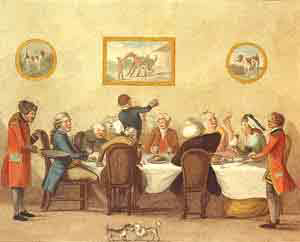
Or maybe we should eat more fruit.The Afternoon Meal by Luis Meléndez, ca. 1772. MMA, 1982.60.39

One option is to rip the carcass apart (see above) and boil it. That would get the job done, for a bone-in chicken stew. However, I am thinking of string roasting chicken (or cornish game hens, since modern grocery store chickens are awfully large).

To be quite technically correct, I could only cook chicken for the Second Helping Regiment. They had a documented poultry thief among their number, one John Smith, who apprehended poultry if it failed to give the correct countersign when challenged. However a chicken is prepared, it will be a messy business, as we have no forks. It’s fingers, knives and spoons for us, as we have no forks. That does increase the appeal of boiling, since the meat would come off the bone more easily.

Share this:

  • Share on Facebook (Opens in new window) Facebook
  • Share on Pinterest (Opens in new window) Pinterest
  • Email a link to a friend (Opens in new window) Email
  • Share on X (Opens in new window) X
Like Loading...

Drawing Beef and Flour

26 Wednesday Jun 2013

Posted by kittycalash in Food, Living History, Reenacting, Research

≈ Comments Off on Drawing Beef and Flour

Tags

10th Massachusetts, 18th century, cooking, Events, food, Research, Revolutionary War

The Durham Ox: yet to come in 1778

Drawn meat: The Durham Ox.

Or beeve and flower, depending on how you’re spelling in 1778.
John Buss of the 10th Massachusetts complained mightily of the rations he drew, and the quality of the beef, pining in his letters home for cheese and cider. His affection for cheese has become part of the unit’s lore and an in-joke, so I did make certain to have plenty of cheese for Monmouth. Bread, cheese, ham, fruit in season, beef stew: yawn, after a while.

Trying to cook authentically in the field could result in dull, repetitive menus, recreating the soldiers’ experience, but unless everyone you’re feeding has signed up for that, you may have an unhappy crowd on your hands. Mostly they just want food, but people will grumble if you are cooking the same thing every week (and that opportunity exists). When I was a kid, my mother cooked chicken and broccoli every Sunday night, and to this day, I won’t eat chicken and broccoli unless it is in satay sauce.

Sorry, Private: not in this man's Army.

Sorry, Private: not in this man’s Army.

The 10th can count themselves lucky that they weren’t on the expedition to Quebec, when Newfoundland was on the 2nd Rhode Island’s menu, as well as squirrel-head-and-candle-wick soup. (Try explaining this Newfoundland business to your creative writing group. I tried historical fiction and got a reputation for being “dangerous,” and you can, too.)

At Monmouth, we served as another regiment’s….disposers…on Sunday morning, and were treated to the extra steaks they cut from a ham. Grilled and stacked on bread with hard cheddar cheese, this was delicious. Our conversation turned quickly to the question of grilling. After all, we only have kettles and sticks. I said I’d buy and carry a grate if they wanted ham so much, but the Adjutant proposed weaving a grid of green sticks and holding that over coals, and just brushing off the ashes when the meat fell into the coals. The minor detail left out is what we would use to retrieve the meat, though it must be a stick by any other name.

One cannot fry in or on tinware: the tinning will melt. We know soldiers carried as little as they could even in the regular infantry, so light infantry units were packing nothing but what they had to carry. No frying pan; no grate. Upon reaching this conclusion, we turned our sad-eyed stares on the other regiment with their table and stools and grill and ham, and were rewarded with another grilled ham piece each. Dogs have got a good thing going.

Begging and sharing aside, what about ham? The joke we make at home about ham being the natural prey of cats who butcher, brine, and cook the ham they beg for applies just as much to light infantry troops and their hangers-on. (They shouldn’t really have me along, but they are stuck and I’m pretty handy for getting the meals out, the canteens filled, and the wounds bandaged.) But a ham? Harder still to justify. Salt pork, yes; salt beef, yes. But the attractive and portable boneless hams at the supermarket are, sadly, more delicious than authentic.

One can take on the task of preparing meat properly oneself, in one’s copious spare time, but that won’t fix July and August’s meals. Staring sad-eyed at other regiments seems a parasitic and reputation-destroying plan. What to do?

Tune in next time for more adventures in historic meats!

Share this:

  • Share on Facebook (Opens in new window) Facebook
  • Share on Pinterest (Opens in new window) Pinterest
  • Email a link to a friend (Opens in new window) Email
  • Share on X (Opens in new window) X
Like Loading...

Monmouth Millinery

25 Tuesday Jun 2013

Posted by kittycalash in 1763 Project, Clothing, Making Things, Reenacting, Research

≈ 6 Comments

Tags

18th century, 18th century clothes, 2nd Rhode Island, Clothing, Costume, fashion, Revolutionary War, Rhode Island

New hat!

New hat!

As Eloise or her Nanny might say, It is rawther warmer than I care for. Lucky for me, I have a new hat. It’s a black straw hat of a kind you might see called a bergère, along with 4 yards of silk ribbon, purchased at Burnley & Trowbridge’s tent at Monmouth. Jim and Angela and their assistants were very helpful, and this was rawther a splurge for me, as I mostly buy my ribbon from Wm Booth’s remnants, when they are available. (We are tenant farmers. Mostly.)

Coromandel Coast lined hat, from an auction.

Coromandel Coast lined hat, from an auction.

But in this instance, I wanted a lady’s hat, so I pleated up about two yards of green silk ribbon, and added a bow. To get the multi-vector bending effect, I stitched millinery wire from Abraham’s Lady around the brim. The inside of the brim is lined with pieced scraps of the purple “Fleurs d’Inde” I used for a jacket (also made from a Wm Booth remnant). It ties on with yet another yard or more of ribbon. This is really a frivolous hat, for me. There are extant examples of straw hats lined with chintz, as you can see.

As luck would have it, I got to wear it right off, the very day I made it. How often do you get the chance to do without panic and pain? We attended the Saturday version of the Rochambeau Tea on Joy Homestead, an event which has its dedicated fans.

First hat outing

First hat outing

I wore this same gown last year, and to Nathan Hale; to my delight, I am enjoying it more each time I wear it. I think this petticoat is the right one; madder was too close and black too contrasty. Since the Rochambeau Tea “year” is 1780, this dress passes (ahem) muster; for many of the events I attend, it is too fashion forward.

London Cries: the Fishmonger. Paul Sandby ca. 1759. YCBA B1975.3.210

This hat will, I think, also work for the 1763 event, as the woman in yellow here is wearing a similarly dual-plane twist hat. I’ll never have a yellow gown though: I look pretty horrid in yellow.

Share this:

  • Share on Facebook (Opens in new window) Facebook
  • Share on Pinterest (Opens in new window) Pinterest
  • Email a link to a friend (Opens in new window) Email
  • Share on X (Opens in new window) X
Like Loading...

To Wash or Not to Wash

20 Thursday Jun 2013

Posted by kittycalash in Clothing, Events, Living History, Reenacting

≈ 2 Comments

Tags

18th century clothes, Clothing, common dress, laundry, Reenacting, Revolutionary War

Mr S and his waistcoat at Monmouth

Mr S and his waistcoat at Monmouth

Sometimes I can almost hear, “Good God woman, what are you thinking?!” but so far I have only seen it in a man’s eyes. This is usually in regard to laundry.

I erred once in asking if one wanted his hunting shirt laundered, and I had planned only on cold water and hand washing, as the item seemed a bit crunchy and crumpled to my eye and hand. But, no, some other woman had washed that shirt some time ago, and it had taken considerable time—years—to reestablish fringe from fluff.

Well patinated now, formerly embarrassingly white.

Now, I give you Mr S’s waistcoat and overalls. Mr S’s waistcoat was completed on the New Jersey Turnpike in November 2011 while headed to Fort Lee. Since then, it has a acquired a smattering of powder specks, a patina of grunge, a stain or two of greasy beaver (curry, actually) and, most recently, spots of toothpaste. This is where I draw the line: the toothpaste spots must go, as they are inauthentic.

Shirts, shifts, stockings, aprons, and waistcoat

One doesn’t want one’s clothes too clean for reenactments or living history events: you’re “living” in the pre-detergent era, but that doesn’t mean you should never wash your clothes. We know that the armies employed women to wash clothing, and we know that linens–shirts, shifts, and drawers–were washed more frequently than outerwear like breeches, waistcoats, and gowns. It’s not so different from today, when we don’t clean business suits as often as we launder shirts or underwear. Still, we do clean our clothes, and there comes a point when those overalls will get washed. Right about when you figure you need gloves to handle them…

Share this:

  • Share on Facebook (Opens in new window) Facebook
  • Share on Pinterest (Opens in new window) Pinterest
  • Email a link to a friend (Opens in new window) Email
  • Share on X (Opens in new window) X
Like Loading...

Two Words: Bed Sack

19 Wednesday Jun 2013

Posted by kittycalash in Events, Living History, Reenacting

≈ 2 Comments

Tags

18th century, common soldier, Reenacting, Revolutionary War, sleep patterns

The Young Mr outside our tents

The Young Mr outside our tents

I’m making one. Or two. Whatever: I’m making them for famille Calash. Sleeping on straw and a sleeping pad is better than either alone, but I find with the arthritis that I need more warmth and more cushion than I used to require. True, I am self-padded, but the steel prosthesis does feel—it is only an illusion, but I feel this—closer to the surface, and thus colder, than bone. This makes for a Cranky Kitty, and it is far better for all concerned that Madam Commissariat be a Happy Kitty. I will forgo chairs and tables and other clutter—it is both authentic and pleasant to be unburdened—but I like to sleep well.

There’s a simple enough pattern in one of the Packet books, but the gist of the thing is this: Enormous Market Wallet. Interior common tent dimensions are about 6×6 or 6×7 feet, so you need to end up with something along the lines of 3×6 or 4×6 or 6×6 feet. The Packet suggests four pieces of ticken, each 30 x 80 inches, aiming for a finished size of 42×72 inches, with an center slit four inches wide and a couple feet or so long. (I used the 18th Century New England Life market wallet instructions for a guide in making ours, and will use the same idea for bed sacks.)

I’m not yet aware of extensive documentation of these for Continental troops, but there is one reference in a West Point waste book (see here, footnote three). Since we don’t allow fire in the tents, I am willing to compromise on cotton ticking for these, and (ssshh!!) machine sewing the seams, with a hand-finished slit edge. I might even borrow the serger from work to make really quick work of this business. They will truly hardly be seen, so although I know I am cutting corners, I don’t feel too wretched about it.

Share this:

  • Share on Facebook (Opens in new window) Facebook
  • Share on Pinterest (Opens in new window) Pinterest
  • Email a link to a friend (Opens in new window) Email
  • Share on X (Opens in new window) X
Like Loading...
← Older posts
Newer posts →

Archives

wordpress statistics

Creative Commons License
Kitty Calash blog by Kirsten Hammerstrom is licensed under a Creative Commons Attribution-NonCommercial-ShareAlike 4.0 International License.

Website Built with WordPress.com.

  • Subscribe Subscribed
    • Kitty Calash
    • Join 621 other subscribers
    • Already have a WordPress.com account? Log in now.
    • Kitty Calash
    • Subscribe Subscribed
    • Sign up
    • Log in
    • Report this content
    • View site in Reader
    • Manage subscriptions
    • Collapse this bar
 

Loading Comments...
 

    %d