• Home
  • Completed Costumes/Impressions
  • Emma and Her Dresses
  • Free Patterns and Instructions

Kitty Calash

~ Confessions of a Known Bonnet-Wearer

Kitty Calash

Tag Archives: sewing

Documenting Mr S

16 Friday Aug 2013

Posted by kittycalash in Clothing, Events, Research

≈ 7 Comments

Tags

18th century, 18th century clothes, authenticity, Clothing, common dress, common people, Costume, Events, fashion, living history, menswear, Reenacting, Research, sewing

The guys are usually easy: they wear what the sergeant tells ’em to wear, and they like it, because that’s what soldiers do.

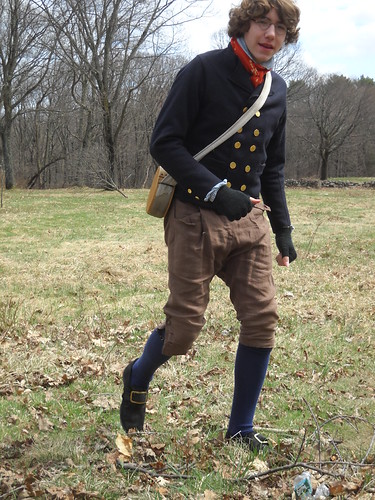
Mr S in Cambridge

Sergeant’s not a sergeant in quite the same way in 1774-1775: he’s a militia sergeant, and while we can still get up to tricks that get us yelled at, the clothing we wear is more personal. Mr S’s clothes seemed, at first, to be completely undocumentable.

Really? Yes, I have been known to have some anxiety issues over small matters. So I calmed down, re-read the standards, and looked again.

The shirt is checked linen, see here for details. The stockings, which will be replaced by hand-knit blue stockings, are also documented to Rhode Island.  But wait! That’s 1777, can it count for 1775? How long do stockings last, anyway?

I’ll own up to having been described as “literal and precise,” and I’m taking that comment to heart. Reader: literal is where one gets into trouble when one is precise. Literal interpretations can lead you, almost hubristically, into creating replicas of runaway ads  or extant garments that don’t reflect who you are, or what time you are portraying, not really.
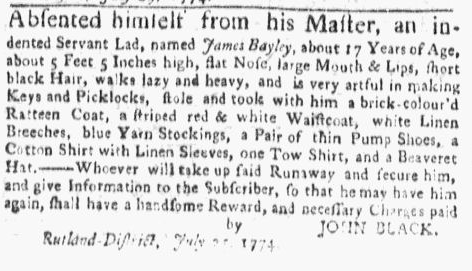
bluestockings_whitebreeches

Boston Post Boy, 7/25/1774

But not to worry, I dug up the blue stockings. This is from the Boston Post Boy, July 25, 1774. “White Linen Breeches, blue yarn stockings.” This is not too bad: Mr S has got his basic extremities covered now. It’s hard not to be distracted by the Cotton Shirt with Linen Sleeves, which reminds me of women’s shifts with finer sleeves, or sleeves to pin on.

browncamblet Waistcoat 7-4-1772 providence

Providence Gazette, 7/4/1772.

Keeping focused, let’s get Mr S more fully dressed, more proper, and warmer, since this is late August. You can’t see his waistcoat under the green jacket, but here you can. I know this broadcloth fabric, and its color, are from the acceptable palette for the last quarter of the 18th century, but can I find one in Providence or Massachusetts? Just about. The waistcoat described in this ad is camblet. There’s no goat or camel in Mr S’s camel-colored waistcoat, but I think we’ll call it found and be grateful that Mr S has not taken any action despite the numerous photos I have posted of him in various “poofy shirts” and “funny outfits,” as some of my friends describe them.

What’s left? There’s John Appleton’s ad in the Essex Gazette of May 17, 1774 for “blue, green and cloth colored bandannoes,” which pretty much takes care of the neck cloth; we’ve a brownish one, and a blue one; the Young Mr likes the orangey one, but I think we have those documented.

1774_greenJacket

Essex Gazette, 12/6/1774

1774_Prov_greenJacket

Providence Gazette, 1/29/1774

The green jacket, that’s what’s left. In the Essex Gazette of December 6, 1774, we find a “green jacket, light breeches, and yard Stockings,” much like what Mr S is wearing.  Nice! Multiple sources of documentation for items are always welcome chez Calash.

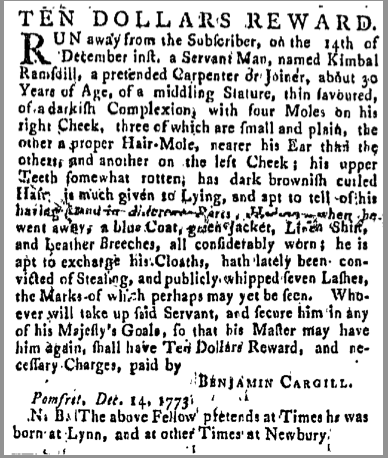
And, knowing that, you will not be surprised that I have found another jacket, closer to home. In the Providence Gazette of January 29, 1774, the man with the “proper hair mole” runs away in a green jacket. He’s also got leather breeches, and they’re on my wish list, though other things must come first, given their expense–things like tires, and allergy drops for the Young Mr.
Share this:

  • Share on Facebook (Opens in new window) Facebook
  • Share on Pinterest (Opens in new window) Pinterest
  • Email a link to a friend (Opens in new window) Email
  • Share on X (Opens in new window) X
Like Loading...

The Authenticity Challenge

14 Wednesday Aug 2013

Posted by kittycalash in Clothing, Events, Research

≈ 3 Comments

Tags

18th century clothes, authenticity, Clothing, common dress, common people, Events, gowns, newspapers, Research, resources, sewing

We’re going up to Minute Man on August 24, or at least that’s the plan. We have hostages to exchange (one ends up with other folks’ spoons and bowls when one does the dishes) and drilling to do for the September 28 event in Boston.

Immediately after Sturbridge, the authenticity question blossomed on the interwebs, as there was an unusually fine crop of bodices on view in the village that weekend. (To be clear, I am pro-authenticity and anti-bodice, but I am still working over my thoughts on authenticity, which veered into hermeneutics, and are therefore not really germane to the conversation.)

Authenticity and standards are in the ether, and for this year’s event, all participants are asked to provide documentation, not just the people taking part in the challenge. I plan attend but not to partake of the challenge, as I have no desire to relive my childhood of never-even-third-place, thank you. Instead, I’m merely queasy and scrambling, as the only person in our household who seems really documented to me is the Young Mr, with his snuff-colored trousers  currently under construction, and two jackets from which he may be able to choose (presuming I get all buttonhole inspired). So he’s good. Run away!

I’ve been working on a ‘secret’ gown that’s not totally secret, but don’t feel I can adequately document it for this event. I have examples of the fabric advertised for sale, and a period print. But so far, the only gowns of this fabric type described in runaway ads have dark grounds. Granted, servants might tend to wear darker, more dirt-hiding colors, but I don’t feel that one print and some wrong-ground ads are enough. Next!

Anne Carrowle is Philadelphia, not New England: she’s passable for Monmouth and other Mid-Atlantic events. Chintz jackets: also fine for those runaway Dutch servants in NY and Philadelphia. Next!

Brown wool seemed too heavy for August, but the way the weather has been of late, maybe not. Well, anyway, it could get hotter. Next!

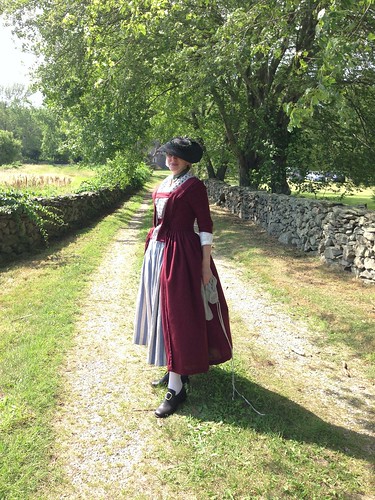
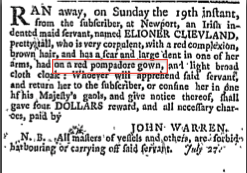
1772 red pompadoreThat leaves me with the New Favorite Gown, which I like, but which is based on an earlier British watercolor, so must be slightly altered at the sleeve or cuff as well as documented. At first I could find nothing to suggest that the color and fabric were within the realm of documentary possibility. Eventually I did find an ad in the Newport Mercury for what might be a likely candidate.

“Ran away on Sunday the 19th instant, from the subscriber at Newport, an Irish indented maid servant, named Elioner Clievland, pretty tall, who is very corpulent, with a red complexion, brown hair, and has a scar and a large dent in one of her arms, had on a red pompadore gown, and light broadcloth cloak: ” Newport Mercury, 8-10-1772

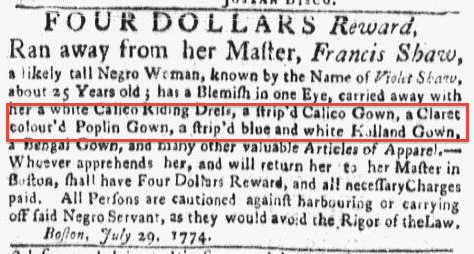
claret poplinTwo years later, “ a likely tall Negro Woman, known by the name of Violet Shaw, about 25 years old; has a Blemish in one Eye, carried away with her a white Calico Riding Dress, a strip’d Calico Gown, a claret colour’d Poplin Gown, a strip’d blue and white Holland Gown, a Bengal Gown, and many other value Articles…” Boston Evening Post, 8-1-1774

Well, I’m tall, and far from 25, but thankfully, I am not corpulent. But here are two wool or wool-blend, gowns, in reddish colors, in the right time period and place. Unfortunately, I have not yet found striped, or striped linsey, petticoats in Rhode Island, Connecticut or Massachusetts in 1772-1775—plenty in Philadelphia, where there are more servants running away—so what to do? I’ll look a damn fool without a petticoat.
brown petticoat newport

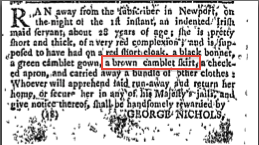
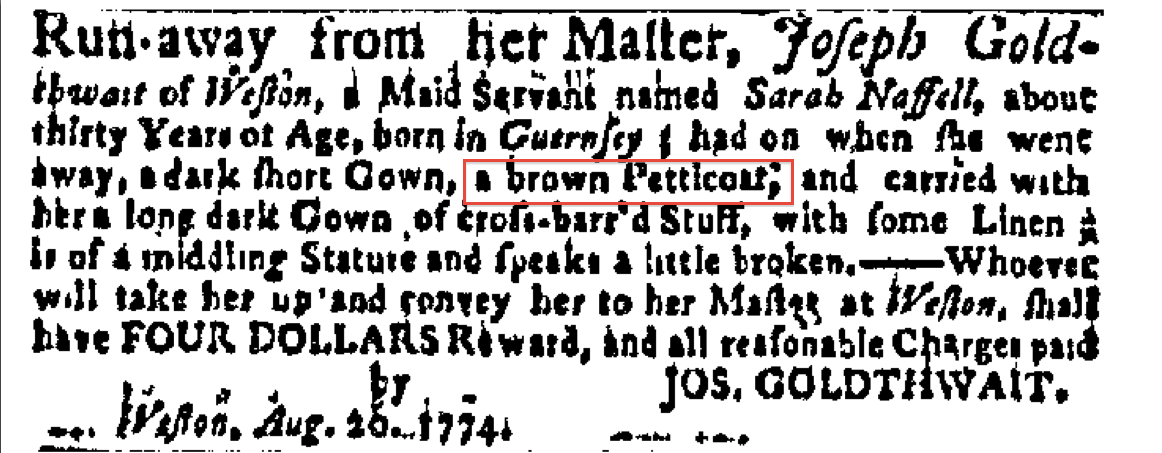
ShortGown There’s the brown petticoat solution. There is one in Boston (Weston), in August, 1774, and another in Newport, in January, 1773. I like the “brown camblet skirt;” I don’t have camblet, but at least the drape of the lightweight wool and cotton will be closer to camblet than to wool. I can agonize over the suitability of fabrics (and the vagaries of style) in some other post.

I made the gown intending to wear it with a blue and yellow striped as-yet-unmade petticoat (to look like the watercolor), but have some brown wool I can make up instead. Better documented than not (or nude).

Share this:

  • Share on Facebook (Opens in new window) Facebook
  • Share on Pinterest (Opens in new window) Pinterest
  • Email a link to a friend (Opens in new window) Email
  • Share on X (Opens in new window) X
Like Loading...

Authenticity: Sources I

09 Friday Aug 2013

Posted by kittycalash in Clothing, Living History, Making Things, Research

≈ 1 Comment

Tags

18th century clothes, authenticity, Clothing, common dress, Costume, fashion, linen trousers, Research, resources, Rhode Island, sewing, style

There he goes!

You know this guy: the reluctant drummer and avid ensign who wants to be in uniform but struggles with the fact that he might be seen by someone. (14 is complicated.) I’ve been mulling over several upcoming events and the comments that swirl around on the Interwebs after any large event, and, as I often do, find my clarity in writing. That means you’ll have to wait till the end of this post or a series to get “answers,” or what pass for them.

One of the things I struggle with is that the kid is not a mannequin. He has stated quite plainly that he feels like I fuss too much over his appearance, when he has nothing to do at events, which leads him to believe that I am fussing over nothing. There’s some truth in that, right: while God and authenticity may be in the details, all is for nought if there’s nothing to do or interpret.

This means I cannot simply dress him up as I see fit, I have to negotiate with him, and keep on eye on what he’ll be doing. And I don’t have the time to make all the lovely things I’d like to make (or not all at once, anyway) so it’s a matter of choosing.

June 21, 1774 Connecticut Courant

Connecticut Courant, June 21, 1774

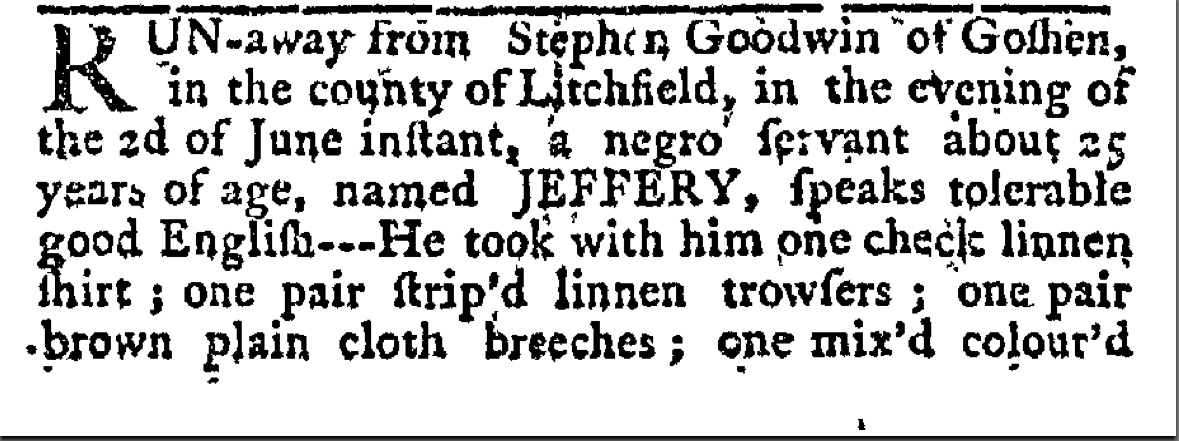
Let’s start with what the kid has already: the blue jacket, checked shirt, neck cloth, breeches, stockings and shoes. I went to the newspapers (the lower sorts’ Vogue) looking for examples of runaways, and found some good ones. On June 21, 1774, an ad was published in the Connecticut Courant for a boy who had run away in a “check linen shirt, pair of striped linen trousers, one pair brown plain cloth breeches…” but the Young Mr wants no part of striped linen trousers, and his breeches are linen, not wool.

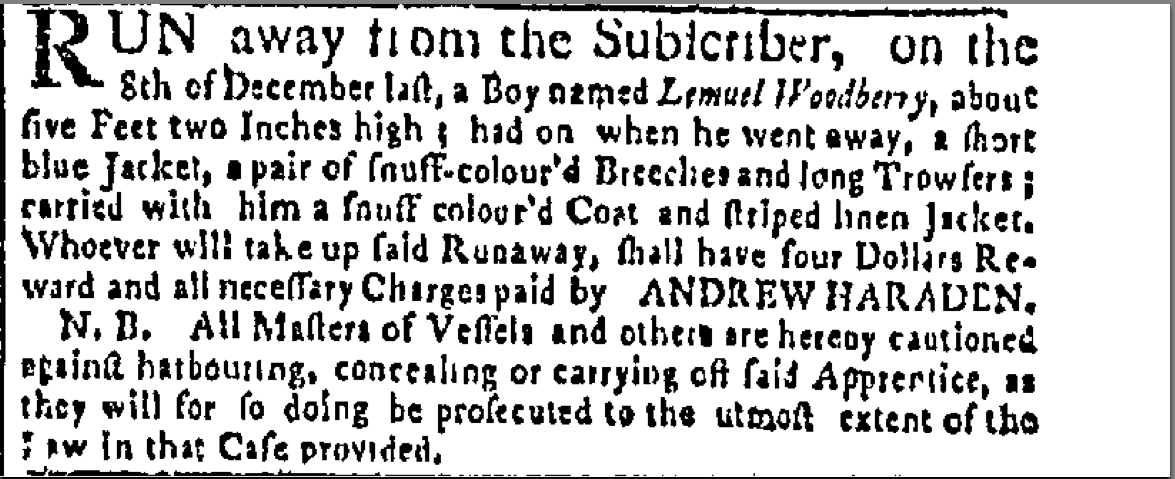
Essex Gazette, January 10, 1775

Essex Gazette, January 10, 1775

On January 3, 1775, the Essex Gazette ran an ad for a boy in a “short blue jacket, snuff colored breeches and long trousers.” Now that’s more like it!

Long trousers sound good to the kid, more “normal” than breeches,  but there’s a jacket in there that would satisfy my stripey love. For the short run, even if I don’t get the trousers made up in the next couple of weeks, he’s reasonably well documented, or at least within the realm of plausible appearances, even if he should be in wool and not linen, and even if one of the best reasons for making trousers is to replace the poorly-fitted breeches.

Kids shouldn’t just get a pass for inauthentic clothing, and children in what are really costumes do make me crazy–probably because I’m hand-sewing clothing for a wily teenager to grow out of, and looking for sources to make sure the choices I make have some form of documentation.

Share this:

  • Share on Facebook (Opens in new window) Facebook
  • Share on Pinterest (Opens in new window) Pinterest
  • Email a link to a friend (Opens in new window) Email
  • Share on X (Opens in new window) X
Like Loading...

Alterations in Force

15 Monday Jul 2013

Posted by kittycalash in Clothing, Living History, Making Things

≈ Comments Off on Alterations in Force

Tags

10th Massachusetts, 18th century clothes, authenticity, common dress, Costume, fashion, Reenacting, sewing

Horrid Green Frock Coat at Birth

Remember this coat? I’ve been attempting to solve this coat for a while. While the Zombie Coat had to be put aside after the tail pleat debacle (what was I thinking? Sewing while tired means hems only, or simple straight seams), I finished up the Horrid Green Frock Coat. It is somewhat less horrid now. Mr S wore it yesterday to be a member of the Jackson’s militia impression of the 10th MA at Longfellow House in Cambridge.

The sleeves were removed and the seam taken in to remove excess material. Perhaps I could have slimmed it a bit more, but it needed to sit the armscye.

The shoulder seam (where back and front join) was also taken in and snugged up twice. The side seams were taken in a great deal from the armscye down, but not enough. To fix the remaining bagginess at the small of the back above Mr S’s hips, I will have to take more out of the front panel, “and work it into the side pleats.” (Easy enough for the Master to say, harder for my brain to figure out.)

Somewhat better, but two more seams to snug.

This is the closest photo to the one above. You can see that the line of the front has been changed and slimmed, and a collar added for stability and style in addition to those cuffs. I also changed the shape of the pocket flaps, and moved them to change the look of the front panels. They don’t have to match the pocket slits, as long as they don’t reveal the slits (one bag is madder linen, I ran out of large pieces of green), so I moved them to change the look of the front.

The mariner’s cuffs were fun. If the Zombie behaves decently this week, I’ll give him mariner’s cuffs on his too-short-blue-wool-sleeves. Well, I’ll probably give him mariner’s cuffs anyway, just so he can get the coat on and off.

On Brattle Street, Cambridge, while it was still “cool.”

And, finally, a full-length view of the coat. It takes more than webbing and belts to reshape a silhouette. It’s taken 13 months from first making that coat to get it to this point. Thanks to an expert’s chalk marks in February, transforming it into something at least wearable was possible, though at first sight, those chalk marks were devastating and overwhelming. It took overalls to get me to face this coat, so thank goodness for the horribleness of overalls.

Share this:

  • Share on Facebook (Opens in new window) Facebook
  • Share on Pinterest (Opens in new window) Pinterest
  • Email a link to a friend (Opens in new window) Email
  • Share on X (Opens in new window) X
Like Loading...

In the Pink

14 Sunday Jul 2013

Posted by kittycalash in Clothing, Making Things, Reenacting, Research

≈ Comments Off on In the Pink

Tags

18th century clothes, Clothing, common dress, Costume, dress, fashion, resources, sewing

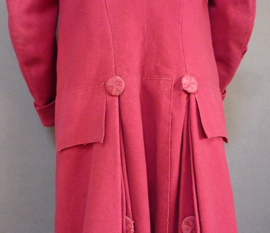
Detail, back pleats

Detail, back pleats

I swear I try to be positive about the mistakes I make. But not only did I discover this morning that I had lost my struggle with spacial processing, now I have found clear imagery to show how I should have handled the pleats on the Zombie Coat. Live, learn, unstitch and restitch: that’s all I can do. Now I have only to decide whether to do the unstitching this weekend, or next week. It will have to be done: now I know the way I’ve done it is wrong, and the master’s eye will be on that mistake and then he will know, and I will know that he knows, and it will just go on from there to tired shame.

Man's wool  coat, 1770s. Meg Andrews.

Man’s wool coat, 1770s. Meg Andrews.

My favorite part of the description is this:

Either the coat was altered for another man or the wearer got fatter! … There is a half moon insertion under the arms… There’s no detail photo of that half-moon insertion, but I do so wish there was. The description notes additional changes: “If you look at one cuff you can see a lighter part of a button shape next to the seam. The cuffs have been removed and then added to the edge of the cuff to lengthen the sleeve.” At least we know garments in the past, even ones as lovely as this, were altered and changed.

Puckering on the Zombie Coat. It’s still a nice blue, and you know what? It fits me, so maybe he’ll lose it to his refugee mother.

I will probably be inserting shapes of various kinds into the Zombie Coat, since I do now have a diagnosis for this puckering at the shoulder blades. “Viewed from the back and sides, it appears that the sleeve is binding on the front of his shoulder, causing pulling across the back shoulders – the puckers are caused by the stretching of the fabric across the rounding of the back and shoulders. If you make the top of the upper sleeve wider, or raise the shoulder cap it will create more fullness over the top of the sleeve and reduce the binding that is translating down the sleeve and across the back.”

By the time I make the changes I need to, the Zombie Coat will have acquired its own pre-history.

Share this:

  • Share on Facebook (Opens in new window) Facebook
  • Share on Pinterest (Opens in new window) Pinterest
  • Email a link to a friend (Opens in new window) Email
  • Share on X (Opens in new window) X
Like Loading...
← Older posts
Newer posts →

Archives

wordpress statistics

Creative Commons License
Kitty Calash blog by Kirsten Hammerstrom is licensed under a Creative Commons Attribution-NonCommercial-ShareAlike 4.0 International License.

Website Built with WordPress.com.

  • Subscribe Subscribed
    • Kitty Calash
    • Join 621 other subscribers
    • Already have a WordPress.com account? Log in now.
    • Kitty Calash
    • Subscribe Subscribed
    • Sign up
    • Log in
    • Report this content
    • View site in Reader
    • Manage subscriptions
    • Collapse this bar
 

Loading Comments...
 

    %d