• Home
  • Completed Costumes/Impressions
  • Emma and Her Dresses
  • Free Patterns and Instructions

Kitty Calash

~ Confessions of a Known Bonnet-Wearer

Kitty Calash

Category Archives: Clothing

Wrap it up, I’ll take it

20 Tuesday Feb 2018

Posted by kittycalash in Clothing, Living History, Making Things, Museums, Research

≈ 7 Comments

Tags

Anna Maria Garthwaite, banyan, handsewn, I sew for money, museum replica, Robert Feke, sewing, silk, wrapping gown

To be honest, I would love to wrap my self up and take this silk, but it is for a museum to display, so instead the box is wrapped and ready to ship.

I was lucky to be included in a message group started by a friend asking if any of us had a banyan or wrapping gown to loan. Well, no… but I can make one!

So I did.

Banyan or wrapping gown
in silk designed by Anna Maria Garthwaite

My version is based on this 1750-1760 example at the Victoria and Albert Museum, of silk designed by Anna Maria Garthwaite ca. 1740-1750. To be honest, this is one of my favorite gowns, despite the fact that it bears no practical relationship to any part of my daily or living history life. A girl can dream, though…

Just a little bit scary, despite being able to get more silk if I really messed up.

In particular, I like the way the style combines the t-shape of a basic banyan with the pleats used to shape European women’s gowns. Tricky, right?

Ann Shippen Willing, oil on canvas by Robert Feke, 1746. Winterthur Museum Museum purchase with funds provided by Alfred E. Bissell in memory of Henry Francis du Pont. 1969.0134 A

I made a pattern in muslin (it took two) primarily by draping, reading the V&A description, and looking at the original images as large as I could get them. By the time I had a pattern, I was mostly convinced, but still intimidated by the silk. I’ve had my eye on this ever since I saw at the local store, for it reminded me strongly of the Anna Maria Garthwaite silk worn by Ann Shippen Willing (Mrs. Charles Willing) of Philadelphia in this portrait by Robert Feke.

In the interest of economy, I machine sewed the long seams and the interior (lining) pleats, though I would not if I wear to make this for myself. Once the main seams were done, I pleated and pinned again.

IMG_3400
IMG_3409

Then it was time for my one of my favorite activities, hand-stitching pleats. It’s impressive how the look of a garment changes (and improves) as you continue to work on it. The fullness of the gown with the inserted pleats is pretty impressive and very satisfying to wear. It sounds fabulous as it moves with your body.

Front...
Front…
back, and side...
back, and side…
just before packing.

Once the gown is fully dressed on a mannequin (that is, over a shift and petticoat), I know it will assume the more correct shape of the green gown at the V&A– it looks better even on me, although it is too small, being made for a mannequin representing an 18th century woman.

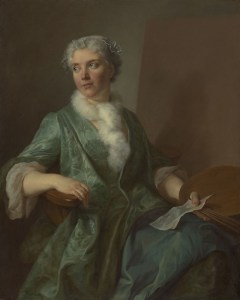
Portrait of a Woman Artist, c. 1735
Oil on canvas
40 x 32 5/16 in. (101.7 x 82 cm)
Restricted gift of Mrs. Harold T. Martin in honor of Patrice Marandel, 1981.66
Art Institute of Chicago

Along the way, I found another green silk wrapping gown or banyan, this time worn by a French artist.I can guarantee you I would never wear silk to paint in, but your mileage may vary, and if I had a maidservant and unlimited cash in 1760, perhaps I would emulate the Mademoiselle at left.

Share this:

  • Share on Facebook (Opens in new window) Facebook
  • Share on Pinterest (Opens in new window) Pinterest
  • Email a link to a friend (Opens in new window) Email
  • Share on X (Opens in new window) X
Like Loading...

Compare and Contrast

28 Sunday Jan 2018

Posted by kittycalash in Clothing, Events, Living History, Reenacting

≈ Comments Off on Compare and Contrast

Tags

18th century clothes, 18th century clothing, Boston Massacre, Bostonian Society, Events, living history, women's history, women's work

2016's 1770
2016’s 1770
2018's 1770
2018’s 1770

Boston Massacre planning is underway for everyone involved at every level, including me.

I’ve made changes to what I plan to wear, in part because I have a newer gown that fits better and keeps me warmer, and because I have learned more, and looked at more, in the intervening time. Since 2016, I’ve made/upgraded a quilted petticoat (in a bronze silk, a color documented to Rhode Island quilted ‘coats), settled in to wearing my cap tied under my chin, and made both a new apron and a new bonnet.

2017's 1777
2017’s 1777
2018's 1770
2018’s 1770

Cap and bonnet shape and shoes help make time period distinctions between 1777 and 1770; if I could find the wool I made the gown from, I would add the cuffs it desperately needs. The heeled shoes skew earlier than 1770, but they are the only heeled shoes I have….if the weather is wretched, I will wear the flats for safety and comfort.

2016's Bonnet
2016’s Bonnet
2018's Bonnet
2018’s Bonnet

The bonnet, which I affectionately call “Lampshade,” is meant to have the shape of pre-1770 bonnets as seen in Sandby’s illustrations, and which I have been working on for a while.

Martha Collins, Thomas Sandby’s Cook. watercolor on paper by Paul Sandby, 1770-1780. RCIN 914339

I know from reading the standards that the understanding of mitt material has evolved, and my time this morning looking for an elusive apron shape raises questions for me as well. Here’s Martha Collins, painted by Paul Sandby. What’s that black thing on her arm? A mitt? An arm warmer? Is it knit, or woven? There’s always more to figure out, and more to make.

Cuffs on my gown don’t seem like a big enough deal to warrant buying wool for a whole new gown (with only six weeks to go), so my choices are live with no cuffs, alter the red gown of 2016’s event to fit properly, or initiate an extensive search for the scraps left over from the green gown…which may or may not be buried in storage. Tick tock.

Share this:

  • Share on Facebook (Opens in new window) Facebook
  • Share on Pinterest (Opens in new window) Pinterest
  • Email a link to a friend (Opens in new window) Email
  • Share on X (Opens in new window) X
Like Loading...

Squirrel!

28 Tuesday Nov 2017

Posted by kittycalash in Clothing, Living History, Making Things, Reenacting

≈ Comments Off on Squirrel!

Tags

18th century clothes, 18th century clothing, authenticity, common dress, sewing, squirrels, waistcoat, winter

It’s astonishing to me, in a way, that I haven’t posted about this before, but shockingly, I have not. Remember the need to keep warm in Princeton? Tested on at Ti? A compromise?

I updated that garment and wore a nearly-completed version at Ti last February but never wrote about the new version: the Squirrel Waistcoat.

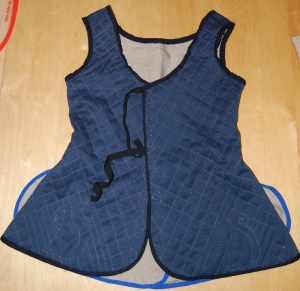
Wool hand-quilted to a wool backing and lined with wool, I wore this almost finished at Fort Ti last February, and found it comfortable and cozy. I had imagined its state to be far worse than it was: with a lining in need of piecing, mangled seams, your worst nightmare come true. But no: all it really needed was some binding adjustment, not surprising considering that I stitched the binding by candlelight while chattering away with friends over cider.

The back pieces weren’t bound at all, but because I’d imagined this needed so much more work than it did, I put it aside until now, when I know I will want it for a weekend in Trenton, and another at Ti in December. All it took was a little time, and accepting that the bindings will not match.

DSC_0831
DSC_0826 7.41.36 PM

This wasn’t a long, involved project, really, though I spent lunch hours and evenings working on it last January and February. It is, as so many things are, about patience. Patience and good needles.

The construction was based on the quilted waistcoat I made two years ago, with a pattern derived from Sharon Burnston’s research, using fitting adjustments I’d made to an earlier jacket pattern (long since abandoned due to living in New England).

I don’t fully remember how it fits best, over or under my stays, but I’ll get a couple of opportunities to test drive the layers in the next two weeks. And in the meantime? Squirrel!

Share this:

  • Share on Facebook (Opens in new window) Facebook
  • Share on Pinterest (Opens in new window) Pinterest
  • Email a link to a friend (Opens in new window) Email
  • Share on X (Opens in new window) X
Like Loading...

Gathering Thoughts

25 Saturday Nov 2017

Posted by kittycalash in Clothing, Living History, Making Things, Research

≈ 1 Comment

Tags

apron, classes, Paul Sandby, Research, sewing, sewing project

Someone must watch the baggage.

You only live once, as they say, so you might as well enjoy yourself, and have a nice apron while you’re at it.

At last I have finished the one I made to serve as a demonstration model for the apron class I taught for Crossroads of the American Revolution. Plain, unbleached linen (osnaburg), it will be a good, serviceable garment well suited to getting dirty through use. There’s a lot to be said for filth, and my first-ever apron has acquired a fine patina of stains and wear.

Paul Sandby RA, 1731–1809, British, London Cries: A Girl with a Basket on Her Head ("Lights for the Cats, Liver for the Dogs"), ca. 1759, Watercolor, pen and brown ink, and graphite on medium, cream, slightly textured laid paper, Yale Center for British Art, Paul Mellon Collection
Paul Sandby RA, 1731–1809, British, London Cries: A Girl with a Basket on Her Head (“Lights for the Cats, Liver for the Dogs”), ca. 1759, Watercolor, pen and brown ink, and graphite on medium, cream, slightly textured laid paper, Yale Center for British Art, Paul Mellon Collection
Paul Sandby RA, 1731–1809, British, London Cries: "Do You Want any Spoons...", ca. 1759, Watercolor, pen and brown ink and graphite on medium, cream, slightly textured laid paper, Yale Center for British Art, Paul Mellon Collection
Paul Sandby RA, 1731–1809, British, London Cries: “Do You Want any Spoons…”, ca. 1759, Watercolor, pen and brown ink and graphite on medium, cream, slightly textured laid paper, Yale Center for British Art, Paul Mellon Collection

So why make a new one, aside from needing a teaching aid? Especially when you already HAVE a checked apron that’s looking used, and you have others in your wardrobe: why? One reason was the sheer cussedness of making the plainest, dullest, least-pretty item as finely and carefully as I could. Another was that the more I looked for apron data and examples, the more I noticed plain linen aprons. Yes: the preponderance of aprons are check, but looking at Sandby again made me realize that plain was documented, and under-represented in living history.

Sandby shows working women in checked and in blue aprons, but he also seems to depict women in plain, unbleached linen aprons, particularly the women in the street scenes. All the more reason to make up a plain apron, when your preference is portraying the urban underclass.

DSC_0811
DSC_0824

It’s also a good chance to hone one’s skills and keep in practice when you’re avoiding sewing the things that need sewing, like new shifts. And a basic project is meditative in a way that a new pattern is not: making stitches small and even is to sewing what scales are to piano playing or singing.

The first supervised apron I ever made is described here, and I’m pleased that my skills have improved since.

DSC_0825
DSC_0826

Stroke gathers are worth practicing, since they’re used on shifts and shirts as well as aprons; I’ve even used them on early 19th century garments to evenly distribute fine cotton lawn across the back of a gown. Sharon Burnston explains them here. I don’t know that there’s any one “trick” to them aside from patience and even stitches, but that “trick” will take you far in assembling pretty much every hand-made garment.

Share this:

  • Share on Facebook (Opens in new window) Facebook
  • Share on Pinterest (Opens in new window) Pinterest
  • Email a link to a friend (Opens in new window) Email
  • Share on X (Opens in new window) X
Like Loading...

A Vision in Vermillion

22 Friday Sep 2017

Posted by kittycalash in Art Rant, Book Review, Clothing, History

≈ 3 Comments

Tags

18th century clothing, american art history, art history, British Army, fine art, John Copley, uniforms

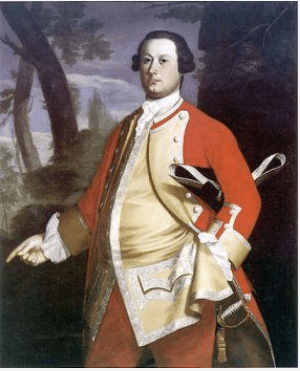
Lt. Joshua Winslow, oik on canvas by John Singleton Copley, 1755. Santa Barbara Museum of Art.

Or scarlet, as the case may be.

I’m reading Jane Kamensky’s “A Revolution in Color: The World of John Singleton Copley,” and just 56 pages in, I’m annoyed.

Writing about Copley’s success at painting military officers during the 7 Years War, currently at the Santa Barbara Museum of Art, though not online, Kamensky says of the 1755 portrait of Joshua Winslow:

“Hanging in his quarters at Fort Lawrence, Winslow’s portrait in uniform would have served as a subtle reminder of his valuable connections. Copley’s three-quarter-length portrait lavishes attention on the young officer’s silver lace and pulsing red coat, a uniform more elaborate than the one he likely wore. The painter seemingly delights in the play of light upon shining surfaces, from the buff-colored sateen pulled taut across Winslow’s ample waist to the golden braid and tassel dangling from his silver-hilted sword.” (pp 56-57; emphasis added.)
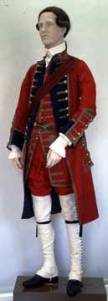
1760-65 Uniform of Captain Thomas Plumbe of the Royal Lancashire Militia.

I missed that bit about sateen last night when I read this aloud to Drunk Tailor, so let’s roll back to the part that first set me off: the young officer’s silver lace and pulsing red coat, a uniform more elaborate than the one he likely wore.

Ahem.

Here’s the 1760-65 uniform of the 1st Royal Lancashire Militia as worn by Captain Thomas Plumbe.  “The oldest, most complete, British army uniform in the world, similar to the pattern worn at the Battle of Culloden in 1746 and in the Wars of American Independence.”

Granted, Plumbe’s uniform is later than Winslow’s portrait, and Plumbe was a Captain and Winslow a Lieutenant, but the difference between them is rather less than, say, a private and a captain. Why does Kamensky assume that Winslow’s uniform is not the one he wore? Is it the lace? Winslow held a commission, and served as paymaster and commissary, roles Kamensky describes as “relatively modest.” Yes, Lieutenant isn’t Colonel; it’s the baby of officers, but it’s still commissioned officer and reasonably responsible (and, one might imagine, relatively remunerative if one was hooked into the Boston mercantile network). And uniforms were ornamented with tape, in gold, silver, or wool– see below, in Morier’s painting of two privates. (I further wonder whether it’s reasonable to describe a portrait of 50″ x 40″ as subtle, but perhaps it was placed in an enormous room.)

Privates, 119th (Prince’s Own) Regiment of Foot, 1762-3. Oil on canvas by David Morier. RCIN 406873 Royal Collection Trust/© Her Majesty Queen Elizabeth II 2017

From Winslow, Kamensky moves to Brattle. “As his personal, military, and commercial fortunes rose in tandem, Brattle commissioned Copley to portray him in a fanciful uniform nearly identical to the one in Joshua Winslow.” (p 58 emphasis added)

William Brattle, oil on canvas by John Singleton Copley, 1756. Harvard Art Museums/Fogg Museum, Partial Gift of Mrs. Thomas Brattle Gannett and Partial Purchase through the generosity of Robert T. Gannett, an Anonymous Donor and the Alpheus Hyatt Purchasing Fund 1978.606

Fanciful? Fancy to our eyes, yes. Fanciful, no. Brattle was eventually a Major-General, so the uniform portrayed here, when he was likely a captain (same rank as Plumbe), seems pretty reasonable. If we were considering replicating a Massachusetts officer’s uniform ca 1755, we would consider Brattle and Winslow’s biographies and ranks, compare the two portraits of two men, probably both captains at this time, and, cross-referenced with Plumbe’s amazingly extant uniform and the 1751 warrant, begin to form an opinion that we would be making a coat in scarlet superfine broadcloth faced with buff, with buff small clothes, gold tape, and domed buttons. (Sateen is a weave structure, and wool sateen was not used in military uniforms.)

But that’s now how Kamensky is approaching this, of course, and why would she? She’s a historian, not a curator, material culture person, or a reenactor. Why does she assert that the uniforms worn by Winslow and Brattle are fanciful, and “more elaborate” than what they wore– without a footnote to back that assertion? And why does she then describe Major George Scott’s portrait “as the meticulously rendered uniform of his parent regiment, The Fortieth Foot” in contrast to “the fanciful, half-imagined costumes of Winslow and Brattle”? (p 58)
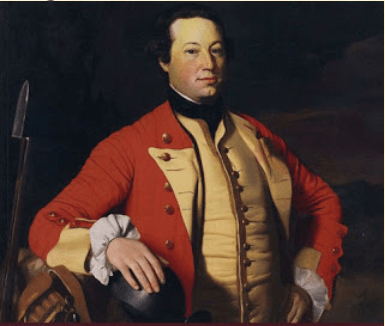
Major George Scott (detail), oil on canvas by John Singleton Copley, 1755-58. Private Collection

The sitters’ biographies are footnoted, but nothing appears in the notes about the uniforms. Kamensky makes a great leap to the “fanciful,” which I find curious, considering that most male portraits are rendered carefully if flatteringly, and many female portraits are made for the male gaze, and are more likely to be “fanciful” or “fancy dress.”

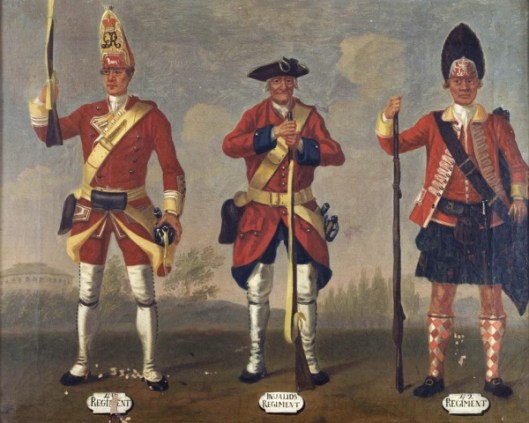
Grenadiers, 40th Regiment of Foot, and Privates, 41st Invalids Regiment and 42nd Highland Regiment, 1751. Oil on canvas by David Morier, 1751. RCIN 405589 Royal Collection Trust/© Her Majesty Queen Elizabeth II 2017

We are fortunate to have the David Morier image of a grenadier of the 40th to compare with the slightly later Scott portrait; I like the grenadier’s belly box, which appears on the left of Scott’s portrait and is described by Kamensky as “”tricked out for foul-weather fighting.” (p 59) Did I miss something? Were belly boxes and cartridge boxes once flap-free? I stumble over “tricked out,” too, which seemed to betray a particular lack of interest in understanding what Copley was portraying.

I find myself wondering how it is that historians and art historians can write so confidently about images without understanding the material depicted. It’s as if they are all context and no content, while many reenactors/costumers favor content over context. In any case, having encountered these speed bumps in the book, I’ll certainly be reading it with a dose of skepticism when portraits are dissected.

Adam Stephen’s Waistcoat and Gorget
Date: ca. 1754
Catalog #: 12197; 12199 gorget Accession #: 52984
Credit: Division of Military History and Diplomacy, National Museum of American History

Edited to add: Drunk Tailor reminded me after I posted this that the NMAH possesses an actual officer’s waistcoat from the 1750s. Here’s the General History note in the online exhibit: “In 1755, the officers of the Virginia Regiment received orders from Washington to provide themselves with a “Suit of Regimentals” of good blue cloth. The coat was to be faced and cuffed in scarlet and trimmed with silver; they were to wear blue wool breeches and a scarlet wool waistcoat with silver lace.”

Scarlet wool waistcoat with silver lace. Sure does resonate with those portraits of Winslow and Brattle, and makes me all the more uncomfortable Kamensky’s assertions of “fanciful” depictions.

Share this:

  • Share on Facebook (Opens in new window) Facebook
  • Share on Pinterest (Opens in new window) Pinterest
  • Email a link to a friend (Opens in new window) Email
  • Share on X (Opens in new window) X
Like Loading...
← Older posts
Newer posts →

Archives

wordpress statistics

Creative Commons License
Kitty Calash blog by Kirsten Hammerstrom is licensed under a Creative Commons Attribution-NonCommercial-ShareAlike 4.0 International License.

Website Built with WordPress.com.

  • Subscribe Subscribed
    • Kitty Calash
    • Join 621 other subscribers
    • Already have a WordPress.com account? Log in now.
    • Kitty Calash
    • Subscribe Subscribed
    • Sign up
    • Log in
    • Report this content
    • View site in Reader
    • Manage subscriptions
    • Collapse this bar
 

Loading Comments...
 

    %d