• Home
  • Completed Costumes/Impressions
  • Emma and Her Dresses
  • Free Patterns and Instructions

Kitty Calash

~ Confessions of a Known Bonnet-Wearer

Kitty Calash

Category Archives: Events

History Camp Next Weekend!

21 Saturday Mar 2015

Posted by kittycalash in Events, History, History Space, Living History, Museums

≈ Comments Off on History Camp Next Weekend!

Tags

conference, history, History Camp, History Space, living history

Gradient--Boston2015

Where will you be on March 28th, now that the LTB muster is cancelled? How about HistoryCamp 2015? You can register here for free if you volunteer or for a nominal fee otherwise.

You can check out sessions here, but I know there’s a really good one on living history…because I’ll be presenting along with Elizabeth Sulock of Newport Historical Society in the Risky Business: Living History Events in Tradition Museums session. There’s a lot of other good stuff, too, so if you’re in the area, why not register so you can check it out?

Share this:

  • Share on Facebook (Opens in new window) Facebook
  • Share on Pinterest (Opens in new window) Pinterest
  • Email a link to a friend (Opens in new window) Email
  • Share on X (Opens in new window) X
Like Loading...

An Afternoon in N’port

15 Sunday Feb 2015

Posted by kittycalash in Events, History, Living History, Museums, Reenacting

≈ 4 Comments

Tags

#WalkNPT, 1820s, 19th century, 19th century clothing, common people, Costume, dress, Events, Kitty Smith, living history, millinery shop, Nathaniel Sweet, Newport, Newport Historical Society, Rhode Island history, Whitehorne House

IMG_3041

New coat!

I set off for Newport yesterday to spend the day at Whitehorne House with Sew 18th Century. I was pleased to have my coat, and pleased as well to see the ads for “lead colored pelisse cloths” at Nathaniel Sweet’s shop at 112 Cheapside in N’port. Everything fits better when you have some documentation.

We occupied the kitchen at Whitehorne House, interpreting the lives of mythical maids and cousins Eliza and Kitty Smith.

DSC_0607

The Whitehorne Kitchen

We hope to save enough to reopen our millinery shop, which flourished once in Salem just a few years ago. Times are hard in Newport, but there are some promising lotteries–a $10,000 prize in the Kennebec Bridge lottery and an incredible $25,000 prize in the New York Literature Lottery! We will have to save our wages to buy even one ticket– difficult to do with so many tempting’ wares in the shop–but the rewards would well worth our efforts.

A shop on Thames Street is to let not far from the Great Friends Meeting House. We think ’tis a fine location, for while Friends may be plain, they are well dress’d. One of our visitors offered to spread the rumor that the shop is haunted, so no one else will rent it, but I worry that such a tale might drive off custom.

DSC_0611

Gingerbread, bread-and-cheese and apples form’d our repast

Visitors called from as far away as New Jersey, New York and Connecticut, but found Mr Whitehorne at the Coffee House and Mrs Whitehorne out makin’ calls. As prominent citizens, they are busy about the town. Mrs Whitehorne is well-known for her receipts, and we were pleased to offer callers a sample of her fruited gingerbread. Indeed, ’tis delicious, though not as sticky as the late Mr S preferred.

Some visitors thought our plan to invest in woolen mills was a fine idea, and in addition to the mills on the island (there is one in Portsmouth), we hear there are several in Hartford. Providence has not the monopoly on industry she imagines.

DSC_0615

There is much washin’ and mendin’

The laundry does pile up in a household of seven children, and since we have run out of wood, I suspect the laundress has as well. The island is short of lumber now, and wood must come from Swansea. Still, there is always mending’ to be done.

Perhaps if we had known how many visitors would call, I might have taken more care in tidyin’ up the kitchen. ‘Twas a surprise to see so many, from so far away, but we do think N’port is due for a revival. ‘Tis a busier day of visitin’ than I was accustomed to in winter at the farm on Poppasquash Neck, but with Mr Smith now dead, and our lad on a brig in the coastal trade, we could not keep the lease. I am grateful to my cousin for helpin’ me find work in such a lovely house.

IMG_3043

Share this:

  • Share on Facebook (Opens in new window) Facebook
  • Share on Pinterest (Opens in new window) Pinterest
  • Email a link to a friend (Opens in new window) Email
  • Share on X (Opens in new window) X
Like Loading...

A Valentine’s Puzzle Purse

14 Saturday Feb 2015

Posted by kittycalash in Events, History, Living History, Making Things, Museums

≈ 2 Comments

Tags

1820s, 19th century, common people, living history, Making Things, Museums, Newport, Rhode Island, Rhode Island history

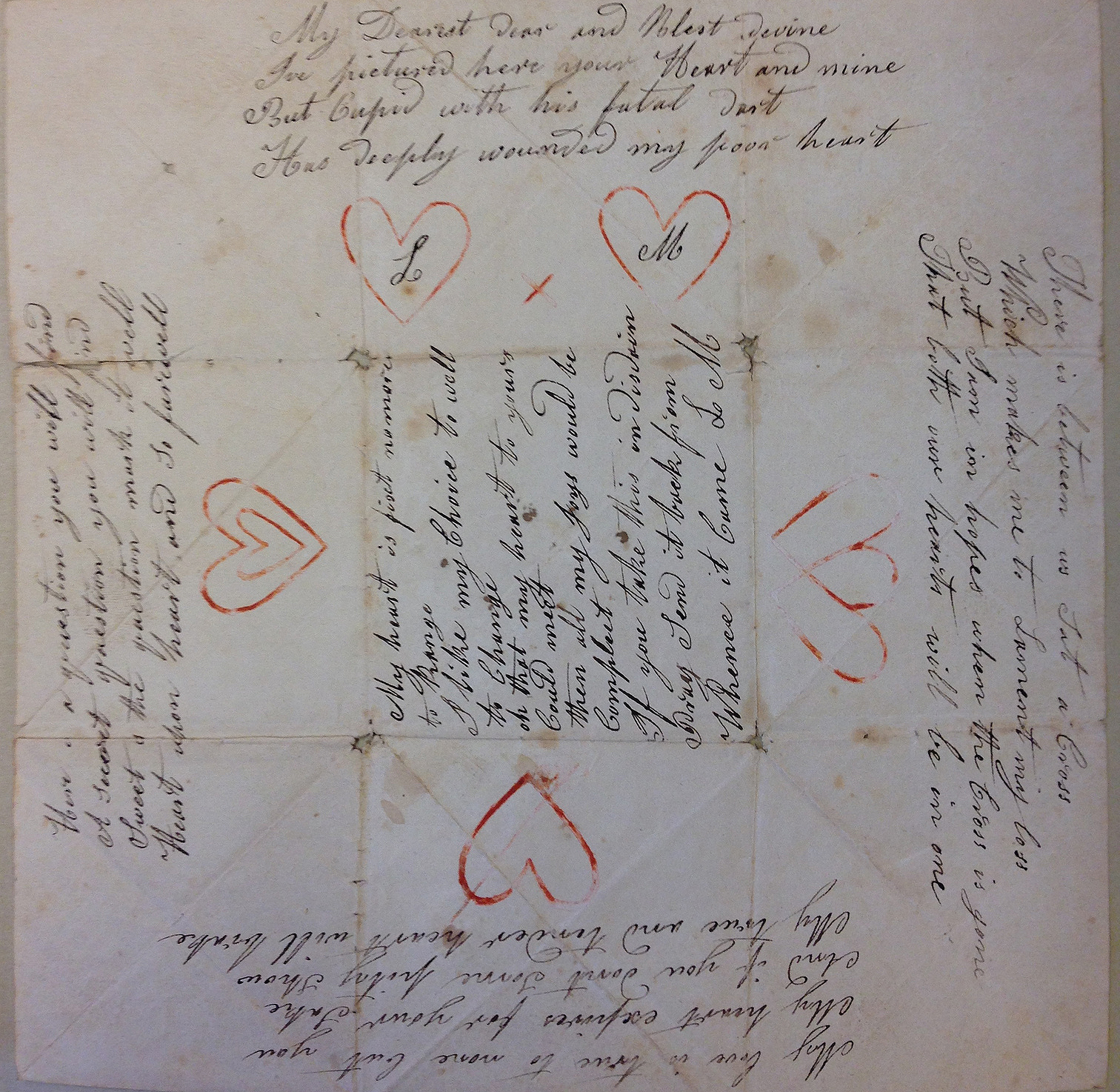
Puzzle Purse Valentine. RIHS Graphics Collection Lot 42

Puzzle Purse Valentine. RIHS Graphics Collection Lot 42

Here’s a nifty little thing you can make: A puzzle purse. This is from the collections of the Rhode Island Historical Society, but the form seems to have been fairly common; I know I’ve seen other fancifully-folded letters.

Because I’ll be spending Valentine’s Day in 1820, I thought I’d try to replicate this token. News on how it turned out later… I don’t feel clever enough to write my own verse, but here is the Rhode Island example transcribed.

My love is true to none but you
My heart expires for your sake
And if you don’t me pity show
My true and tender heart will brake

Here a question you will find
A sweet question you will find
Sweet is the question mark it well
Heart upon heart and so farewell

My Dearest dear and Blest Devine
I’ve pictured here your Heart and mine
But Cupid with his fatal dart
Has deeply wounded my poor heart

There between us sat a Cross
Which makes me to Lament my loss
But I am in hope when the Cross is hone
That both our hearts will be in one

My heart is fix’t no more to Range
I like my Choice to well to Change
Oh that my Heart to yours could meet
Then all my joys would be compleast
If you take this in disdain
Pray send it back from
Whence it Came L M

Share this:

  • Share on Facebook (Opens in new window) Facebook
  • Share on Pinterest (Opens in new window) Pinterest
  • Email a link to a friend (Opens in new window) Email
  • Share on X (Opens in new window) X
Like Loading...

Peale’s Progress, or, High on History

08 Thursday Jan 2015

Posted by kittycalash in Events, History, Living History, Philosophy, Reenacting

≈ 2 Comments

Tags

18th century, authenticity, common soldier, Events, interpretation, living history, New Jersey, Philadelphia Associators, Reenacting, Revolutionary War

No, we didn’t go, and I have regrets. Six weeks before the event, I thought I was working on January 3rd, and by the time the schedule changed, it was too late. Instead, you can read about Drunktailor’s experience.

Reenactors portraying Philadelphia Associators take part in the real time tour of the Battle of Princeton, Princeton, NJ, January 3, 2015. Beverly Schaefer, Times of Trenton

Reenactors portraying Philadelphia Associators. Beverly Schaefer, Times of Trenton

The background is interesting, similar to the kind of events and projects we’ve been talking about here in RI: site- and time-specific events that combine commemoration, history, and experimental archaeology, or an emotional and social archaeology, if you will.

From event co-organizer Dave Niescior, quoted in the Rutgers-Camden News Now: “The goal is to gain a better understanding of the hardships endured by individuals who lived and made a critical moment in history.It is one thing to write ‘the troops marched overnight to Princeton,’ it is yet another to understand what that physically and mentally meant to the men who had to put one foot in front of the other all night long.” Co-organizer Matt White told NJ.com, “We’re trying to stage a number of vignettes to give people a sense of what was going on in the Continental Army in this period between late December and early January of 1776 and 1777.”

that’s cold. From Daily Reenactor

These and other collected images help convey a sense of the event,  which–as far as I can tell– did provide participants with the kind of transcendent experience I know I enjoy and hope to find at events.

This is the kind of event that I think proves a belabored (and elsewhere belittled) point: accuracy matters. It is just about ALL that matters.

On a now-defunct phone, I had an old video of the Young Mr with a now-deceased reenactor of whom I was quite fond, despite our wildly divergent politics. In it, Mr D shows his Charleville to the Young Mr on the front porch of an 18th century home and asks, “Do you know what this is?” The Young Mr shakes his head, and Mr D answers, “It’s a time machine.”

Although I remain committed to reducing the degree to which living history is musket-centric, there’s truth in that statement: Mr D had an original, period Charleville and a fairly well-cut uniform, considering his generous figure. Using, showing, and interpreting actual period pieces and well-made, correct replicas is the single best way to connect the present, and the public, to the past. Accuracy matters because it’s the literal key to the past: you have to cut the pattern right.

Accurate impressions rendered in a place of shared value will transport you to the past, and give you insights you did not expect. That is the point of these exercises: insight and understanding. It’s how to get high on history.

Share this:

  • Share on Facebook (Opens in new window) Facebook
  • Share on Pinterest (Opens in new window) Pinterest
  • Email a link to a friend (Opens in new window) Email
  • Share on X (Opens in new window) X
Like Loading...

Good Enough Coat

05 Monday Jan 2015

Posted by kittycalash in Clothing, Events, Living History, Making Things, Research

≈ 3 Comments

Tags

1820s, 19th century clothing, fashion, fashion plates, Federal style, greatcoat, sewing, sewing project, style, tailoring, winter, winter coat

The great coat is nice, but how ’bout them gaiters?

Winter is firmly here, with the snow, fog and ice that marks the season in the Ocean State. It’s not fun weather for living in the past, though there’s not a lot of that happening right now. Even so, there’s a February program on the horizon and what better excuse for fastening on a garment and making it?

Even if I’ll likely spend the day in a kitchen interpreting life below stairs in 1820 (while the light infantry occupies my living room and denudes my kitchen), an early 19th century event on a winter weekend seemed a worthwhile excuse for making a greatcoat, and, eventually, gaiters.

IMG_2733

With no pattern, and only 2 and 3/4 yards of thick, soft, grey double faced wool*,  I’m adapting my standard Spencer pattern. I didn’t upsize this too much, because women didn’t have frock coats and waistcoats to wear under their greatcoats or Carrick [carriage?] coats or Reding cotes. (I’m too engrossed with sewing to parse garment names.) The skirts will be attached at the waist, with a belt to hide the seam. At my height, cutting a back in one piece takes yardage I do not possess. Happily, the Taylor’s Instructor describes Redingcoats or Habits for women with attached skirts.

It's a new collar shape.
It’s a new collar shape.
IMG_2732

The collar shape diverges from my usual 1790s collar, and is based on another fashion plate, this time from 1815. The program I’ll be doing with Sew 18th Century is set in 1820. As a maid, I think an 1815 coat is pushing it a bit, since red wool cloaks hold up well, but I’ll take any excuse for some tailoring, I suppose.

1815, with a round collar that can stand up.

I plan to use this button arrangement, too, stylish as it is in not-quite-double breasted. Bring on the button-making– we all have to go death’s head sometime, and this wool is too thick for covered buttons without much heartbreak.

IMG_2735
IMG_2736

The lower front pins are there from the moment when I realized the front was hanging strangely — because I had neither marked nor sewn the bust darts. That oversight, and the pain in my ear, do suggest that the delightful cold I’ve had for weeks may be affecting me more than I think– but that’s just another argument in favor of a cozy wool coat.

IMG_2737

The sleeve pattern (again, not upsized) is once again the old standby two-piece sleeve from Henry Cooke’s 1770s unlined man’s frock coat, so of course it fits well.

I’m hoping to stitch up the sleeves this evening, and set them later this week. I’m still pondering lining materials– there’s just enough silk “persian” to do the body and sleeves–but I have some twilled wool that would increase the warmth and still provide some ‘slip’ in the sleeves.

And those blue gaiters? They’ll come in time, from the scraps of blue wool a friend is making his first ditto suit from. I’ll spot him some remnant table chintz for a summer waistcoat, and expect greater sartorial splendor will grace the spitting stamp inspector in Newport this August in exchange for my blue wool ankles.

*Holy burned hair smell, Batman! Mr Cooke’s right when he says this almost feels like foam, but put a flame to it, and you might as well be smoking sheep.

Share this:

  • Share on Facebook (Opens in new window) Facebook
  • Share on Pinterest (Opens in new window) Pinterest
  • Email a link to a friend (Opens in new window) Email
  • Share on X (Opens in new window) X
Like Loading...
← Older posts
Newer posts →

Archives

wordpress statistics

Creative Commons License
Kitty Calash blog by Kirsten Hammerstrom is licensed under a Creative Commons Attribution-NonCommercial-ShareAlike 4.0 International License.

Website Built with WordPress.com.

  • Subscribe Subscribed
    • Kitty Calash
    • Join 621 other subscribers
    • Already have a WordPress.com account? Log in now.
    • Kitty Calash
    • Subscribe Subscribed
    • Sign up
    • Log in
    • Report this content
    • View site in Reader
    • Manage subscriptions
    • Collapse this bar
 

Loading Comments...
 

    %d