• Home
  • Completed Costumes/Impressions
  • Emma and Her Dresses
  • Free Patterns and Instructions

Kitty Calash

~ Confessions of a Known Bonnet-Wearer

Kitty Calash

Category Archives: History

Reflecting Fashion

21 Thursday Jan 2016

Posted by kittycalash in Clothing, History, Museums, Research

≈ 1 Comment

Tags

fashion plates, Federal style, frock coats, menswear, miniatures, portraits, tailoring

Whilst serving as the commandant for a research-paper writing prison*, I spent some time perusing the Met’s digital collections, in particular the Costume Institute’s collection of Men’s Fashion Plates, because, you know, stuff.

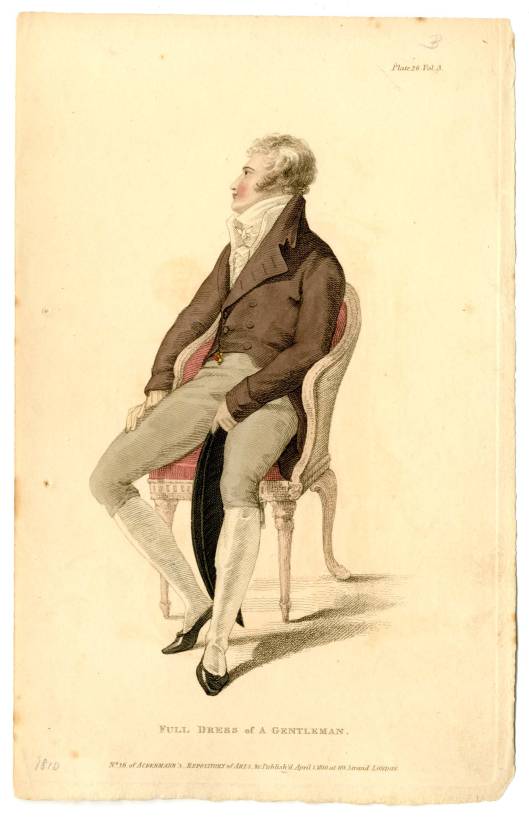
Men's Wear 1790-1829, Plate 002, 1807. Gift of Woodman Thompson Costume Institute Fashion Plates Metropolitan Museum of Art
Men’s Wear 1790-1829, Plate 002, 1807. Gift of Woodman Thompson Costume Institute Fashion Plates Metropolitan Museum of Art
John Myers. Oil on canvas by Thomas Sully, 1814. MFA Boston 45.894 Gift of Maxim Karolik for the M. and M. Karolik Collection of American Paintings, 1815–1865

I stopped at Plate 002, because I knew I’d seen that coat somewhere before. Why, yes: at the MFA in the Art of the Americas Wing, where I recently spent a pleasant afternoon with the Drunk Tailor. After some initial joy at discovering dust on a teapot, we got down to the business of setting off proximity alarms, reading labels, and contemplating  the occasional neck stock.

Mr Myers stopped me, though: what a handsome coat. High shoulder seams, long cuffs, buttoned all the way up. Nifty high-waisted grey trousers, too, and what seems to be a yellow waist coat. The portrait is dated 1814, and the fashion plate 1807.
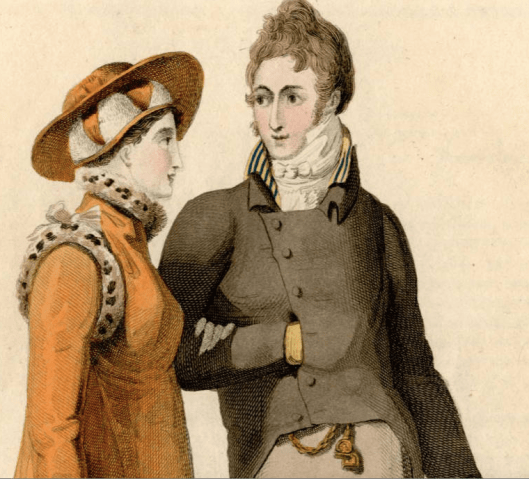
Detail, 1807 fashion plate

Detail, 1807 fashion plate

Hmmmm…

Men's Wear 1790-1829, Plate 005, 1807. Gift of Woodman Thompson, Metropolitan Museum of Art

Men’s Wear 1790-1829, Plate 005, 1807. Gift of Woodman Thompson, Metropolitan Museum of Art

The brown M-notch collar coat is clearly a thing in 1807. It’s popular in 1802. So popular. 1802 on the left. On the right, 1812.

Portrait of a Gentleman of the Society of the Cincinnati. Miniature by James Peale, American, 1802. Philadelphia Museum of Art, 2000-137-11
Portrait of a Young Man by James Peale, 1812. Philadelphia Museum of Art, 1944-47-1


And our friend Sully paints one in 1814.

After seeing Copley and other early American painters use English prints as references for portraiture, I wondered if Sully was at all influenced by fashion plates, and then to what degree American men and their tailors were influenced by published fashion plates.

Portrait of the Artist. Thomas Sully, 1821. Metropolitan Museum of Art, 94.23.3

Brown coats are clearly classic: Sully’s got one himself in 1821. I’m sure there’s a dissertation out there somewhere on the influence of fashion plates on American men’s  fashion and representation in portraiture–  I can almost remember stumbling across the reference. So that echoes and re-echoes and reflects through time even as I recall not just the the folk wisdom about brown suits, but the significance of well-tailored suit. Maybe from 1802-1821, brown is the new black.


*Ah, teenagers. The Young Mr failed to complete a paper by the due date, so I spent some quality time ensuring he got back on track.

Share this:

  • Share on Facebook (Opens in new window) Facebook
  • Share on Pinterest (Opens in new window) Pinterest
  • Email a link to a friend (Opens in new window) Email
  • Share on X (Opens in new window) X
Like Loading...

Transparent Visions

20 Wednesday Jan 2016

Posted by kittycalash in History, Living History, Philosophy

≈ 1 Comment

Tags

authenticity, history, interpretation, living history, watercolor, watercolors

With armloads of cash, the NPYL has, as I’m sure you know, digitized thousands of items which are now available on a ridiculously procrastination-worthy (it’s research, I tell you) site.

Carl H. Pforzheimer Collection of Shelley and His Circle, The New York Public Library. (1795 - 1834). Portrait silhouette.

Carl H. Pforzheimer Collection of Shelley and His Circle, The New York Public Library. (1795 – 1834). Portrait silhouette.

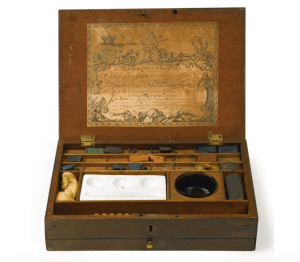
In my current quest for watercolor boxes and miniature inspiration, I found the Anne Wagner album particularly interesting. The pages in the book compile verses, mottoes, collages, locks of hair, and a portrait silhouette. In all likelihood, Anne Wagner had a watercolor box not unlike this one coming up at Sotheby’s on Thursday.

Lot 738, Sotheby's Sale N09466 REGENCY MAHOGANY PAINT BOX BY W. REEVES & WOODYER, FIRST QUARTER 19TH CENTURY

Lot 738, Sotheby’s Sale N09466
REGENCY MAHOGANY PAINT BOX BY W. REEVES & WOODYER, FIRST QUARTER 19TH CENTURY

Every young lady of some means would have had a watercolor box suited to her station (they came in a variety of sizes), and young ladies with leisure time occupied themselves with diaries, commonplace books, amateur silhouettes, and paintings. Diana Sperling is one of the better-known examples of amateur artists, with drawings occasionally appearing at auction. The best of these watercolors give us a literally transparent look at the long 18th century from inside.

 May 25th. Henry Van electrifying - Mrs Van, Diana, Harry, Isabella, Mum and HGS. Dynes Hall.

May 25th. Henry Van electrifying – Mrs Van, Diana, Harry, Isabella, Mum and HGS. Dynes Hall.

Museums try to connect the people of the past to the people of the present, and sometimes in focusing on similarities critical differences are missed.

It’s not just that the people of the past accepted racism, slavery, and sexism. They literally saw the world differently. I’ve watched contemporary amateur artists try to recreate the imagery of the past, and it’s hard. I wonder, as I try my own had at the task, if we can manage it. Color sensibilities were different; taste was different (checks from hell, remember?). My own style is more graphic and bold than an 18th or 19th century artists’– more Fairfield Porter than Edward Malbone.

Carl H. Pforzheimer Collection of Shelley and His Circle, The New York Public Library. (1795 - 1834). Threaded shells.

Carl H. Pforzheimer Collection of Shelley and His Circle, The New York Public Library. (1795 – 1834). Threaded shells.

We are, each of us, products of our environment and our time. Can we really recreate the past? We can dress correctly, carry the right stuff (or almost no stuff at all), but how can we overcome our own thought barriers, our own vision? I think it’s by attempting that effort that we can do better at replicating the past whether we try in four dimensions, or in two– and acknowledge the unbridgeable gap to the past.

Share this:

  • Share on Facebook (Opens in new window) Facebook
  • Share on Pinterest (Opens in new window) Pinterest
  • Email a link to a friend (Opens in new window) Email
  • Share on X (Opens in new window) X
Like Loading...

Objectification

14 Thursday Jan 2016

Posted by kittycalash in History, Museums, personal, Philosophy, Reenacting

≈ 3 Comments

Tags

chairs, historic house museums, historic interiors, interpretation, living history, Museums, objects

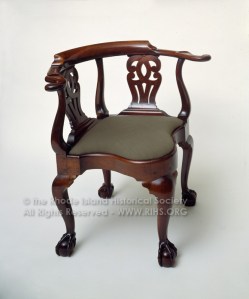
Corner chair. Mahogany with fabric-covered slip seat. John Goddard, 1763. RIHS 1990.36.1 RHix5136

Corner chair. Mahogany with fabric-covered slip seat. John Goddard, 1763. RIHS 1990.36.1 RHix5136

I’ve had more alone time than usual at work, which is to say, I’ve been the only living creature in 16,000 SF for multiple consecutive days, which allows me both time to get lots of work done but also permits my mind to wander more than it might otherwise. One of the ideas I continually return to is about the objectification of objects. That’s a terrible phrase, isn’t it? What is the essential thingness of any given thing?

Let’s take chairs: I really like chairs, which is to say that I have, at last, succumbed to the seductive qualities of chairs.[i] But what makes a chair a chair?

Most simply, a chair is to be sat upon. Keeps your rump off the cold, cold ground. Supports your legs and back. Sometimes a chair is for lolling. Sometimes it’s for working. Sometimes it’s for projecting power. But essential, a chair is for sitting.

If use– specifically human use[ii]– is what chairs are for, what happens when a chair is removed from use, and placed on display in a museum?[iii] And what difference does it make whether that chair is on a white plinth in an art museum, or in a historic house, or in the historic house where it was used? When is a chair most a chair, other than the times you are sitting in one?

As I said: a lot of alone time.

servant mannequin in 18th century room

That’s no ghost, that’s my kid. Corner chair just in front of the ghost.

Within a historic house, it seems that the ideal situation is the chair in the room in the house.

That would seem to maximize the “realness” of the thing, right? But we don’t always have the chair, and even when we do, we may not know which room it was used in most often.

The way a chair is displayed and understood in an art museum: Object of Beauty is very different from the way a chair is displayed and understood in a history: Who Sat Here? It’s a conundrum though, because just as the chair become Beautiful Thing in an art museum, it can become Story from the Past in a history museum. Neither presentation/interpretation really gets at Chairness, which is really best experienced by sitting in the chair yourself.

Did I mention I spend a lot of time alone with objects?

Storeroom, Rhode Island Historical Society. RHix17 399

Storeroom, Rhode Island Historical Society. RHix17 399

The way that I think these questions about Chairness relate to living history is by realizing that just as museums fetishize objects on white pedestals, living history interpreters/reenactors sometimes fetishize objects without contextualizing them. You know: Muskets. Clothes. Spinning Wheels.[iv]

Putting the chair in the room where it was used gives it context, and the visitor a new perspective that wouldn’t be gained from a white pedestal, or from the curb. The same is true of the things that we carry as interpreters. Context matters. It’s how meaning is derived and understood. Like repetition, isolation can rob an object—or a person—of meaning. Not that I’m lonely. I have all those chairs, after all.

____________________________

[i] Not to get too weird, though: I won’t rhapsodize (yet) about the sensual curve of a chair leg, or a delicate, finely-turned ankle, as I have heard some (fetishistic?) curators so. Yet: there’s still time.

[ii] Sorry cats: chairs were not actually made for you. Now get down!

[iii] If you know anything about art history and theory, you can probably guess which decade I was in graduate seminars.

[iv] My *favorite* thing to see in a military setting.

Share this:

  • Share on Facebook (Opens in new window) Facebook
  • Share on Pinterest (Opens in new window) Pinterest
  • Email a link to a friend (Opens in new window) Email
  • Share on X (Opens in new window) X
Like Loading...

High Style/Low Brow

08 Friday Jan 2016

Posted by kittycalash in Collecting, History, Research

≈ 3 Comments

Tags

18th century, american art history, art history, auctions, Clothing, Costume, history, interpretation, paintings, Robert Feke, Sotheby's

It’s auction season again, the best one of all: the major Americana sales and the Winter Antiques Show in New York. I won’t be at any of the exhibitions or sales, which is just as well for me; my friends know the twitchy “must-touch” finger motion that means I need to leave my wallet and checkbook in wiser, saner hands.

Still, even if we can’t buy, we can learn. This time around, I was delighted by the juxtaposition of two pre-1750 paintings in the Sotheby’s sales.

First, the ever-delightful Robert Feke’s portrait of Mrs Tench Francis.

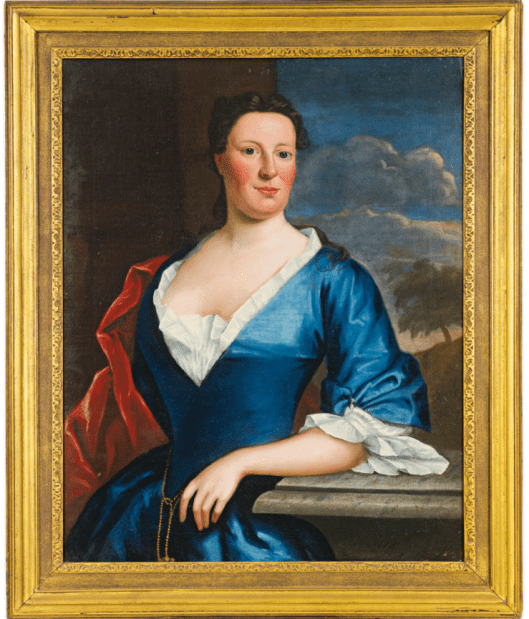
Robert Feke (1707 - 1752) PORTRAIT OF MRS. TENCH FRANCIS In what appears to be the original frame; Bears a label on the back of the frame: Mr. Willing, Bryn Mawr. Painted circa 1746. Label on the back of the stretcher: Philadelphia Museum of Art, Robert Feke, Portrait of Mrs. Tench Francis, 11-1969-2. Lender: Mr. E. Shippen Willing, Jr. Oil on canvas 36 by 28 1/2 in. Sotheby's Sale N09456 Lot 1595

Robert Feke (1707 – 1752)
PORTRAIT OF MRS. TENCH FRANCIS
In what appears to be the original frame; Bears a label on the back of the frame: Mr. Willing, Bryn Mawr.
Painted circa 1746.
Label on the back of the stretcher: Philadelphia Museum of Art, Robert Feke, Portrait of Mrs. Tench Francis, 11-1969-2. Lender: Mr. E. Shippen Willing, Jr.
Oil on canvas
36 by 28 1/2 in.
Sotheby’s Sale N09456 Lot 1595

Francis. Shippen. Willing. This thing is DEEP in the history of Philadelphia, and by my fave 18th century RI painter.

But does she Remind you of anyone? Like a Smibert, maybe? Or perhaps it’s a Copley?

Mrs Samuel Browne by Smibert, RIHS 1891.2.2
Mrs Joseph Mann by Copley, MFA Boston, 43.1353

It was a THING, that blue silk gown business with a red silk wrapper. Better yet? This one:

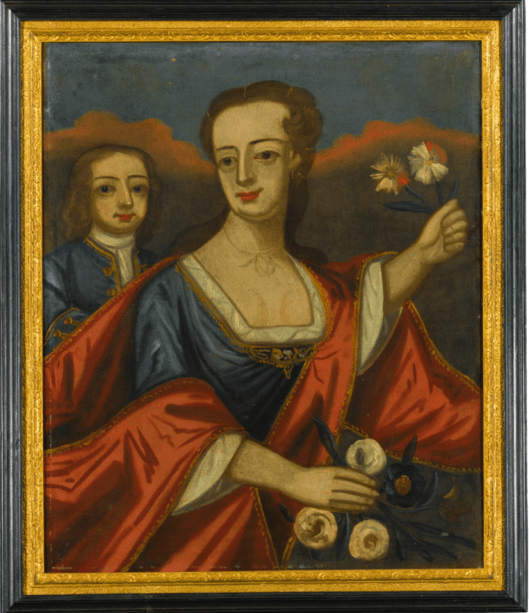
Attributed to J. Cooper 1685 - 1754 WOMAN WITH YOUNG BOY Appears to retains its original frame attributed to J. Cooper. oil on canvas 30 in. by 25 in. CIRCA 1715. Sotheby's Sale N09466, Lot 398

Attributed to J. Cooper 1685 – 1754
WOMAN WITH YOUNG BOY
Appears to retains its original frame attributed to J. Cooper.
oil on canvas
30 in. by 25 in.
CIRCA 1715. Sotheby’s Sale N09466, Lot 398

What I love about the J. Cooper is how crude it is: that painting looks more like a woolwork picture than a painting. But that vernacular adaptation tells us how prevalent this portrait style was, and how desirable.

Share this:

  • Share on Facebook (Opens in new window) Facebook
  • Share on Pinterest (Opens in new window) Pinterest
  • Email a link to a friend (Opens in new window) Email
  • Share on X (Opens in new window) X
Like Loading...

Lysistrata on the Lake (and elsewhere)

07 Monday Dec 2015

Posted by kittycalash in Fail, History, Living History, Philosophy, Reenacting

≈ 7 Comments

Tags

authenticity, feminism, history, interpretation, living history, progressive reenacting, women's history, women's work

Let me be clear: Fort Ti was amazing. It was everything I’d hoped for. Far away, made of stone, populated with people I like, with an event cleared of all the crap that makes me crazy.

File_000 copy

The issues that enrage me are both societal and hobby-specific.

While boys were boys and women were women this past weekend, I found myself tired out by biologically deterministic behaviour. For the love of Christ, you can listen to a woman, not talk over her or interrupt her even if:

a) she is not your boss or mother
and/or
b) you do not want or expect to sleep with her.

Gentlemen: we are human beings as smart as- if not smarter– than you. If we are smarter, society has taught us to manage that for you, so you won’t feel <ahem> small. I know that what men fear most is humiliation (the bravest ones will admit it) and what women fear most is violence (it’s true).

But a woman’s interest in history, or even military history, should be as joyous to you as your male friend’s interest.

So why the shouty?
Why the taking over of the conversation?
Why the relegation of women to a separate bench?
Why am I pointing this out?

Well… because even some of the best progressive reenactors have trouble getting past uber-traditional gender roles.

I get it, really, I do. I am accustomed to being a woman in a (hyper manly) man’s world.

I studied sculpture in college in the Dark Ages and I know from male-dominated fields. I ran a foundry in grad school, and a bunch of mostly-male work study students. I’m an owner’s rep for construction projects, and work with a lot of different contractors and construction workers.

But that doesn’t mean I have to like it or tolerate it, as any of my history, art, or construction associates will tell you. My younger counterparts have even less tolerance than I do, so I advise you to listen up, think about gender roles, gun shows, assault/predation and interpretation or consider Lysistrata the future you have earned.

It’s really simple.

You like living history?
We like living history.

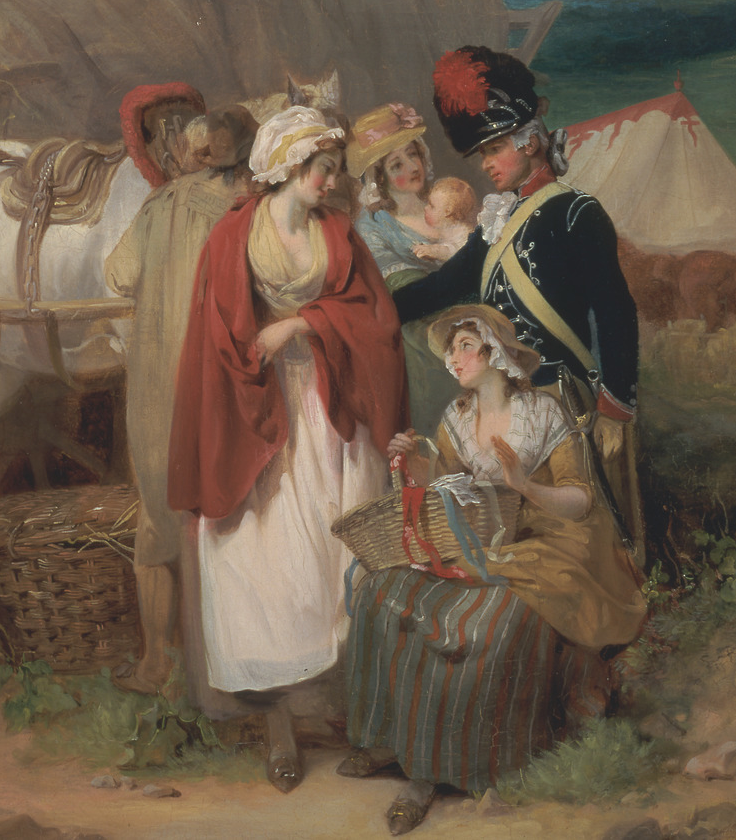
Francis Wheatley, 1747-1801, British, Soldier with Country Women Selling Ribbons, near a Military Camp, 1788, Oil on canvas, Yale Center for British Art, Paul Mellon Collection

Francis Wheatley, 1747-1801, British, Soldier with Country Women Selling Ribbons, near a Military Camp, 1788, Oil on canvas, Yale Center for British Art, Paul Mellon Collection

Let’s play together better to more accurately represent the past without replicating crappy gender relations. If you start listening and stop interrupting, we’ll stop laughing at you.

Share this:

  • Share on Facebook (Opens in new window) Facebook
  • Share on Pinterest (Opens in new window) Pinterest
  • Email a link to a friend (Opens in new window) Email
  • Share on X (Opens in new window) X
Like Loading...
← Older posts
Newer posts →

Archives

wordpress statistics

Creative Commons License
Kitty Calash blog by Kirsten Hammerstrom is licensed under a Creative Commons Attribution-NonCommercial-ShareAlike 4.0 International License.

Website Built with WordPress.com.

  • Subscribe Subscribed
    • Kitty Calash
    • Join 621 other subscribers
    • Already have a WordPress.com account? Log in now.
    • Kitty Calash
    • Subscribe Subscribed
    • Sign up
    • Log in
    • Report this content
    • View site in Reader
    • Manage subscriptions
    • Collapse this bar
 

Loading Comments...
 

    %d