• Home
  • Completed Costumes/Impressions
  • Emma and Her Dresses
  • Free Patterns and Instructions

Kitty Calash

~ Confessions of a Known Bonnet-Wearer

Kitty Calash

Category Archives: History

Generation Gap

03 Friday Apr 2015

Posted by kittycalash in History, Living History, Philosophy, Reenacting, Research, Thanks

≈ 5 Comments

Tags

18th century, authenticity, interpretation, living history, Reenacting, Research, resources, Revolutionary War

Early gal trooping. I insisted on a frock coat and actual breeches.

Early gal trooping: Sam Adams, pre-beer.

Historiann has an interesting take on the scholarly study of the American Revolution:

I think it will take a fresh generation with no memories of the 1970s to revolutionize studies of the American Revolution. What do the rest of you think, those of you who remember the 1970s as well as those of you who don’t?

Historiann is riffing on a piece over at the Junto, on whether cultural historians have lost the American Revolution.

You know what this reminds me of?

Why, yes: The Progressive Movement and Various Backlashes in Revolutionary War Reenacting. (Supply caps and fonts as you like).

Now, Drunk Tailor is not specifically saying the same thing here but he is making a generational point.

They are half my age and already exceed me in sewing skill. They find new cultural nuggets I have never seen before.

I’ll see your camp kitchen and raise it a malnourished goat and acorns. (image from Drunk Tailor)

And that– younger people are finding new things–reminds me of Historiann’s post.

I could say we’re all standing on the shoulders of giants, but it is more about perspective, different ways of looking, and openness. The schisms are not just generational, but philosophical.

None of these breaks fall neatly, of course, but crack and splinter along desires and motivations. As long as you are willing to keep learning and changing (i.e. researching and making) then you’ll keep pushing at the edge of the interpretive envelope and that can only help push understanding of all kinds forward.

Share this:

  • Share on Facebook (Opens in new window) Facebook
  • Share on Pinterest (Opens in new window) Pinterest
  • Email a link to a friend (Opens in new window) Email
  • Share on X (Opens in new window) X
Like Loading...

History Camp Next Weekend!

21 Saturday Mar 2015

Posted by kittycalash in Events, History, History Space, Living History, Museums

≈ Comments Off on History Camp Next Weekend!

Tags

conference, history, History Camp, History Space, living history

Gradient--Boston2015

Where will you be on March 28th, now that the LTB muster is cancelled? How about HistoryCamp 2015? You can register here for free if you volunteer or for a nominal fee otherwise.

You can check out sessions here, but I know there’s a really good one on living history…because I’ll be presenting along with Elizabeth Sulock of Newport Historical Society in the Risky Business: Living History Events in Tradition Museums session. There’s a lot of other good stuff, too, so if you’re in the area, why not register so you can check it out?

Share this:

  • Share on Facebook (Opens in new window) Facebook
  • Share on Pinterest (Opens in new window) Pinterest
  • Email a link to a friend (Opens in new window) Email
  • Share on X (Opens in new window) X
Like Loading...

Glaciers in the House

19 Thursday Mar 2015

Posted by kittycalash in History, Museums

≈ 6 Comments

Tags

historic house museums, historic interiors, history, interpretation, museum practice, Museums

IceDamFeb2015

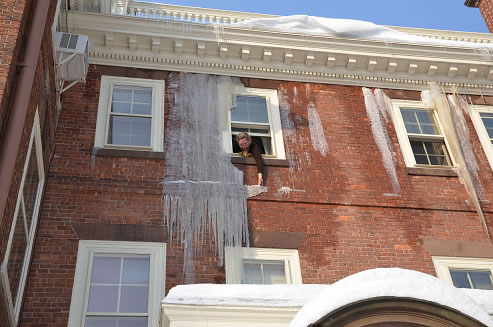
I don’t mean the ice dams and icicles that plagued the house and streaked the service ell’s windows as they melted: I mean change.

I’m reading The Half Has Never Been Told (it kept selling out, so I only just got a copy), and thinking about the representation of a past that people would rather forget, and sometimes actively deny in the North– and the South, as you will tell from reading African-American History Fail.

Change in historic houses can be glacially-paced, as staff and docents alike resist changes to interpretation. Resistance to change is usually about comfort and confrontation, especially when the change is large.

I get that: Oh no, new stuff to learn. What was wrong with what we did before? But docents and staff get comfortable and loose sight of the context of the content they present. They say some interesting stuff.

Most jaw-dropping of all: Sometimes I like to pretend I’m Mrs Owner of the House. That one was creepy, to me. But it did give me some insight into the “ooh, wish I lived here” backwardly aspirational tour motivation.

How would you feel if living here meant you owned and traded slaves? Defended the slave trade in Congress? If a small girl had the care of your horses? We don’t ask those specific questions, but I think we need to. Slavery is slavery.

In the 1790 census of Rhode Island, there are 948 slaves, representing 1.3% of the population. That would be 13,000 people of Rhode Island’s total population today, less than the city of Central Falls (19,383 in the last census, and one of our smallest towns).

We think it’s a small number, but to those 948 people, being enslaved was everything. I don’t necessarily want to make our visitors feel personal guilt about slavery– that’s up to them–but I do want to them to think about what slavery meant, and what it did, as an economic system.

I want visitors to understand that the beauty of the house they see is built in part on the ugly and forced exploitation of a class of people. If they relate that to the rest of the world they inhabit today, even better. I think we owe at least this much to every site where enslaved people worked or lived.

Share this:

  • Share on Facebook (Opens in new window) Facebook
  • Share on Pinterest (Opens in new window) Pinterest
  • Email a link to a friend (Opens in new window) Email
  • Share on X (Opens in new window) X
Like Loading...

Lighting Out for the Territories

10 Tuesday Mar 2015

Posted by kittycalash in Art Rant, History, personal

≈ 2 Comments

Tags

19th century, George Caleb Bingham, Karl Bodmer, landscape, light, Missouri River, paintings, weather

I don’t know about you, but the end of winter often seems harder than the beginning: will this ever end? The snow begins to melt, the dirt turns to mud and you’re walking on ice suspended in pudding. It’s claustrophobic.

George Caleb Bingham (American, 1811–1879). Boatmen on the Missouri, 1846. Oil on canvas. Gift of Mr. and Mrs. John D. Rockefeller 3rd. Fine Arts Museums of San Francisco, 1979.7.15

George Caleb Bingham (American, 1811–1879). Boatmen on the Missouri, 1846. Oil on canvas. Gift of Mr. and Mrs. John D. Rockefeller 3rd. Fine Arts Museums of San Francisco, 1979.7.15

The weather turns here and the lid finally comes off the sky and reveals that blue above and I think of the vistas of the west, the fields that open up along the rivers of the center of this continent, the fields rough with corn stubble punctuated by trees that pass your car window like drum beats in a song, so regular.

I wonder about the people in the past, wonder what they thought and knew about. Of course it was different for the uneducated and the poor then as now, but if you were wealthy, oh, the places you could go.

Karl Bodmer (Swiss, 1809-1893),  White Castles on the Missouri , 1833  watercolor on paper, 9 x 16 3/8 in.; 22.86 x 41.59 cm  gift of Enron Art Foundation, Joslyn Art Museum, 1986.49.176

Karl Bodmer (Swiss, 1809-1893),
White Castles on the Missouri , 1833
watercolor on paper, 9 x 16 3/8 in.; 22.86 x 41.59 cm
gift of Enron Art Foundation, Joslyn Art Museum, 1986.49.176

At the dawn of time back in Missouri, I never had the pleasure to hold but I did get to order 8×10 color transparencies* of things as wonderful as the Karl Bodmer watercolors of the trip he took up the Missouri River, and George Caleb Bingham’s Fur Traders Descending the Missouri.

Art history classes will teach you to recognize painters and images, styles and eras, but they won’t teach you the kind of seeing you can only get by being in the same place at the same time in the same light.

Fur Traders Descending the Missouri. Oil on canvas, George Caleb Bingham, 1845. Metropolitan Museum of Art, 33.61

Fur Traders Descending the Missouri. Oil on canvas, George Caleb Bingham, 1845. Metropolitan Museum of Art, 33.61

Far from the wide Missouri, I have to be content with images in books and the internet, but I can tell you from looking: Bingham got it right. The sky really does look like that above those rivers and plains; the light is rosy and grey at once, the river swift and glassy. I don’t know how it works, I only know how happy it makes me.

Come, spring: bring us the river and the light.

*Yes, and we had the printers run separations and then FedExed them to other museums for approval. Can you imagine!

And, if you’re handy to the place, the St Louis Art Museum (SLAM) is having a Bingham show. 

Share this:

  • Share on Facebook (Opens in new window) Facebook
  • Share on Pinterest (Opens in new window) Pinterest
  • Email a link to a friend (Opens in new window) Email
  • Share on X (Opens in new window) X
Like Loading...

Wrestling with Myself

08 Sunday Mar 2015

Posted by kittycalash in Fail, History, Living History, Making Things, personal, Philosophy, Reenacting

≈ 5 Comments

Tags

authenticity, common dress, common people, everyday, first person interpretation, first world problems, interpretation, living history, Meriwether Lewis, ordinary people, Reenacting, William Clark, William Clark Papers

Hard choices!

Hard choices!

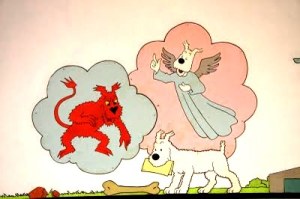
I wrestle a lot with myself, which sounds much sexier and more athletic than it is, when it’s your patience and conscience. It’s a constant fight with my own brain and animal nature, like Snowy pondering a bone.

  • It’s hard to keep sewing for an ever-taller young man who refuses almost all attempts at fitting. (Especially when your calloused fingertips and split thumb keep catching on the silk buttonhole twist.)
  • It’s hard to have program ideas and then realize you will end up as the maid, serving a meal to a group including some people you might not like. (Don’t you think that must be a fairly authentic emotion, historically?)
  • It’s hard to put aside plans for your first pretty silk dress because someone doesn’t want to go where you want to go.
  • It’s hard to embrace the importance and meaning of interpreting the ordinary in a culture that celebrates the unique.

I come to that and stop: mission.

I'm a bad maid. Watercolor by Thomas Rowlandson, 1785? Lewis Walpole LibraryDrawings R79 no. 7

Watercolor by Thomas Rowlandson, 1785? Lewis Walpole LibraryDrawings R79 no. 7

You can take anything too far, of course, and an occasional silk gown and turn around a dance floor might make being the maid a little easier, but in the end I know that what’s important to me is representing the people who have been forgotten.

That same impulse may be part of what drives the splintering into ever-smaller groups with every-different coats, but walking the cat back also leads me to think that lace, tape, and shiny buttons may be part of the equation, too. Are those uniforms the gents’ equivalent to cross-barr’d silk sacques? As in any culture, it is easier to have your cake and eat it, too if you’re a guy.

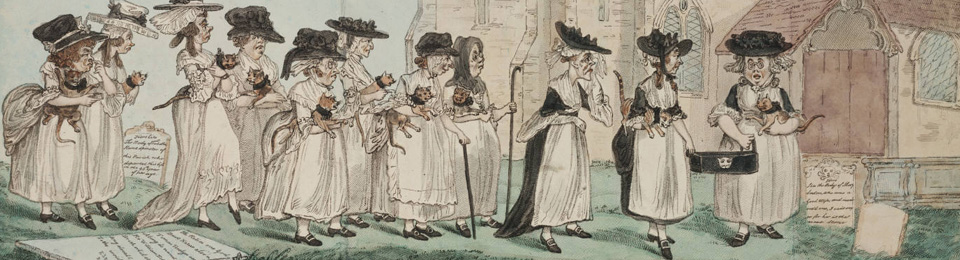
For most of us women inhabiting the past, if we’re not baking cake, we’re serving it.

Playing the game at quadrille : from an original painting in Vauxhall Gardens. London : Robert Sayer, ca. 1750. Lewis Walpole Library, 750.00.00.14

Playing the game at quadrille : from an original painting in Vauxhall Gardens. London : Robert Sayer, ca. 1750. Lewis Walpole Library, 750.00.00.14

It’s a funny thing to want a break from work you find important, but as with anything, variety and perspective are important.

She looks wistful, doesn't she? The others are whist-full.

She looks wistful, doesn’t she? The others are whist-full.

In a world of individualists, each trying to stand out, quotidian celebrities– cast a skeptical glance at your social media feed and tell me I’m wrong–our impulse may not be to inhabit the background. But most of us are the background. We’re large only in our own minds, stars of the movies of our lives that flicker past our eyelids. And that’s ok: that’s noble, even, to live a small, thoughtful life.

 Silver Pocket Watch of Meriwether Lewis, 1936.30.5

Silver Pocket Watch of Meriwether Lewis, 1936.30.5

Once upon a time, when I worked in Missouri, I was fortunate enough to spend a lot of quality time with some amazing artifacts.

Meriwether Lewis’s refracting telescope.

William Clark’s compass.

Meriwether Lewis’s pocket watch.

William Clark’s Account with John Griffin for thread, cloth and other articles including a hat for George and shoes for Mary. (July 1820, William Clark Papers, B13/F5, MHS)

Account of expenses in “horse keeping,” 1829- 1831. Request to Clark to pay to Mrs. Ingram, with request to serve as receipt. On same document: ADS Dashney to Major Graham, 26 June 1826. Order to pay William C. Wiggins. (1831 Dec 13, William Clark Papers, B14/F2, MHS).

There are letters to one of Clark’s sons, trying to get him to stay at West Point. There are bills for bolts and iron work for Clark’s house. Yes: there are amazing things in the collection as well, and historians of all kinds can do amazing work in the papers.

But they are ordinary. They are daily life played out in the first third of the nineteenth century in St. Louis, bills and accounts punctuated by letters from famous people and news of wars and explorers. But after processing the family’s collection, what struck me more than anything was how ordinary they were, how quotidian.

Meriwether Lewis in Indian dress. engraving after St. Memin, 1807.

Meriwether Lewis in Indian dress. engraving after St. Memin, 1807.

Lewis was fabulous, interesting and mysterious. I don’t know what really happened on the Natchez Trace, but I know what happened in St. Louis. William Clark kept living, paying his bills and stumbling sometimes, refusing a role as territorial governor before accepting it. He got boring. And for that, I love him more than Lewis.

There’s real value in interpreting the everyday, ordinary people, in bringing work and working people to life in the past. I don’t always love repressing my ego, but I know that a nostalgic view of the past can be dangerous. I meant backwardly aspirational when I first wrote it, and I mean it now: most of us would not have been merchants wearing silks and velvets and superfine wools.

After wrestling with my ego and silk dress disappointment most of this afternoon*, I’ve found satisfaction in the thought of expanding my understanding of working class women. If really digging into interpreting the world of the marginal makes me uncomfortable, it must be worth doing, and doing well.

*Thankfully whilst performing useful tasks like running errands and thus wasting little real time on this nonsense.
Share this:

  • Share on Facebook (Opens in new window) Facebook
  • Share on Pinterest (Opens in new window) Pinterest
  • Email a link to a friend (Opens in new window) Email
  • Share on X (Opens in new window) X
Like Loading...
← Older posts
Newer posts →

Archives

wordpress statistics

Creative Commons License
Kitty Calash blog by Kirsten Hammerstrom is licensed under a Creative Commons Attribution-NonCommercial-ShareAlike 4.0 International License.

Website Built with WordPress.com.

  • Subscribe Subscribed
    • Kitty Calash
    • Join 621 other subscribers
    • Already have a WordPress.com account? Log in now.
    • Kitty Calash
    • Subscribe Subscribed
    • Sign up
    • Log in
    • Report this content
    • View site in Reader
    • Manage subscriptions
    • Collapse this bar
 

Loading Comments...
 

    %d