• Home
  • Completed Costumes/Impressions
  • Emma and Her Dresses
  • Free Patterns and Instructions

Kitty Calash

~ Confessions of a Known Bonnet-Wearer

Kitty Calash

Category Archives: History

The Checkered Past

26 Tuesday Nov 2013

Posted by kittycalash in Clothing, History, Research

≈ 3 Comments

Tags

18th century clothes, authenticity, Clothing, common dress, common people, common soldier, Costume, dress, exhibits, fashion, living history, Research, resources, Rhode Island

Coat, 1790s American CB: 38 in. Gift of The New York Historical Society, 1979.346.42. MMA
Textile Sample Book, 1771. British Rogers Fund, 156.4 T31, MMA

Some gentlemen I know should consider what they might want to do to avoid (or alternately, encourage) having this coat made for them. It’s really a lovely thing, found as the best things are, while looking for something else.

It reminded me, too, of the textile sample book at the Met, currently on display in the Interwoven Globe exhibition. (No, I haven’t seen it; I’m going to try, but…).

Wm Booth has a new linen coming in the winter, and as the men in my house have outgrown or outworn their shirts, I am thinking of making new check shirts. I did finish a white shirt at Fort Lee, which will go to the Young Mr (his small clothes being now his too-small clothes). I will have to make Mr S a white shirt for best wear, but they could each use a second working shirt. At least with checks you get “cut here” and “sew here” lines.

Last week, I found a weavers’ book in the Arkwright Company Records (Box 1, Folder 1, 1815). It’s a slim, blue paper-covered volume with small samplers glued in to the pages, and full of checks and stripes. Blue and white, red and blue, checks and stripes were prevalent in the late 18th and early 19th centuries. The more I look at extant garments, sample books, and ads, the more I think the streets must have been a vibrant, if grimy, visual riot.

Share this:

  • Share on Facebook (Opens in new window) Facebook
  • Share on Pinterest (Opens in new window) Pinterest
  • Email a link to a friend (Opens in new window) Email
  • Share on X (Opens in new window) X
Like Loading...

‘A perfidious wretch’: A Sermon on Benedict Arnold

24 Sunday Nov 2013

Posted by kittycalash in History, Research

≈ Comments Off on ‘A perfidious wretch’: A Sermon on Benedict Arnold

Tags

Benedict Arnold, Enos Hitchcock, Research, Revolutionary War

Reverend Enos Hitchcock, pastel on paper. RIHS 1970.23.1

By now you probably know how much I like the Reverend Enos Hitchcock in all his forms and centuries. I am lucky enough to have near-constant access to a collection of his papers, and in going through them folder by folder looking for clues to the Reverend’s waistcoat habits, I came upon a seemingly innocuous folder: Notes, untitled and undated sermons, commonplace book. You won’t find receipts for pink satin in there, but every folder is worth a look.

This folder was worth every minute I have spent on it, and every other folder in that box.

I found an undated sermon, but was able to date it by the content: October 1, 1780.

In his diary, Hitchcock notes the days of divine service, and the verses he used.

Diary of Enos Hitchcock, published by the RIHS, 1899.

Diary of Enos Hitchcock, published by the RIHS, 1899.

PS 122, 6,7,8 refers to the text he used, Psalms 122, A Prayer for the Peace of Jerusalem. He quotes it at the very end of the sermon.

As I read this manuscript, I was struck by the anger in it, and wondered if the “perfidious wretch” could really be who I thought it was, and yes, it was true: I had found Hitchcock’s sermon on Arnold’s treason.

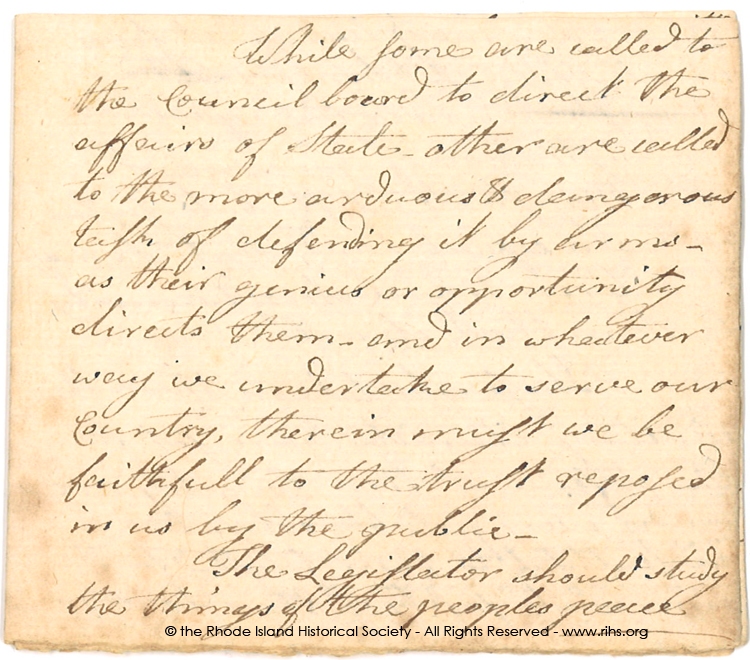
...faithfull to the trust reposed in us...

…faithfull to the trust reposed in us…

Here is the full transcript of the text:

MSS 78 Enos Hitchcock Papers
Box 1 Folder 57 Sermons: Notes, not titled and undated sermons

While some are called to the Council board to direct the affairs of State other[s] are called to the more arduous & dangerous task of defending it by arms- as their genius or opportunity directs them- and in whatever way we undertake to serve our Country, therein might we be faithfull to the trust reposed in us by the public.

The Legislator should study the things of the peoples [sic] peace that they may lead quiet lives in all Godliness & honesty The Magistrate under the equal administration of Government. The Magistrate distribute [sic] Justice with an equal hand, that he may be a terror to Evil doers & security to them that do well.

Those who take on them the Military Character & are set for the defence of their Country, are under every possible obligation to be faithful to their trust—for the immediate safety of their country depends on it. They have committed to you their liberties & their all & they look up to their Army for protection & security- and your own is connected with theirs in common—that in betraying your trust, you might would involve your country in all the miseries consequent upon the invasion of an unbridled Enemy- reduce Millions to absolute subjection to British Tyranny- ages & generations yet unborn to all the wretchedness of Slavery. What then can tempt the Soldier to desert his colours & treaterously [sic] betray the trust reposed in him – besides being guilty of perfidy, he must share in the consequences with them, must be afraid of the face of his Countrymen- or if he take refuge with the Enemy, must live an Exile in a State of Banishment & despised by every noble Spirited Friend to their interest. A Deserter- A Runaway- a perfidious wretch who has once betrayed his trust & therefore no confidence can ever be placed in him again! detestible [sic] Character! May every American Soldier have a Spirit above it.

If this be the danger & disgrace of Soldiers [sic] deserting his Country’s Cause & perfidiously betraying his trust- What Language will convey a Just Idea of the magnitude & blackness of that horrid plot, laid, by the Commander of a Department, for the tame Surrendery of the most important fortress in America? here language fails us! A design, black as Hell! a plot laid at the root of American Liberty! Millions of Subjects bartered away for a little shining dust!

“What chosen curse, what hidden vengeance in the Store of heaven Thunderbolt red with uncommon wrath, shall blast the man who owes his greatness to his greatness [sic] to his Country’s ruin?”

O Lucifer how art those fallen! Arnold, lately proclaimed, by our Orators, the thunderbolt of war, now a vile perfidious refugee with the Enemy, must live despised & die accurst by every generous Lover of his Country! May that day ever be remembered by America in which the discovery was made of the plot which must have nearly determined its fate!

While we regret the Treason, let us with gratitude acknowledge the goodness of providence in effecting the discovery. The train of minute circumstances which led to it, at once shews a superintending providence guideing [sic] the affairs of mankind, and that the justice of our cause challenges the divine patronage.

The Annals of history don’t afford a more striking instance of baseness & ingratitude, nor a more special interposition of divine providence. Tis the language even of the infidel, that the hand of providence is visible in this event, and indeed how can he do otherwise when he considers all the steps that lead to the discovery. A combination of circumstances, small in themselves, wholly independent of each other and yet necessarily connected in producing this Event & could all these take place in their proper order by merely chance or accident? Most certainly they shew an observant Eye penetrating thro’ all the secret machinations of vile, designing men- & a wise hand skillfully conduct the little adventitious events which opened the way to this important discovery.

Let us, my candid and generous fellow Soldiers, acknowledge with gratitude & the goodness of divine providence in this event- and express the sense we have of it by resigning ourself [sic] & all our concerns to the service of that God who governs all things in wisdom. & by a steady & uniform adherence to the cause & interests of our Country-

It often happens that the worst & most wicked designs of men are overruled in such a manner as to be productive of the greatest good. What advantages we shall derive from this cruel & vilainous [sic] act may be more clearly seen a twelvemonth than at present.

We have so often experienced the secret but powerful operations of divine providence concerning itself for our good, producing event very different from the designs of our enemys, leaving us no room to dispond but to hope its continuance to work out out [sic] real good & happiness & doubtless it will if we are not wanting in duty to God, our Country, & ourselves.

Pray, then with humble confidence in divine providence, for the peace of America: they shall prosper that love thee.

Peace be within thy walls and prosperity within thy palaces.

For my Brethren & Companion’s sake, I will now say peace be within thee.

Because of the house of the Lord, I will seek thy good.

Amen

Share this:

  • Share on Facebook (Opens in new window) Facebook
  • Share on Pinterest (Opens in new window) Pinterest
  • Email a link to a friend (Opens in new window) Email
  • Share on X (Opens in new window) X
Like Loading...

Bust darts from Hell

05 Tuesday Nov 2013

Posted by kittycalash in Clothing, History, Making Things, Research

≈ 6 Comments

Tags

19th century, bust darts, details, dress, Events, fashion, museum collections, patterns, sewing, Spencer

Spencer ca. 1800. MMS 1991.239.2

It all started out so well, in the muslin, but in the wool, not so much. I cut up a remnant, proving that a yard and a quarter of 60” fabric is enough for a Spencer, even for my arm length (but not less, thanks to that arm length and a respect for the grain).

The pattern I’m using has bust darts, which I haven’t sewn in years. They took some tweaking with the steam iron.

In 18th century clothing, one doesn’t see bust darts; there are some above the bust, shaping gowns at the robings, but for the most part they aren’t needed. Think cones, thanks to the stays. And later in the 18th century, a lot of work is done by gathers and drawstrings, as in the white and black  ca. 1800 French spencer at the Met.

Spencer ca. 1818-1819. MMA 1982.132.3

Spencer ca. 1818-1819. MMA 1982.132.3

But if you’ve got an endowment of the non-fiscal kind, and you want your military-inspired garment to fit smoothly over your endowment, what do you do?

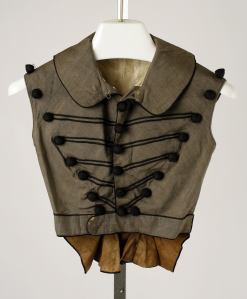
In this example, you hide the bust dart under braid and buttons. Check out that diagonal seam—and that the fabric appears to have been cut on the bias.
Brilliant, right? Gain ease by using the stretchy quality of the bias and hide the shaping under decorative elements.

Here’s an extreme detail.

Spencer, 1813. MMA C.I.39.13.48

Spencer, 1813. MMA C.I.39.13.48

In the garment below, of wool, three bust darts of the same length help shape the front. And again, decorative braid hides the shaping. 

It’s only cataloged as “wool,” with no weave given. There is a detail image of the darts and braid as well; I think that might be serge, and not superfine broadcloth. Still, three bust darts help achieve a smooth fit.

The Swedish Spencer at the museum in Lund has but one grainy photo: it’s hard to imagine that it doesn’t have bust darts, but the photo leaves much to the imagination.

Share this:

  • Share on Facebook (Opens in new window) Facebook
  • Share on Pinterest (Opens in new window) Pinterest
  • Email a link to a friend (Opens in new window) Email
  • Share on X (Opens in new window) X
Like Loading...

Letters for Service

25 Friday Oct 2013

Posted by kittycalash in History, Literature

≈ Comments Off on Letters for Service

Tags

19th century, examples, instruction manuals, letter writing, letters

The Letter, oil on canvas by Pietro Longhi. MMA 14.32.1.

The Letter, oil on canvas by Pietro Longhi. MMA 14.32.1.

Sew 18th Century wrote me the loveliest letter, and ever since I have been remiss in my epistolary duty. To better prepare myself, I took a look at a lovely little imprint at work, The Fashionable American Letter Writer: or, The Art of Polite Correspondence (Providence: Edward and J.W. Cory. 1833) which is thus far the earliest letter writing manual I have found in that collection. Below you will find some examples about servants, or for servants.

Letter XXV.—Recommending a Man Servant.
Sir—
The bearer has served me with integrity and fidelity these three years, but having a desire to settle in New-York, he left my house about a week ago, and by a letter received from him this day, I find you are willing to employ him on my recommendation., and it is with the greatest pleasure that I comply with his request. His behavior while with me was strictly honest, sober, and diligent, and I doubt not but it will be the same with you. I have sent this enclosed in one to himself, and if you employ him, I hope he will give satisfaction.
I am, sir, your humble servant,

Letter LXX.—From a young Woman just gone to service, to her mother in the country.
Dear Mother—
It is now a month that I have been at Mr Wilson’s. My master and mistress are both worthy people, and greatly respected by all their neighbors. At my first coming here I thought every thing strange, and wondered to see such multitudes of people in the streets; but what I suffer most from is, the remembrance of yours and my father’s kindness; but I begin to be more reconciled to my state, as I know you were not able to support me at home. I return you a thousand thanks for the kind advice you was so good as to give me at parting, and I shall endeavor to practice them as long as I live. Let me hear from you as often as you have an opportunity. With my duty to you and father, and kind love to all friends, I remain ever,
Your most dutiful daughter,

Letter LXXI.—The Mother’s Answer.
My Dear Child—
I am glad to hear that you reside in so worthy a family. You know that we should never have parted with you had it not been for your good. If you continue virtuous and obliging, all the family will love and esteem you. Keep yourself employed as much as you can, and be always ready to assist your fellow servants. Never speak ill of anybody; but when you hear a bad story, try to soften it as much as you can. I am in great hopes that all the family are kind to you, from the good character I have heard of them. If you have any time to spare from your business, I hope you will spend some part of it reading your Bible, and other religious books. I pray for you daily, and there is nothing I desire more than my dear child’s happiness. Your father desires his blessing, and your brothers and sisters their kind love to you. Heaven bless you, my dear child, and continue you to be a comfort to us all, and particularly to
Your affectionate mother,

Share this:

  • Share on Facebook (Opens in new window) Facebook
  • Share on Pinterest (Opens in new window) Pinterest
  • Email a link to a friend (Opens in new window) Email
  • Share on X (Opens in new window) X
Like Loading...

Behind the Scenes, Below Stairs

21 Monday Oct 2013

Posted by kittycalash in History, Museums, Research

≈ Comments Off on Behind the Scenes, Below Stairs

Tags

Adriaan de Lelie, art, art history, Clothing, common dress, common people, family portrait, portraits, Rijksmuseum, servant girls, servants

Jonkheer Gijsbert Carel Rutger Reinier van Brienen van Ramerus (1771-1821), met zijn vrouw en vier van hun kinderen, Adriaan de Lelie, 1804

Jonkheer Gijsbert Carel Rutger Reinier van Brienen van Ramerus (1771-1821), met zijn vrouw en vier van hun kinderen, Adriaan de Lelie, 1804

Perhaps because I just finished Longbourn and have just started Year of Wonders, servants are on my mind.

In the family portrait at left, the servants are visible (just) to the right of the tree.

The man and woman almost literally mirror the main subjects, Carel Rutger Reinier van B can Ramerus and his wife, positioned as they are in opposite relationship to each other. The servants, too, are surrounded with life, carrying a child and dogs and game.

servants

The woman is holding the infant of the van Ramerus couple, and even without Google Translate (that’s “four of their children”) we can figure this out. How? Because the child is held away from her body, and faces forward. It is a slightly odd arrangement, with the infant so peripheral to the main image, but we’re fortunate, because this composition allows us to see the servants.

Class distinctions are clear in the dress: the female servant wears a cap, kerchief and short gown, the male servant-gamekeeper, perhaps–wears breeches and a jacket from the pervious century, as well as a cocked, and not a tall, hat.

It does remind me strongly of the imperative to continue a family line, and the lot of women to breed and produce male heirs. For all that I love the past, I know I could not live there easily.

Share this:

  • Share on Facebook (Opens in new window) Facebook
  • Share on Pinterest (Opens in new window) Pinterest
  • Email a link to a friend (Opens in new window) Email
  • Share on X (Opens in new window) X
Like Loading...
← Older posts
Newer posts →

Archives

wordpress statistics

Creative Commons License
Kitty Calash blog by Kirsten Hammerstrom is licensed under a Creative Commons Attribution-NonCommercial-ShareAlike 4.0 International License.

Website Built with WordPress.com.

  • Subscribe Subscribed
    • Kitty Calash
    • Join 621 other subscribers
    • Already have a WordPress.com account? Log in now.
    • Kitty Calash
    • Subscribe Subscribed
    • Sign up
    • Log in
    • Report this content
    • View site in Reader
    • Manage subscriptions
    • Collapse this bar
 

Loading Comments...
 

    %d