• Home
  • Completed Costumes/Impressions
  • Emma and Her Dresses
  • Free Patterns and Instructions

Kitty Calash

~ Confessions of a Known Bonnet-Wearer

Kitty Calash

Category Archives: material culture

Style Council

28 Friday Jul 2017

Posted by kittycalash in Living History, material culture

≈ Comments Off on Style Council

Tags

interpretation, living history, material culture, Reenacting

National Gallery of Art furniture gallery, May 2017

One of the critiques leveled at historic house museums is that they’re often “frozen in time,” specifically a particular moment, rather than reflecting the changes that happened over time. This charge is sometimes leveled at period room installations as well, when all the furniture in a room is from a tight time span– a year, maybe five– when for most of us, the furnishings in our homes and the clothes in our closets reflect a number of years, rather than a tight twelve or eighteen months.

So, when we go out “into the field” (or the house or the milliner’s shop or the tavern), shouldn’t our belongings reflect the multiplicity of years of objects? If I’m a woman Of A Certain Age, won’t I have possessions, from jewelry to ceramics to clothing, from multiple decades? Well…. yes and no.
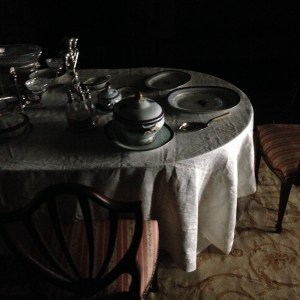
It’s true that as far as we can tell, John Brown moved his 1760 furniture into his 1788 mansion, but we also know he bought new furnishings, including a large (188+ piece) set of Chinese Export Porcelain (see above).

Up-to-date, stylish, expensive: table settings signaled wealth and sophistication as much as clothing and manners, so whatever JB had before 1788, he wasn’t setting his new table with it. What might he (or Mrs B) have done with it? Consigned it to use by grandchildren and servants? Given it to less fortunate relations? Possibly. And if they had creamware, it would not have been singularly out of place in 1788 or 1800 on any table– it was only 40 years old, and heaven knows my “best” china is from the 1930s– but would they have used earlier pottery, even in the kitchen?
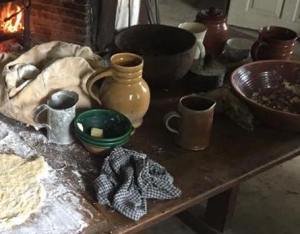
All pottery is not the same: North Devon pottery, while imported to North America in the late 17th and early 18th century, is not what you would expect to find in a late-18th century farm kitchen. It’s here, sure, into the mid-18th century, but in 1799, it’s not the form you would expect to see. So what does that mean for living history folks? Does it matter what you use?

You know what I think: there ain’t nothing like the real thing and that means paying careful attention to details. If you’re portraying a camp follower in 1778, or tenant farmer in 1799, you are not likely to have, say, a Jackfield-type figured tea pot, just as you are not likely to have a salt-glazed squirrel-relief cream jug, no matter how much you adore it.

Time and style matter. The people of the past read each other the same way we read each other. Remember Clarice Starling, with her “good bag and her cheap shoes”? Get on a train anywhere, and you can read your fellow travelers: you can guess income and education levels, marital status, and sometimes interests and hobbies if you look closely. You make assumptions about people based on their appearance, whether you’re conscious of it or not– and so did the people of the past. To portray them accurately, and to help the public learn to read the past, the details matter.

Share this:

  • Share on Facebook (Opens in new window) Facebook
  • Share on Pinterest (Opens in new window) Pinterest
  • Email a link to a friend (Opens in new window) Email
  • Share on X (Opens in new window) X
Like Loading...

Serving Delaplace

21 Tuesday Feb 2017

Posted by kittycalash in Events, History, Living History, material culture, Museums, Reenacting

≈ 2 Comments

Tags

18th century, authenticity, cleaning, common soldier, cooking, Drunk Tailor, Fort Ticonderoga, interpretation, living history, Revolutionary War, servants

dscn4628

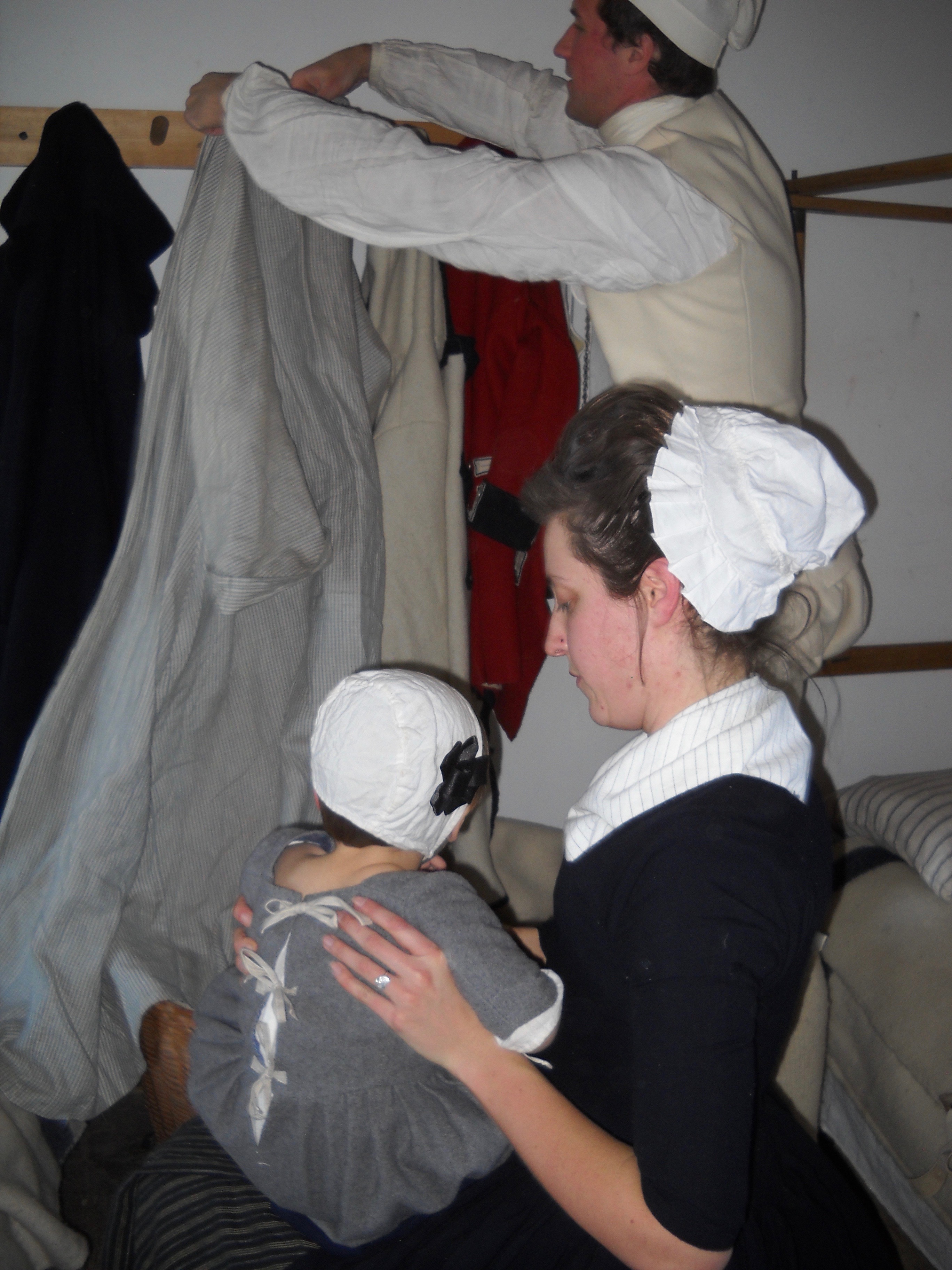
With 400 miles between us, Drunk Tailor and I have few chances to explore the past together, so I was both delighted and nervous when he agreed to join the British Garrison 1775 event at Fort Ticonderoga as one of Captain Delaplace’s servants.  Even better, we were also joined by the itinerant Deep North Yankee who wandered around the Fort (possibly seeking roofing shingles, of which he is much in need).

dscn4631

Friday nights are always magical, candle and firelight (and only the warmth of the fire) as we drink cider and talk about history. But morning always comes: Saturday, cold and clear, Mr S and I woke and blinked across the room at each other, and I wondered to what degree I really wanted to ever crawl out of bed…only hunger and an eventual need to pee (and fear of a Sergeant) propelled me.

Yup, you cook 'em on a board.

Yup, you cook ’em on a board.

First order of business: breakfast. Mr S, supplied with his corn meal of choice, made us johnnycakes, which provided perhaps more interpretive than nutritive value. Still, they were warm and tasty and he is the only person I know who can make them; my efforts end up as FEMA disaster sites.

cooking
img_20170218_110626

Captain Delaplace’s servants were tasked with cooking for his mess, so Mr S and I got a start. We had a chicken, an onion (I traded onion # 2 for some bacon), butter, carrots, potatoes, a butternut squash, salt, and some port. I don’t know where this English serving woman of 1775 encountered mis en place, but she accidentally introduced coq au vin to the Captain’s table with the dinner meal.

Captain and Mrs Delaplace dining, manservant in attendance

Captain and Mrs Delaplace dining, manservant in attendance

The Captain and his Lady dined on chicken braised in butter and bacon with root vegetables in a port sauce; we servants waited until they were done before we could eat. (Confession: I need to eat a lot, and have a sensory overload problem, so when visitors fully crowded the room, I had to dash across the parade ground for a Clif Bar and an Ativan before I could continue to wait for my dinner.) In the afternoon, dishes were washed at the table, as was common (at least in early New England), dried, and set away, while the Captain’s lady and child played in the cabbage patch between the beds.

dscn4657

When the room was empty, servants were able to eat (huzzay!) and found the meal very tasty indeed. I would certainly make this again, and learned more about cooking– a typically female task I generally try to avoid– than I had expected to. Then we had yet another round of dishes before it was time to tidy the room and make ready for tea or supper.

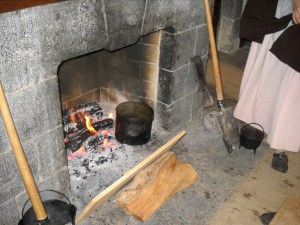
To that end, we cleared the table and broke it apart to reveal the floor and hearth, which needed to be swept of bread crumbs, squash peels, dead leaves, and other detritus. The best way to sweep an unfinished floor in the 18th century (per Hannah Glasse et al) is to strew the floor with wet sand and then sweep. I mixed sand with lavender-infused vinegar and threw it on the floor; this keeps the dust down as you sweep months of dust and dirt out of the corners and from behind tables and chests.

img_20170218_144218
img_9513

The trick is to sweep in one direction (more or less) from the back of the room to the front, and then to gather up the sand (here in a shovel) and pitch it off the landing. Much was thrown out the door and over the stair rail, just as servants would have done in 1775. (And I am told it is soothing to nearly hit the sergeant, but perhaps that’s merely hearsay, if not heresy.)

img_9478

When we were done, we restored the table (Drunk Tailor noticed the height of the ceiling, and wondered about hanging birds in cages whist awaiting the return of the tabletop), fully reset with cloth, candlesticks, plates, and knives, ready for the supper we didn’t cook, as we skipped away at the close of the day to find our own meal in Glens Falls, where live music is inescapable on a Saturday night.

Share this:

  • Share on Facebook (Opens in new window) Facebook
  • Share on Pinterest (Opens in new window) Pinterest
  • Email a link to a friend (Opens in new window) Email
  • Share on X (Opens in new window) X
Like Loading...

Staging Christmas

22 Thursday Dec 2016

Posted by kittycalash in Events, material culture, personal, Philosophy

≈ 2 Comments

Tags

christmas, emotions, interpretation, material culture, personal

The house on High Street, Noank CT, 2000

The house on High Street, Noank CT, 2000

It’s pretty stagey to begin with, isn’t it? Full of ritual, some so old we don’t know why we still perform them. What I like best is the food, not the cakes and cookies, delicious as they are, but savory meals and the warmth of a full table. Second to that, decorating.

The past year has given me opportunity to reflect on the tasks I love, and why, and the basis for the work I’m passionate about. Curiously, it began in high school, as the props mistress for drama productions, morphed into installations, performance art, and site specific sculpture in college, before metastasizing into exhibition development, installation, and historic house interpretation with a side line in living history because, you know, costumes. Things and I go way back, and thinking about that made getting ready for yet another Christmas more fun.

Providence, 2016

Providence, 2016

Embracing the staginess makes the sometimes uncomfortable family closeness easier; I have proposed celebrating by reenacting a Don Draper Christmas, as long as someone else does the driving. Adding a layer of actual performance somehow made it easier to understand, a phenomenon opposite to what happens when you write a word over and over until it makes no sense. It’s the same distance you feel when you really try to understand someone’s past, and how they think. It’s familiar, but somehow unrecognizable.

This is probably the last Christmas in this apartment, which adds a poignancy to the proceedings, and it’s the first interactions for some participants, so, as with What Cheer Day, I’ve set a stage and we’ll see what happens.

Christmas with Katie, Chicago.

Christmas with Katie the Cat, Chicago, ca 1978

Every year, some things are the same: a balsam fir, candles, apples, cats. The characters and locations ebb and flow, with some consistency. Cats come and go, the boy grows. The love remains the same.

Share this:

  • Share on Facebook (Opens in new window) Facebook
  • Share on Pinterest (Opens in new window) Pinterest
  • Email a link to a friend (Opens in new window) Email
  • Share on X (Opens in new window) X
Like Loading...

Museum Fail: Icon, not Replica

21 Wednesday Dec 2016

Posted by kittycalash in Art Rant, Fail, History, material culture, Museums

≈ Comments Off on Museum Fail: Icon, not Replica

Tags

authenticity, collections, difficult interpretations, exhibits, interpretation, material culture, Museums, National Marine Corps Museum, objects

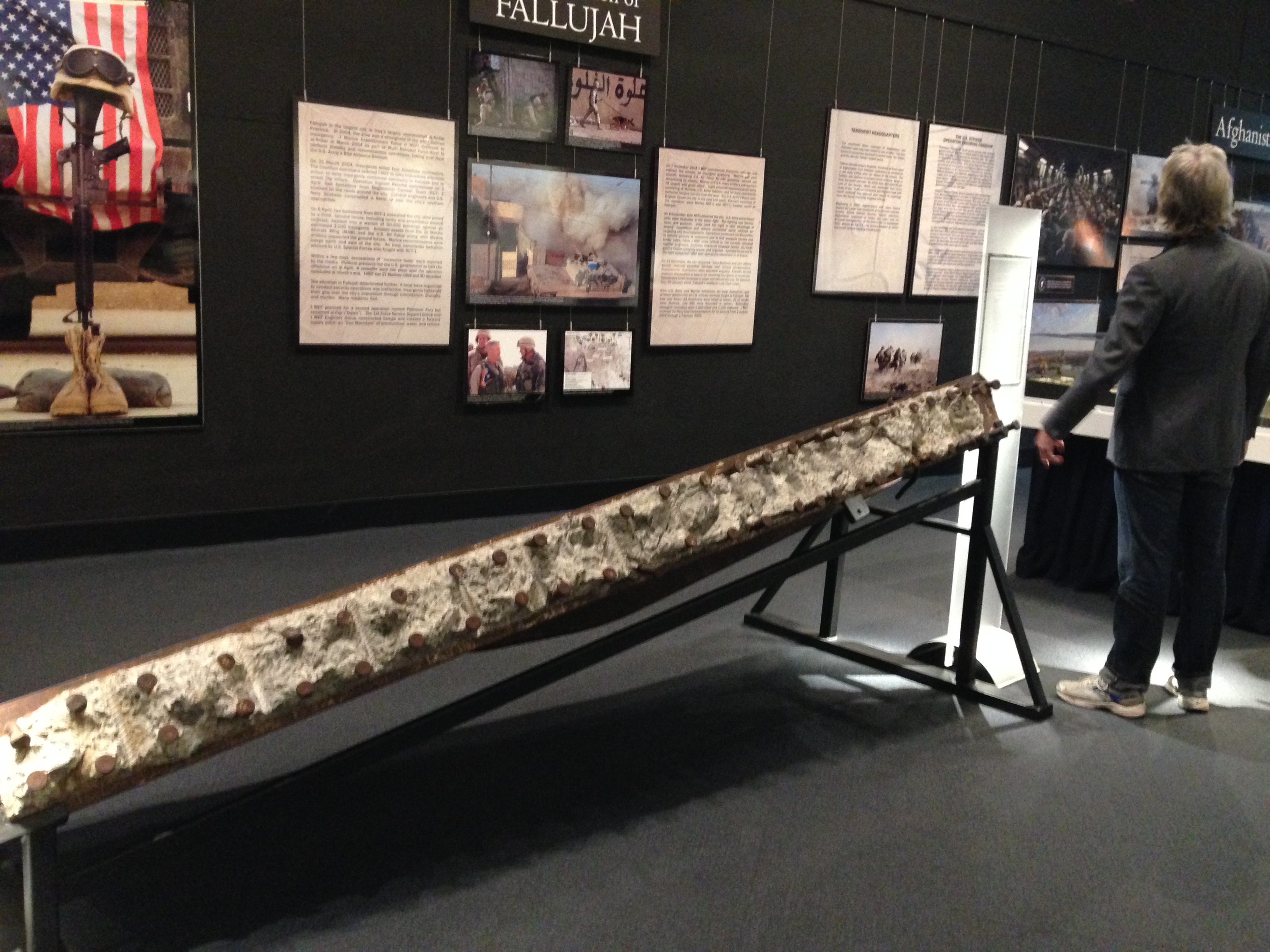
img_8606

What am I?

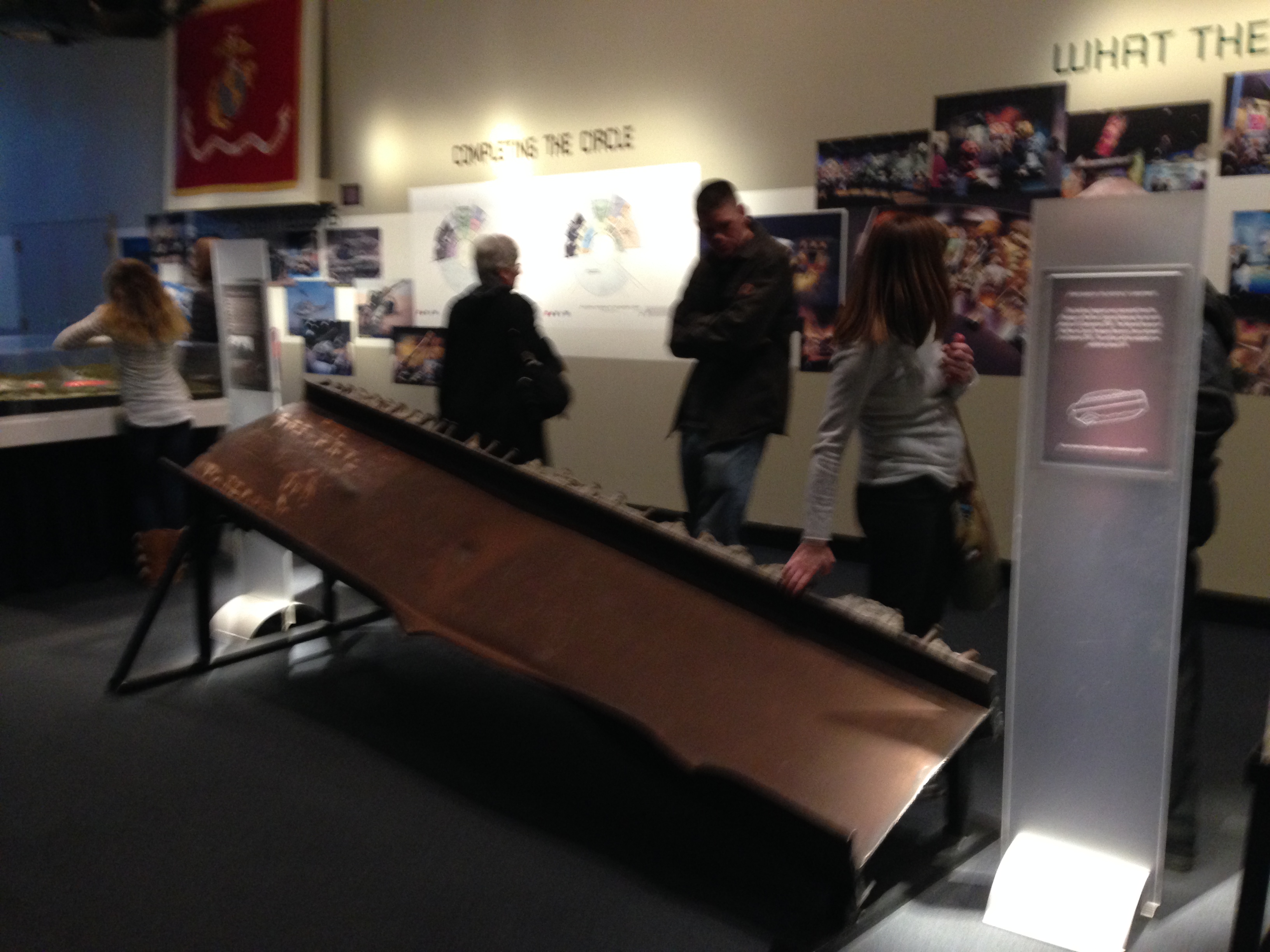
Do you know what this is? Do you think it’s real? Here’s a clue: it’s a relic of an iconic event in early 21st-century North America.

On the last visit to the National Marine Corps Museum, I watched the tourists circle objects at the end of the traditional galleries and displays, and overheard a woman ask her companions:

What’s this a replica of?

Reader, I cringed– and not for the sentence construction.

What's this a replica of?

What’s this a replica of?

And then I stepped back. I thought that for someone my age it would be obvious. Here, have some additional museum context.
img_8604

In a museum where everything is real, how does a visitor come to ask not only if that World Trade Center steel beam is a replica, but what is it replicating? I’m not sure semiotics can save us here. My first, New York Times-reading, media-soaked, Northeast Corridor response was, How can you miss that? How can you not recognize that, let alone mistake the steel and concrete relic for a replica?

img_8603

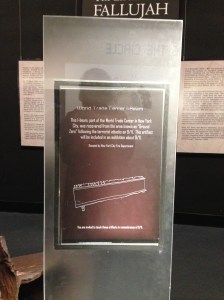
Ah, hubris. There is a label, though I have seen better. Would it be more helpful in a larger font, turned perpendicularly to the I-beam? Possibly. But the lesson that’s deeper than label formatting and placement is recognizing how much we take for granted. Our visitors, even those we assume to be educated consumers of media and information, may not share our knowledge base. They may not read objects or images as readily as we think they do; we certainly cannot assume they’re all taking away the same information– and that has nothing to do with education or background.

Everyone truly sees the world differently. How, and what, we choose to put on a label should always be grounded in remembering that we do not all share the same information. Context is critical, and probably would have made these relics more real, and less replica.

Share this:

  • Share on Facebook (Opens in new window) Facebook
  • Share on Pinterest (Opens in new window) Pinterest
  • Email a link to a friend (Opens in new window) Email
  • Share on X (Opens in new window) X
Like Loading...

A Tisket, A Tasket: What Basket?

17 Saturday Sep 2016

Posted by kittycalash in History, Living History, material culture, Reenacting

≈ Comments Off on A Tisket, A Tasket: What Basket?

Tags

18th century, authenticity, baskets, common people, interpretation, living history, Research, shopping

Nancy had a great question: What did middle class ladies use to carry their shopping?

But here’s the thing: they didn’t carry the shopping, because they didn’t do the shopping– not the big shopping, anyway.

La Pourvoyeuse, oil on canvas by Jean-Simeon Chardin, 1739. Louvre Museum.

La Pourvoyeuse, oil on canvas by Jean-Simeon Chardin, 1739. Louvre Museum.

La Pourvoyeuse by Chardin shows a woman returning from market in 1739. No basket. A bundle or bag with a fowl in it, head down. Unwrapped loaves of bread. But clearly a servant.

From waste books, it’s pretty clear that people are sending their “boys” and “girls” (servants or slaves) to fetch liquor. That will come home in bottles, like the ones at the feet of La Pourvoyeuse. And I think it comes home just in their hands, but perhaps- and more likely not– in a basket. A floppy basket, usually for floppy birds.

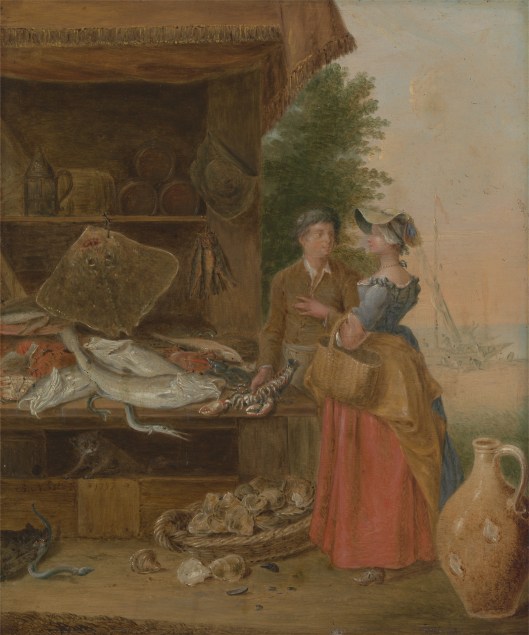
Balthazar Nebot, active 1730–1762, Spanish, active in Britain (from 1729), Fishmonger's stall, 1737, Oil on copper, Yale Center for British Art, Paul Mellon Collection

Balthazar Nebot, active 1730–1762, Spanish, active in Britain (from 1729), Fishmonger’s stall, 1737, Oil on copper, Yale Center for British Art, Paul Mellon Collection

Baskets have come up before. So this is part of a larger argument. Mostly, we see servants marketing. Middle class ladies certainly shop– what is the class level of this woman (above)?— but so many things can be delivered, or are peddled door-to-door, and servants are so common, that I think we don’t yet fully understand shopping in the 18th century.

After the meteoric rise of consumerism, after department stores, yes: shopping is more like what we do. But in the pre-ice box and pre-packaged era, meat cannot be bought and frozen, and milk will not last all that long. Things were brought home one at a time, or a few at a time, many times a week. And middle class ladies bought small things– ribbons, almanacks, shoes– and bring them home in their pockets, just in their hands, or, I would guess, wrapped in a bundle of paper (a pair of shoes) or in a band box (a bonnet) if the things are not delivered.

A long winded way to say, I don’t know: but I’m pretty sure middle class ladies sent their servants out frequently so the ladies didn’t carry baskets and the servants used bags, aprons, and their hands.

Share this:

  • Share on Facebook (Opens in new window) Facebook
  • Share on Pinterest (Opens in new window) Pinterest
  • Email a link to a friend (Opens in new window) Email
  • Share on X (Opens in new window) X
Like Loading...
← Older posts
Newer posts →

Archives

wordpress statistics

Creative Commons License
Kitty Calash blog by Kirsten Hammerstrom is licensed under a Creative Commons Attribution-NonCommercial-ShareAlike 4.0 International License.

Website Built with WordPress.com.

  • Subscribe Subscribed
    • Kitty Calash
    • Join 621 other subscribers
    • Already have a WordPress.com account? Log in now.
    • Kitty Calash
    • Subscribe Subscribed
    • Sign up
    • Log in
    • Report this content
    • View site in Reader
    • Manage subscriptions
    • Collapse this bar
 

Loading Comments...
 

    %d