• Home
  • Completed Costumes/Impressions
  • Emma and Her Dresses
  • Free Patterns and Instructions

Kitty Calash

~ Confessions of a Known Bonnet-Wearer

Kitty Calash

Category Archives: Museums

Way Finding & the Social Museum

20 Monday May 2013

Posted by kittycalash in Art Rant, History, Museums

≈ Comments Off on Way Finding & the Social Museum

Tags

Exhibitions, Metropolitan Museum of Art, Museum of Fine Art Boston, Museums

open storage at the Met Museum

Open Storage: Luce Center at the Met

I can’t say this enough: museums are best when they are social experiences. The happiest moment of my day came early, when I was in the Ipswich room of the American wing. Another iPad toting guy and I talked about the lowness of the ceiling, the large fireplace, the bed, and how cozy the room was. (I told him to go to Plimoth if he got a chance.) but it was exciting to talk and share: that’s the best part of discovery, and that’s what museums are about. They’re about finding things, or yourself, or ideas.

The Luce Center was nearly empty of people. A school passed through on their way to someplace else, but I had it pretty much to my self. None of the computers were being used. I saw very few of any screened devices used in the Museum, aside from personal devices.

baby rattle at the Met

Late 17th-early 18th century rattle. Appears to be missing its coral

The Met collection is astounding, no doubt. But I was pleased to see that there are some finer pieces in Rhode Island storerooms and museum rooms. And I think that the way finding could use some real attention. The MFA, last time I was there, had it down: interns, stationed throughout the galleries, to ask if you needed directions whenever you looked lost. NY, not so friendly but maybe more necessary. Also, the galley number for one show I wanted to see was not even included in its web listing. That was a serious annoyance, but I was able to find it eventually.

Replica furniture at the MFA Boston

American Wing at the MFA Boston

The installations are excellent, though standard and in some cases unimaginative. I know: I just dissed the Met. And I’m sticking with that. The exploded chest in the Luce storage wing was one of the best items spotted. I’d say that when it comes to furniture, American furniture, the MFA bests the Mets installation. And I like some other period rooms just as well. Like my own. They just need to be cleaner. What’s wrong with those housemaids? Oh, right. One’s in England, and the other one’s exhausted from her trip back from New York.

Share this:

  • Share on Facebook (Opens in new window) Facebook
  • Share on Pinterest (Opens in new window) Pinterest
  • Email a link to a friend (Opens in new window) Email
  • Share on X (Opens in new window) X
Like Loading...

Punk is Dead and Buried at the Met

18 Saturday May 2013

Posted by kittycalash in Art Rant, Clothing, Museums

≈ 5 Comments

Tags

art history, arts, Clothing, couture, Exhibitions, fashion, fine art, Metropolitan Museum of Art, Museums, punk, reviews

So, I went to New York yesterday and spent the day at the Met. It was a good, if epically long, trip. I saw everything my feet could bear. One show I even went through twice, Punk: Chaos to Couture. I was trying to “get” it.

The [In]famous Bathroom

The [In]famous Bathroom

Punk got a lot of hype in the NYer and the NYT but it was the least imaginative installation in the Museum. Oh, so what about the CBGB bathroom! If we had to walk through it to get to the gallery, now that would be something. Instead, the bathroom and the “store” are offset, afterthoughts to the main drag, which is a drag.

Hall of Classics. Worship these Gods of Fashion.

Hall of Classics. Worship these Gods of Fashion.

The galleries main attractions are mannequins lined up as if on a catwalk, above us, so couture, so not punk. Rainbow colored spike wigs do not make Gianni Versace punk. Or, honestly, Vivienne Westwood at this late juncture, let alone Zandra Rhodes. I found the mannequins trite, and the clothing uninspired and only vaguely reminiscent of what I remember of punk.

Naked Raygun at the Metro

As for the store: I never shopped at Clothes for Heroes, or even Trash & Vaudeville (I had to send my Dad for my Johnson’s motorcycle boots) but I did buy Trash & Vaudeville label and band t shirts at Wax Trax, in the back. I wore the zip minis and fishnet stockings (real stockings) and vintage from the AmVets. I made my own tshirts, with spray paint, markers, and my dad’s castoffs. And even in 1980 Chicago, even at The Exit or Lucky Number or the Cubby Bear, I knew I was ersatz. I knew I was not really punk.

Graffiti & Agitpror

Graffiti & Agitpror

The Met show shines with the Alexander McQueen dresses. They are by far the most interesting and best made pieces. They’re clearly genius. Everything else, save for Rei Kawakubo, is merely derivative.

The sections of the show, Hardware, Graffiti & Agitprop, and Destroy, make sense. Yes, safety pins, chains, spikes and belts (hardware) were typical. Slogans and hand-made clothes, also typical, as well as shredded (purposeful or not, often not, but worn), are fitting descriptors or sub-genres of the punk aesthetic. But the clothes displayed disappointed and dismayed, a grand “So what?” And why?

Maybe it’s Andy Warhol, Mr. Anti-Punk in my mind. But I think it is the great postmodernist movement, where by at this point anything once ironic or referential is now merely self-referential. Punk could have a sense of humor. With few exceptions (Kawabuko, mostly) the clothes in this show lack the intelligence for humor, let alone politics.

Am I glad I went? Yes, absolutely. Because now I know there are bigger risks to take installing shows, and I’m ready to think about what they might be. I’d put a couple of those Kawabuko black-sleeve dresses, or McQueen’s black “bubble-wrap” gowns on display with over in Impressionism, Fashion and Modernity, and see what happens. That’s when chaos and couture would really meet.

Share this:

  • Share on Facebook (Opens in new window) Facebook
  • Share on Pinterest (Opens in new window) Pinterest
  • Email a link to a friend (Opens in new window) Email
  • Share on X (Opens in new window) X
Like Loading...

On the Rails

17 Friday May 2013

Posted by kittycalash in Museums

≈ 5 Comments

Tags

Travel

20130517-071119.jpg

Headed down to New York today for a day at the museum. Just because I keep track of revenue doesn’t mean I don’t appreciate what that revenue can provide. Looking forward to ideas, and getting a truly worthwhile museum headache.

Share this:

  • Share on Facebook (Opens in new window) Facebook
  • Share on Pinterest (Opens in new window) Pinterest
  • Email a link to a friend (Opens in new window) Email
  • Share on X (Opens in new window) X
Like Loading...

The Business

16 Thursday May 2013

Posted by kittycalash in Art Rant, Literature, Museums

≈ 1 Comment

Tags

arts, auctions, authenticity, endowments, fine art, Museums, sales, Sotheby's

Sotheby's sale June 11 2013

Fine Books & Manuscripts, June 11, 2013

I’m in this business, so I shouldn’t be bothered. I have been a seller and a buyer, and I’m a card-carrying member of Team Hoarder, AKA the Curators. So why does this bother me?

This sale features a strong selection of modern authors highlighted by Property from the Descendants of William Faulkner, including the manuscript of his Nobel Prize speech with the gold Nobel medal and diploma (1950), autograph letters written to his mother from Paris in 1925, the typescript book of his poem sequence “Vision in Spring” in a handmade binding by the author, drawings, corrected typescripts and other items.

You’d think I’d know better by now: Life isn’t an Indiana Jones movie, and no amount of saying “It belongs in a museum!” will help matters along.

More and more I see the cultural economy–and the disposition of cultural goods–following the “winner takes all” pattern of the larger economy. I give you Walmart, and Walmart gives you the Crystal Bridges Museum of Art. The FAQ’s deny any tie to Walmart stores, but Alice Walton founded the museum. For a lot of people, that’s a connection to Walmart. The claim that there is no connection seems even more disingenuous when you visit the homepage and read “General admission to Crystal Bridges is sponsored by Walmart. There is no cost to view the Museum’s permanent collection, which is on view year-round.”

The people of Arkansas deserve a nice museum; everyone does–that’s not my point. My point is that private collectors can buy, and keep from public hands, important pieces of material cultural and cultural heritage. Faulkner’s work post-Nobel may have paled compared to earlier work, but he won the Nobel–score one for Southern Literature and the power of Faulkner’s words, the sway he held over American letters.

Also in what is shaping up to be a very wordy sale: “[O]ne of possibly as few as three intact 1924 recordings of Joyce reading Ulysses.” Joyce reading Ulysses. That’s pretty damn cool. Lucky for you and me, if we’re word fans, you can listen to another recording here, thanks to The Public Domain Review.

Would an online photo, or a magazine photo, of Faulkner’s medal ever be as good as the online version of Joyce’s reading? No,  I don’t think so.  Because there is a power in the authentic, in the real. And the medal is material, three-dimensional: sound waves over an internet speaker wouldn’t be as frisson-inducing as listening to a recording in a darkened library, but they’re still sound waves.

Authenticity will be the subject of an upcoming session at AAM’s Annual Meeting in Baltimore, and though I can’t be there, I’m following as best I can.

Authenticity is something reenactors strive for in their work. Museums present authentic– real– objects and experiences. I sit the gallery and one of the most common questions people ask is, “Is it real?” and when told, “Yes, it is,” they gasp a little.

So when museums and libraries are priced out of the auction or private sale market, what does that mean? It means less public access to authentic items, to the “real,” three-dimensional evidence of the past.

We’re choosy, of course: it could well be that the University of Virginia did not want these items. Perhaps they did not contribute materially to Faulkner scholarship–the medal wouldn’t, really, would it? But the additional papers and letters might, but would be hard to justify at $250,000-$350,000.

Private collectors, people who can afford a $286,000 watch, drive up prices. Museums that can attract major donors attract more major donors.

MET MFA RIHS NHS
2011 Income $470,048,040 $157,082,067 $3,440,281 $615,008

That’s a chart of the 2011 income for the Met, the MFA, the RIHS, and the Newport Historical Society. All four have decorative art, art, and textile collections. All four would be interested in pieces of Newport furniture. Two are art museums, two are historical societies. Only one has the financial power to bid for major pieces.

And then there’s Crystal Bridges: 2011 revenue? $625,995,749. Sorry Met, you were just outdone by $155,947,709. Over one hundred and fifty-five million dollars. Dr. Evil is beyond impressed. The Crystal Bridges Form 990 includes a donor list with $700,000 from Cisco Systems. Nicely done. With endowment return of just a little more than $16 million, and  $37 million for “museum procurement expenses,”  they need those donations to stay healthy financially. But that $37 million buys a lot of art.  And where does that leave smaller museums and collecting organizations?

Pretty much where Walmart left small businesses: highly specialized but small.

And what does that mean for Faulkner’s papers, or a Plunket Fleeson chair?

Chances are they’ll be in private hands, accumulating value.

Share this:

  • Share on Facebook (Opens in new window) Facebook
  • Share on Pinterest (Opens in new window) Pinterest
  • Email a link to a friend (Opens in new window) Email
  • Share on X (Opens in new window) X
Like Loading...

Details. All in the Details.

04 Saturday May 2013

Posted by kittycalash in Clothing, History, Living History, Making Things, Museums

≈ 4 Comments

Tags

18th century, authenticity, embroidery, muse, pockets, Research, Rhode Island, sewing project

Detail, pair of pockets. Gallery of Costume, Platt Hall, Manchester City Galleries. MCAG.1922.2150

This image is from the fantastic VADS site‘s  gallery of pockets. I need new pockets, or a pocket update and overhaul, so I went looking for inspiration.

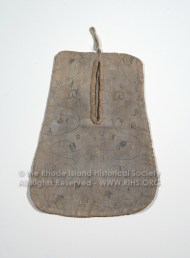
Child's Pocket, 1720-1760. RIHS 1985.1.9.

Child’s Pocket, 1720-1760. RIHS 1985.1.9.

This is a dangerous path to go down if you are as unskilled with a crewel needle as I am.

Sew18thCentury can do it– so, sew, lovely. Me…well, everything I knew about embroidery I learned as a child, and promptly forgot with puberty. So my skills remain appropriate for reproducing this, from a Rhode Island collection. The pocket is child-sized, at 14 inches, and the embroidery has a crabbed, angry look, as if the girl would much rather have been outside, chasing her dog or brother.  I can relate, at least to the dog part.

My copy, on the clearance-bin frame.

My copy, on the clearance-bin frame.

I  made a pattern of the embroidery, traced it onto linen, and started working on dredging up those long-forgotten skills. As a child, I had a sewing or embroidery book, but what I remember most about the projects I made was how far their finished form was from what I had envisioned.

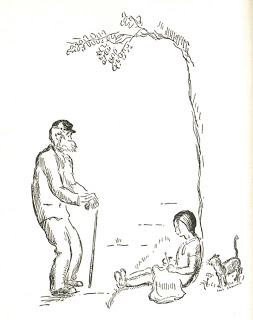
Jane, and the Oldest Inhabitant

Jane, and the Oldest Inhabitant

This is not an uncommon experience for children; my son has certainly experienced this, and even adults are subject to it. I think the best rendition of it, sewing-wise, is Eleanor Estes’ portrayal in The Middle Moffat of Jane Moffat attempting to make a “brocated bag” for Mama’s Christmas present.

The image of Jane sewing or crocheting under a tree while talking to Cranbury’s Oldest Inhabitant, a Civil War veteran, sums up every reenactment I’ve ever been part of… but I digress.

DSC_0283

A detail. Sigh. I know, practice, but…

My embroidery stitches lack a lot, but most of what they lack is practice–and that’s what makes reproducing that RIHS pocket a perfect project for me. Pockets were “sampler” projects, and suitable for girls to learn on. This combines plain sewing with embroidery, and ends up as something useful and authentic, so what more can I ask?

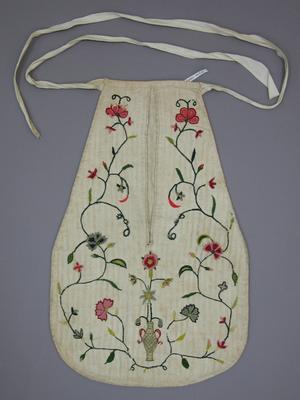
Pocket, single, embroidered. Snowshill Costume Collection, National Trust (UK). mid 1700s. SNO1452

Pocket, single, embroidered. Snowshill Costume Collection, National Trust (UK). mid 1700s. SNO1452

The VADS site has tons of images to inspire me, and with practice, someday I could manage something as beautiful as this. I need only make sure that it fits my time period and station–and for some events it will, but for most, the plain pocket or the crabbed-stitch embroidered pocket, are probably far more appropriate.

Share this:

  • Share on Facebook (Opens in new window) Facebook
  • Share on Pinterest (Opens in new window) Pinterest
  • Email a link to a friend (Opens in new window) Email
  • Share on X (Opens in new window) X
Like Loading...
← Older posts
Newer posts →

Archives

wordpress statistics

Creative Commons License
Kitty Calash blog by Kirsten Hammerstrom is licensed under a Creative Commons Attribution-NonCommercial-ShareAlike 4.0 International License.

Website Built with WordPress.com.

  • Subscribe Subscribed
    • Kitty Calash
    • Join 621 other subscribers
    • Already have a WordPress.com account? Log in now.
    • Kitty Calash
    • Subscribe Subscribed
    • Sign up
    • Log in
    • Report this content
    • View site in Reader
    • Manage subscriptions
    • Collapse this bar
 

Loading Comments...
 

    %d