• Home
  • Completed Costumes/Impressions
  • Emma and Her Dresses
  • Free Patterns and Instructions

Kitty Calash

~ Confessions of a Known Bonnet-Wearer

Kitty Calash

Category Archives: Reenacting

Finding Bridget Connor

16 Thursday Jan 2014

Posted by kittycalash in History, Laundry, Living History, Reenacting, Research

≈ 8 Comments

Tags

10th Massachusetts, Brigade of the American Revolution, common people, living history, Reenacting, Research, Revolutionary War

Two washerwomen, one of the sketches made in Edinburgh and the neighbourhood after the rebellion of 1745 Pen and black ink and grey wash, over graphite. Paul Sandby, British Museum Nn,6.10.+

Regimental Orders, July 23rd 1782
At a Regimental Court Martial whereof Capt Francis is president, Briget Conner a Woman Belonging to the 10th Massachusetts Regiment was tried for purchesing a publick Shurt from a Soldier in Sd. Regiment found Guilty and Sentanced to Return the Shurt to the person from whom she purshest it and loos what She gav for the Shurt.
The Colo approves the opinion of the Court and orders it to take place Immediately

Regimental orders July 25th 1782
Bridget Conner a woman Belonging to the 10th Massachusetts Regiment is Directed to Leave Camp Between this and to Morrow Morning at Roal Call for her Insolence to the officers of sd Regiment on pane of Being Treated with Severity

The entries above are from the orderly book kept by Captain Stephen Abbot who served under Colonel Benjamin Tupper of the 10th Massachusetts Regiment. (This is a Continental Regiment, so the entry for the book in the holding library’s catalog is, um, confusing.)

The entries were sent to me by Mr Cooke as a place to start working on Bridget Connor (name confusion, it is Connor). I checked the Massachusetts Soldiers and Sailors of the Revolutionary War, and what did I find? Francis Connor.

Francis Connor. Where did he come from?

Francis Connor, in the middle. Where did he come from?

Francis Connor was in Benjamin Tupper’s (10th) Regiment. He enlisted on December 25, 1781, and was reported deserted on July 25, 1782, the same day Bridget is directed to leave camp. Do you think Bridget might be Francis’s wife? I think she might be, and I am inordinately pleased about it.

It is a sad but true thing that it is easier to find a man in the 18th century records than it is to find a woman. (See Jill Lepore’s new book about Jane Franklin Mecom.) But with a husband to look for, maybe I can find more about Bridget. And if I can find more about Bridget (and even if I don’t) I can start asking the questions that create a more engaging impression or interpretation.

  • Where did Bridget live before they joined the 10th?
  • Where was she born?
  • How old was she?
  • What did Francis (if he was her husband) do for a living?
  • Did Bridget work? (Probably- but at what?)
  • Why did she join Francis in the Army?
  • Did she have previous run-ins with authority?

I have guesses about Bridget and Francis, and even if I can find no more than what I’ve found, I can create plausible stories about their lives to make the past more real. For history, though, I prefer telling truths to making up stories.
Share this:

  • Share on Facebook (Opens in new window) Facebook
  • Share on Pinterest (Opens in new window) Pinterest
  • Email a link to a friend (Opens in new window) Email
  • Share on X (Opens in new window) X
Like Loading...

“All sorts and conditions of women”

13 Monday Jan 2014

Posted by kittycalash in Clothing, History, Laundry, Living History, Reenacting, Research

≈ Comments Off on “All sorts and conditions of women”

Tags

10th Massachusetts, 18th century clothes, authenticity, camp life, common dress, common people, common soldier, cooking, dress, fashion, interpretation, James Peachey, living history, Revolutionary War, tents

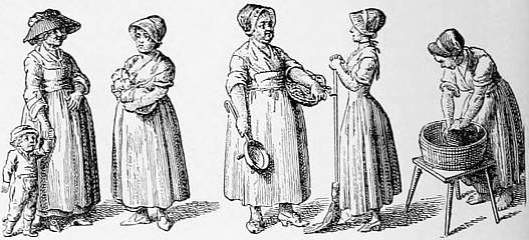
img094

Ever on the track of laundresses and working women, I came upon The Project Gutenberg EBook of The History of Modern Painting, Volume 1 (of 4), by Richard Muther. I was rewarded with  a laundress and a cook holding a spider. Daniel Chodowiecki, a German artist, seems to have been as drawn to the common people as Paul Sandby. The caveat of course is that is he German, so details may not always be correct for American interpretations (pinner aprons, for example).

Still, we have the classic washtub-on-a-table set up, and the laundress is barefoot, which makes very good sense, though my feet hurt just from thinking about standing barefoot on the stubble of the field at Saratoga.

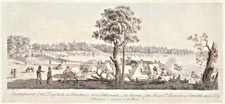
Encampment of the Loyalists at Johnstown, a New Settlement, on the Banks of the River St. Lawrence in Canada, taken June 6th 1784, James Peachey.

Encampment of the Loyalists at Johnstown, a New Settlement, on the Banks of the River St. Lawrence in Canada, taken June 6th 1784, James Peachey.

Laundresses come with style, too, though I am asking myself, “Is that a fabulous hat, or is your head just in front of some balled-up, sleeping livestock?” Was is discernible is that her hair is down, and she is leaning on the washtub. The tent seams are also clearly visible, and she does have the iconic washtub on a table set up.

Encampment of the Loyalists at Johnstown, a New Settlement, on the Banks of the River St. Lawrence in Canada, taken June 6th 1784. James Peachey

Encampment of the Loyalists at Johnstown, a New Settlement, on the Banks of the River St. Lawrence in Canada, taken June 6th 1784. James Peachey

In another detail of the same image, we have a woman who is clearly wearing a black bonnet, tending a kettle on a fire. Here’s yet another piece of evidence for the three sticks-two kettles-no matches set up, and for the tinned kettles being left to get black on the outside.

What is she wearing on her body? There’s a white (or a least white-grounded) kerchief, and what looks like a grey or drab petticoat. But is that a short gown, jacket or bed gown? I’d say jacket, mostly because of the fit, but it’s hard to say at this distance. Whatever word you care to use, she’s wearing a reddish-brown garment fitted to her torso that appears to have a side-back seam.

Once again, tent seams are visible. This tent, just like the one in the other detail, also has some large off-white item thrown over the end. Could it be a blanket, out to air in the sun?

I do also appreciate the short blue jacket/white trousers of the man or boy to the left of the woman, since I know a guy who possesses those clothes and prefers trousers to breeches. He appears to be drinking from a cup as he carries a kettle, presumably of fresh water.

Encampment of the Loyalists at Johnstown, a New Settlement, on the Banks of the River St. Lawrence in Canada, taken June 6th 1784, James Peachey.

Encampment of the Loyalists at Johnstown, a New Settlement, on the Banks of the River St. Lawrence in Canada, taken June 6th 1784, James Peachey.

The entire view of the Loyalists’ camp is here, with a zoomable image. The drawing is full of details applicable to camp life interpretations, from women’s bonnets to fishing rods.

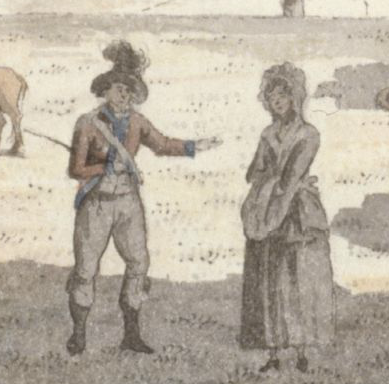
As I contemplate the troublesome Bridget Mahoney, I find the detail below of a solder and a woman rather pleasing.

Does she solemnly swear she is up to no good?

Does she solemnly swear she is up to no good?

Share this:

  • Share on Facebook (Opens in new window) Facebook
  • Share on Pinterest (Opens in new window) Pinterest
  • Email a link to a friend (Opens in new window) Email
  • Share on X (Opens in new window) X
Like Loading...

Mummers Crash

05 Sunday Jan 2014

Posted by kittycalash in Events, History, Living History, Reenacting

≈ 3 Comments

Tags

10th Massachusetts, 18th century clothes, authenticity, common people, Events, living history, Major John Butttrick House, masks, Minute Man National Historic Park, Mummers, Twelfth Night

Visards. chipboard, paint and ribbon

On Thursday, Mr S and I got an intriguing invitation from Mr Cooke: would we like to be part of a secret plan to create a disturbance? We are the sort of people who got thrown out of a mattress store just for asking questions, so we said yes. You’re invited to the best riot you know about, you say yes.

This plan involved crashing the Colonial Twelfth Night Party at the Major John Buttrick House in Concord. As mummers. In masks.

‘Mascara’, Givannbi Grevembroch. Venetian, 18th century

This morning, after some very cursory research and reading of the documents we were sent, I made our ‘visards.’ The form is based on the Elizabethan ‘visard’ shown here, and while that object is too early, it seems to be typical of the masks that persist, even into the 18th century.

In the Venetian carnival traditions, this round, black form is known as a moretta, held in place by a button the woman held in her teeth.

We were having none of that– I was supposed to make a ruckus, after all–so I opted for ties, which I sewed on despite the presence of a stapler. The basic form is an oval, 7 inches by 7 inches, but I would recommend cutting the forehead down if you will be wearing this with a hat or bonnet. (I had to trim Mr S’s, and should trim my own.)

Mr S borrowed my blue cloak, we both borrowed sticks for Mr Cooke, who had a very fine, knobby and thorny-looking shillelagh. In the kitchen of the Butterick House, we joined Mr C, Mr JH, and Mr GH to go over the plan one more time, and to try out our lines. Once we were gathered, we put on our masks, hoods, and visards/visages, and felt pretty creepy. Wearing a mask is very disorienting– you don’t look like yourself, but more importantly your vision is altered (especially those who couldn’t wear their glasses under their guides) and significantly limited. I wish I’d practiced a bit more, especially with the mask and bonnet combo’s bucket-on-my head sensation.

Mummer in the house.

We managed not to terrify ourselves but rather to compliment one another on our very fearsome and convincing appearances as rabble-rousing mummers. Mr JH gathered us up, and off  we went slinking out the door and to the street, where Mr Cooke and Mr FC began to sing. The two of them together made a fine and convincing racket, which I was only sorry that Mr S and I could not join (much to learn). We barged into the house and into the room where the very proper guests were gathered, and launched in.

Did I mention this was a secret? There were some confederates in the room, but the sedate civilians were caught unawares and were, according to reports, frightened. (Also very entertained, but also shocked.) A scene played out with the mummers begging for money, teasing guests, and generally causing commotion until the constable arrived and  read us the act prohibiting such behaviour. We protested each clause, but it was clear we had broken the law. Fortunately, the spirit of Christmas prevailed, and on this night before Twelfth Night, we were allowed food and drink if we would let the company alone. It was a happy conclusion for everyone.

Share this:

  • Share on Facebook (Opens in new window) Facebook
  • Share on Pinterest (Opens in new window) Pinterest
  • Email a link to a friend (Opens in new window) Email
  • Share on X (Opens in new window) X
Like Loading...

So Hip

02 Thursday Jan 2014

Posted by kittycalash in A Silk Sacque, Clothing, Making Things, Reenacting

≈ 5 Comments

Tags

10th Massachusetts, 18th century clothes, 18th century clothing, Costume, fashion, patterns, questioning my sanity, sacque, sewing, silk taffeta, style

I don’t always feel the need to enhance my anatomy; in fact, I rarely do, but then I started on the sacque. Ah, the sacque. I nearly abandoned the whole business but then I thought I’d look pretty silly dressed as the maid, or for George Washington’s funeral instead of his birthday party.[1]

I also don’t want to have a house littered with UFOs, because that is what my knitting stash is for. In order for the sacque to look right, I need hips. HIPS.

And while I planned to make panniers AKA pocket hoops, a simpler and easier solution occurred to me. Hip pads: I’d seen them on Sharon’s site and thought I could at least try a pair. They’d help my poor fake quilted petticoat (FQP, long story[2]), which will come in handy for a party in February. So I spent my New Year’s Day making hips and playing a bit with the sacque silk.

Half hipped, or me, right after my hip replacement.
Whole hipped: symmetrical, and wide.

To make the hips, I started out by laying a piece of muslin against Cassandra, and tracing a waist arc. I worked between the muslin and paper to create a paper pattern, and then made up a muslin, which I filled with polyester stuffing and then tested under the FQP. Better, no?

Then I added the seam allowance to the paper pattern (which you can download here and print at 100% if you have a waist in the 30 inch range and want enormous hips yourself) and cut four more of linen.

After three episodes of Death Comes to Pemberly[3], I had hips. They weren’t quite the same size, but my right hip is larger or higher or something, so I put the smaller one on the right and the larger on the left to balance my own deficiencies.

The alteration to the silhouette is pretty amazing, though Mr S did laugh. Perhaps this figure is an acquired taste.


[1] All I have right now to wear with the Celebration Spencer is a black petticoat, so I’d be rocking the 1799 George-is-Dead look.

[2] The story is that I have a real one basted onto a frame but I cannot fit both the frame and a sofa in the apartment. We chose sofa. I am sad but comfy.

[3] I’m ambivalent. Though I do love Trevor Eve, I wondered why there was not more changing of dress for various times of day

Share this:

  • Share on Facebook (Opens in new window) Facebook
  • Share on Pinterest (Opens in new window) Pinterest
  • Email a link to a friend (Opens in new window) Email
  • Share on X (Opens in new window) X
Like Loading...

Ironing on Grass

06 Friday Dec 2013

Posted by kittycalash in Laundry, Living History, Reenacting, Research

≈ 4 Comments

Tags

18th century, 18th century clothes, common dress, common people, Costume, drawings, laundry, Paul Sandby, Research

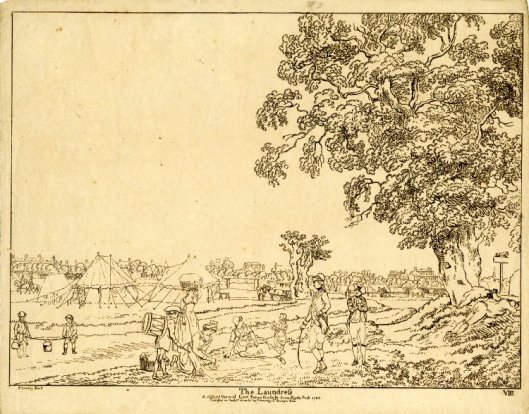
Paul Sandy, The Laundress, 1780. British Museum, 1904,0819.624

Paul Sandy, The Laundress, 1780. British Museum, 1904,0819.624

This print makes me think of Gertrude Stein, “Irons on the grass alas” because I think I would be pretty alas if I were ironing on grass. Still, I’m glad to know that ironing in camp is plausible, because it’s one more thing I can do, though also one more heavy item to pack.

I continue to chase laundry in my spare time, with a Pinterest board of collected images, which will give you a sense of the timeless drudgery of washing clothes. There will be stooping.

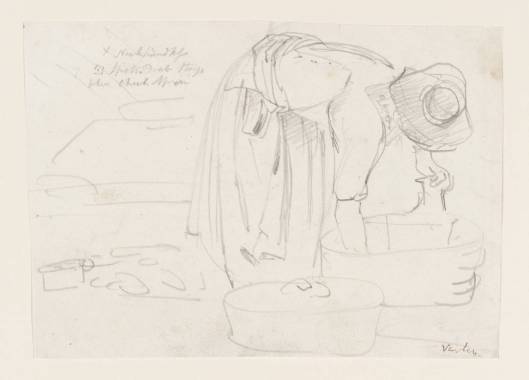
A Washerwoman, by John Varley (1778-1842). Tate Britain, T08695

A Washerwoman, by John Varley (1778-1842). Tate Britain, T08695

In this sketch by John Varley, he has helpfully given notes to supplement the lines.

“neckhandkf
spots Drab stays
blue check apron”

The symbol in front of ‘spots’ suggests the neckhandkerchief’s pattern, a dot in a square, much like the ones you can today from Burnley & Trowbridge.  “Drab stays” suggests a very utilitarian pair of wool stays, and that the washerwoman has stripped off her gown or bodice, and is working in shift, stays, and petticoat(s). This seems to be the same woman is in the “Woman with Wash-Tubs” drawing, and I’d guess her hat is straw.

A Scotch Washerwoman. Crayon drawing by Pauil Sandby after 1745. British Museum, Nn,6.61

A Scotch Washerwoman. Crayon drawing by Pauil Sandby after 1745. British Museum, Nn,6.61

There’s a remarkable consistency in the English drawings, though Varney and Sandby are about two decades apart. The tubs, the tools, the stooping: laundry is hard and unglamorous work, Sandby’s Scottish laundress aside. I can guarantee you that the 10th Massachusetts would have to outsource laundry in that style. (In any case, Scotland typified poverty and backwardness for late-eighteenth century Englishmen, so Sandby’s drawing, in addition to being titillating, is perpetuating English stereotypes of Scottish dress and practices and is, thankfully, not a reliable source.)

Share this:

  • Share on Facebook (Opens in new window) Facebook
  • Share on Pinterest (Opens in new window) Pinterest
  • Email a link to a friend (Opens in new window) Email
  • Share on X (Opens in new window) X
Like Loading...
← Older posts
Newer posts →

Archives

wordpress statistics

Creative Commons License
Kitty Calash blog by Kirsten Hammerstrom is licensed under a Creative Commons Attribution-NonCommercial-ShareAlike 4.0 International License.

Website Built with WordPress.com.

  • Subscribe Subscribed
    • Kitty Calash
    • Join 621 other subscribers
    • Already have a WordPress.com account? Log in now.
    • Kitty Calash
    • Subscribe Subscribed
    • Sign up
    • Log in
    • Report this content
    • View site in Reader
    • Manage subscriptions
    • Collapse this bar
 

Loading Comments...
 

    %d