• Home
  • Completed Costumes/Impressions
  • Emma and Her Dresses
  • Free Patterns and Instructions

Kitty Calash

~ Confessions of a Known Bonnet-Wearer

Kitty Calash

Category Archives: Research

Can it!

13 Wednesday May 2015

Posted by kittycalash in Food, History, Living History, Research

≈ 3 Comments

Tags

18th century, 19th century, common people, cooking, food, food preservation, Museums, Research, resources

Jar. Paul Cushman, 1805-1833. Stoneware. 20032.475


Or, how do you keep your pickles?

At work, we have found that the road to history is paved with unexpected documents. As often happens, while looking for something completely different, m’colleague and I found two documents that might help illuminate the question of food preservation and storage in the 18th century.

Probate inventories: I read all the way through and had one of those d’oh! moments. Why? Because at the end, there’s all the kitchen stuff. Andirons, warming pans, roasting pans, kettles, firkins, kneading trays, piggins, barrels, casks, bottles. This is the stuff of cooking and keeping food.

There are clues in the receipts (recipes): Amelia Simmons gives a hint in the final instructions “To pickle or make Mangoes of Melons.”

“put all these proportionably into the melons, filling them up with mustard-seeds; then lay them in an earthen pot with the slit upwards, and take one part of mustard and two parts or vinegar, enough to cover them, pouring it upon them scalding hot and keep them close stopped.”

To pickle Barberries ends thusly:

“let it stand to cool and settle, then pour it clear into the glasses; in a little of the pickle, boil a little fennel; when cold, put a little bit at the top of the pot or glass, and cover it close with a bladder or leather.”

Jar, Thomas Commeraw.1797-1819. Stoneware. 18.95.13

To pickle cucumbers:

“put them into jars, stive them down close, and when cold, tie on a bladder and leather.”

To keep Green Peas till Christmas:

“have your bottles ready, fill them, cover the them with mutton suet fat when it is a little soft; fill the necks almost to the top, cork them, tie a bladder and a leather over them and set them in a dry cool place.”

If we tease these apart, we come up with some basics: preservation is done with pickling and “putting up” foodstuffs in pots, jars, bottles, and glasses. These are sealed with bladders, which are tied on; there is a sense in the first receipt that “close stopped” might imply corkage, but the repetition of bladders in the following receipts suggests otherwise for most of these; the entry for Emptins does state “will keep well cork’d in a bottle five or six weeks.”

Covered jar, Connecticut. Earthenware, 1800-1830. 18.27.1a, b

The other key? You’ve probably come across food packages that require storage in a “cool dry place,” and as we have cupboards in our kitchens, or perhaps in our pantries, early cooks also had pantries or butteries (say it but-trees). How’d they do it?
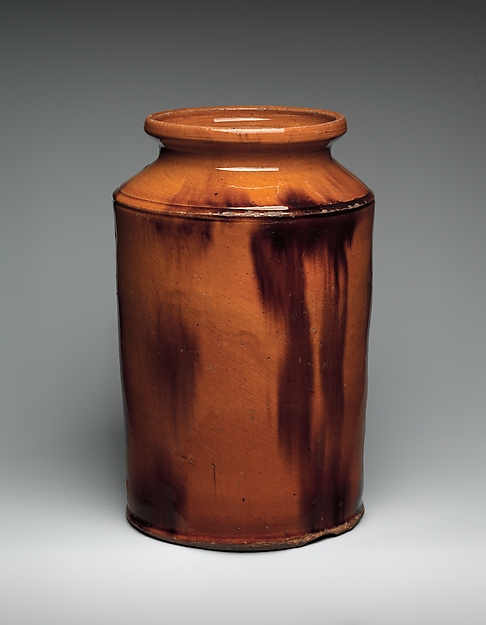
Jar,. Earthenware, 1800-1900. 18.95.11

Jar,. Earthenware, 1800-1900. 18.95.11

The 18th century house was not centrally heated. 18th century Providence residents recorded temperatures of 48 and 58 degrees indoors in the winter, in rooms with fireplaces. An unheated room or cellar would be cool, too; here in the Ocean State, maintaining dry conditions could be the bigger challenge.

What did those jars and pots look like? As you can see in this post, the Met has a few– fortunately, these appealed to collectors and wound up in museums. Closer to home for the original question, the Missouri History Museum has a collection with a number of jars. A cursory look showed dates in the 1830-1860 range, but the shares are consistent with those seen at the Met.

I’m not a food historian, and I don’t pretend to be, but as I think about answering a question, these are the steps I take. Recipes, collections, and then more looking. I just hadn’t remembered that probate inventories would list everything, so one might get a sense of a household’s contents and thus its eating and storage habits.
Share this:

  • Share on Facebook (Opens in new window) Facebook
  • Share on Pinterest (Opens in new window) Pinterest
  • Email a link to a friend (Opens in new window) Email
  • Share on X (Opens in new window) X
Like Loading...

Shark Tank

12 Tuesday May 2015

Posted by kittycalash in Clothing, Living History, Making Things, Research

≈ 3 Comments

Tags

18th century, 18th century clothes, 18th century clothing, authenticity, common dress, common people, fashion, living history, Making Things, menswear, Reenacting, Research, resources, style, Watson and the Shark

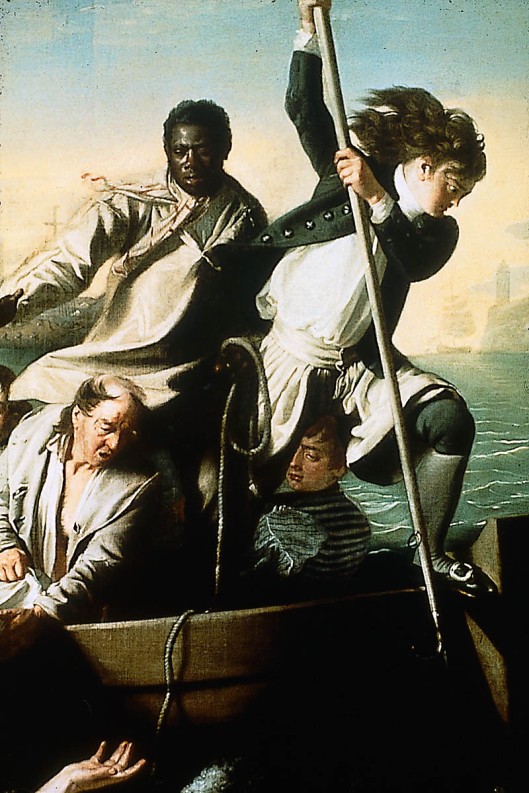
I’ve been thinking a lot about Watson and the Shark, at least when I am not thinking about the Raft of the Medusa, make of that what you will.

Here’s why: Waistcoats. Shirts. Open Jackets.

Detail, Watson and the Shark. MFA Boston 89.481

Detail, Watson and the Shark. MFA Boston 89.481

As you would expect from recent reports, the Young Mr has outgrown almost everything he owns, with the exception of his shirt. I put a lot of time into that blue wool jacket, so I’m not ready to sell it on Etsy yet, but I do have to replace it. Sewing new things means I get a chance to look again at sources for inspiration, and to do better this time around.

Since we’re in summer, I’m thinking blue linen, since I have access to very local inspiration in the form of Oliver Hazard Perry’s short jacket. But for earlier ideas, there’s Copley. I particularly like the horizontal stripe on the waistcoat, and what seems to be a striped shirt. Striped shirt! How exciting is that?

I’m thinking striped trousers, based on a Massachusetts letter, but we’ll see how far I get with that. The final deciding factor in wearing, of course, could be striped trousers are better than no trousers.

Share this:

  • Share on Facebook (Opens in new window) Facebook
  • Share on Pinterest (Opens in new window) Pinterest
  • Email a link to a friend (Opens in new window) Email
  • Share on X (Opens in new window) X
Like Loading...

Generation Gap

03 Friday Apr 2015

Posted by kittycalash in History, Living History, Philosophy, Reenacting, Research, Thanks

≈ 5 Comments

Tags

18th century, authenticity, interpretation, living history, Reenacting, Research, resources, Revolutionary War

Early gal trooping. I insisted on a frock coat and actual breeches.

Early gal trooping: Sam Adams, pre-beer.

Historiann has an interesting take on the scholarly study of the American Revolution:

I think it will take a fresh generation with no memories of the 1970s to revolutionize studies of the American Revolution. What do the rest of you think, those of you who remember the 1970s as well as those of you who don’t?

Historiann is riffing on a piece over at the Junto, on whether cultural historians have lost the American Revolution.

You know what this reminds me of?

Why, yes: The Progressive Movement and Various Backlashes in Revolutionary War Reenacting. (Supply caps and fonts as you like).

Now, Drunk Tailor is not specifically saying the same thing here but he is making a generational point.

They are half my age and already exceed me in sewing skill. They find new cultural nuggets I have never seen before.

I’ll see your camp kitchen and raise it a malnourished goat and acorns. (image from Drunk Tailor)

And that– younger people are finding new things–reminds me of Historiann’s post.

I could say we’re all standing on the shoulders of giants, but it is more about perspective, different ways of looking, and openness. The schisms are not just generational, but philosophical.

None of these breaks fall neatly, of course, but crack and splinter along desires and motivations. As long as you are willing to keep learning and changing (i.e. researching and making) then you’ll keep pushing at the edge of the interpretive envelope and that can only help push understanding of all kinds forward.

Share this:

  • Share on Facebook (Opens in new window) Facebook
  • Share on Pinterest (Opens in new window) Pinterest
  • Email a link to a friend (Opens in new window) Email
  • Share on X (Opens in new window) X
Like Loading...

“The Young Philosopher”

27 Friday Feb 2015

Posted by kittycalash in Clothing, Frivolous Friday, Research

≈ 4 Comments

Tags

18th century clothing, 19th century clothing, authenticity, British Museum, Charlotte Smith, common dress, common people, early novels, maids, Research, watercolors

Madora [sic] water color by Maria Caroline Temple ca 1800. Inscribed Maria C. Temple. delt.' and 'Vide "Young Philosopher." British Museum 1869,0612.599

Madora [sic] water color by Maria Caroline Temple ca 1800. Inscribed Maria C. Temple. delt.’ and ‘Vide “Young Philosopher.” British Museum 1869,0612.599

I was looking for images of maids in 1800, and came across this in the British Museum. Having no idea what Maria Temple meant by Vide Young Philosopher, I went searching. Turns out the answer is surprisingly easy: It’s a novel published in 1798 by Charlotte Smith. So it seems that what Maria Caroline Temple did was to draw a scene from a novel she’d read. I was delighted by this, as something I used to do a long time ago was to draw scenes from books I had read and loved.

With a publication date of 1798, I think we can feel pretty confident in the British Museum’s ca. 1800 date; what I was looking for was a non-satirical illustration of a maid in 1800: what did she wear, how did she comport herself? not because I haven’t been a maid in 1800 before, but because I need to be a better maid in 1800.

The things to love in this image, aside from the clothes, are the checked slipcover and window drape, the brass lock on the heavy wooden door, and the view through those wavy panes of glass. I don’t love the wallpaper, but I appreciate the evidence of it– but not as much as I appreciate the hint of drape matching that raucous slipcover.

Now I just need to hunt down an affordable copy of this clearly dramatic and romantic work of early fiction, and to find out exactly what books were being read in 1800 Rhode Island.

Share this:

  • Share on Facebook (Opens in new window) Facebook
  • Share on Pinterest (Opens in new window) Pinterest
  • Email a link to a friend (Opens in new window) Email
  • Share on X (Opens in new window) X
Like Loading...

Smock it to Me

18 Wednesday Feb 2015

Posted by kittycalash in Clothing, History, Making Things, Museums, Reenacting, Research

≈ 2 Comments

Tags

19th century clothing, anna maria von Phul, authenticity, Clothing, Colonial Williamsburg, common dress, common people, Costume, fashion, Federal New England Fashion, Federal style, Missouri History Museum, New England, style, watercolors

Smock, Checked cotton, Pocumtuck Valley Memorial Association. #2000.01.869.

Smock, Checked cotton, PVMA. #2000.01.869.

Edited to correct numerous typos and to add a bad sketch of the OSV apron. Don’t try to do research while conducting a small but energetic boy through a musket exhibit.

Two aprons, many questions, all of them excellent.

It’s really tough when an extant garment lacks provenance or even faux-venance, as in the “Revolutionary War” garments that turn out to be later. So, where do we look to figure things out when we a) like a garment a lot and don’t know if it’s right or b) are embarking on something a little new? And yes, in this case, we are talking bibbed aprons in the first quarter of the nineteenth century, in Rhode Island and in the Missouri Territory.

We start with questions:

1. What documentary sources can I find?
2. Is the form plausible for time period/area?
3. What is the typical fabric for the time period/area?
4. Is the item appropriate for my character/persona/impression?

Apron, checked with high waist, 1800-1820. Plain weave linen, probably Southeastern US. Colonial Williamsburg 1995-53

Apron, checked with high waist, 1800-1820. Plain weave linen, probably Southeastern US. Colonial Williamsburg 1995-53

What documentary sources do we have?

OSV's apron: I do my best work on the fly.

OSV’s apron: I do my best work on the fly.

We have some extant garments, two with images.

1. Extant apron 26.39.4, Old Sturbridge Village
2. Extant smock ca. 1800, Pocumtuck Valley Memorial Association 2000.01.869
3. Extant apron 18100-1820, 1995-33, Colonial Williamsburg (unstable links, search for accession number)
4. Apron 2005.24.4 at Historic New England has an intriguing description: A reddish brown linen apron with blue and white plaid. The apron is smock-like, with two holes for the arms and ties that extend from under the arms to the back. The bottom has a double hem. The neckline can be tightened or loosened with a blue and white string. What does that look like? Could it look like the Stonington plaid? It’s certainly a plausible New England weave 1810-1820.
5. Apron 1989.3, also at Historic New England, with a description similar to the CW high waisted apron:Cream & blue plaid linen; tucked at waist; no waistband; long cotton tape ties. (The tucked waist is similar to CW’s)

We have some imagery from the United States.

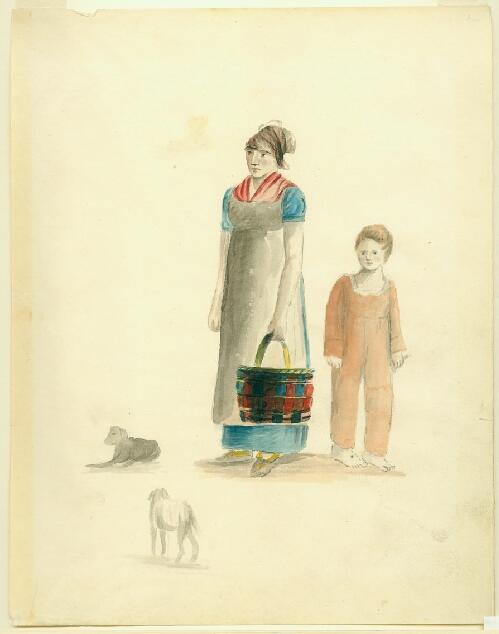
1. “Creole woman and child,” watercolor by Anna Maria von Phul, 1953.158.37, Missouri Historical Society

What else is out there? MHS’s database has an Apache error today, so not sure what aprons  they have, though they’re exactly where we need to look for one instance. I’ve looked and failed to find aprons of this description in the following catalogs: Historic New Orleans, Chicago Historical Society, State Historical Society of Wisconsin, Connecticut Historical Society, the Met, MFA Boston, Maine Historical Society, New Hampshire Historical Society, Ohio Historical Society, Newport Historical Society and Little Compton (RI) Historical Society. I’m now really tired of interacting with Past Perfect software.

Is this form plausible?

We have 5 objects and one image, all found in a cursory afternoon. Me, I’m still liking this form for the first quarter of the nineteenth century in the United States. I think the form varies somewhat, as can be seen in the descriptions; the OSV apron is the outlier, with the other 4 extant garments seeming more smock-like.

From RIHS MSS 72, Preserved Pearce papers,  Tailor's and Tavern account books, 1778-1781.

From RIHS MSS 72, Preserved Pearce papers, Tailor’s and Tavern account books, 1778-1781.

Fabric type?

Neither the OSV apron nor the PVMA smock have much (any) provenance, but the fabric is very typical of New England from the Connecticut River to the coast; it appears in inventories from 1777, on home- bound volumes, extant aprons in Deerfield and and in sample books from 1815.

Blue and white check: I am comfortable saying that those two aprons are 1800-1820 New England based on form and fabric. I am delighted to have found it in the apron at Colonial Williamsburg, which is thought to be from the Southeastern United States. I think that expand the range down the eastern seaboard. With the evidence of the extant garments and fabrics typical in New England, I am still OK with this form of apron, even if my rendition of the OSV apron is rather poor, thank you for noticing.

But what about Missouri? What should you wear out there, on the banks of the Mississippi?

Creole woman and boy. Acc. # 1953.158.37. Watercolor and pencil on paper by Anna Maria von Phul, 1818. Missouri History Museum Collections. Von Phul 37

Creole woman and boy. Acc. # 1953.158.37. Watercolor and pencil on paper by Anna Maria von Phul, 1818. Missouri History Museum Collections. Von Phul 37

Enter Anna Maria Von Phul. She is a little sketchy on some details– these are watercolors, after all–but I think she would have made the apron blue if it was made of blue and white check. She has rendered some stripes (?) in the head scarf, so she does hint at some detail.

Because I know AMVP, I believe that she is documenting fashions pretty typical of the time and place. The ladies she portrays in St. Louis in 1818 are fashionably dressed and not behind the times for the year, even if we cannot see every detail of dress.

If I were to make the cognitive leap that women across what is now the eastern half-or-so of the United States wore bibbed-style smocks or aprons between 1810-1820, and made them up in the most common fabric of their area (cue blue and white checks for New England), I might step back from that link in Wm Booth’s catalog. If I were to copy this image’s apron, I think I would make it in plain, unbleached linen, based on how I read this color and shading.

Ideally, you would find bracketing aprons– that is, some a little earlier and some a little later– in a “typical” fabric. I didn’t find those animals in the Western Reserve or Louisiana Purchase Territory collections available online, but that only means I didn’t dig in hard enough.

I don’t think these utilitarian garments will turn up in shop records, and I don’t think we are likely to find detailed probate inventory descriptions– mostly it says “apron,” which is too general for our purposes. We won’t find runaway ads: it’s too late for those, and a little early for newspapers in the Territories, though it wouldn’t hurt to search online.

I think our best alternate documentary sources in this case will be in diaries (again, we may not get the specificity we want; Sylvia Lewis only makes Spencers differentiated by color, so we are ignorant of collar shape, trims, number of buttons, closures, etc.) and in watercolors and drawings, often amateur, of everyday life.  After all, you can never have too many sources.

Is it appropriate?

Well…the evidence on the PVMA smock is of some use, though stains can be acquired in storage, too. The CW smock-apron is less used. I think this form in a checked or plain linen fabric would be best suited for everyday and working wear, cleaning, cooking, gardening, but not for serving at table (in a house that supported that), and not for dress or best, when white would have been what was wanted.

Share this:

  • Share on Facebook (Opens in new window) Facebook
  • Share on Pinterest (Opens in new window) Pinterest
  • Email a link to a friend (Opens in new window) Email
  • Share on X (Opens in new window) X
Like Loading...
← Older posts
Newer posts →

Archives

wordpress statistics

Creative Commons License
Kitty Calash blog by Kirsten Hammerstrom is licensed under a Creative Commons Attribution-NonCommercial-ShareAlike 4.0 International License.

Website Built with WordPress.com.

  • Subscribe Subscribed
    • Kitty Calash
    • Join 621 other subscribers
    • Already have a WordPress.com account? Log in now.
    • Kitty Calash
    • Subscribe Subscribed
    • Sign up
    • Log in
    • Report this content
    • View site in Reader
    • Manage subscriptions
    • Collapse this bar
 

Loading Comments...
 

    %d